
How to Choose a Wholesale Bedroom Furniture Manufacturer for Bulk Orders
If you are an importer, wholesaler, or retailer, you must choose the right wholesale bedroom furniture manufacturer. The same applies if you are a developer, hotel purchaser, or project contractor. This is one of the most important decisions in your supply chain.

A good supplier does much more than quote a price. The right manufacturer helps you control quality and protect your margin. They shorten lead time and reduce claims. They improve packaging and support OEM or ODM development. They also deliver consistent products across repeat orders. The wrong one creates delays, unstable workmanship, damaged shipments, poor communication, and expensive after-sales problems.
For B2B buyers, the challenge is not simply finding a factory that can make wardrobes or bedside tables. It’s challenging to find one that can make dressing tables or complete bedroom sets. The real challenge is finding a manufacturer that can support bulk orders. They must understand project specifications. Additionally, they should work professionally with hotel, apartment, student housing, rental furnishing, and branded retail programs.
This guide explains how professional buyers evaluate a wholesale bedroom furniture manufacturer. It covers what documents and product details to confirm before placing an order. It also explains how to reduce sourcing risk when working with a China-based export factory.
Table of Contents
- Why Choosing the Right Bedroom Furniture Manufacturer Matters
- What Wholesale Buyers Should Check Before Sending an Inquiry
- How to Evaluate Product Quality and Materials
- MOQ, Lead Time, and Production Capacity Explained
- Customization Options for Importers and Distributors
- Packing, Shipping, and Export Support
- Why Work With a Chinese Wholesale Bedroom Furniture Manufacturer
- Common Mistakes Buyers Make When Sourcing Bedroom Furniture
- Final Checklist for Bulk Bedroom Furniture Orders
- FAQ
Why Choosing the Right Bedroom Furniture Manufacturer Matters
In B2B furniture sourcing, the supplier you choose affects far more than product cost. It influences your sales timeline, warehouse efficiency, installation schedule, customer satisfaction, and repeat business.
For example, a hotel project buyer may need matching wardrobes, nightstands, and TV cabinets. They might also require dressing tables delivered in phases for multiple rooms. An apartment developer may need stable dimensions, repeatable finishes, and easy-install flat pack construction. A wholesaler may care more about container loading efficiency, MOQ flexibility, and fast replenishment. A furniture brand may prioritize OEM design protection and custom packaging.
That is why experienced buyers do not evaluate a manufacturer on price alone. They look at the supplier’s total delivery capability. This includes engineering, raw materials, and surface finish consistency. It also involves hardware quality, packaging design, export documentation, and communication speed.
For many buyers, compliance also matters. Low-emission composite wood products are increasingly important in export markets, and the U.S. EPA’s TSCA Title VI regulation is one of the best-known references for formaldehyde emission standards in composite wood products. US EPA+1 Responsible wood sourcing is another growing concern. FSC and PEFC are widely used as reference systems. They ensure sustainable forestry and traceable supply chains. PEFC+3森林管理委员会+3森林管理委员会+3
In short, the best wholesale bedroom furniture manufacturer is not the one with the lowest quote. It is the one that can protect your business over the full life cycle of the order.

What Wholesale Buyers Should Check Before Sending an Inquiry
Many sourcing problems start before production begins. Buyers send incomplete inquiries. They receive incomplete quotations. Then they discover hidden differences in materials, dimensions, hardware, finish, packaging, or delivery terms.
Before contacting a supplier, prepare the following information as clearly as possible:
Product Scope
List the exact items you need. For example:
- Wardrobes
- Bedside tables
- Dressing tables
- Chests of drawers
- Bedroom sets
- TV units for bedroom use
- Small-space storage furniture
- Flat pack bedroom furniture
Target Market
Tell the supplier where the products will be sold or installed:
- Wholesale distribution
- Retail chain
- E-commerce fulfillment
- Hotel guestrooms
- Apartment projects
- Student housing
- Rental properties
- Brand private label program
Dimensions and Layout
If possible, provide:
- Overall dimensions
- Internal storage requirements
- Drawer numbers
- Shelf positions
- Hanging space
- Space-saving or multifunctional needs
Material Requirements
Specify whether you prefer:
- Plywood
- MDF
- Particle board
- Melamine-faced panel
- Veneer finish
- Low-emission boards
- Moisture-resistant boards
Finish and Appearance
Clarify:
- Wood grain or solid-color finish
- Matte or gloss level
- Texture preference
- Edge banding expectations
- Handle style
- Hardware brand level
- Color matching standards
Order Structure
Include:
- Estimated quantity
- Trial order or full order
- Annual volume
- Target launch date
- Delivery schedule
- Container quantity planning
Trade Terms
Buyers should also clarify whether the quote is expected under FOB, CIF, DDP, or another structure. ICC’s Incoterms 2020 remain the widely used framework for clarifying responsibility split between seller and buyer in international trade. ICC – International Chamber of Commerce+1
A complete inquiry helps the manufacturer quote correctly, recommend better solutions, and avoid costly misunderstandings later.

How to Evaluate Product Quality and Materials
When buyers compare bedroom furniture suppliers, the most common mistake is to judge quality only by photos. Photos can show style, but they rarely show durability.
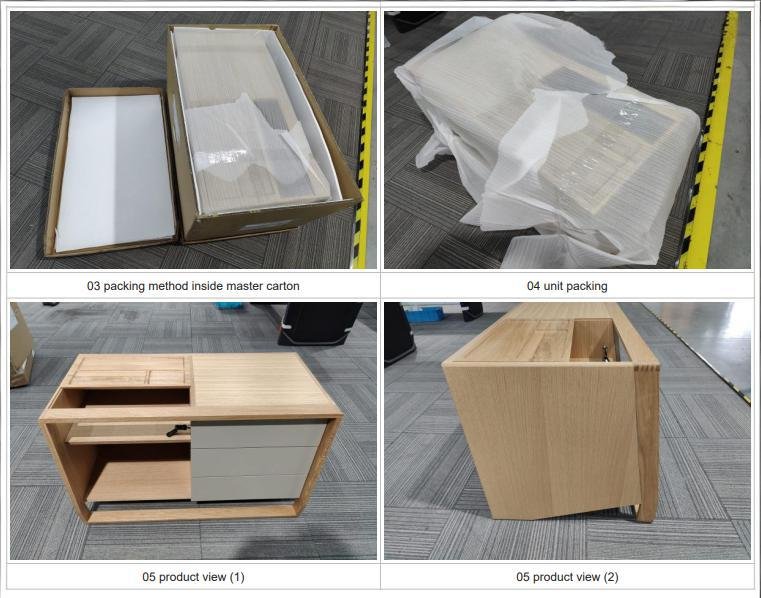
Professional evaluation should focus on the following:
Panel Material
Panel furniture quality starts with the core board. Ask what base material is used and where it is sourced. Inquire whether the manufacturer can provide specifications for density, thickness tolerance, moisture performance, and emissions.
If your market requires low-emission composite wood products, ask whether the supplier understands the requirements relevant to your destination market. The U.S. EPA states that TSCA Title VI regulates formaldehyde emission standards for composite wood products. These include hardwood plywood, medium-density fiberboard, and particleboard. US EPA+1
Edge Banding and Surface Finish
Inspect whether the edge banding is neat, sealed, and consistent. Poor edge banding causes swelling, chipping, and visible defects. For bedroom furniture, surface consistency is critical. This includes wardrobes and nightstands. These products are often viewed at close range in finished residential or hospitality environments.
Hardware Quality

Good furniture performance depends on hinges, drawer slides, connectors, and assembly fittings. For bulk bedroom furniture orders, poor hardware is one of the fastest ways to generate claims. If you are supplying hotels, apartments, or high-traffic rental properties, insist on tested and stable hardware specifications.
Structural Design
Flat pack and ready-to-assemble furniture must be engineered for repeated assembly logic, transit protection, and stable final installation. Commercial buyers often use BIFMA references when discussing furniture safety, performance, and sustainability expectations for certain product categories. bifma.org+1
Sustainable Sourcing
If sustainability matters to your buyers or project owners, ask about chain-of-custody awareness. FSC describes certification as a way to connect businesses to a globally recognized standard for responsible forest management. PEFC positions its system as support for sustainable forest management and traceability. PEFC+3森林管理委员会+3森林管理委员会+3
Quality is not one detail. It is the result of the whole system. This includes board selection, machining accuracy, lamination, and drilling precision. It also involves hardware consistency, packaging strength, and inspection discipline.
MOQ, Lead Time, and Production Capacity Explained
A dependable wholesale bedroom furniture manufacturer should be transparent about three things: MOQ, lead time, and capacity.
MOQ
MOQ is not only about factory policy. It is usually linked to material purchasing, finish setup, hardware procurement, packaging design, and machine efficiency. Buyers who understand this can negotiate more effectively.
If you are launching a new market, ask whether the factory supports:
- Sample order
- Mixed container order
- Trial color assortment
- Flexible MOQ for first cooperation
- Shared-material production to reduce startup cost
Lead Time
Lead time is often underestimated. Production is not just assembly. It includes:
- Drawing confirmation
- Sample approval
- Material procurement
- Board cutting
- drilling
- lamination
- hardware preparation
- assembly testing
- packaging approval
- final inspection
- container loading
For project buyers, ask for a stage-based schedule instead of a single delivery promise. That gives you a more realistic view of whether the supplier is managing production professionally.

Production Capacity
Capacity is not only monthly output. It also includes:
- how many product lines the supplier runs
- whether they support multiple finishes at the same time
- whether they can maintain repeat orders
- whether peak season affects delivery
- whether they have separate lines for project orders and standard wholesale orders
A factory with a formal quality management structure often performs better in repeat production. ISO explains that ISO 9001 is a globally recognized standard for quality management systems. It helps organizations improve consistency. It also enhances efficiency and customer confidence. 国际标准化组织+1
For buyers managing hotel and apartment schedules, stable lead time is often more valuable than a slightly lower unit price.
Customization Options for Importers and Distributors
One reason buyers prefer working directly with a factory is flexibility. A professional manufacturer should support different levels of customization depending on your business model.
OEM for Brands and Distributors
OEM is usually the better route when you already have product drawings, dimensions, reference samples, or brand requirements. This is common for:
- private label furniture brands
- importers with established product lines
- regional distributors
- hotel groups with brand standards
- apartment furnishing contractors
OEM work may include:
- custom size
- custom finish
- custom hardware
- packaging artwork
- instruction manuals
- labels and barcodes
- brand marks
- export carton specifications
ODM for Faster Market Entry
ODM is useful when buyers want a faster route to market. The manufacturer provides an existing design platform, and the buyer adjusts finish, size, hardware, or branding.
This model works well for:
- wholesalers testing new collections
- retailers building exclusive SKUs
- project buyers who need quick adaptation
- distributors entering a new region
Customization for Projects
Hotel and apartment projects usually require more than cosmetic changes. Buyers often need:
- room-specific layout adjustments
- storage optimization
- fire-retardant or easy-clean surfaces where required
- coordinated finishes across several product categories
- repeat consistency for phased delivery
A supplier who understands project logic can transform a standard wardrobe or bedside table. They can turn it into a practical commercial solution. It’s more than just a catalog item.
Packing, Shipping, and Export Support

Many buyers focus heavily on product development and forget that export packing often decides whether the order arrives profitably.
Export Packaging
Strong packaging should protect:
- corners
- edges
- surface finish
- hardware sets
- glass or mirrors
- internal panel movement during transit
For flat pack bedroom furniture, packaging design should also support:
- easier warehouse handling
- efficient container loading
- lower damage rate
- easier identification during installation
Shipping Efficiency
Ask the factory how they plan:
- carton dimensions
- net and gross weight
- pallet use or no-pallet loading
- mixed container planning
- loading ratio
- carton marking
- batch identification

Wood Packaging Compliance
If wood packaging material is used in export, buyers should understand ISPM 15. The International Plant Protection Convention describes ISPM 15 as the standard for phytosanitary measures. These measures reduce the risk of pests associated with wood packaging material in international trade. ippc.int
Trade Documents and Coordination
A reliable export manufacturer should be familiar with:
- commercial invoice
- packing list
- bill of lading coordination
- certificate requests where applicable
- labeling requirements
- destination-specific documentation support
This is also where trade terms matter. ICC notes that Incoterms are the globally used trade terms that define responsibilities in B2B sale and purchase contracts. ICC – International Chamber of Commerce+1
For bulk buyers, the right supplier is not only a producer. It is an export partner.
Why Work With a Chinese Wholesale Bedroom Furniture Manufacturer
For many international buyers, China remains a practical sourcing base for panel furniture. This is due to its mature supply chain, customization depth, and export experience.
A capable Chinese manufacturer can often offer:
- broader material options
- faster sample development
- flexible OEM and ODM support
- better coordination for mixed product lines
- stronger flat pack engineering
- scalable production for wholesale and project orders
- integrated export handling
This matters especially for buyers sourcing complete bedroom solutions rather than single items. If you need wardrobes, nightstands, dressers, and vanities, factory cooperation can help. It also simplifies the supply chain for TV cabinets and storage pieces with matching finish and structure.
China is also strong in panel furniture process integration. A factory that manages board cutting, drilling, lamination, and edge banding is usually better positioned to deliver stable quality. It also handles hardware fitting, assembly testing, and export packaging under one system.
That said, smart buyers still verify the factory carefully. The value of sourcing from China comes from choosing the right partner, not from country origin alone.
Common Mistakes Buyers Make When Sourcing Bedroom Furniture
Even experienced buyers can lose margin through avoidable mistakes.
Mistake 1: Comparing Quotes Without Matching Specifications
One supplier quotes plywood carcass, another quotes particle board. One includes upgraded slides, another uses economy fittings. The lower quote may not represent the same product.
Mistake 2: Ignoring Packaging Until the End
Weak packaging can destroy profit on a good order. Confirm export packing before mass production.
Mistake 3: Focusing Only on Unit Price
A slightly cheaper supplier with poor lead time can be costly. Unstable finish might also increase costs. Weak communication can lead to higher expenses through claims and delays.
Mistake 4: Skipping Sample Approval
For OEM and project work, approved samples are essential. Without them, there is no true benchmark for production quality.
Mistake 5: Asking for Impossible Lead Times
Buyers sometimes push for unrealistic delivery, which causes rushed production and higher defect risk. A professional schedule is better than a fast promise that cannot be maintained.
Mistake 6: Overlooking Compliance and Market Requirements
If your market requires low-emission boards, sustainable sourcing references, or packaging compliance, discuss those points early. References such as EPA, FSC, and PEFC are often part of buyer due diligence. ISPM 15, ISO, and BIFMA may also be necessary depending on product type and destination market. bifma.org+5US EPA+5森林管理委员会+5
Mistake 7: Not Planning Repeat Orders
The first order matters, but repeatability matters more. Ask how the factory controls color consistency, hardware continuity, and material availability for future orders.
Final Checklist for Bulk Bedroom Furniture Orders
Before placing an order with a wholesale bedroom furniture manufacturer, confirm the following:
Product
- Final drawings approved
- Material specifications confirmed
- Finish and color standard agreed
- Hardware list approved
- Dimensions checked
Commercial
- MOQ confirmed
- price structure approved
- payment terms agreed
- Incoterms clarified
- delivery schedule defined
Quality
- sample approved
- inspection standard agreed
- defect tolerance discussed
- replacement policy clarified
Packaging
- carton design approved
- drop protection confirmed
- labels and marks confirmed
- flat pack instructions checked
Export
- loading plan reviewed
- document requirements confirmed
- destination compliance discussed
- shipment schedule aligned with your warehouse or project calendar
If a supplier can answer all of these points clearly, you are moving towards reliability. Consistent answers bring you closer to a reliable long-term partnership.
Conclusion
Choosing a wholesale bedroom furniture manufacturer is not only about finding a factory that can produce wardrobes or bedside tables. It is about selecting a supply partner that understands your market, protects your timeline, and supports your growth.
For wholesalers, that means stable repeat orders and efficient containers. For retailers, it means attractive products and lower claim rates. For hotel and apartment buyers, it means project coordination, finish consistency, and installation-friendly delivery. For brands, it means dependable OEM and ODM execution.
The strongest suppliers combine manufacturing discipline, customization flexibility, export experience, and clear communication. Those are the partners that help B2B buyers scale confidently.
CTA: Ask for catalog / quotation
If you are looking for a dependable wholesale bedroom furniture manufacturer for bulk supply, contact us for a catalog. We also offer OEM/ODM development, hotel projects, apartment furnishing, or flat pack export programs. Contact us for a quotation or project discussion.
Frequently Asked Questions
What is a wholesale bedroom furniture manufacturer?
A wholesale bedroom furniture manufacturer is a factory that produces bedroom furniture in bulk. It serves importers, wholesalers, retailers, contractors, project buyers, and private label brands. This is rather than selling single items to end consumers.
What should I ask before placing a bulk bedroom furniture order?
Ask about materials, board emissions, hardware grade, MOQ, lead time, packaging, customization options, trade terms, inspection process, and repeat-order consistency.
Is OEM or ODM better for bedroom furniture buyers?
OEM is better when you already have your own design or detailed requirements. ODM is better when you want faster market entry based on an existing product platform from the manufacturer.
Why is flat pack bedroom furniture popular in export business?
Flat pack furniture reduces shipping volume, improves container efficiency, simplifies warehousing, and often lowers transportation cost for importers and distributors.
What certifications or standards should buyers pay attention to?
Buyers may review different criteria depending on the market and product. These include formaldehyde emission requirements for composite wood products and sustainable wood sourcing references. They also look at quality management practices, furniture performance references, and export packaging compliance. bifma.org+5US EPA+5森林管理委员会+5
How do I know if a furniture supplier can handle hotel or apartment projects?
Check whether the supplier can manage consistent finishes. Also, assess if they can handle multiple room types and phased delivery. Verify their ability to provide custom dimensions and durable hardware. Ensure they offer project packaging and clear production planning.
What is a wholesale bedroom furniture manufacturer?
A wholesale bedroom furniture manufacturer is a factory that produces bedroom furniture in bulk for importers, wholesalers, retailers, contractors, project buyers, and private label brands.
What should I check before choosing a bedroom furniture supplier?
Buyers should review material specifications, product quality, hardware, MOQ, lead time, customization options, export packaging, inspection standards, and communication efficiency.
Is OEM or ODM better for bulk bedroom furniture orders?
OEM is better for buyers with their own design and brand requirements, while ODM is better for buyers who want faster development using the manufacturer’s existing design platform.
Why is flat pack bedroom furniture suitable for importers?
Flat pack bedroom furniture improves container loading efficiency, reduces shipping cost, saves warehouse space, and makes distribution easier for wholesalers and retailers.
Can a wholesale bedroom furniture manufacturer support hotel and apartment projects?
Yes, a professional manufacturer can support hospitality and residential projects with custom sizes, matching finishes, coordinated product ranges, project packaging, and phased delivery planning.