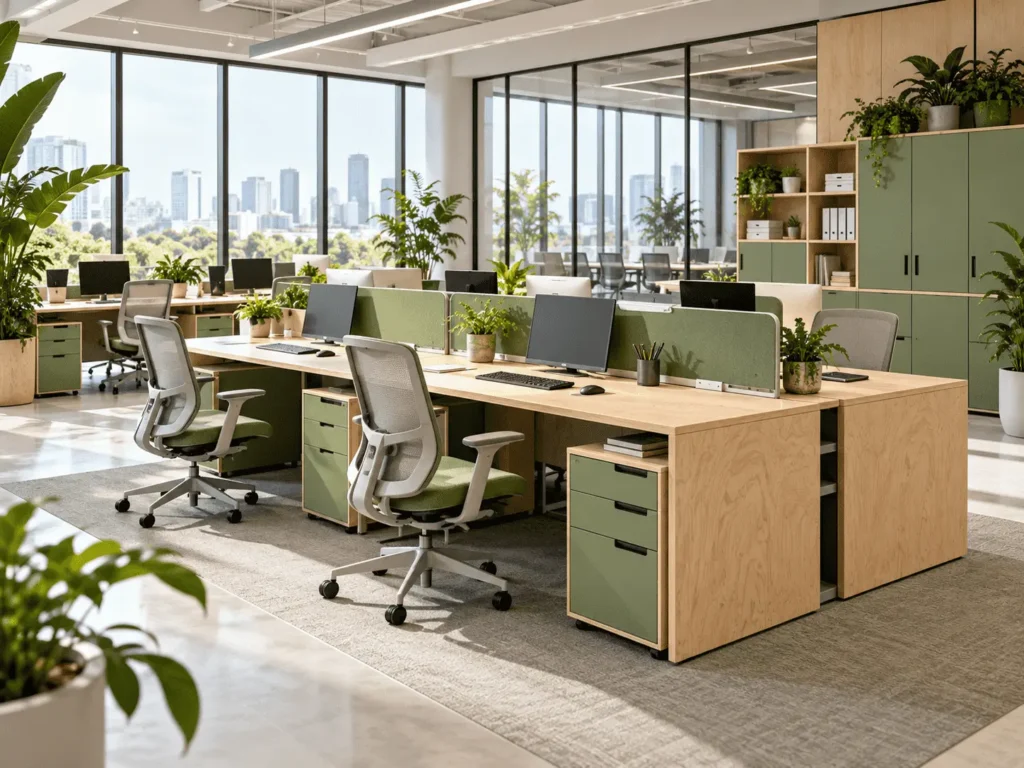
For furniture importers, office furniture distributors, commercial interior contractors and corporate procurement teams, sourcing eco-friendly plywood office furniture involves more than choosing a natural wood finish. Buyers need a manufacturer that can supply consistent panel specifications, review environmental documentation, customize desk dimensions, control production quality and prepare furniture for international shipment. Whether you are furnishing a corporate headquarters, coworking office, serviced apartment or commercial development, the right sourcing partner should support your project from drawings and sampling to bulk production and export packaging. This guide explains how to evaluate sustainable office desks from a factory and procurement perspective, helping B2B buyers make practical decisions about materials, costs, compliance and repeat orders.

Table of Contents
- Why Corporate Buyers Choose Plywood Office Furniture
- What Makes Office Furniture Environmentally Responsible?
- Choosing the Right Panel Material
- Environmental Compliance and Material Documentation
- What to Look for in an Office Furniture Manufacturer
- OEM and ODM Customization for Corporate Projects
- MOQ, Quotation and Cost Planning
- Production Lead Time and Order Management
- Export Packaging and Logistics
- Quality Control for Bulk Office Furniture
- Applications for Commercial and Corporate Spaces
- How to Prepare an RFQ
- Frequently Asked Questions
- Request a Factory Quotation
Why Corporate Buyers Choose Plywood Office Furniture
Corporate workspaces increasingly require furniture that combines a professional appearance, practical functionality, manageable procurement costs and clearly documented material specifications. For B2B buyers, plywood office furniture can be an attractive option when its construction, finish and intended use match the project requirements.
Plywood is manufactured by bonding layers of wood veneer, generally with adjacent layers oriented in different directions. This construction can provide useful strength and dimensional stability for selected furniture applications. Its visible layered edges can also create a distinctive architectural appearance for modern workspaces.
For a commercial furniture program, plywood may be used in desk tops, work surfaces, shelving, storage components and decorative panels. The final suitability depends on the panel grade, thickness, support structure, hardware and finish.
The commercial advantages are especially relevant to buyers managing multiple locations or repeat orders.
- Consistent design: Standardized desk dimensions and finishes help maintain a unified corporate identity.
- Flexible customization: Desk layouts, storage configurations, colors and hardware can be developed around a project brief.
- Practical logistics: Knock-down furniture can reduce shipping volume when the design is engineered for flat-pack packing.
- Coordinated procurement: Desks, bookcases and office storage can be developed as a compatible furniture program.
- Material transparency: Specifying the exact panel, adhesive, finish and supporting documents makes sustainability claims easier to evaluate.
Plywood is not automatically more sustainable than every alternative. Buyers should compare material sourcing, adhesive chemistry, expected service life, manufacturing waste, transport requirements and end-of-life options before making a final decision.
For importers and project contractors, the objective is to find a commercially viable product that meets the project’s documented requirements and can be manufactured consistently at scale.
What Makes Office Furniture Environmentally Responsible?
The term “eco-friendly” is useful for describing a product direction, but it is not a technical material specification. A responsible purchasing decision needs measurable requirements rather than a general promise that a desk is environmentally friendly.
When developing a sustainable office furniture program, buyers should evaluate several factors together.
Responsible Wood Sourcing
Start by identifying where the wood-based materials originate and whether the project requires independently verified sourcing. Some corporate customers, developers and furniture brands specify FSC-certified materials or documented chain-of-custody information.
The Forest Stewardship Council’s Chain of Custody guidance explains how certified forest-based materials are tracked through relevant supply-chain stages. If your project requires FSC claims, confirm that the supplier, material, product scope and transaction documentation support the specific claim. Do not assume that a factory offering plywood automatically holds the necessary certification.
Formaldehyde and Other Emissions
Adhesives and surface-finishing products can affect indoor emissions. The appropriate requirements depend on the panel type, finished product, destination market and project specification.
Request the relevant test reports, declarations or compliance documents before confirming bulk production. Check whether the evidence covers the actual material or finished product being supplied, rather than a similar product from a different production program.
Durable Construction
A desk that remains functional for years may avoid premature replacement. For commercial buyers, durability depends on more than the appearance of the tabletop. Joint design, load distribution, edge protection, hardware quality and resistance to everyday wear all matter.
Ask how the product will perform under its intended conditions, including repeated assembly, frequent cleaning, movement and routine office use.
Efficient Material and Packaging Use
A factory can review panel layouts, cutting plans and product structures to reduce avoidable offcuts. Standardized components may also help simplify production and future replacement parts.
Packaging should protect the furniture without unnecessary material or excessive carton volume. However, reducing protective packaging too aggressively can increase transport damage and replacement shipments. The right balance is the one that protects the product while using packaging efficiently.
For B2B procurement, the strongest sustainability specification is one that connects these factors to verifiable documents and practical manufacturing controls.
Choosing the Right Panel Material
Plywood is not the only suitable material for commercial office furniture. Depending on the design, finish, budget and performance requirements, a manufacturer may recommend plywood, MDF, particleboard or a combination of engineered panels.
The best material decision should be made component by component rather than by applying one material to every part of a furniture collection.
Plywood for Selected Work Surfaces and Structural Components
Plywood can be suitable where buyers value its layered construction, wood appearance or particular mechanical properties. Its suitability still depends on the grade, veneer quality, core construction, thickness, moisture conditions and support arrangement.
For desk tops, long spans and concentrated loads must be considered during design review. A visually thick panel does not automatically guarantee a stable work surface. The supporting frame, connection positions and overall structure also influence performance.
Buyers should confirm whether the plywood is intended to remain visible or receive a veneer, laminate, paint or other surface treatment. Exposed edges may become a defining design feature, but they also require appropriate finishing and protection.
MDF for Smooth and Decorative Surfaces
Medium-density fibreboard is often selected for components that require a consistent surface, painted finishes or detailed machining. It can be appropriate for selected drawer fronts, decorative panels, cabinet components and desk elements.
Its performance depends on the specified grade and intended environment. Edge protection and moisture exposure deserve particular attention where furniture may be cleaned frequently or installed in challenging conditions.
Particleboard for Cost-Controlled Panel Furniture
Particleboard is widely used in flat-pack furniture programs because it supports standardized panel processing and a range of decorative surface options.
For commercial procurement, the important factors include panel quality, thickness, screw-holding performance, edge treatment, hardware selection and the intended service conditions.
A competitive material cost is only useful when the finished product can meet the project’s functional and quality requirements.
Melamine, Laminate and Veneer Finishes
The surface finish affects appearance, cleaning requirements, scratch resistance, edge details and overall cost.
Melamine-faced panels are often practical for standardized furniture collections because they provide repeatable colors and woodgrain patterns. High-pressure laminate may be considered for selected applications requiring a specified surface performance. Natural wood veneer can deliver a more distinctive appearance, but buyers should agree on grain selection, color variation and finishing standards.
When comparing quotations, confirm the full material construction rather than simply comparing descriptions such as “oak finish” or “natural wood.” Two desks with similar photographs may use very different core boards, edge treatments and surface materials.
Environmental Compliance and Material Documentation
Environmental requirements should be discussed before the factory finalizes materials or produces a sample. This avoids the risk of approving a design that later needs to be changed to satisfy the destination market or a project consultant.
Requirements for US-Bound Furniture
For products entering the United States, covered composite wood materials and finished goods may be subject to formaldehyde-emission requirements under TSCA Title VI.
The US Environmental Protection Agency’s official guidance on formaldehyde emission standards explains the requirements affecting covered hardwood plywood, MDF, particleboard and relevant finished goods.
Buyers should identify the applicable product category and ask for the documentation required for their order. Verify that the documents relate to the material actually used and that any required labeling and supply-chain records can be provided.
A generic statement such as “low formaldehyde” is not a substitute for the required evidence.
Low-Emitting Materials for Building Projects
For corporate interiors, developers and design teams may work with green building frameworks or indoor environmental quality specifications.
The US Green Building Council’s guidance on low-emitting materials provides a useful starting point for understanding how product documentation and emissions-related evidence can be evaluated within a building project.
Do not assume that a furniture product automatically qualifies for a particular credit or certification. The project team should confirm the applicable version, product category, testing method and documentation requirements.
Responsible Sourcing for European Buyers
European importers should also assess their responsibilities concerning wood-based products and the relevant supply chain.
The European Commission’s official EUDR implementation resource provides guidance on the EU Deforestation Regulation and its implementation. Applicability, product scope, company role and implementation dates should be checked against the current official guidance before an order is placed.
If traceability or sourcing documentation is required, tell the manufacturer at the quotation stage. Material availability and document preparation can influence the proposed specification and purchasing schedule.
Make Environmental Claims Specific and Verifiable
Buyers should be cautious of unsupported descriptions such as “100% green,” “completely harmless” or “fully sustainable.”
The US Federal Trade Commission’s Green Guides summary explains why broad environmental marketing claims need appropriate qualification and supporting evidence.
For your own product catalog, prefer precise descriptions that identify the relevant material attribute or documented certification. Use environmental claims only when they can be substantiated.
The practical rule is simple: define the requirement, request the evidence and confirm the scope before approving the order.
What to Look for in an Office Furniture Manufacturer
A reliable commercial furniture manufacturer should be able to discuss more than a catalog price. Buyers need a production partner that understands product development, panel processing, quality control, packaging and international delivery.
Starwood Industry Co., Ltd. is a panel furniture manufacturer based in Jiangmen, Guangdong, China. Its manufacturing program supports flat-pack furniture, OEM/ODM development, sampling, bulk production, quality control and export-oriented packaging.
You can review the company and factory information to understand its manufacturing background and the types of B2B customers it serves.
When evaluating a potential supplier, ask about the following capabilities.
Engineering and Panel Processing
The factory should be able to review drawings and identify manufacturing issues before sampling. These may include unsupported desk spans, panel thickness, drilling positions, joint design, edge treatment, hardware clearances and carton dimensions.
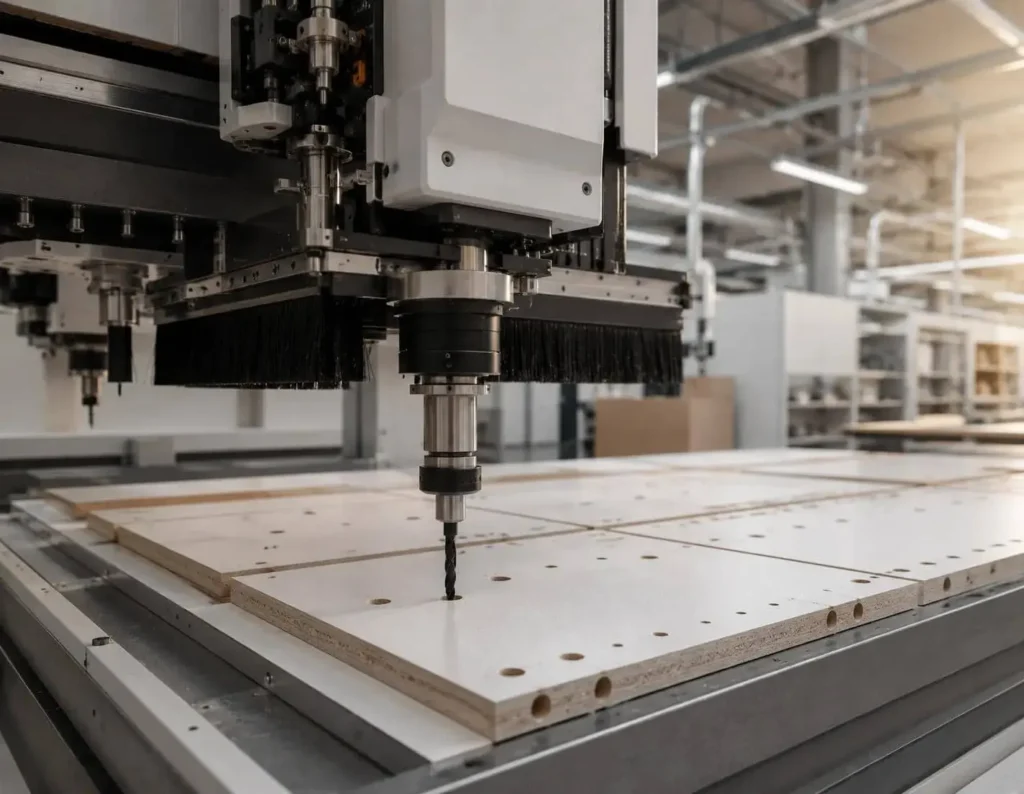
CNC cutting and repeatable drilling are especially relevant to knock-down furniture, where component accuracy affects assembly at the destination.
Material and Finish Control
A buyer should be able to approve the board specification, finish reference and hardware list before mass production.
For repeat orders, the approved specification should remain the reference for future production. Changes to board suppliers, finishes or hardware should be discussed and approved where they affect the agreed product.
Sampling and Quality Control
A physical sample allows the buyer to evaluate dimensions, appearance, assembly, stability and finish quality before committing to bulk production.
For project orders, sampling also helps confirm that the desk works with the room layout and other furniture items. A good-looking sample is useful, but repeatable production is the more important commercial objective.
Export Packaging and Communication
Ask how the factory identifies cartons, protects edges, separates hardware and prepares assembly instructions. Clear communication is also essential when the order involves multiple models, phased deliveries or several project locations.
For a broader overview of its manufacturing services, visit the Plywood MFR website.
OEM and ODM Customization for Corporate Projects
OEM and ODM arrangements allow buyers to develop office furniture around their own product requirements, market positioning or project layouts.
OEM Office Furniture Manufacturing
OEM is suitable when the buyer already has drawings, a reference sample or a defined product specification.
The buyer can provide dimensions, panel materials, finishes, hardware, quantities and packaging requirements. The factory reviews the details, evaluates production feasibility and prepares the proposed quotation and sample plan.
For corporate desks, OEM customization may include:
- Desk width, depth and height.
- Drawer configurations and cable-management provisions.
- Modesty panels, privacy screens and storage combinations.
- Plywood, MDF or particleboard specifications.
- Surface finishes, colors and edge details.
- Hardware, handles and drawer slides.
- Carton marks, branding and assembly instructions.
ODM Furniture Development
ODM is useful when the buyer has a target market or design direction but has not finalized the product.
For example, a distributor may want a coordinated collection of compact office desks, bookcases and filing cabinets. The manufacturer can review the intended use, target price, room dimensions and packaging requirements before recommending a practical design direction.
The objective is not simply to create a distinctive appearance. It is to develop a product that can be manufactured consistently, assembled efficiently and sold at a commercially viable price.
Learn more about OEM and ODM furniture manufacturing services and discuss which development route best matches your project.
Customization for Commercial Interiors
A corporate office may need a different configuration from a coworking space or a serviced apartment. Customization can cover work surfaces, storage layouts, finish combinations, dimensions and hardware.
However, unnecessary variations between units can complicate production, installation and replacement-part management. For large projects, standardizing selected components and finishes can make procurement more efficient.
The best specification balances design intent with repeatability and total project cost.
MOQ, Quotation and Cost Planning
Minimum order quantity (MOQ) is one of the first questions B2B buyers ask, but there is no universal MOQ that applies to every customized office desk.
The practical minimum depends on the product design, materials, finish, hardware, packaging, production setup and whether several SKUs can be combined in one order.
For standard flat-pack furniture programs, Plywood MFR lists a container-based MOQ on its main website. However, buyers should confirm the current requirement for the specific office furniture program, including any mixed-SKU arrangements or trial-order options.
When requesting a quotation, provide both the initial order quantity and your expected repeat-order volume. This helps the factory evaluate whether standard materials or a more customized specification offers better commercial value.
A useful quotation should clarify:
- Unit price and quotation basis.
- Panel materials, thickness and finish.
- Hardware and accessories.
- Sample costs, where applicable.
- MOQ and order quantity.
- Packaging specification and carton dimensions.
- Branding and labeling requirements.
- Production lead time after approval.
- Shipment terms and destination information.
Avoid comparing suppliers on unit price alone. A cheaper desk may use a different board, simpler hardware or less protective packaging. These differences can affect product life, damage rates, installation costs and customer satisfaction.
For a meaningful comparison, make sure every supplier is quoting the same specification.
Production Lead Time and Order Management
Production lead time should be confirmed for the actual order rather than assumed from the date of the initial inquiry.
Customized furniture generally moves through several stages: drawing review, quotation, material confirmation, sample production, sample approval, bulk production, quality inspection, packing and shipment preparation.
Each stage may affect the final delivery date.
For a new product, the sample stage may require revisions to the dimensions, finish, hardware or packaging. For a repeat order using an approved specification, some development work may be reduced, but material availability and production capacity still need to be checked.
When requesting a schedule, ask the manufacturer to distinguish between:
- Sample development time.
- Sample revision and approval.
- Material preparation.
- Bulk production.
- Final inspection and packing.
- Shipment preparation.
For office fit-out projects, work backward from the required installation date. Allow additional time for international transport, customs clearance, inland delivery and installation.
The factory should confirm the production schedule in the quotation or order documents. Avoid committing to an installation date based only on an informal estimate.
Export Packaging and Logistics
Packaging is a major part of commercial furniture manufacturing because it affects transport protection, warehouse handling and total landed cost.
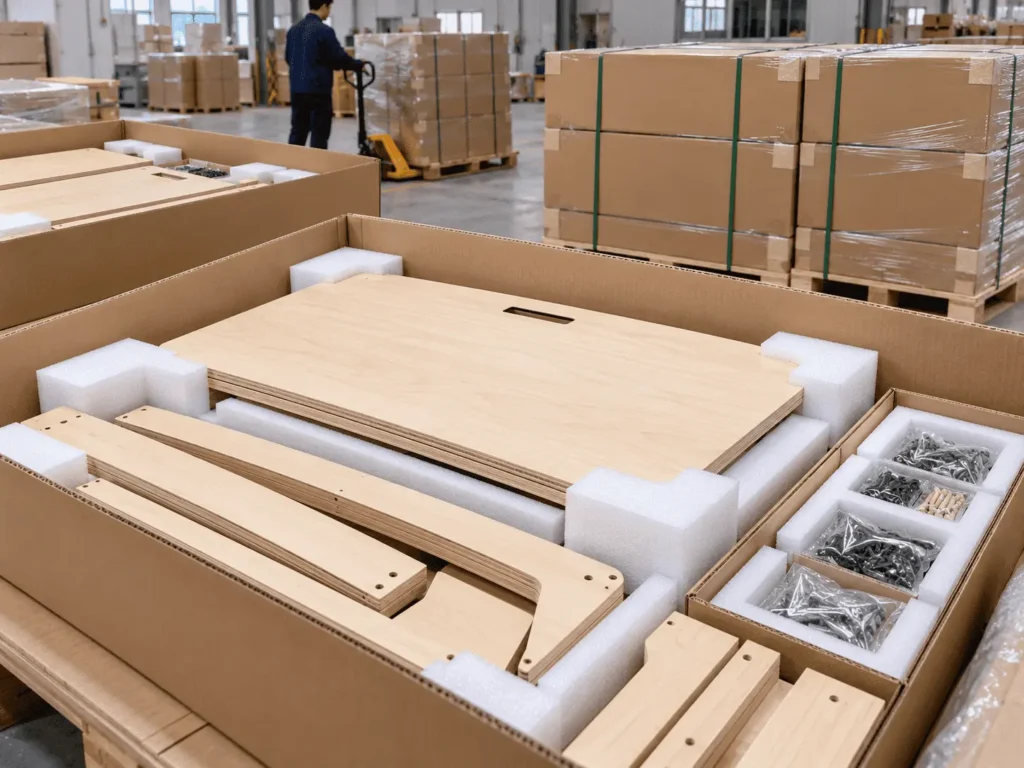
Flat-pack or knock-down packaging can help reduce shipping volume when the product has been designed for efficient disassembly and cartonization. It can also simplify storage and handling for distributors.
However, packaging should be developed around the actual product rather than added as an afterthought.
For plywood office desks, the factory should consider the protection of tabletop edges, finished surfaces, long panels, corners and hardware. Components should be separated where necessary to reduce abrasion during transport.
For multi-carton products, clear carton numbering helps buyers and installers identify the complete set. Hardware packs and assembly instructions should correspond to the approved product specification.
Buyers should confirm the following before bulk packing:
- Carton dimensions and gross weight.
- Number of cartons per furniture unit.
- Internal protective materials.
- Surface and corner protection.
- Hardware-pack identification.
- Carton marks and barcodes.
- Assembly manuals and language requirements.
- Palletization or other handling requirements, if applicable.
- Container-loading plan where relevant.
For project orders, packaging should also support installation sequencing. If furniture is delivered to several floors, rooms or sites, carton labels may need to identify the relevant model or destination.
Ask the manufacturer to confirm the proposed packing method and, where appropriate, provide sample-packaging photos or other agreed verification before shipment.
Quality Control for Bulk Office Furniture
Quality control should begin before production and continue through final packing.
For a B2B buyer, the most important question is whether the factory can repeatedly manufacture the approved specification, not simply whether one sample looks acceptable.
Incoming Material Checks
Confirm the specified board type, thickness, surface finish and hardware before processing. Where environmental or regulatory documents are required, verify the relevant documentation against the material being used.
Machining and Assembly Checks
Panel dimensions, drilling positions and edge finishing affect how the desk fits together. In knock-down furniture, small errors in critical locations can create assembly problems at the destination.
Where practical, trial assembly can help identify misaligned holes, unstable connections, incorrect hardware or difficult installation sequences before shipment.
Surface and Hardware Checks
Inspect finish consistency, scratches, chipped edges, visible glue marks, drawer movement and hardware fit according to the approved quality standard.
The acceptance criteria should be agreed before bulk production rather than invented after the goods are finished.
Final Packing Checks
Before shipment, verify that the correct components, hardware packs, manuals, labels and protective materials are included.
For repeat orders, use the approved sample and documented specifications as the reference. If a material or hardware substitution becomes necessary, agree on the change before it enters production.
A clearly defined QC process helps both the buyer and the manufacturer manage expectations, reduce avoidable rework and maintain consistency across orders.
Applications for Commercial and Corporate Spaces
Eco-friendly plywood office furniture can be considered for several types of commercial interiors, provided the material and construction match the intended use.
Corporate Headquarters and Private Offices
Executive desks, workstations, bookcases and filing cabinets can be developed around a consistent finish palette. Buyers may prioritize a professional appearance, integrated storage and compatibility with the wider office design.
Coworking Spaces and Shared Offices
Shared workstations often require standardized dimensions, practical cable-management provisions and durable surfaces. Repeatable modules can simplify procurement when the project involves several rooms or locations.
Reception Areas and Meeting Rooms
Reception desks, meeting-room storage and presentation furniture may require specific dimensions or coordinated finishes. The specification should reflect the intended traffic, cleaning routine and functional requirements.
Serviced Apartments and Mixed-Use Developments
Compact desks and storage furniture can be incorporated into residential and hospitality layouts. In these projects, the desk should be coordinated with room dimensions, electrical access and the wider furniture package.
For larger developments, explore project furniture manufacturing services to understand how panel furniture can be customized for commercial and residential projects.
The key is to select a design that works in the actual space while remaining practical to manufacture, transport and install.
How to Prepare an RFQ
A clear request for quotation helps a manufacturer provide more accurate pricing and identify technical questions early.
Rather than sending only a reference photograph, prepare a concise purchasing brief containing the following information.
Product requirements: Include drawings, reference photos, dimensions, functions and the number of models.
Material specification: State whether plywood is mandatory or whether alternative engineered panels may be considered. Identify any required finish, thickness or emissions documentation.
Destination market: Specify the country of sale or installation and any applicable compliance requirements.
Quantity: Provide the initial order quantity, target MOQ and expected repeat-order volume.
Project details: Explain whether the order is for wholesale distribution, a corporate office, a coworking space or a multi-site project.
Packaging: Identify export packing, private-label requirements, carton marks, assembly instructions and any special delivery constraints.
Schedule: State the required delivery or installation date and ask for a proposed sample and production schedule.
Commercial terms: Identify the preferred quotation basis and destination port or delivery location, as applicable.
A good RFQ gives the factory enough information to review materials, production feasibility and cost without repeatedly requesting missing details.
If you have not finalized the design, say so. An ODM discussion may help you evaluate a practical product configuration before committing to a full specification.
Frequently Asked Questions
Is plywood a sustainable material for office furniture?
Plywood can be a suitable option for some office furniture applications, but sustainability depends on sourcing, adhesive chemistry, manufacturing efficiency, durability, finishing and end-of-life considerations. Buyers should evaluate the actual specification and supporting documentation rather than assume that every plywood product is environmentally preferable.
Can a manufacturer customize eco-friendly plywood office furniture for corporate projects?
Yes. OEM/ODM development may cover dimensions, layouts, panel materials, finishes, hardware, storage configurations, branding and packaging. The available options depend on the design, order quantity, material availability and project requirements.
What is the MOQ for plywood office desks?
MOQ depends on the product program, material, finish, hardware and packaging. Plywood MFR lists container-based MOQ information for its standard flat-pack program, but buyers should confirm the current minimum for the specific office desk order and ask whether mixed-SKU loading or trial-order options are available.
How long does production take?
The schedule depends on sample development, specification approval, material availability, order quantity and factory capacity. Request separate sample and bulk-production timelines, and confirm when the production clock starts. Allow additional time for international shipping and installation.
What documents should I request for US-bound office furniture?
Depending on the materials and product, buyers may need applicable composite-wood compliance documentation, test reports, labeling and supporting records under relevant US requirements. Confirm the exact requirements with the importer or compliance team and the manufacturer before production.
Can office desks be shipped in flat-pack cartons?
Yes, when the product has been engineered for knock-down or flat-pack construction. The manufacturer should confirm carton dimensions, component protection, hardware packing, assembly instructions and the proposed loading arrangement.
Can I order desks together with storage cabinets and bookcases?
A coordinated furniture program may be possible. Combining products can help maintain consistent finishes and simplify purchasing, but MOQ, carton sizes, production schedules and container-loading feasibility must be confirmed for the specific combination.
How can I compare quotations from different manufacturers?
Compare identical specifications, including board materials, thickness, finish, hardware, dimensions, packaging, documentation, MOQ, lead time and quotation terms. A lower unit price is not necessarily the lower total cost if it results in additional damage, installation difficulties or replacement expenses.
Request a Factory Quotation for Eco-Friendly Plywood Office Furniture
Choosing the right supplier means balancing environmental requirements, product design, manufacturing consistency and export logistics.
For importers, distributors, office furniture brands and commercial project buyers, the most effective approach is to confirm the specification early, review material documentation, approve a sample and agree on the production and packing requirements before bulk manufacturing.
Starwood Industry Co., Ltd. supports panel furniture OEM/ODM development, sampling, bulk production, quality control and export-oriented packaging for international buyers.
To discuss your project, visit our home office furniture manufacturing page or review our OEM/ODM manufacturing services.
When contacting the factory, include your drawings or reference photos, target quantity, destination market, material requirements, finish preferences and expected delivery schedule.
Request a quotation: Email info@plywoodmfr.com with your office desk or commercial furniture requirements.
Share your product specifications and project goals so the manufacturing team can review feasibility, discuss material options and prepare the next steps for your order.