Sourcing a modern wood coffee table for a retail collection, furniture import program, hotel renovation or apartment project requires more than choosing an attractive design. Professional buyers must evaluate materials, manufacturing consistency, customization options, minimum order quantities, lead times, packaging efficiency and long-term supply reliability.
For furniture importers, wholesalers, private-label brands and commercial project contractors, working directly with an experienced modern wood coffee table manufacturer in China can simplify product development and bulk procurement.
At plywoodmfr.com , we specialize in OEM and ODM panel furniture manufacturing, supporting international buyers with material selection, custom designs, sampling, production coordination, quality control and export-ready flat-pack packaging.
This guide explains the practical purchasing considerations that matter when sourcing modern wooden coffee tables for international markets.

Table of Contents
- Why Modern Wood Coffee Tables Are Relevant to B2B Buyers
- Modern Wood Coffee Table Designs for Different Markets
- Materials and Finishes for Commercial Production
- OEM and ODM Coffee Table Manufacturing
- Wholesale MOQ, Pricing and Production Lead Times
- Coffee Tables for Hotels, Apartments and Commercial Projects
- Factory Quality Control and Product Testing
- Export Packaging and Container Loading
- How to Evaluate a Coffee Table Manufacturer in China
- Coffee Table Customization and Order Process
- Common Procurement Mistakes
- Request a Factory-Direct Coffee Table Quotation
- Frequently Asked Questions
Why Modern Wood Coffee Tables Are Relevant to B2B Buyers
A modern wood coffee table is a versatile furniture category that fits different residential and commercial environments.
Its clean lines, natural wood appearance and functional construction make it suitable for furniture retailers, home furnishing brands, apartment developers and hospitality procurement programs.
For B2B buyers, this product category offers several commercial advantages.
Consistent Demand Across Multiple Markets
Modern wood-look furniture is suitable for a broad range of interior styles, including:
- Scandinavian-inspired living rooms
- Minimalist residential interiors
- Contemporary apartment developments
- Serviced apartments and rental properties
- Hotel suites and guest lounges
- Student accommodation common areas
- E-commerce furniture collections
A carefully developed coffee table design can serve multiple customer segments through adjustments to dimensions, colors, materials and packaging.
This allows importers and furniture brands to build coordinated product collections without developing an entirely new structure for every market.
Suitable for Flat-Pack Furniture Distribution
Modern panel-based coffee tables can be engineered for knock-down (KD) construction.
Flat-pack designs offer practical advantages for importers and distributors:
- More efficient warehouse storage
- Compact shipping carton dimensions
- Reduced handling volume
- Easier parcel or retail distribution
- Simplified replacement-part management
- Consistent assembly procedures
However, the actual logistics savings depend on the table design, carton dimensions, protective materials and loading arrangement.
A professional supplier should evaluate these factors during product development rather than after production is complete.
Opportunities for Private-Label Furniture Collections
For furniture brands, a modern wood coffee table can be developed as part of a coordinated living room collection.
Matching items may include TV cabinets, side tables, console tables, storage cabinets and bookshelves.
Starwood supports furniture buyers seeking coordinated panel furniture programs through its plywoodmfr.com .
Combining several compatible product categories with one manufacturing partner can simplify finish matching, production communication and purchasing coordination.
Modern Wood Coffee Table Designs for Different Markets
For commercial buyers, product selection should begin with the intended customer and sales channel.
A design that performs well in a showroom may not necessarily be suitable for compact apartment interiors, online retail distribution or high-frequency hospitality environments.
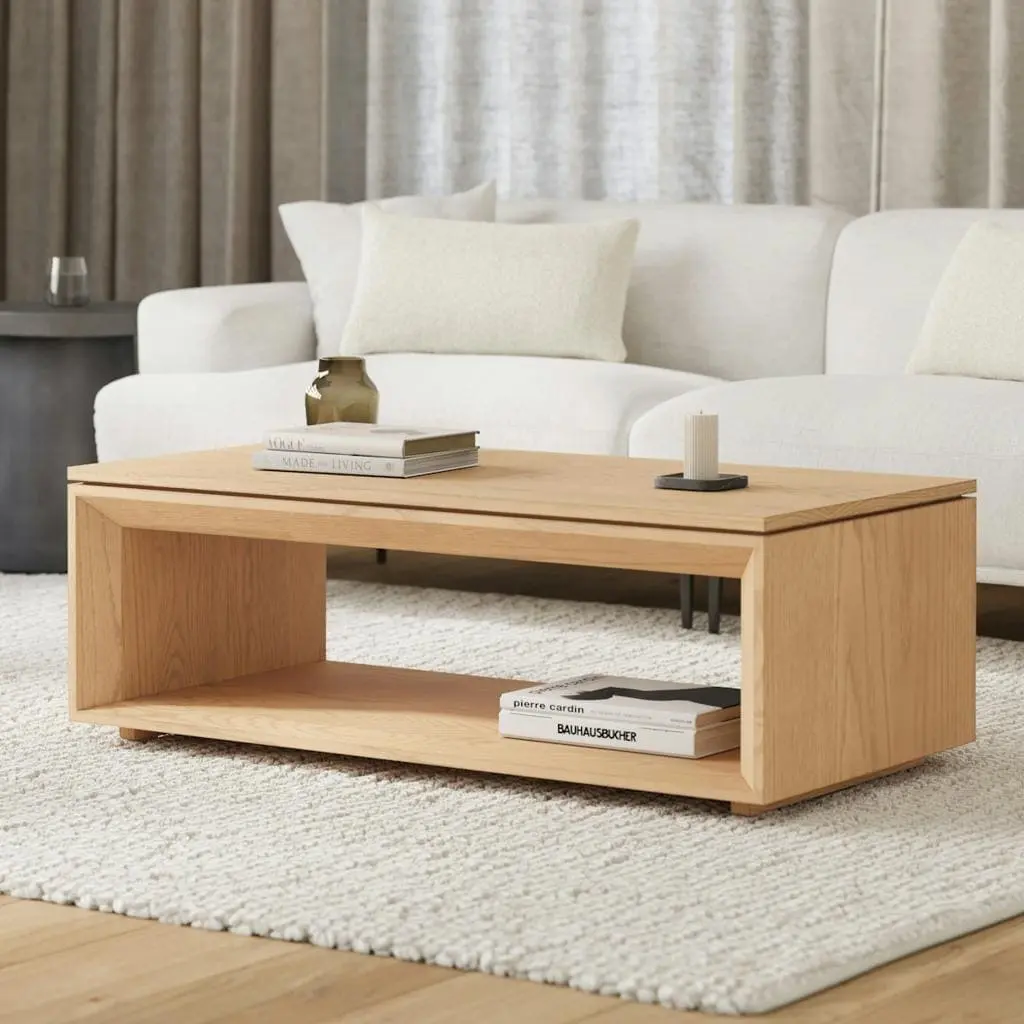
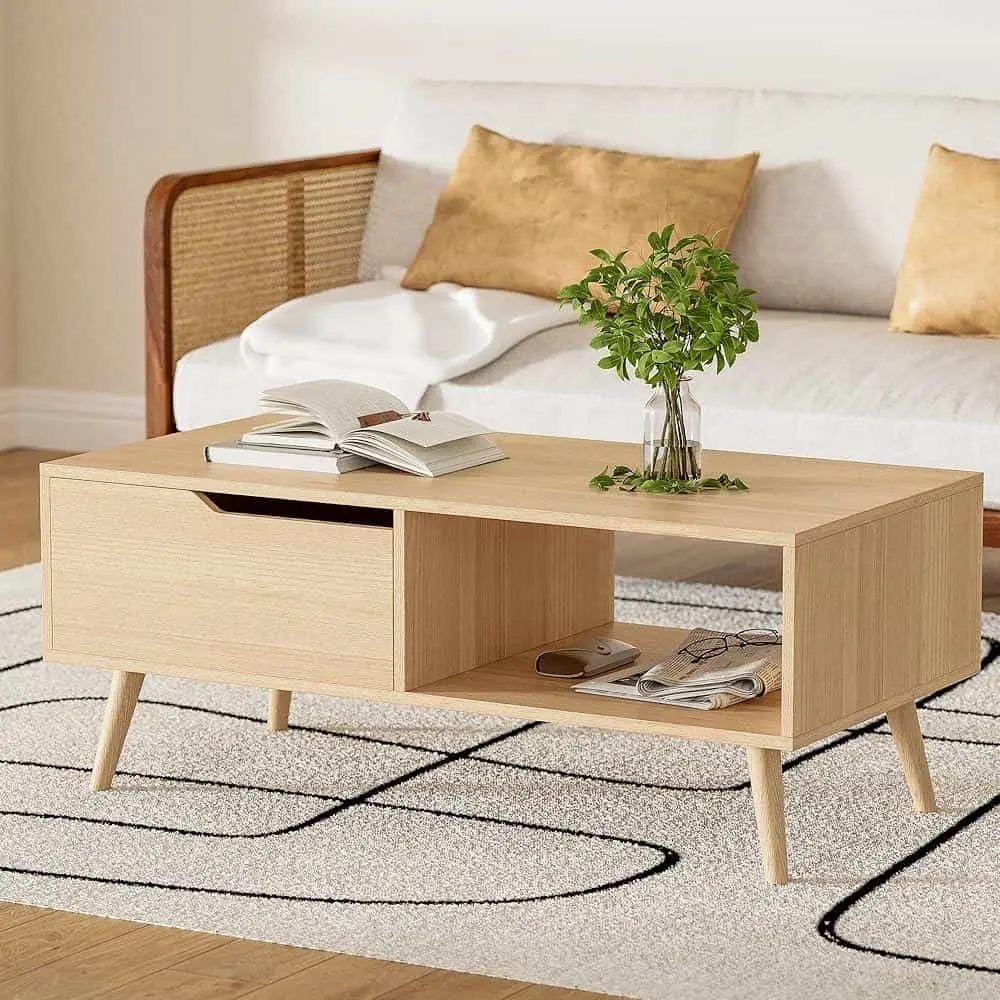
Minimalist Rectangular Wood Coffee Tables
Rectangular coffee tables remain a practical option for contemporary living rooms.
Their straightforward geometry works well with panel furniture production and supports repeatable manufacturing.
Typical design features include:
- Clean rectangular tabletops
- Natural oak or walnut-look finishes
- Straight or softly rounded edges
- Open lower storage shelves
- Hidden fastening systems
- Compact knock-down structures
For wholesale furniture programs, rectangular designs can also be developed in several dimensions using a coordinated material and finish specification.
This can help retailers offer multiple price points within the same collection.
Round and Oval Wood Coffee Tables
Round and oval coffee tables are suitable for interiors requiring softer visual lines.
They are often considered for hotel lounges, reception spaces, serviced apartments and contemporary residential collections.
However, curved designs require additional manufacturing attention.
Buyers should confirm:
- Edge finishing methods
- Curved panel processing capability
- Connection strength
- Stability requirements
- Carton protection
- Assembly procedures
Rounded tabletops may also require more careful packaging than simple rectangular panels.
For export production, design appearance and transportation protection should be evaluated together.
Modern Wood Coffee Tables with Storage
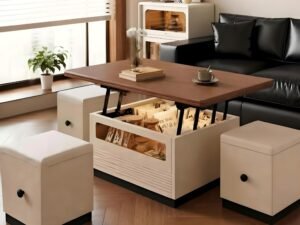
Coffee tables with shelves or drawers are particularly relevant to apartment and small-space furniture programs.
Popular configurations include:
- Open lower shelves
- Concealed drawers
- Two-tier tabletops
- Integrated storage compartments
- Combined display and storage areas
Storage features can increase perceived product value, but they also introduce additional hardware, assembly operations and quality-control requirements.
For example, drawer-equipped models require checks for alignment, smooth operation and hardware consistency.
Before approving bulk production, buyers should evaluate whether the additional functionality supports the target selling price.
Natural Wood-Look Finishes for Minimalist Interiors
Natural oak, walnut and other wood-grain finishes are widely used in contemporary panel furniture collections.
For manufacturers, the important challenge is consistency.
A suitable finish should maintain an acceptable appearance across:
- Different production batches
- Adjacent tabletop and shelf panels
- Matching furniture products
- Replacement components
- Repeat purchase orders
Professional buyers should confirm approved color samples and surface textures before mass production.
A finish reference should ideally include a physical sample rather than relying only on digital images.
Materials and Finishes for Modern Wood Coffee Table Manufacturing
Material selection directly affects product cost, durability, appearance, weight, assembly performance and market suitability.
For B2B coffee table procurement, the most suitable material is not necessarily the most expensive.
It is the material that meets the intended performance requirements at an acceptable landed cost.
MDF Coffee Tables
Medium-density fiberboard (MDF) is commonly used in engineered-wood furniture production.
It provides a relatively uniform substrate that can support different decorative surface treatments.
MDF may be suitable for:
- Painted furniture components
- Melamine-faced panels
- Contemporary flat-panel structures
- Decorative wood-look finishes
- Coordinated furniture collections
Buyers should specify panel thickness, density where relevant, surface finish and moisture exposure requirements.
An MDF tabletop intended for regular hospitality use may require different performance expectations from a table designed for occasional residential use.
Particle Board Coffee Tables
Particle board is another common material for cost-conscious panel furniture programs.
It can support efficient production of simple, repeatable furniture designs.
For wholesalers and furniture importers, particle board may offer an appropriate balance between manufacturing cost and functionality.
However, panel grade, screw-holding performance, board thickness and edge protection must be considered.
For knock-down furniture, repeated assembly and disassembly can place additional demands on connection points.
Factory engineering should therefore evaluate the relationship between board properties and hardware selection.
Plywood Coffee Tables
Plywood can be considered for selected furniture structures where its layered construction and mechanical characteristics provide an advantage.
Depending on the design, plywood may be appropriate for:
- Selected structural components
- Curved or shaped panels
- Specific veneer-finished designs
- Applications requiring particular fastening performance
Plywood does not automatically outperform every MDF or particle board specification in every application.
The appropriate choice depends on board grade, thickness, veneer construction, connection design and intended use.
Melamine, Laminate and Veneer Finishes
The decorative surface influences appearance, cleaning requirements, production cost and long-term customer satisfaction.
| Finish | Typical purchasing consideration | Potential application |
|---|---|---|
| Melamine-faced panel | Cost control, consistent decorative surface | Wholesale and apartment furniture |
| Laminate | Surface performance and finish specification | Selected commercial programs |
| Natural wood veneer | Real wood appearance and visual character | Premium furniture collections |
| Painted MDF | Custom color matching and smooth appearance | Private-label contemporary furniture |
| Decorative wood-grain foil | Appearance, processing method and price | Cost-sensitive retail collections |
Actual performance depends on the complete panel system and manufacturing quality, not simply the finish name.

Formaldehyde Emission Requirements
Composite wood furniture exported to regulated markets may be subject to formaldehyde emission requirements.
For products intended for the United States, buyers should review the US Environmental Protection Agency’s guidance on epa.gov .
The applicable requirements depend on the materials and finished goods involved.
Buyers should request relevant supplier documentation and confirm that the specified panel products are suitable for the destination market.
For procurement teams, a practical material specification should include:
- Board type and grade
- Panel thickness
- Decorative surface
- Edge-banding specification
- Applicable emission requirements
- Color and texture reference
- Intended product application
A clear specification reduces the risk of misunderstanding during sampling, quotation and mass production.
OEM and ODM Modern Wood Coffee Table Manufacturing
For furniture brands and professional importers, OEM and ODM services provide opportunities to develop products that fit specific markets.
Rather than purchasing only standard catalog furniture, buyers can define product dimensions, materials, colors, features and packaging.
OEM Coffee Table Manufacturing
OEM manufacturing is suitable when the buyer already has a product design or technical specification.
The customer may provide:
- Product drawings
- Reference images
- Dimensions
- Material requirements
- Finish samples
- Hardware specifications
- Packaging instructions
- Branding requirements
The factory then reviews manufacturing feasibility, material selection and production requirements.
For example, a buyer may provide a rectangular minimalist coffee table design with an oak-look finish, open storage shelf and KD construction.
The engineering review should establish whether the intended structure can be manufactured consistently and assembled reliably.
Any proposed modification should be discussed before the approved sample is finalized.
ODM Coffee Table Development
ODM services are suitable for buyers who have a market concept but need manufacturing and product-development assistance.
A buyer may request:
“A compact modern wood coffee table for apartment living, with storage, natural oak appearance, easy assembly and a target wholesale price.”
The development process can then involve:
- Reviewing the target market and selling channel.
- Defining product dimensions and functional requirements.
- Selecting practical panel materials and finishes.
- Developing or refining the structure.
- Reviewing estimated manufacturing cost.
- Preparing samples.
- Testing assembly and evaluating packaging.
- Confirming specifications for bulk production.
At Starwood, our plywoodmfr.com is designed to support this transition from product requirements to repeatable panel furniture production.
Customization Options for Wholesale Buyers
Depending on the approved design and production requirements, customization may include:
- Length, width and height
- Panel thickness
- Oak, walnut and other decorative finishes
- Drawer or shelf configurations
- Edge profiles
- Hardware selection
- Product labels
- Carton artwork
- Assembly instructions
- Private-label packaging
Not every customization is cost-neutral.
For example, changing a product’s dimensions may affect material utilization, hardware placement, carton size and container loading efficiency.
A reliable quotation should consider these changes rather than treating customization as a simple color replacement.
Wholesale MOQ, Pricing and Production Lead Times
Minimum order quantity, unit cost and production scheduling are among the most important considerations for B2B buyers.
These factors should be discussed during the quotation stage.
What Is the MOQ for Modern Wood Coffee Tables?
There is no universal MOQ for custom coffee table manufacturing.
The actual minimum order quantity depends on factors such as:
- Standard or customized design
- Material availability
- Panel finish selection
- Hardware sourcing
- Packaging requirements
- Quantity per finish
- Production scheduling
- Mixed-container opportunities
A standard model using existing materials may have different minimum quantity requirements from a newly developed coffee table with custom components.
Starwood’s company profile indicates support for low-MOQ manufacturing arrangements. However, the confirmed MOQ must be quoted for the specific model and finish.
For initial market testing, buyers should ask whether smaller trial orders or mixed-product shipments are available.
What Determines Wholesale Coffee Table Pricing?
A factory-direct quotation should consider the complete manufacturing specification.
Important cost factors include:
| Cost factor | What buyers should confirm |
|---|---|
| Board material | MDF, particle board, plywood, grade and thickness |
| Surface finish | Melamine, laminate, veneer or paint |
| Dimensions | Overall size and component quantities |
| Structure | Fixed, knock-down, drawer or shelf design |
| Hardware | Type, quantity, quality and source |
| Packaging | Carton structure, protection and branding |
| Order quantity | Units per model, finish and shipment |
| Delivery terms | Incoterms and destination requirements |
The lowest quoted unit price does not always represent the lowest landed cost.
A coffee table requiring an oversized carton, complex assembly or frequent replacement parts may create additional expenses after importation.
Professional buyers should compare quotations using consistent product specifications and delivery terms.
How Long Does Coffee Table Manufacturing Take?
Lead times vary depending on customization, material availability, order volume, approval cycles and factory scheduling.
For planning purposes, procurement teams should separate the timeline into several stages:
- Technical review and quotation
- Sample development
- Sample approval or revision
- Material procurement
- Mass production
- Quality inspection
- Packing and shipment preparation
A factory should confirm the production schedule after the final specification, order quantity and material requirements are agreed upon.
For hotel or apartment projects with fixed installation dates, buyers should also allow time for freight, customs clearance, inland delivery and possible corrective actions.
Purchasing recommendation: Request a written production schedule with clear approval milestones rather than relying on an estimated shipping date alone.
Modern Wood Coffee Tables for Hotels, Apartments and Commercial Projects
Commercial furniture procurement differs from conventional retail purchasing.
Project buyers must coordinate furniture specifications with site conditions, room layouts, installation schedules and operational requirements.
Coffee Tables for Hotel Rooms and Suites
Hotels may require coffee tables for guest suites, lobby seating areas and shared lounges.
Selection criteria can include:
- Consistent finish appearance
- Stable construction
- Easy-to-clean surfaces
- Suitable dimensions for room layouts
- Impact-resistant edges
- Efficient installation
- Replacement component availability
In hospitality environments, a visually attractive product is only one part of the specification.
Procurement teams should also evaluate durability and maintenance requirements based on actual use.
Coffee Tables for Serviced Apartments
Serviced apartments often require furniture that balances contemporary appearance with budget control.
A modern wood coffee table may be supplied alongside TV cabinets, side tables, wardrobes and other panel furniture.
Using coordinated finishes across several categories can help maintain a consistent interior appearance.
For apartment projects, buyers should confirm whether all furniture products will follow a common color reference and approval process.
This is particularly important when components are produced at different times.
Coffee Tables for Rental Housing and Student Accommodation
Rental properties and student accommodation projects may prioritize:
- Practical dimensions
- Simple construction
- Easy cleaning
- Durable surface finishes
- Replaceable hardware
- Efficient installation
- Cost-effective repeat purchasing
Products should be selected according to the operating environment rather than purely decorative preferences.
For large developments, standardized specifications can simplify future maintenance and replacement orders.
Coordinated Furniture Procurement for Projects
A project buyer may need coffee tables together with:
- TV stands
- Sideboards
- Storage cabinets
- Desks
- Bedside tables
- Wardrobes
- Bookshelves
Starwood supports commercial buyers through its plywoodmfr.com , including OEM/ODM production for apartments, hotels, student housing and other commercial applications.
Coordinating several panel furniture categories through one supplier can support more consistent specifications, packaging requirements and delivery planning.
Factory Quality Control for Modern Wood Coffee Tables
Consistent manufacturing quality is essential for wholesale and project furniture procurement.
A product sample may look satisfactory, but commercial buyers must also consider repeatability across hundreds or thousands of units.
Incoming Material Inspection
Quality control begins before panel processing.
Depending on the agreed inspection plan, checks may cover:
- Material identification
- Panel thickness
- Surface defects
- Decorative finish consistency
- Edge-banding material
- Hardware specifications
Purchasers should ensure that approved specifications are communicated to production and inspection teams.
Panel Cutting and Edge-Banding Quality
Accurate panel cutting affects assembly alignment and final product appearance.
Typical inspection points include:
- Component dimensions
- Squareness and machining accuracy
- Edge-banding adhesion
- Edge finish consistency
- Visible surface damage
- Correct positioning of drilled holes
Poor machining consistency can create assembly problems even when the furniture appears acceptable before packing.
Hardware and Assembly Verification
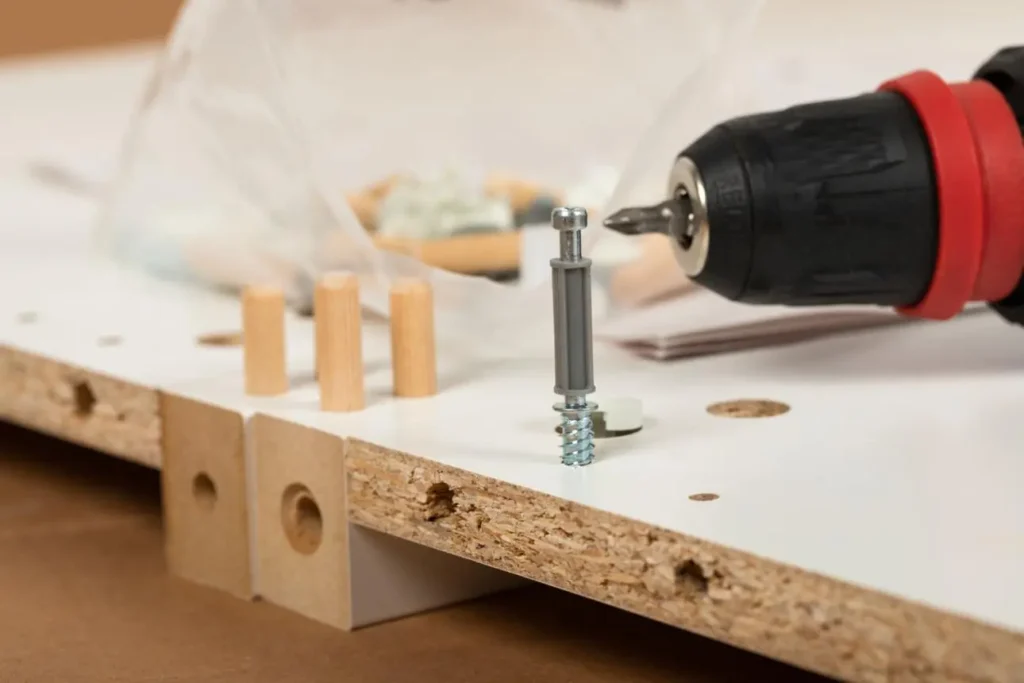
Flat-pack coffee tables depend on correctly positioned connection points and suitable hardware.
Buyers should confirm that sample inspection includes a complete assembly trial.
This can reveal:
- Missing components
- Incorrect drilling positions
- Unclear instructions
- Misaligned shelves or drawers
- Unstable construction
- Inadequate fastener engagement
For commercial furniture, assembly testing is particularly useful because products may be installed by contractors rather than end consumers.
Structural and Stability Testing
Testing requirements should be selected according to the product design, intended use and destination market.
For example, the International Organization for Standardization maintains furniture testing standards, including iso.org .
This particular standard is relevant to applicable storage-unit designs; it should not automatically be treated as the correct test standard for every coffee table.
Buyers should agree on the appropriate product-specific test methods before placing an order.
Where independent testing is required, the test scope, laboratory and acceptance criteria should be confirmed in writing.
Export Packaging and Container Loading
Packaging is a major procurement consideration for furniture importers.
For panel-based coffee tables, packaging design affects freight efficiency, product protection, warehouse handling and customer experience.
Flat-Pack Coffee Table Packaging
Knock-down structures are commonly considered for export-oriented panel furniture.
A typical flat-pack package may include:
- Individually protected panels
- Edge and corner protection
- Separated hardware components
- Assembly instructions
- Outer corrugated cartons
- Product identification labels
The exact packaging configuration should be developed according to product geometry and transportation risks.
Preventing Transportation Damage
Coffee tables can experience damage during handling, stacking and international transportation.
Common risks include:
- Chipped corners
- Scratched decorative surfaces
- Damaged edge banding
- Crushed cartons
- Missing hardware
- Panel movement inside the carton
Buyers should request an appropriate packaging evaluation before production release.
ASTM International provides store.astm.org , which offers a framework for evaluating shipping units under defined distribution conditions.
Its applicability and the appropriate test cycle should be determined for the specific packaged product.
Container Loading Efficiency
Carton dimensions influence the number of units that can be loaded into a shipping container.
For importers purchasing bulk coffee tables, packaging optimization may reduce freight cost per unit.
However, minimizing carton size must not compromise adequate product protection.
The factory and buyer should review:
- Master carton dimensions
- Gross and net weights
- Carton stacking limitations
- Loading quantities
- Mixed-product loading requirements
- Handling risks
Actual container quantities should be calculated using the approved packed dimensions and loading plan.
Private-Label Export Packaging
For furniture brands and distributors, customized packaging may be required.
Depending on the program, options can include:
- Printed outer cartons
- Buyer-specific product labels
- SKU identification
- Barcodes
- Branded assembly manuals
- Hardware identification
- Market-specific warning labels
These requirements should be confirmed before packaging materials are ordered.
Late changes to carton artwork or labeling can delay production and shipment preparation.
How to Evaluate a Modern Wood Coffee Table Manufacturer in China
Choosing a supplier requires more than reviewing product images and unit prices.
A professional procurement process should assess manufacturing capability, communication quality, product development support and export experience.
Confirm Direct Manufacturing Capability
Buyers should establish whether the supplier operates manufacturing facilities or works primarily as a trading intermediary.
A direct manufacturer should be able to explain its production processes and how quality is controlled.
Relevant questions include:
- What panel furniture categories are produced?
- Which manufacturing operations are handled in-house?
- Can the factory review technical drawings?
- How are custom finishes approved?
- What quality-control checkpoints are used?
- Can the supplier support repeat orders?
plywoodmfr.com is based in Jiangmen, Guangdong, China, and states that it has specialized in OEM and ODM panel furniture manufacturing since 2013.
Its published capabilities include panel furniture production, customization, sampling, quality control and export-oriented packaging.
Review Export Market Requirements
Importers should identify applicable regulatory, material, labeling and documentation requirements before issuing a purchase order.
For example, buyers concerned about responsible forest sourcing can consult the fsc.org .
FSC certification claims should only be made for qualifying products and supply chains supported by valid documentation.
Similarly, buyers supplying the European Union should review relevant product-safety obligations through the single-market-economy.ec.europa.eu .
The applicable compliance requirements depend on the product, market and business role.
A manufacturer should not be assumed to hold a certification simply because a standard is mentioned in its marketing materials.
Evaluate Communication and Documentation
Good supplier communication reduces commercial risk.
Professional buyers should expect clear responses regarding:
- Product drawings
- Material specifications
- Approved samples
- Quotation terms
- MOQ
- Production schedule
- Inspection arrangements
- Packaging details
- Shipping documents
A supplier that can provide organized technical information is generally easier to integrate into a structured procurement process.
Assess Long-Term Supply Suitability
For retailers and furniture importers, supplier performance matters beyond the first container.
Repeat orders require consistent specifications, reliable communication and appropriate change management.
Before developing a long-term coffee table collection, buyers should discuss how the factory handles:
- Material discontinuation
- Finish variation
- Hardware substitutions
- Product revisions
- Replacement components
- Repeat-order documentation
A stable supply program depends on controlling these changes over time.
Coffee Table Customization and Bulk Order Process
An organized order process helps both the buyer and the manufacturer reduce uncertainty.
The following workflow is suitable for many OEM/ODM panel furniture sourcing programs.
Step 1: Send Product Requirements
The buyer provides the initial information required for quotation.
This may include:
- Product photographs or drawings
- Overall dimensions
- Preferred material
- Surface finish
- Quantity
- Destination country
- Packaging requirements
- Target delivery schedule
For customized projects, the buyer should also identify any mandatory functional requirements.
Step 2: Technical Review and Preliminary Quotation
The manufacturer reviews the proposed design and assesses production feasibility.
Potential issues may include:
- Panel thickness
- Structural connections
- Edge finishing
- Material availability
- Hardware compatibility
- Packaging dimensions
The supplier then prepares a quotation based on the agreed assumptions.
If an alternative construction could improve manufacturing efficiency, it should be proposed for buyer approval.
Step 3: Sample Development and Approval
Sampling allows the buyer to evaluate the proposed coffee table before bulk production.
The sample review should cover:
- Appearance
- Dimensions
- Finish quality
- Assembly
- Stability
- Functionality
- Packaging requirements
Any changes should be recorded and reflected in the final approved specification.
Step 4: Bulk Production
After sample approval and commercial confirmation, the order can proceed according to the agreed production schedule.
Material preparation, panel processing, drilling, edge finishing, hardware allocation and packing should follow the approved requirements.
Changes during production should be controlled through documented agreement.
Step 5: Inspection and Packaging
Finished products should be inspected according to the agreed quality-control plan.
Typical checks may include product appearance, dimensional accuracy, assembly performance, hardware completeness and packaging condition.
For larger orders, buyers may arrange an independent pre-shipment inspection.
Step 6: Shipment and Repeat Order Support
Following the required inspection and shipping arrangements, finished coffee tables are prepared for export.
For repeat programs, approved drawings, finish references, packaging specifications and product identification should be retained.
This helps maintain consistency in future orders.
Common Procurement Mistakes When Buying Wholesale Coffee Tables
Even experienced buyers can encounter problems when product development and sourcing requirements are not clearly defined.
Comparing Prices Without Matching Specifications
Two coffee tables may appear identical in photographs but use different materials, thicknesses, hardware or packaging.
A meaningful price comparison requires a consistent technical specification.
Approving Finishes from Digital Images Alone
Screen colors vary, and digital images cannot fully communicate texture or gloss.
Physical finish samples are useful for confirming important color requirements.
Ignoring Assembly Performance
A table may appear attractive when assembled by an experienced technician but prove difficult for the intended customer or installation contractor.
Assembly trials should be part of sample evaluation.
Treating Packaging as an Afterthought
Insufficient packaging can lead to damage claims, product returns and replacement costs.
Packaging should be considered during engineering and cost estimation.
Failing to Confirm Production and Delivery Milestones
Project delays can result when sample approval, materials, inspection and shipping dates are not coordinated.
Buyers should establish written milestones and assign responsibility for approvals.
Request a Factory-Direct Modern Wood Coffee Table Quotation
For professional buyers, successful coffee table procurement depends on a combination of design suitability, material selection, manufacturing consistency, logistics efficiency and reliable communication.
A well-developed modern wood coffee table should meet the expectations of the target market while remaining practical to manufacture, package, ship and assemble.
Starwood Industry Co., Ltd. supports furniture importers, wholesalers, private-label brands and commercial project buyers seeking OEM/ODM panel furniture manufacturing in China.
Our manufacturing services cover product development, material and finish customization, sampling, bulk production coordination, quality control and export-ready packaging.
Whether you are sourcing a minimalist coffee table for a retail collection or developing coordinated living room furniture for apartments and hospitality projects, we welcome your purchasing requirements.
Looking for a modern wood coffee table manufacturer for bulk orders or OEM/ODM projects?
Send us your product drawings, reference images, target quantity, material preferences and destination market.
Our team can review your requirements and discuss suitable manufacturing options.
plywoodmfr.com
Email: info@plywoodmfr.com
Explore our related manufacturing capabilities:
- plywoodmfr.com
- plywoodmfr.com
- plywoodmfr.com
- plywoodmfr.com
Frequently Asked Questions About Modern Wood Coffee Table Manufacturing
Can I order modern wood coffee tables directly from a manufacturer in China?
Yes. Professional importers, distributors, furniture brands and commercial buyers can source coffee tables directly from manufacturers in China. Buyers should confirm production capability, technical specifications, MOQ, quality-control arrangements and export terms before placing an order.
Does Starwood provide OEM and ODM coffee table manufacturing?
Starwood provides OEM and ODM panel furniture manufacturing services. Coffee table customization requests can be reviewed according to the proposed design, materials, dimensions, finishes, order volume and manufacturing feasibility.
What materials are available for modern wood coffee tables?
Common options include MDF, particle board and plywood with different decorative surfaces. Material selection depends on design requirements, intended use, budget, finish expectations and destination-market regulations.
What is the minimum order quantity for wholesale coffee tables?
MOQ depends on the product model, customization level, material availability, finish requirements and production arrangements. Buyers should submit the intended specifications and quantities to receive a model-specific quotation.
Can I customize coffee table dimensions and finishes?
Yes, dimensions and finishes can be reviewed as part of an OEM or ODM project. Any customization should be evaluated for structural performance, manufacturing feasibility, packaging requirements and cost implications.
Are flat-pack coffee tables suitable for international shipping?
Flat-pack designs can be suitable for international distribution because components can often be packed more compactly. The final packaging design should provide appropriate protection and be validated for the intended transportation conditions.
Can one supplier manufacture coffee tables and matching living room furniture?
A panel furniture manufacturer may be able to coordinate coffee tables with TV cabinets, sideboards, shelves and other living room products. Buyers should confirm product scope, material compatibility and finish consistency during the quotation stage.
Can modern wood coffee tables be supplied for hotel and apartment projects?
Yes. Custom coffee tables may be developed for hospitality and residential projects based on approved dimensions, finishes, functional requirements and quantities. Project-specific testing, installation and delivery requirements should be agreed upon before production.
How can importers verify coffee table quality before shipment?
Buyers can review approved samples, factory inspection records, assembly checks, material documentation and packaging specifications. Independent pre-shipment inspection can also be arranged when required.
What information should I send to receive an accurate coffee table quotation?
Provide product drawings or reference images, dimensions, material preferences, finish requirements, estimated order quantity, destination market, packaging instructions and desired delivery schedule. Complete information helps the manufacturer prepare a more accurate proposal.