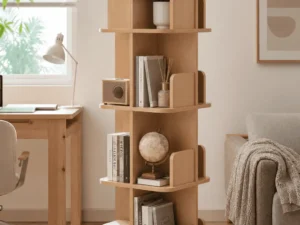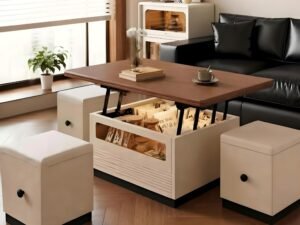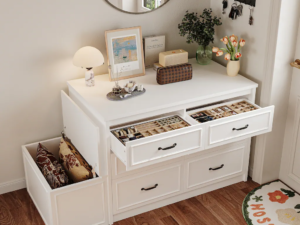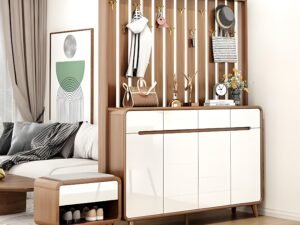
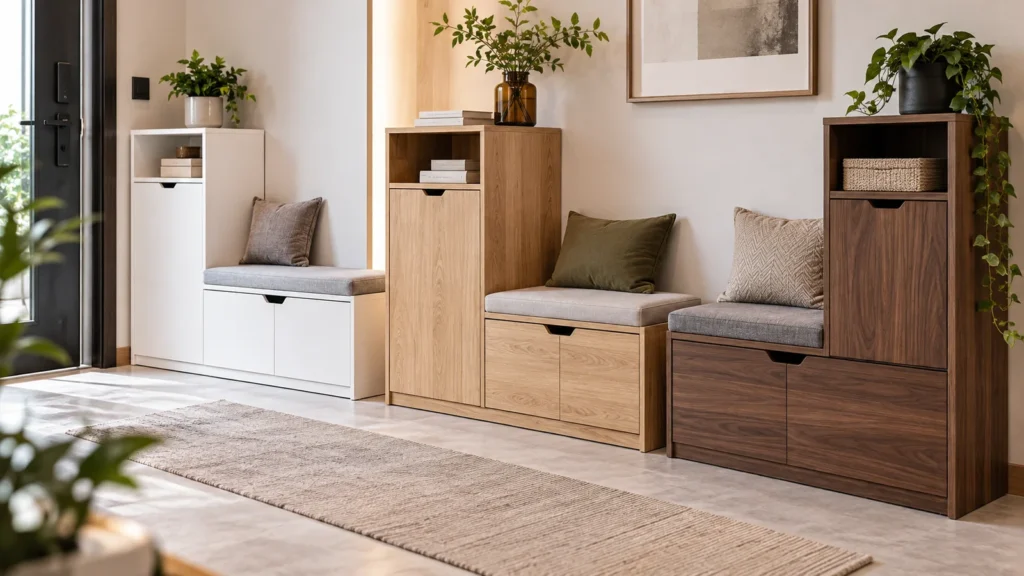
For furniture importers, wholesalers, private-label brands, hotel procurement teams, and apartment developers, sourcing storage cabinets with built-in seating for small rooms requires more than selecting an attractive space-saving design. Buyers must evaluate seating strength, engineered wood materials, cabinet construction, customization costs, minimum order quantities (MOQ), and export delivery requirements.
A storage cabinet with integrated seating performs two functions within one furniture footprint, but its structural demands are different from those of an ordinary storage unit.
At Starwood Industry Co., Ltd., we support OEM and ODM panel furniture manufacturing for international B2B customers. This factory-focused purchasing guide explains how to specify, customize, inspect, and order storage cabinets with seating for wholesale and commercial furniture projects.
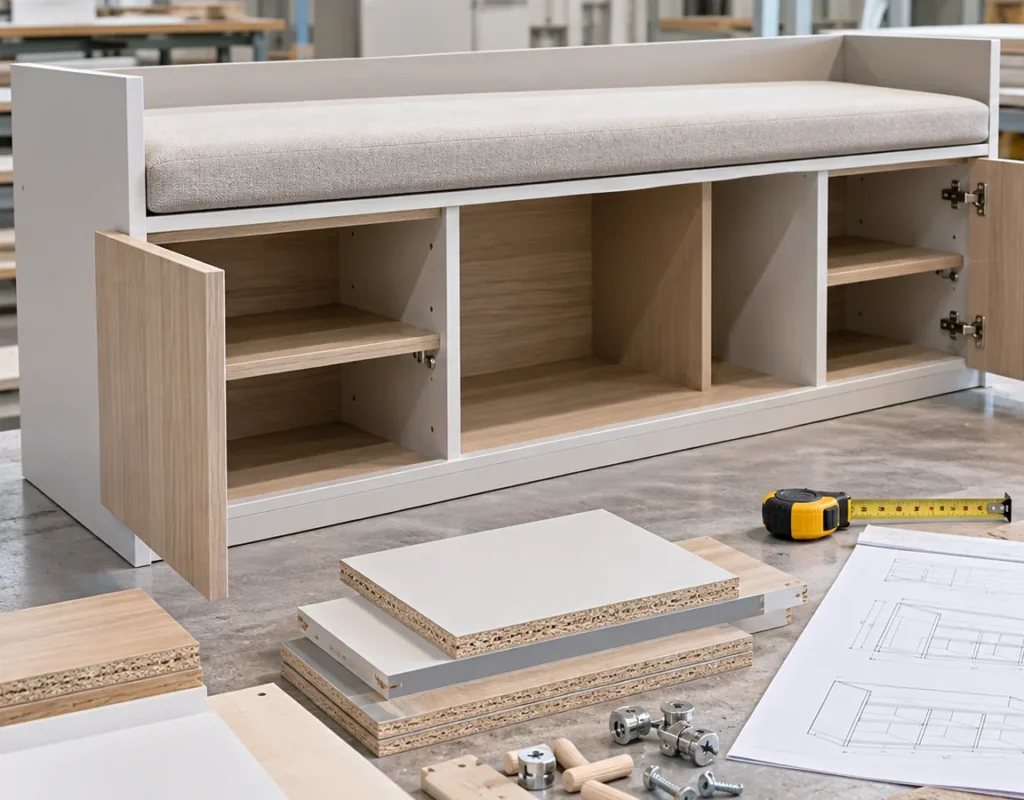
Table of Contents
- Why Buyers Source Storage Cabinets with Built-in Seating
- Five Proven OEM Buying Checks
- Factory Manufacturing Capabilities
- Applications in Small Rooms and Commercial Projects
- Seating Structure, Load Testing and Safety
- Materials and Finishes for Panel Storage Cabinets
- OEM and ODM Customization
- MOQ, Factory Pricing and Bulk Order Planning
- Sampling, Lead Times and Quality Control
- KD Packaging, Container Loading and Shipping
- Hotel and Apartment Project Procurement
- Material Compliance and International Standards
- How to Prepare a Storage Cabinet RFQ
- Our OEM/ODM Manufacturing Workflow
- Frequently Asked Questions
- Request a Factory-Direct Quotation
Why Buyers Source Storage Cabinets with Built-in Seating
Space-saving furniture is an important category for international distributors and project purchasing teams serving compact residential and hospitality markets.
Combining storage and seating within one engineered-panel furniture unit can reduce the need for separate entryway benches and cabinets.
For apartment developers, this arrangement may help organize shoes, bags, accessories, and other everyday items without requiring multiple pieces of furniture.
For hotel and serviced apartment projects, the integrated configuration can provide a coordinated entrance or dressing-area solution.
Commercial Purchasing Requirements
Professional buyers usually evaluate these products according to their intended sales channel.
Furniture importers may prioritize repeatable specifications, carton efficiency, and competitive landed costs.
Private-label brands may require customized appearances, different storage layouts, and branded packaging.
Project buyers often focus on dimensions, installation conditions, structural performance, and coordinated material finishes.
The purchasing objective is therefore not simply to maximize storage capacity.
A successful program must balance function, manufacturing cost, safe seating performance, and export practicality.
Why Factory-Direct Sourcing Matters
Storage cabinets with seating require coordination between cabinet engineering and the seating function.
Changing the seat width can affect panel support, component dimensions, hardware positions, and carton specifications.
Working directly with a panel furniture manufacturer can make these technical decisions easier to evaluate during product development.
Starwood supports international customers through factory-direct OEM and ODM production. Learn more about our manufacturing background on the Starwood factory and company profile.
Five Proven OEM Buying Checks Before Ordering
Before purchasing storage cabinets in bulk, buyers should verify five essential aspects of the product and manufacturing arrangement.
1. Confirm Seating Dimensions and Load Requirements
A cabinet designed only for storage should not automatically be considered suitable for seating.
When the product includes a sitting area, the buyer should identify the intended number of users, expected loading conditions, seat dimensions, and applicable safety requirements.
The factory must evaluate how the load transfers through the seat panel, vertical partitions, structural connections, and cabinet base.
A larger seating span may require additional engineering consideration.
For contract projects, the buyer should specify the intended use and required test criteria before the sample is approved.
Avoid accepting an unsupported statement such as “heavy-duty seating” without relevant technical details or testing evidence.
2. Define Cabinet Storage Capacity and Layout
A compact product must make efficient use of its available dimensions.
Possible configurations include shoe compartments, enclosed doors, pull-out drawers, open shelving, and accessory storage.
However, storage layout directly affects the supporting structure.
Removing a vertical divider to create a wider compartment may change the way the seating panel is supported.
For this reason, storage capacity and seat construction should be developed together.
Buyers should provide both external dimensions and required internal storage functions.
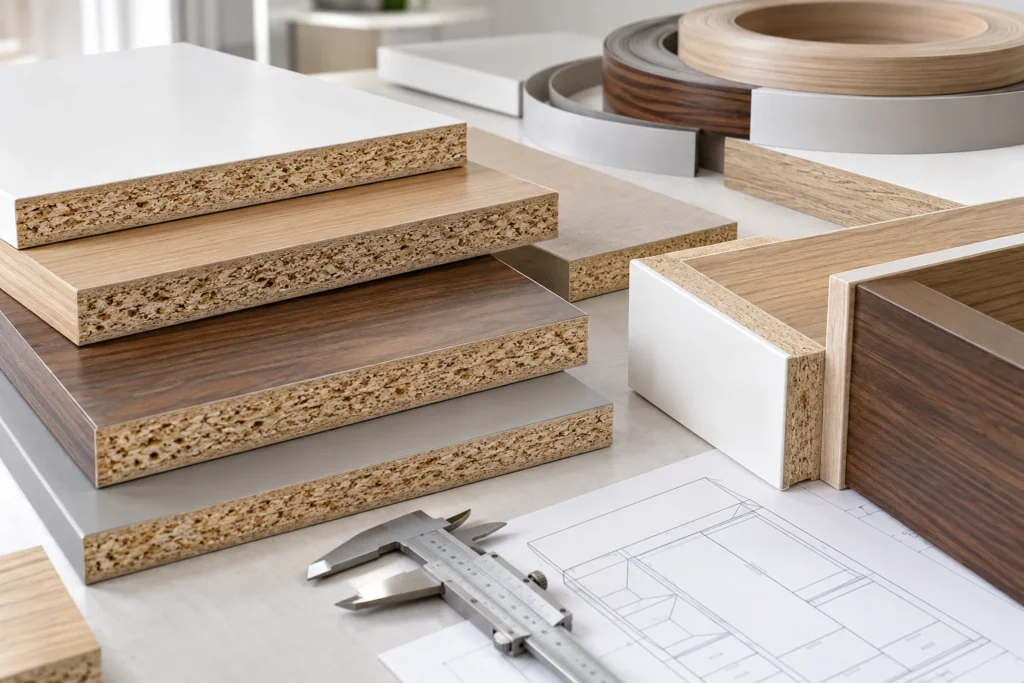
3. Compare Engineered Panel Specifications
Board material and thickness influence manufacturing cost, weight, screw-holding characteristics, and the cabinet structure.
Two products with similar decorative finishes may have different internal panel specifications.
Before comparing quotations, request details covering panel grade, thickness, surface finish, edge banding, and component construction.
For products intended for international markets, applicable material documentation should also be confirmed.
A lower quotation is not necessarily a better purchasing decision if the specifications are not equivalent.
4. Verify MOQ and Customization Costs
Minimum order quantity can vary according to the product dimensions, finish, hardware, upholstery, and packaging requirements.
A standard cabinet and a completely redesigned OEM storage bench may have different production minimums.
Buyers should ask whether the quoted MOQ applies to each model, finish, or total order.
If multiple colors or configurations are required, provide an estimated quantity breakdown by SKU.
The factory can then assess whether components and materials can be standardized across the order.
5. Confirm Lead Time, Packing and Inspection
An attractive purchase price is only one part of the complete sourcing decision.
Buyers should also verify sample requirements, manufacturing timelines, quality inspection arrangements, carton dimensions, and shipment readiness.
The production schedule should identify which approvals are required before the lead-time calculation begins.
For hotel projects, the factory must understand the required delivery sequence and installation deadlines.
All of these requirements should be recorded in the purchase agreement or approved order documents.
Factory Manufacturing Capabilities at Starwood
Starwood Industry Co., Ltd. is a flat-pack panel furniture manufacturer based in Jiangmen, Guangdong, China.
Our OEM and ODM furniture manufacturing experience dates back to 2013.
We work with international importers, wholesalers, furniture brands, e-commerce businesses, and project purchasing teams.
Panel Processing and Production Engineering
Our manufacturing activities include engineered wood panel cutting, CNC machining, drilling, edge banding, component preparation, quality inspection, and export packaging support.
For storage cabinets with integrated seating, manufacturing accuracy is important because individual panels must fit together and support the approved structure.
Consistent drilling positions help improve assembly and hardware alignment.
Accurate cutting and edge processing also contribute to the appearance of finished cabinet doors, drawers, and visible seating supports.
Product Development and Sample Support
Customers may submit technical drawings, reference products, material specifications, or design concepts.
Our team can review dimensions, component structures, hardware, decorative finishes, and packaging requirements.
The product should be evaluated as a complete furniture system rather than as separate decorative panels.
For more information, explore our OEM and ODM furniture manufacturing services.
Applications in Small Rooms and Commercial Projects
The final configuration should be selected according to the application rather than following a single design for every purchasing channel.
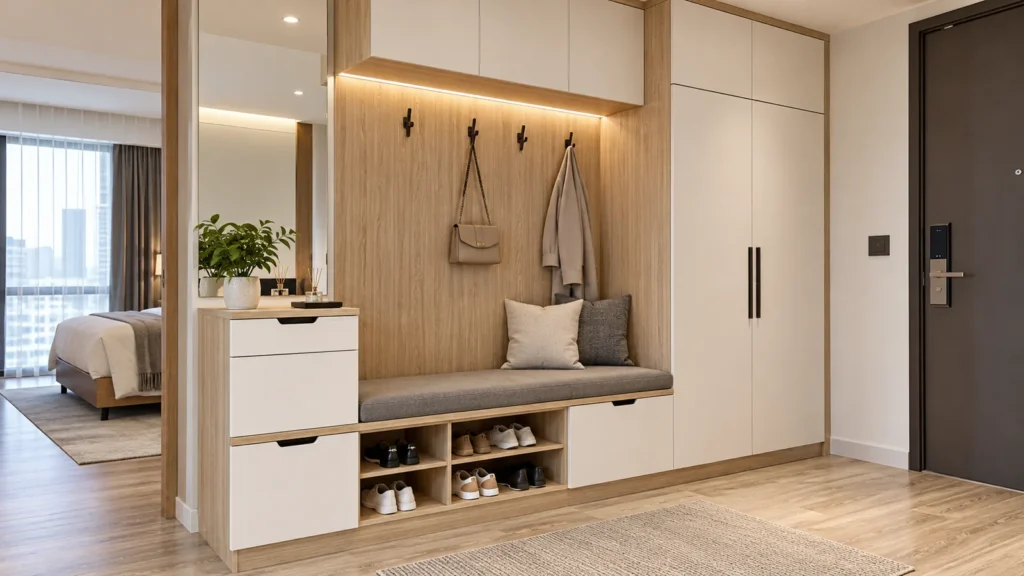
Apartment Entryways and Hallways
Compact apartment entryways often require shoe storage, a sitting area, and space for personal accessories.
A storage bench cabinet can combine these functions within a coordinated layout.
For rental properties, easy cleaning, accessible hardware, and replacement component planning may also affect the purchasing decision.
Hotels and Serviced Apartments
Hotel entryway furniture may need to coordinate with wardrobes, luggage storage, mirrors, wall panels, and other casegoods.
A storage cabinet with seating can be adapted for guestroom entrance areas where space permits.
The approved design should account for circulation clearance, door swings, cleaning access, and guest use.
Student Housing and Co-Living Properties
Shared residential projects often need compact, practical furniture with predictable maintenance requirements.
Standardized panel finishes and hardware can simplify replacement and repeated installation across multiple units.
Furniture Wholesale and Private-Label Retail
Importers may choose several cabinet widths or decorative finishes for a coordinated product collection.
A common internal construction system can sometimes support multiple retail appearances while keeping manufacturing arrangements manageable.
Buyers developing a complete hallway collection can review our entryway storage cabinet with integrated seating as an OEM product starting point.
Seating Structure, Load Testing and Safety
Structural performance is one of the most important differences between a standard storage cabinet and a cabinet designed to support seated users.
A well-finished surface does not establish that the product is safe for seating.
Understanding the Load Path
The seat panel receives the user’s weight and transfers that load through its supporting components.
Depending on the design, these may include vertical partitions, side panels, rails, fasteners, and the cabinet base.
Long unsupported spans, inappropriate connections, or poorly positioned supports can create structural concerns.
The factory should review how the seating system behaves under expected use, including loading near edges or individual seating positions.
An upholstery cushion adds comfort but should not be treated as a substitute for structural support.
Determining Appropriate Test Requirements
Professional buyers should specify the intended market and usage classification.
For public or contract furniture, the Business and Institutional Furniture Manufacturers Association’s furniture standards guidance provides an introduction to recognized furniture performance standards.
These include standards for public seating and storage products.
However, an integrated cabinet-seat product is not automatically covered by every seating or storage standard. The applicable tests should be selected according to the actual design and intended use.
A supplier should not claim that a product has passed a standard without valid supporting test results.
Stability, Hardware and Installation
Some cabinet configurations may require special attention to stability, particularly when tall storage modules are combined with a lower seat.
The design should be evaluated for foreseeable use, including open drawers, uneven loading, and the intended installation arrangement.
For furniture entering the United States, the Consumer Product Safety Commission’s clothing storage unit guidance is relevant when a product meets the defined regulated category.
Not every storage bench qualifies as a clothing storage unit.
Buyers should determine applicability using the actual design, dimensions, storage purpose, and destination-market regulations.
Materials and Finishes for Panel Storage Cabinets
Starwood specializes in engineered wood panel furniture rather than conventional solid wood cabinet manufacturing.
Material selection should account for structural requirements, appearance, cost, and the intended market.
Melamine-Faced Particleboard
Melamine-faced particleboard is often used for decorative storage furniture where consistent finishes and economical panel production are important.
Available design directions may include white, grey, beige, oak-look, walnut-look, and other decorative colors.
The wood-grain appearance is a decorative surface, not a solid wood construction claim.
Buyers should specify the required panel grade, thickness, edge treatment, and finish reference.
MDF and Alternative Engineered Panels
MDF can be considered for selected components where its machining or surface characteristics suit the product.
Plywood, OSB, and other engineered panels may also be evaluated according to structure, availability, and cost requirements.
No single board type should be assumed suitable for every load-bearing seating design.
Engineering review and appropriate performance testing are necessary for the complete assembled product.
Upholstery and Cushion Details
Where the design includes an upholstered seat, buyers should define the cushion dimensions, cover material, foam specification, attachment method, and cleaning requirements.
Removable cushions may offer different maintenance advantages from permanently attached upholstered components.
For high-use commercial environments, durability and cleanability deserve particular attention.
Edge Banding and Finish Consistency
Storage cabinets contain visible panels that are frequently touched during use.
Poor edge finishing may affect appearance and service life.
Buyers should approve a physical decorative finish sample and establish reasonable inspection criteria for edges, surfaces, and color consistency.
OEM and ODM Customization Options
A major advantage of OEM panel furniture production is the ability to adapt the cabinet to a defined market or project.
Custom Dimensions and Storage Layouts
Customization may include overall width, depth, height, seat dimensions, drawer quantity, shelf positions, and cabinet-door arrangements.
A compact hallway unit may need a narrower depth than a bedroom storage bench.
For an apartment project, the manufacturer should receive architectural drawings showing the available installation space.
Hardware and Construction
Available development directions may include soft-closing drawers, adjustable shelves, concealed hinges, different handles, and knock-down connectors.
Each hardware choice should be evaluated for compatibility with the panel material and approved furniture structure.
Decorative and Private-Label Options
Importers may request selected panel colors, coordinated finishes, upholstered cushions, product labels, barcodes, carton artwork, or customized instructions.
These details should be agreed before sample production and included in the final quotation.
Starwood provides OEM and ODM furniture manufacturing support for customized panel furniture programs.
MOQ, Factory Pricing and Bulk Order Planning
For professional buyers, MOQ and pricing decisions should be based on the actual product specification.
Understanding Published MOQ Information
Our entryway storage cabinet with seating product page lists a reference MOQ of 10 units for that specific model.
This is not a universal MOQ for every custom cabinet or commercial furniture program.
A revised structure, different panel finish, special upholstery, or non-standard hardware can change production requirements.
Final MOQ should be confirmed through the quotation process.
What Determines the Factory Price?
The primary cost factors include:
- Material type, grade, thickness, and consumption.
- CNC machining and edge-banding requirements.
- Seating structure and support components.
- Drawers, hinges, slides, and connectors.
- Upholstery materials and cushion construction.
- Product quantity and number of SKUs.
- Private-label requirements and packaging.
- Inspection and testing requirements.
A supplier comparison is meaningful only when these specifications are equivalent.
Mixed-SKU Order Planning
A wholesale buyer may require several cabinet finishes in one shipment.
Using compatible components across models can help simplify manufacturing, but different colors and upholstery materials may create separate purchasing minimums.
Submit quantities by model and finish so the factory can evaluate the proposed production arrangement.
Sampling, Lead Times and Quality Control
New OEM and ODM furniture programs should allow sufficient time for technical review and sample approval.
Sample Development
A sample should be evaluated for overall dimensions, seating construction, drawer function, finish quality, component fitting, and assembly requirements.
Where the design includes a structural seat, applicable load and durability tests should be identified and arranged as required.
Approval records should clearly identify the final components and any agreed revisions.
Bulk Production Schedule
The published product page provides an approximate 35–40 day reference lead time after deposit for its listed configuration.
Customized products may require a different schedule because of material sourcing, sampling, upholstery, hardware purchasing, or production complexity.
Buyers should confirm the final lead time in writing.
Quality Inspection
Inspection should cover panel dimensions, drilling positions, surface finish, edge banding, door and drawer alignment, seating support, hardware completeness, and packaging.
For projects with strict acceptance requirements, an agreed inspection plan helps avoid uncertainty before shipment.
A quality report should refer to the approved design and actual production batch.
KD Packaging, Container Loading and Export Shipping
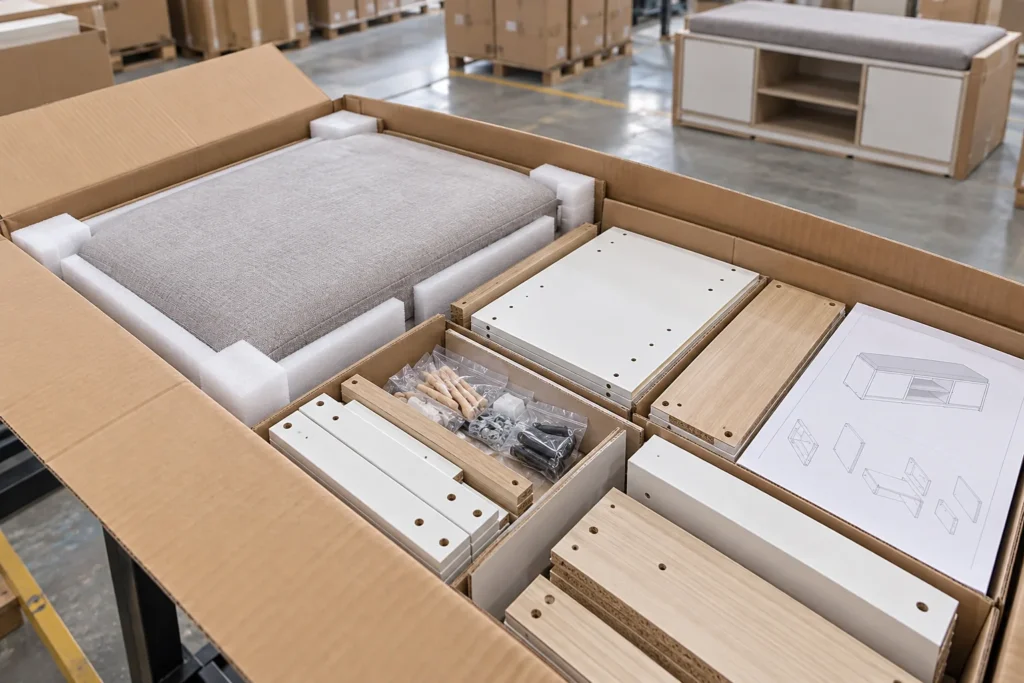
Knock-down furniture can be practical for international distribution when the structure and packaging are engineered together.
However, the seat cushion, load-bearing panels, cabinet components, and hardware may have different protection requirements.
Packing Engineered Panels and Upholstered Components
Protective materials should reduce panel-edge damage, surface abrasion, and movement during transport.
Upholstered components may need separate protection against dirt, compression, or damage.
Hardware bags and assembly instructions should be organized so that installers can identify the correct parts.
Carton and Distribution Planning
Professional buyers should request final carton dimensions, gross weight, net weight, carton quantity per unit, and estimated loading arrangements.
A product intended for containerized wholesale shipment may need a different packaging strategy from one distributed through parcel delivery.
The International Safe Transit Association’s packaging test procedures provide a useful reference for selecting transport evaluation methods.
Any required testing should be agreed according to the actual distribution environment.
Our flat-pack furniture export packaging service supports carton engineering, labeling, component protection, and export loading preparation.
Hotel and Apartment Project Procurement
Commercial furniture projects require coordination between design specifications, manufacturing, logistics, and installation.
A storage cabinet with seating may form part of a wider furniture package including wardrobes, shoe cabinets, desks, shelving, and other storage units.
Coordinated Furniture Specifications
Project buyers should provide room layouts, furniture schedules, selected finishes, installation dimensions, and quantity requirements.
Where several cabinet designs share a decorative surface, physical finish approval can help maintain a consistent appearance.
Mock-Up Room Approval
A sample room can reveal practical issues that may not be obvious from drawings.
Buyers should check seat accessibility, door clearance, drawer operation, nearby wall conditions, and cleaning access.
A mock-up should also verify whether the furniture can be installed according to the planned procedure.
Phased Deliveries
Hotel and apartment developments may require furniture deliveries according to building, floor, or room schedules.
Carton labels and product identification should match the agreed installation plan.
Our project furniture manufacturing service supports coordinated panel furniture production for apartments, hotels, serviced residences, rental housing, and commercial spaces.
Material Compliance and International Standards
Destination-market compliance should be discussed during purchasing rather than after the goods are completed.
U.S. Composite Wood Requirements
For furniture entering the United States, buyers should review the U.S. Environmental Protection Agency’s formaldehyde emission standards for composite wood products.
The rules cover regulated MDF, particleboard, hardwood plywood, and applicable finished goods containing those materials.
Supporting documentation should correspond to the actual panel materials used in production.
Responsible Material Sourcing
Buyers requesting certified forest-based materials can refer to the Forest Stewardship Council’s chain-of-custody certification guidance.
Certification claims must be supported by valid documentation and applicable chain-of-custody controls.
Engineered wood construction alone does not demonstrate FSC certification.
Product and Project Requirements
Other requirements may apply according to the destination market, upholstery materials, installation location, and intended use.
Commercial project buyers should specify any mandatory safety, durability, fire-performance, and accessibility requirements applicable to their product and building.
Testing and certification must be evaluated for the actual design rather than assumed from the general furniture category.
How to Prepare a Professional Storage Cabinet RFQ
A complete request for quotation helps the factory evaluate manufacturing feasibility and prepare a more accurate offer.
Product Requirements
Provide reference photographs or drawings, overall dimensions, seating dimensions, storage layout, panel specifications, surface finish, hardware, upholstery requirements, and target quantity.
For integrated seating, include the intended usage and any required structural testing criteria.
Commercial Requirements
Specify the destination market, estimated quantity by SKU, desired shipment schedule, packing requirements, private-label details, and preferred quotation terms.
A practical inquiry may contain the following information:
Product: Storage cabinet with integrated upholstered seating
Application: Apartment entryway furniture collection
Material: Buyer-approved engineered wood panels
Finish: White and oak-look melamine
Storage: Drawers and shoe compartments
Seating: Integrated cushioned seat with defined support requirements
Quantity: Bulk order with model and finish breakdown
Packaging: KD export cartons with instructions and labeled hardware
Destination: Buyer-specified import market
Quotation Requested: MOQ, unit pricing, sample arrangements, inspection requirements, carton details, and lead time
The more clearly these details are defined, the easier it becomes to compare quotations from different suppliers.
Our OEM/ODM Manufacturing Workflow
Starwood follows a practical product development and production approach for overseas furniture buyers.
Step 1: Inquiry and Specification Review
The buyer submits drawings, reference images, dimensions, materials, expected quantities, and destination-market requirements.
Step 2: Technical Evaluation and Quotation
The factory reviews structural feasibility, seating requirements, hardware compatibility, materials, and packaging needs.
Commercial arrangements are discussed according to the confirmed scope.
Step 3: Sample Development and Approval
A sample is prepared and reviewed against the agreed requirements.
Required revisions and any applicable testing arrangements should be resolved before mass production.
Step 4: Bulk Production and Inspection
Manufacturing follows the approved drawings, samples, and commercial specifications.
Inspection requirements are applied according to the agreed quality plan.
Step 5: Packing and Shipment Preparation
Finished components are packed, labeled, and prepared for the agreed export shipment arrangement.
The buyer and supplier coordinate final inspection, shipping documentation, and delivery requirements.
Export Terms and Commercial Documentation
The quotation should clearly identify the agreed international trade terms.
For example, EXW and FOB arrangements allocate different responsibilities and costs.
The International Chamber of Commerce’s Incoterms 2020 guidance explains the official rules for international purchasing and shipping responsibilities.
Buyers should confirm the selected trade term, named place or port, payment arrangements, commercial invoice, packing list, and other required shipment documents.
Any special inspection or certification requirements should be agreed before order confirmation.
Frequently Asked Questions
Can storage cabinets with built-in seating be customized for small apartments?
Yes. Overall dimensions, seating proportions, storage compartments, panel finishes, hardware, and upholstery can be reviewed for OEM or ODM customization. Buyers should provide room measurements or drawings so that the cabinet design can be evaluated for the available space.
What is the MOQ for OEM storage cabinets with seating?
Our published entryway seating-cabinet product lists 10 units as a reference MOQ. This applies to the listed product information, not every customized design. Material selection, changes to seating structure, finish, hardware, and packaging may affect the final order minimum.
What materials are used to manufacture panel storage cabinets?
Common options include MDF, particleboard, plywood, OSB, and other engineered wood panels according to the project specification. Melamine-faced decorative surfaces can provide oak-look, walnut-look, white, grey, and other finishes without using solid wood construction.
How is the seating strength evaluated?
The seating structure should be reviewed according to its intended use, load path, panel supports, hardware connections, and relevant performance requirements. Buyers should request appropriate engineering review and testing evidence rather than relying on an unsupported weight-capacity claim.
Can storage cabinets be supplied in KD or RTA packaging?
Yes. Suitable designs can be developed with knock-down components, pre-drilled panels, organized hardware bags, assembly instructions, and export cartons. The final packaging should be confirmed according to the product structure and intended distribution channel.
What is the lead time for a bulk storage cabinet order?
The listed entryway storage cabinet provides an approximate 35–40 day reference lead time after deposit. Custom designs may need a different schedule depending on material availability, sampling, structural requirements, quantity, and factory production planning.
Do you manufacture storage cabinets for hotels and serviced apartments?
Yes. Starwood supports OEM and ODM panel furniture manufacturing for hospitality and residential projects. Buyers can provide project drawings, room schedules, quantities, decorative finishes, installation details, and target delivery requirements for evaluation.
What information is required for a factory-direct quotation?
Please provide product drawings or reference photographs, overall and seating dimensions, storage configuration, materials, finishes, hardware, upholstery requirements, estimated quantity, destination market, and packaging needs. Include any applicable seating safety or project standards.
Request a Factory-Direct Storage Cabinet Quotation
Are you looking for a reliable storage cabinets manufacturer for a wholesale furniture collection, private-label brand, hotel project, or apartment development?
Starwood Industry Co., Ltd. supports international buyers with OEM and ODM panel furniture development, customized cabinet manufacturing, sample preparation, bulk production, quality inspection, and export-ready KD packaging.
Send us your product drawings or reference photographs, required cabinet and seat dimensions, panel material preferences, storage configuration, intended usage, target quantity, and destination market.
Our team can review the manufacturing requirements and discuss product feasibility, MOQ, quotation details, sampling, quality expectations, and export arrangements.
Starwood Industry Co., Ltd.
Factory: Jiangmen, Guangdong, China
Email: info@plywoodmfr.com
WhatsApp / Phone: +86 136 9199 4727
Request an OEM Storage Cabinet Quotation
View Our Storage Cabinet with Integrated Seating
Explore OEM and ODM Furniture Manufacturing Services
Explore Hotel and Apartment Project Furniture Solutions
Develop your next small-space storage furniture collection with a China-based panel furniture export manufacturer focused on practical engineering, customizable specifications, and dependable B2B production coordination.