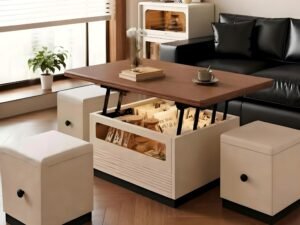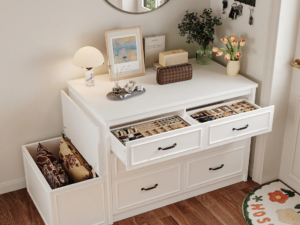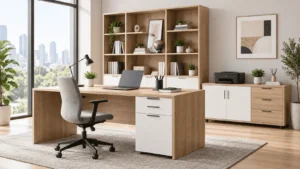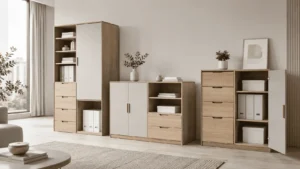
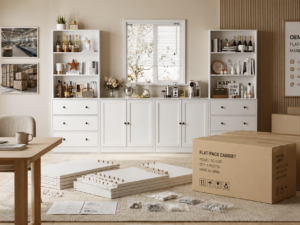
Flat Pack Storage Cabinet Explained
For furniture importers, wholesalers, hotel contractors, apartment developers, and retail furniture brands, flat pack storage cabinets are a cost-efficient solution for OEM/ODM projects, container shipping optimization, and large-scale commercial furniture supply.
As a panel furniture export manufacturer, we provide custom flat pack storage cabinet production with material selection, packaging support, MOQ management, and wholesale project supply for global B2B buyers.
A flat pack storage cabinet is one of the most practical product choices for importers, wholesalers, furniture brands, hotel buyers, apartment developers, and project contractors. Compared with fully assembled cabinets, flat pack cabinets are shipped as panels, hardware, fittings, instructions, and protective packaging. The final product is assembled at the destination by end users, retailers, installers, or project teams.
For B2B buyers, this is not only a packaging style. It affects freight cost, container loading, warehouse space, retail pricing, damage control, after-sales service, and repeat order stability. This is why many importers prefer flat pack storage cabinet programs when sourcing RTA furniture, KD furniture, home office storage, filing cabinets, utility cabinets, hotel storage units, apartment cabinets, and multi-functional panel furniture.
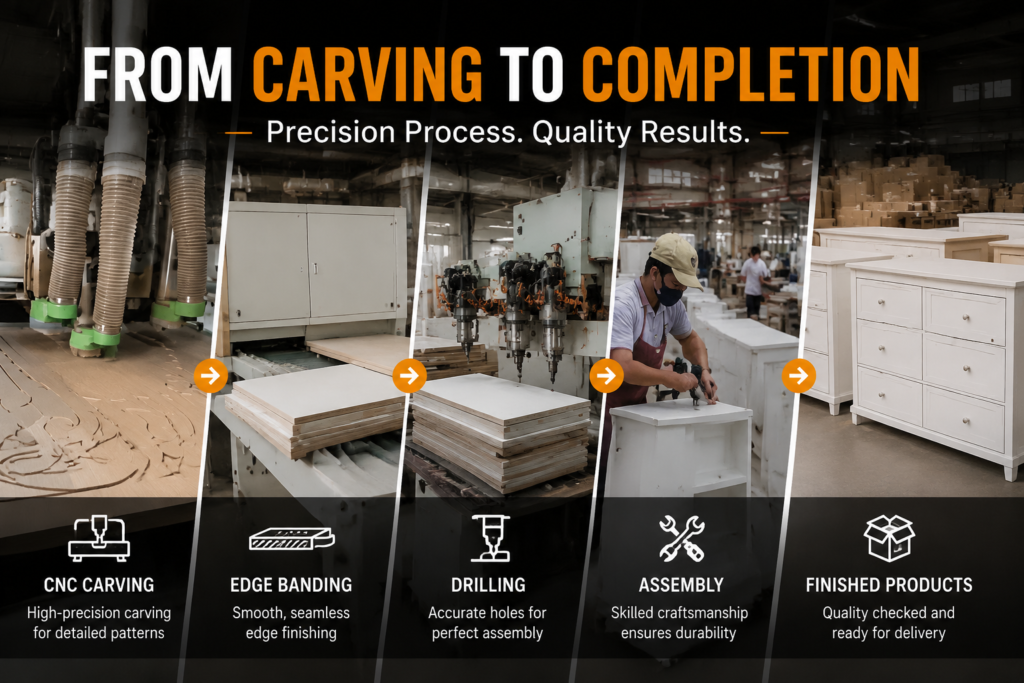
As a panel furniture exporter, a reliable factory should do more than cut boards and pack cartons. It should help buyers choose suitable materials, optimize cabinet structure, calculate MOQ, control lead time, prepare export packaging, support OEM/ODM customization, and reduce logistics risk.
This guide explains why flat pack storage cabinets are preferred by international buyers and how to source them professionally for wholesale, project, retail, and private-label programs.
Table of Contents
- What Is a Flat Pack Storage Cabinet?
- Why Importers Prefer Flat Pack Storage Cabinets
- Flat Pack Cabinet vs Assembled Cabinet
- Main Application Scenarios
- Materials Used for Flat Pack Storage Cabinets
- MOQ, Lead Time, and Cost Factors
- Packaging and Export Logistics
- OEM/ODM Customization Process
- Quality Control Checklist
- How to Choose a Cabinet Manufacturer
- Final Recommendation for Importers
- FAQ
What Is a Flat Pack Storage Cabinet?
A flat pack storage cabinet is a ready-to-assemble cabinet shipped in a disassembled format. It is also commonly called RTA furniture, KD furniture, knock-down furniture, or a flat pack cabinet.
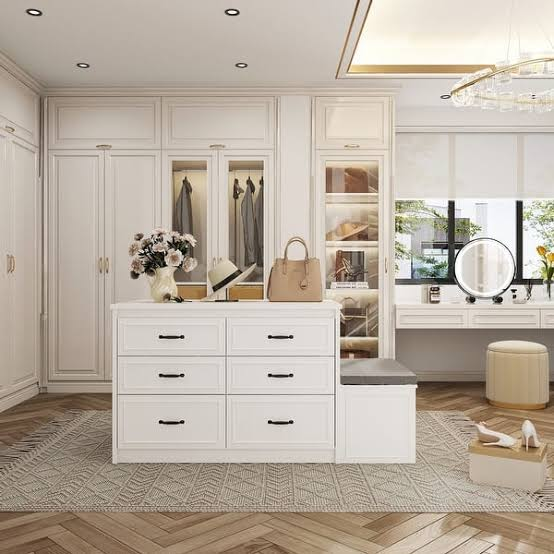
Instead of shipping a finished cabinet as one bulky unit, the factory produces individual panels, applies edge banding, drills hardware holes, prepares fittings, packs the parts into cartons, and provides assembly instructions. At the destination, the product is assembled with cam locks, dowels, screws, hinges, drawer slides, handles, shelf pins, brackets, or other hardware.
This structure is widely used for home office cabinets, filing cabinets, book cabinets, storage cupboards, shoe cabinets, side cabinets, utility cabinets, printer cabinets, drawer cabinets, and modular storage furniture.
For global buyers, the main advantage is efficiency. More products can fit into a container. Warehouse space can be used more effectively. Cartons can be labeled and distributed more easily. The final selling price can also become more competitive because logistics cost is better controlled.
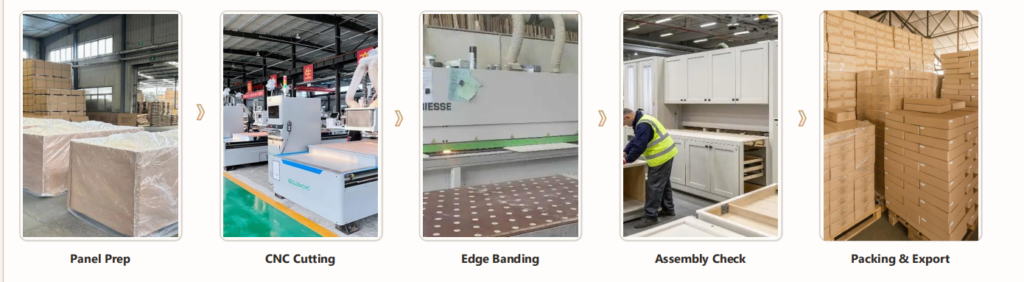
For a China-based panel furniture factory, flat pack cabinet production also supports standardized manufacturing. CNC cutting, edge banding, drilling, pre-assembly checks, hardware packing, carton design, and container loading can all be organized around repeatable processes. This makes flat pack storage cabinet programs suitable for both standard wholesale orders and customized OEM/ODM projects.
Why Importers Prefer Flat Pack Storage Cabinets
Importers prefer flat pack storage cabinet programs because they solve several business problems at the same time: shipping cost, storage efficiency, product variety, private labeling, and after-sales control.
Lower Shipping Volume
Shipping volume is one of the biggest cost factors in furniture importing. A fully assembled cabinet occupies a lot of space because the empty space inside the cabinet is also being shipped. A flat pack cabinet reduces wasted volume by stacking panels efficiently inside cartons.
This allows importers to load more units per container. For price-sensitive markets, this can make the difference between a profitable product and a product that is too expensive to sell.
Better Container Loading
Flat cartons are easier to stack and arrange than bulky assembled cabinets. They can be planned by size, weight, SKU, and loading sequence. This helps buyers improve container utilization and reduce unnecessary empty space.
For importers handling multiple models, this is especially useful. A storage cabinet program may include two-door cabinets, three-door cabinets, drawer cabinets, filing cabinets, book cabinets, and utility storage units. Flat pack packaging makes mixed-SKU loading more practical.
Easier Warehousing
Warehouses prefer cartons that are compact, stackable, and easy to label. Flat pack storage cabinets are easier to palletize, scan, store, pick, and ship. This benefits wholesalers, distributors, retailers, and online sellers.
Compared with assembled cabinets, flat pack cartons also make it easier to manage spare parts, replacement panels, instruction manuals, and hardware kits. For importers with after-sales responsibilities, this is a major operational advantage.
More Competitive Wholesale Pricing
A buyer should not evaluate a cabinet only by factory unit price. The real cost includes product cost, packing cost, container quantity, ocean freight, duty, warehouse handling, local delivery, damage rate, and replacement parts.
Flat pack storage cabinet programs help reduce total landed cost. This gives importers more room to build competitive wholesale pricing, retailer margins, and promotion plans.
Flexible Product Development
Flat pack cabinets are flexible for product development. A buyer can adjust size, finish, layout, handle type, drawer quantity, door structure, shelf design, hardware, packaging, and branding.
For example, one product family can include a low filing cabinet, a tall storage cabinet, a printer cabinet, a side cabinet, and a multi-functional office storage unit. Shared materials and finishes can help create a coordinated product line while keeping production efficient.
Better for Private Label Programs
Many importers and brands need private-label carton marks, instruction manuals, barcode labels, SKU labels, packaging inserts, and branded assembly sheets. A flat pack cabinet is ideal for this because every carton can be designed around the buyer’s retail or distribution system.
For B2B buyers, the customer experience does not begin after assembly. It begins when the carton arrives. Clear labels, complete hardware, clean instructions, and protective packing all influence customer satisfaction.
Flat Pack Cabinet vs Assembled Cabinet
Both flat pack and assembled cabinets have their place. The better choice depends on market positioning, sales channel, project requirements, and logistics model.
| Comparison Point | Flat Pack Storage Cabinet | Assembled Storage Cabinet |
|---|---|---|
| Shipping volume | Lower | Higher |
| Freight cost per unit | Usually lower | Usually higher |
| Warehouse efficiency | Easier to stack and store | Requires more space |
| Assembly | Required after delivery | Already assembled |
| Product damage risk | Depends on carton protection | Corners and frame may be exposed |
| Retail suitability | Strong for wholesale and e-commerce | Strong for premium delivery |
| Project suitability | Good for apartments, offices, rentals | Good for high-end installed interiors |
| Customization | Flexible for panel furniture | Flexible but higher logistics cost |
| Price competitiveness | Strong | Usually higher landed cost |
For most international wholesale and project supply, flat pack storage cabinets offer a practical balance between cost, logistics, customization, and scalability. Assembled cabinets may still be suitable for high-end installed interiors, but for container-based export business, the flat pack model is usually more efficient.
Main Application Scenarios
Flat pack storage cabinet products can serve many B2B markets. The same manufacturing logic can be adapted for home office, apartment, hotel, retail, e-commerce, and commercial project needs.
Home Office Storage
Home office furniture remains a strong category for importers and online sellers. Buyers often need filing cabinets, printer cabinets, drawer cabinets, book cabinets, and compact storage cupboards.
A flat pack storage cabinet for home office use should have practical dimensions, stable structure, smooth drawers, clear assembly instructions, and strong packaging. For related product traffic, buyers can review the factory’s flat pack cabinet category and connect the blog article with a relevant product page.
Apartment and Rental Housing
Apartments require compact, durable, and cost-controlled storage. Flat pack cabinets are useful for bedrooms, living rooms, entryways, laundry areas, small offices, and multi-functional rooms.
For rental housing and serviced apartments, buyers care about repeat orders, easy replacement, cost control, and installation efficiency. KD furniture is suitable because cartons can be delivered by room, floor, building, or project phase.
Hotel and Serviced Apartment Projects
Hotels and serviced apartments need storage cabinets for guest rooms, long-stay units, staff areas, office corners, housekeeping spaces, and back-of-house storage. Flat pack cabinet programs can support a consistent design while controlling logistics and installation cost.
For hotel buyers, the cabinet should balance appearance, durability, cleaning convenience, and easy maintenance. A factory should recommend suitable board thickness, surface finish, hardware, and packaging according to project use.
Wholesale and Distributor Channels
Wholesalers prefer products that are easy to store, easy to ship, and easy to reorder. Flat pack storage cabinets support all three needs.
A distributor may order several models in one container, such as office filing cabinets, side cabinets, drawer cabinets, storage cupboards, and book cabinets. The factory can help optimize carton dimensions and loading plans for better efficiency.
E-Commerce and Online Retail
Online furniture sellers need packaging that can survive parcel delivery and reduce negative reviews. A flat pack cabinet for e-commerce should be easy to assemble, clearly labeled, and packed with strong protection.
Assembly instructions are especially important. If customers cannot assemble the cabinet smoothly, the seller may face returns, replacement requests, and poor reviews. A professional factory should support clear manuals, labeled hardware bags, and simple assembly logic.
Commercial and Institutional Projects
Schools, offices, dormitories, clinics, training centers, staff housing, and commercial spaces often need practical storage cabinets. Flat pack cabinet production can support these projects with standard sizes, stable finishes, and controlled cost.
For these buyers, durability, safety, and repeatable quality are usually more important than complicated decorative design.
Materials Used for Flat Pack Storage Cabinets
Most flat pack storage cabinets are made from engineered wood panels because they are suitable for standardized production, flat packing, and cost-controlled export programs.
Particle Board
Particle board is widely used in RTA furniture and KD furniture because it offers good cost control and works well with laminated surfaces. It is commonly used for side panels, shelves, tops, bottoms, cabinet doors, and internal partitions.
Buyers should confirm board thickness, density, surface quality, screw-holding performance, edge banding, and emission compliance before confirming production.
MDF
MDF is suitable for smooth surfaces, painted panels, routed details, and decorative cabinet fronts. It provides consistent machining and a clean appearance.
For flat pack cabinet production, MDF may be used for drawer fronts, cabinet doors, decorative panels, or selected structural parts. It is often chosen when the buyer wants a more refined finish.
Plywood
Plywood can provide better screw-holding strength and layered structural performance in certain applications. It may be selected for premium projects, load-bearing parts, or buyer-specified cabinet programs.
However, plywood is not always necessary for every component. A professional factory should recommend where plywood adds real value and where MDF or particle board can control cost more effectively.
Surface Finishes
Common finishes include melamine, paper foil, PVC film, veneer, painted finish, UV coating, matte color, wood grain, and stone-look surfaces. For storage cabinets, the finish should be selected based on market preference, scratch resistance, cleaning convenience, color consistency, and target price.
Popular colors include white, oak, walnut, black, grey, light wood, dark wood, and two-tone combinations. For hotel and apartment projects, finish consistency across multiple furniture items is very important.
Hardware and Fittings
Flat pack storage cabinets usually require cam locks, dowels, screws, hinges, slides, handles, shelf pins, adjustable feet, wall anchors, anti-tip kits, and metal brackets.
Hardware should be chosen according to cabinet size, load requirement, expected use, assembly method, and target price. Tall cabinets, heavy filing cabinets, and wall-related storage units should include stability and anti-tip considerations.
Compliance and Material Documentation
For buyers sourcing composite wood products for regulated markets, formaldehyde emission compliance should be discussed early. The U.S. Environmental Protection Agency explains formaldehyde emission standards for composite wood products, while the California Air Resources Board provides details about its Composite Wood Products Program. These references are useful for importers preparing U.S. or California-related sourcing requirements.
For buyers with sustainability policies, forest-based material traceability may also be required. The Forest Stewardship Council explains FSC chain of custody certification, and PEFC provides guidance on PEFC chain of custody certification. These resources can help buyers prepare supplier questionnaires, project documentation, and responsible sourcing files.
MOQ, Lead Time, and Cost Factors
MOQ and lead time are critical for B2B buyers because they affect launch planning, inventory, cash flow, and supplier evaluation.
MOQ for Flat Pack Storage Cabinets
MOQ depends on product size, board material, surface finish, hardware, packaging, number of SKUs, and whether the order is OEM or ODM.
For a standard ODM flat pack storage cabinet, MOQ may be easier to discuss because the factory may already have similar structures, materials, or production experience. For a fully customized OEM cabinet, MOQ may be higher if the buyer requires special board colors, custom handles, exclusive packaging, or new structures.
For export orders, many factories prefer container-based production. Container planning helps control material purchasing, production scheduling, packing efficiency, and shipping cost.
Sample Lead Time
Sample lead time depends on design complexity and material availability. A simple cabinet using standard board colors and common hardware can usually move faster than a fully custom cabinet with special finishes, new hardware, or private-label packaging.
Buyers should allow enough time for drawing confirmation, quotation, sample production, internal review, feedback, and revision.
Bulk Production Lead Time
Bulk production lead time normally begins after sample approval, deposit, material confirmation, and packaging confirmation. The timeline may be affected by order quantity, board availability, hardware lead time, carton printing, production schedule, QC inspection, and shipping booking.
For hotel, apartment, office, and rental housing projects, buyers should plan earlier because installation schedules are often fixed.
Cost Factors
The final cost of a flat pack storage cabinet depends on:
- Board type
- Panel thickness
- Surface finish
- Cabinet size
- Number of doors and drawers
- Hardware specification
- Edge banding quality
- Carton strength
- Internal protection
- Instruction manual requirements
- Private-label packaging
- MOQ
- Container loading efficiency
- QC and inspection requirements
A professional factory should not only quote a unit price. It should help buyers understand where cost comes from and how to improve the product without damaging market value.
For example, buyers may reduce cost by standardizing hardware, using shared panel thickness across multiple SKUs, simplifying decorative parts, optimizing carton size, or designing a cabinet family around common components.
Packaging and Export Logistics
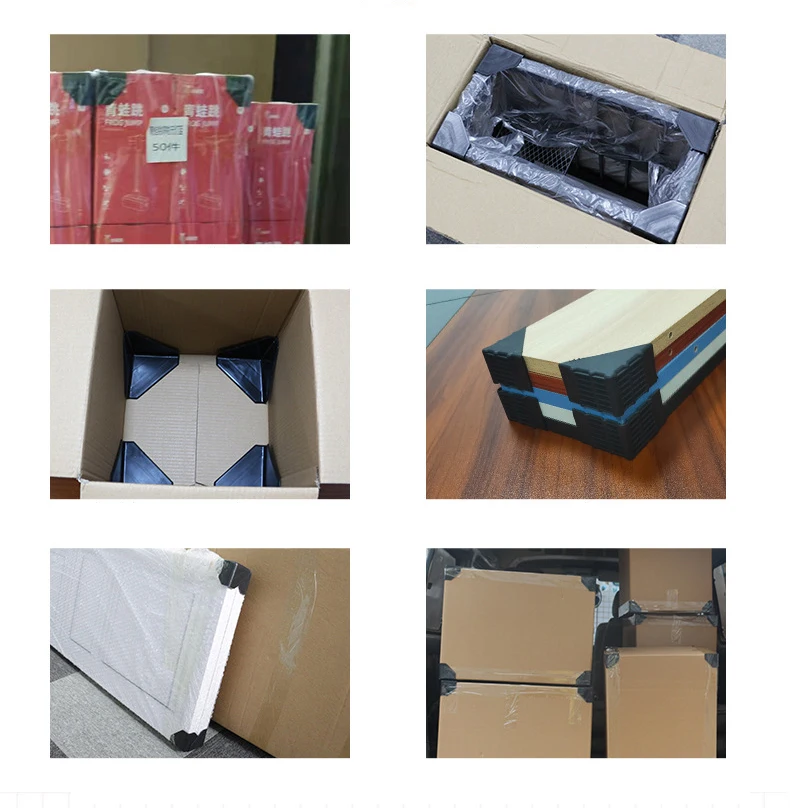
Packaging is one of the biggest reasons importers choose flat pack storage cabinets. Good packaging protects the product, reduces damage claims, improves warehouse handling, and supports a better customer experience.
Export Packaging Basics
A professional flat pack cabinet package should include:
- Strong outer carton
- Clear panel separation
- Corner and edge protection
- Foam, honeycomb board, or protective inserts
- Labeled hardware bag
- Assembly instruction
- Carton marks
- SKU label
- Barcode label when required
- Spare hardware allowance when agreed
- Moisture protection when needed
- Loading sequence consideration
For heavy cabinets, carton structure must be carefully designed. The carton should protect corners, edges, and surfaces. Hardware should not move freely inside the carton because loose fittings can scratch panels during transport.
Carton Size Planning
Carton size affects container loading, warehouse storage, courier handling, and customer delivery. A carton that is too large may be difficult to move. A carton that is too weak may fail during stacking or transport.
For e-commerce sellers, parcel delivery risk should be discussed early. For wholesalers, palletization and warehouse handling may be more important. For project buyers, room-by-room labeling or batch delivery may be required.
Assembly Instructions
Assembly instructions are part of the product experience. A good manual helps reduce installation mistakes, returns, complaints, and replacement costs.
A practical instruction manual should include a parts list, hardware list, step-by-step diagrams, safety reminders, anti-tip guidance, and buyer-specific contact information if required.
Packaging Testing
For buyers who need formal packaging validation, the International Safe Transit Association provides ISTA test procedures for packaged-product performance testing. This is especially useful for importers, e-commerce sellers, and project buyers who want to reduce damage risk before mass shipment.
OEM/ODM Customization Process
A clear customization process helps the buyer and factory reduce mistakes. Whether the buyer needs OEM production or ODM development, the workflow should be organized before sampling begins.
Step 1: Send the Project Brief
The buyer should prepare:
- Target market
- Product type
- Cabinet dimensions
- Reference images
- Material preference
- Finish color
- Hardware requirement
- Load requirement
- Target price
- MOQ expectation
- Packaging requirement
- Branding requirement
- Compliance requirement
- Delivery schedule
For hotel, apartment, office, or rental housing projects, buyers should also provide room layouts, product quantity, installation schedule, and site requirements.
Step 2: Factory Review
The factory reviews cabinet structure, materials, hardware, packing method, production feasibility, and cost. For ODM projects, the factory may suggest existing structures or improved product directions. For OEM projects, the factory checks whether drawings and specifications are complete.
This is where a professional OEM/ODM partner adds value. Buyers can connect this step with the factory’s OEM and ODM furniture manufacturing services page to understand customization, sample development, bulk production, export packing, and shipment support.
Step 3: Quotation
The quotation should clearly include product size, material, finish, hardware, packaging, MOQ, sample cost, sample lead time, bulk lead time, payment terms, and quotation validity.
Buyers should avoid comparing only unit price. A lower quote may use thinner panels, weaker cartons, cheaper hardware, or less protective packaging.
Step 4: Drawing and Sample Confirmation
For flat pack storage cabinet projects, drawings should confirm panel size, drilling position, hardware position, edge banding, carton layout, and assembly logic.
Sample approval should check appearance, stability, dimensions, finish, hardware function, assembly process, packaging, and carton labeling.
Step 5: Bulk Production
After sample approval, the factory prepares materials, production schedule, cutting, edge banding, drilling, sorting, surface checks, trial assembly, packing, and inspection.
Step 6: QC and Shipment
Before shipment, buyers should confirm QC photos, packing photos, carton marks, instruction manuals, hardware bags, final quantity, loading plan, and shipping documents.
For buyers evaluating long-term factory cooperation, the company page can be used as an internal link to introduce factory background, export orientation, and B2B manufacturing positioning.
Quality Control Checklist
Quality control should start before production, not only when the goods are ready to ship.
Panel Quality
Check board thickness, density, surface finish, scratches, stains, warping, moisture condition, and color consistency. For panel furniture, small material differences can affect assembly and long-term stability.
Edge Banding
Edge banding should be smooth, straight, well bonded, and color matched. Poor edge banding may cause peeling, rough edges, visible glue lines, and customer complaints.
Drilling Accuracy
Flat pack cabinets depend on accurate hole positions. If drilling is wrong, the customer cannot assemble the cabinet correctly. CNC drilling, templates, and process inspection are important for repeat production.
Hardware Completeness
Each carton should include the correct hardware. Missing screws, wrong hinges, or incorrect connectors can create costly after-sales problems. Hardware bags should be clearly labeled.
Assembly Test
The factory should conduct trial assembly, especially for new OEM or ODM products. This helps confirm hole alignment, panel fit, drawer movement, door gaps, and cabinet stability.
Load and Stability
Shelves, drawers, and top panels should be suitable for expected use. Tall cabinets and filing cabinets should be reviewed for stability and anti-tip requirements.
For office or commercial storage programs, buyers may also refer to industry guidance such as BIFMA’s overview of furniture standards, which includes categories such as files, storage, and casegoods. The BIFMA standards overview is available through BIFMA.
Packaging Inspection
Check carton strength, internal protection, label accuracy, carton marks, instruction manual, hardware bag, and panel protection. Packaging quality is especially important for export and e-commerce orders.
Quality Management
A factory with structured quality management can support more stable repeat orders. ISO explains that ISO 9001 is a globally recognized quality management standard used by organizations to improve performance and meet customer expectations. While a certificate alone does not replace product inspection, a quality management mindset is valuable for long-term cabinet manufacturing.
How to Choose a Flat Pack Storage Cabinet Manufacturer
The right manufacturer should understand panel furniture engineering, flat pack structure, export packaging, OEM/ODM communication, and international buyer requirements.
Choose a Real Panel Furniture Factory
A real factory should understand CNC cutting, edge banding, drilling, surface finishing, hardware packing, trial assembly, carton design, and container loading. This is different from simply trading finished products.
Check OEM/ODM Capability
If you are building your own cabinet line, the supplier should support both OEM and ODM. OEM is suitable when you already have drawings, dimensions, and technical details. ODM is useful when you need the factory to help develop structure, materials, finishes, and packaging.
Review Export Packaging Experience
For flat pack cabinet programs, packaging is as important as product design. The factory should understand carton strength, long-distance shipping, hardware organization, container loading, and damage prevention.
Confirm Material and Compliance Support
Different markets may require different material documents and compliance support. Before ordering, confirm whether the factory can support board information, emission documentation, buyer-specific requirements, and sourcing policies.
Evaluate Communication
Good communication reduces sourcing risk. The factory should answer technical questions clearly, confirm details in writing, and provide practical suggestions instead of only giving general promises.
Start with a Clear Inquiry
A vague inquiry usually leads to a vague quotation. A clear inquiry helps the factory recommend the right flat pack storage cabinet solution.
You can send project requirements through the contact page and ask for packaging solution, material recommendation, MOQ, lead time, and OEM/ODM quotation.
Final Recommendation for Importers
A flat pack storage cabinet is a strong product choice for importers because it combines market demand, logistics efficiency, flexible customization, and competitive landed cost. It is suitable for wholesale distribution, home office programs, apartment projects, hotel storage, e-commerce channels, and commercial furniture supply.
For buyers comparing RTA furniture, KD furniture, and fully assembled cabinets, the decision should not focus only on appearance. The real sourcing decision should include freight cost, container loading, warehouse handling, assembly experience, packaging strength, material compliance, and repeat-order stability.
Choose a flat pack cabinet program if you want:
- Better container utilization
- Lower shipping volume
- Easier warehousing
- More flexible SKU planning
- Private-label packaging
- OEM/ODM customization
- Better wholesale pricing control
- Practical storage solutions for projects and retail channels
If you are sourcing from a panel furniture factory, prepare your brief with dimensions, target market, reference images, material preference, target price, MOQ, packaging needs, and delivery schedule.
CTA: Ask for packaging solution for your flat pack storage cabinet program. Send your product idea, drawings, quantity, target market, and shipping requirements, and our team will recommend the right flat pack cabinet structure, material, packaging method, MOQ, lead time, and OEM/ODM production plan.
FAQ
1. What is a flat pack storage cabinet?
A flat pack storage cabinet is a ready-to-assemble cabinet shipped as panels, hardware, fittings, and instructions. It is assembled after delivery, which helps reduce shipping volume and improve logistics efficiency.
2. Why do importers prefer flat pack storage cabinets?
Importers prefer flat pack storage cabinets because they reduce shipping volume, improve container loading, simplify warehousing, support private-label packaging, and help create competitive wholesale pricing.
3. What is the difference between RTA furniture and KD furniture?
RTA furniture means ready-to-assemble furniture. KD furniture means knock-down furniture. In many sourcing conversations, both terms describe furniture shipped in parts and assembled after delivery.
4. What materials are used for flat pack cabinets?
Common materials include particle board, MDF, plywood, melamine-faced panels, veneer-faced panels, painted panels, and other engineered wood panels. The best choice depends on target market, budget, finish, and compliance requirements.
5. Can flat pack storage cabinets be customized?
Yes. Buyers can customize dimensions, materials, colors, hardware, door style, drawer layout, shelves, packaging, instruction manuals, labels, carton marks, and private-label branding.
6. What is the MOQ for flat pack storage cabinet orders?
MOQ depends on product size, material, finish, hardware, packaging, SKU quantity, and whether the order is OEM or ODM. Container-based production is common for export orders.
7. How long does sample production take?
Sample lead time depends on design complexity, material availability, finish, hardware, and packaging requirements. Standard ODM adjustments are usually faster than fully custom OEM development.
8. Is flat pack packaging suitable for e-commerce?
Yes. Flat pack packaging is suitable for e-commerce when the carton is strong, internal protection is sufficient, hardware is organized, and assembly instructions are clear.
9. What should buyers check before confirming bulk production?
Buyers should check sample quality, dimensions, surface finish, edge banding, drilling accuracy, hardware, assembly process, packaging, carton marks, and compliance documents if required.
10. How do I start a flat pack cabinet OEM/ODM project?
Send your target market, product type, dimensions, reference images, materials, finish, target price, MOQ, packaging needs, branding requirements, and delivery schedule to the factory for review and quotation.