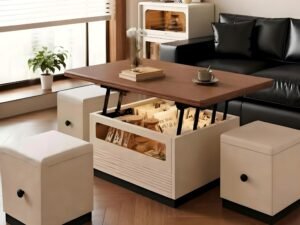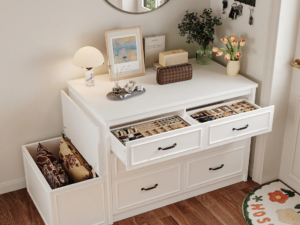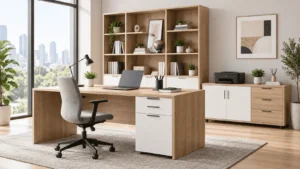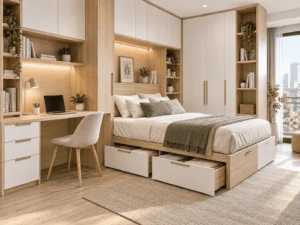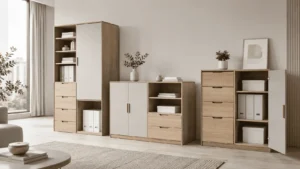
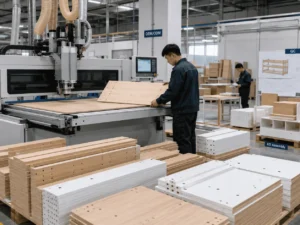
For importers, wholesalers, hotel developers, apartment operators, and furniture brands, choosing a flat pack furniture manufacturer in China is not only about unit price. The real cost is hidden in wrong dimensions, weak board quality, missing hardware, confusing assembly instructions, damaged cartons, delayed containers, and poor follow-up after deposit. A reliable factory should help you turn drawings, reference samples, and project schedules into repeatable OEM/ODM production with stable quality, clear packaging logic, and export-ready delivery. This guide explains how B2B buyers can evaluate a panel furniture export factory before placing a bulk order.
Table of Contents
- Why flat pack furniture sourcing needs a factory-first mindset
- Check whether the supplier is a real panel furniture factory
- Match the factory with your application scenario
- Review materials, finishes, and hardware before quotation
- Confirm OEM/ODM capability and customization workflow
- Discuss MOQ, lead time, and production planning early
- Inspect export packaging, carton marks, and loading logic
- Use quality standards and documents to reduce sourcing risk
- Why work with Starwood for flat pack panel furniture
- FAQ
Why Flat Pack Furniture Sourcing Needs a Factory-First Mindset
Many overseas buyers search for a flat pack furniture manufacturer in China because they need lower shipping volume, easier storage, flexible SKU planning, and better cost control. Flat pack furniture is widely used for apartments, hotels, rental housing, student accommodation, home office programs, kitchen storage, bedroom furniture, and space-saving home furniture.
However, flat pack production is different from ordinary assembled furniture. The factory must understand panel cutting, drilling accuracy, edge banding, hardware matching, carton packing, assembly instructions, and container loading. If one detail is wrong, the final buyer may face installation complaints, high return rates, or project delays.
That is why B2B buyers should not only ask, “What is your price?” A better question is:
Can this factory support repeatable production, export packing, OEM/ODM development, and stable bulk delivery?
A strong commercial furniture manufacturer should be able to support the full process, from product concept to sample confirmation, mass production, QC, packing, and shipment.
For buyers who need OEM or ODM programs, you can also review our OEM & ODM Furniture Manufacturing Services to understand how a source factory supports product development, sampling, bulk production, private-label packaging, and export delivery.
1. Check Whether the Supplier Is a Real Panel Furniture Factory
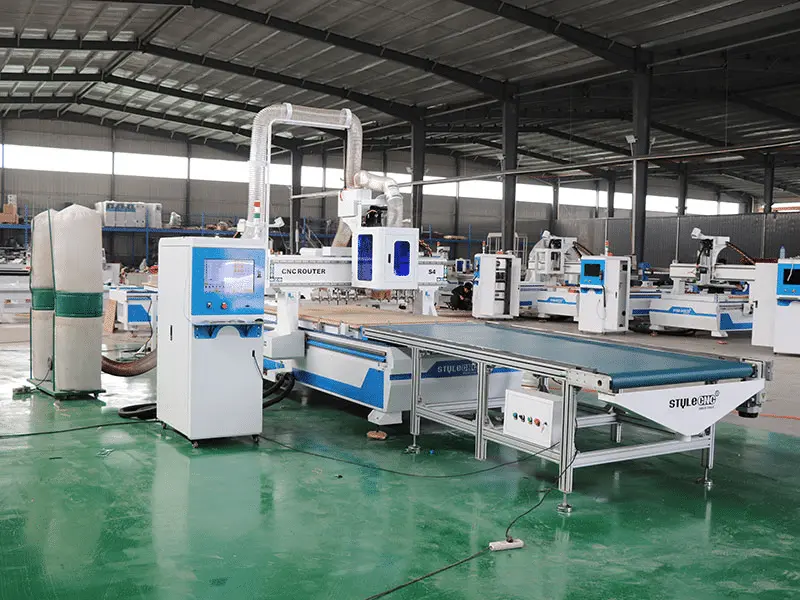
The first step is to confirm whether the supplier is a real factory or mainly a trading company. A trading company can help with communication, but for long-term OEM/ODM furniture sourcing, direct factory cooperation usually gives buyers better control over structure, materials, cost, sampling, and production details.
A real panel furniture export factory should be able to show practical manufacturing capability, such as:
- CNC cutting and drilling
- Edge banding
- Panel handling
- Hardware matching
- Trial assembly
- Quality inspection
- Flat pack packing
- Carton labeling
- Container loading support
Factory capability matters because flat pack furniture depends heavily on dimensional accuracy. A wardrobe, storage bed, kitchen cabinet, TV unit, desk, or shoe cabinet may look simple in photos, but small errors in hole position or panel thickness can create assembly problems.
Before placing an order, ask the factory for:
- Factory photos or production videos
- Machine list
- Main product categories
- Export markets
- Similar project experience
- Sample policy
- QC process
- Packing method
- Lead time range
- Container loading examples
You can view our factory background and production positioning on the Starwood factory page. For B2B buyers, this type of factory information helps confirm whether the supplier is suitable for repeat orders, not just one-time quotation comparison.
2. Match the Manufacturer with Your Application Scenario
Not every furniture factory is suitable for every buyer. A factory that makes small retail cabinets may not be the best choice for hotel furniture. A factory that makes luxury solid wood furniture may not be suitable for cost-controlled apartment furniture. A factory that only produces standard SKUs may not support OEM/ODM drawings or project customization.
Before choosing a flat pack furniture manufacturer, define your application scenario clearly.
For Importers and Wholesalers
Importers and wholesalers usually need stable SKU programs, competitive factory pricing, repeatable quality, export-ready packing, and container loading efficiency. The factory should understand product consistency, carton marks, private labels, and mixed-container planning.
For Furniture Brands
Furniture brands usually care about design protection, custom finishes, hardware options, packaging identity, assembly instructions, and long-term product line development. They need an OEM ODM furniture supplier that can support sampling, technical review, and product improvement.
For Hotel and Serviced Apartment Projects
Hotel and serviced apartment projects need furniture that matches room layouts, design themes, budget targets, and installation schedules. Typical products include wardrobes, luggage racks, minibar cabinets, TV panels, writing desks, bed frames, bedside tables, and bathroom storage cabinets.
For Apartment and Rental Housing Projects
Apartment furniture needs to be durable, cost-effective, easy to install, and suitable for repeated daily use. Common products include wardrobes, storage beds, shoe cabinets, TV stands, kitchen storage units, bathroom cabinets, desks, and multi-functional storage furniture.
For Student Housing and Dormitory Projects
Student housing furniture usually requires compact design, efficient space usage, strong hardware, easy assembly, and stable replacement supply. Flat pack panel furniture is often suitable because it supports shipping efficiency and practical installation.
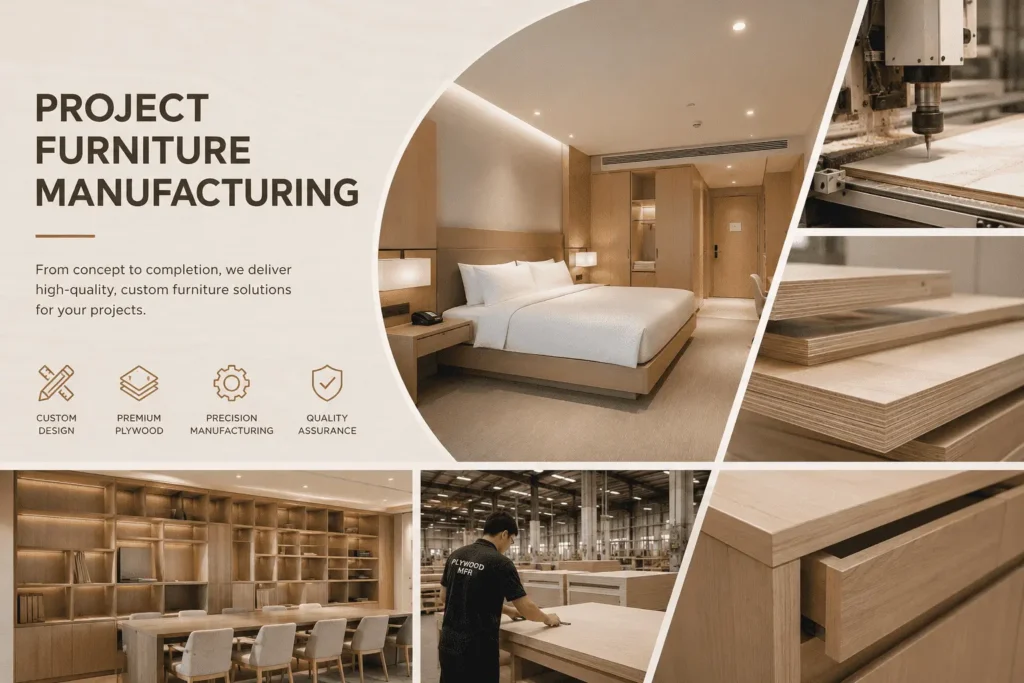
For project-based buyers, our Project Furniture Manufacturing page explains how flat pack panel furniture can be applied to apartments, hotels, rental properties, offices, student housing, and commercial spaces.
3. Review Materials, Finishes, and Hardware Before Quotation
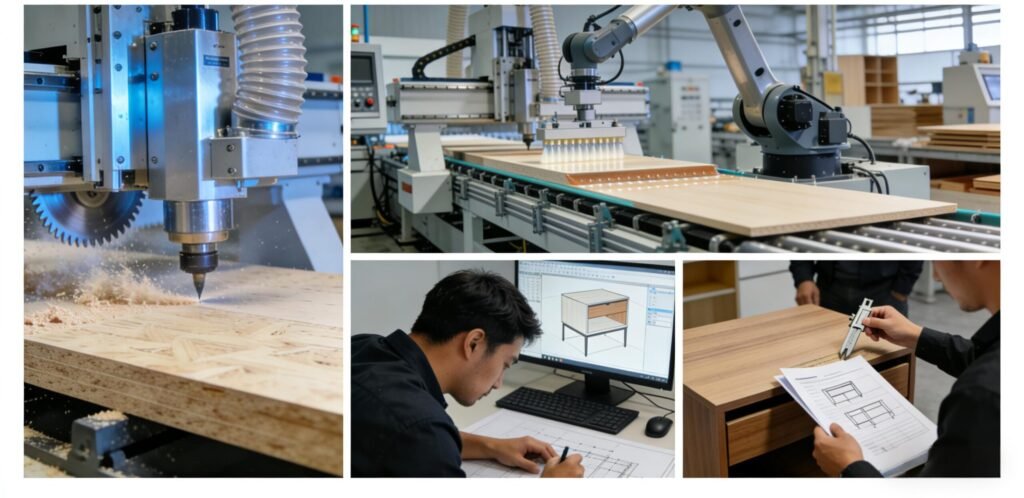
A reliable quotation starts with clear material details. If the buyer only asks for “best price,” different suppliers may quote different board thicknesses, finishes, hardware levels, and packing standards. The price may look lower, but the comparison will not be fair.
For flat pack panel furniture, common materials include:
- MDF
- Particle board
- Plywood
- Melamine board
- Engineered panels
- Veneer or printed finish panels
- Laminate or painted surface options
Each material has different cost, strength, weight, screw-holding performance, finish effect, and market suitability.
Board Thickness
For wardrobes, cabinets, beds, and storage furniture, board thickness affects strength and customer perception. Buyers should confirm whether panels are 12 mm, 15 mm, 16 mm, 18 mm, 25 mm, or customized thickness. Do not compare quotations unless the thickness is clearly listed.
Surface Finish
Surface finish affects both appearance and durability. For commercial furniture, apartment furniture, and hotel furniture, the finish should match the project positioning. A rental apartment may focus on scratch resistance and easy maintenance, while a hotel room may require better texture and color consistency.
Edge Banding
Edge banding quality is very important for panel furniture. Poor edge banding can lead to peeling, rough edges, moisture issues, and poor customer experience. Buyers should ask about edge banding thickness, glue quality, color matching, and corner finishing.
Hardware
Hardware affects assembly and long-term use. Hinges, drawer slides, connectors, handles, screws, cam locks, and wall-fixing parts should be confirmed before mass production. For project orders, it is better to keep hardware standardized to simplify installation and after-sales replacement.
For buyers selling into regulated markets, material compliance can be important. For example, buyers shipping composite wood products or finished goods containing composite wood into the United States often review the U.S. EPA’s guidance on Formaldehyde Emission Standards for Composite Wood Products. This does not replace your own legal review, but it is a useful reference when discussing MDF, particle board, plywood, and finished goods requirements with suppliers.
4. Confirm OEM/ODM Capability and Customization Workflow
Many buyers search for a China flat pack furniture manufacturer because they need custom sizes, private-label packaging, new product development, or project-based furniture. In this case, OEM/ODM capability is more important than a standard catalog.
OEM Furniture Manufacturing
OEM manufacturing is suitable when the buyer already has drawings, samples, specifications, or a target product. The factory’s role is to review the structure, suggest materials, make samples, produce in bulk, and control quality according to the confirmed standard.
Buyers should prepare:
- Product drawings
- Dimensions
- Materials
- Finish requirements
- Hardware requirements
- Packing requirements
- Target market
- Target price range
- Expected order quantity
ODM Furniture Development
ODM development is suitable when the buyer has a product idea but needs factory support for structure, materials, cost optimization, and production feasibility. This is common for e-commerce brands, retail furniture collections, apartment furniture packages, and new market programs.
A good ODM process usually includes:
- Buyer sends market idea, reference photos, or project requirements
- Factory reviews structure feasibility
- Material and finish options are discussed
- Quotation is prepared
- Sample is developed
- Buyer gives feedback
- Sample is revised or approved
- Bulk production starts
- QC and packing are completed
- Goods are loaded and shipped
As a B2B buyer, you should avoid factories that quote too quickly without reviewing details. Fast quotation is useful, but technical review is what prevents mistakes. A professional OEM ODM furniture supplier should ask questions about material, dimension, usage scenario, carton size, loading plan, and assembly method.
For more details about customization scope, see our OEM & ODM Furniture Manufacturing Services.
5. Discuss MOQ, Lead Time, and Production Planning Early
MOQ and lead time are two of the most important topics for importers, wholesalers, project buyers, and furniture brands.
A buyer may want low MOQ to test the market. A factory may prefer container-based production to control setup cost, material purchase, machine planning, and packing efficiency. The best solution is to discuss MOQ by product type, SKU mix, finish, hardware, and container plan.
What Affects MOQ?
MOQ may be affected by:
- Board material availability
- Custom color or finish
- Hardware selection
- Carton printing
- Private-label packaging
- Number of SKUs
- Production line setup
- Container loading efficiency
- Sample approval requirements
For standard panel furniture, MOQ may be easier to discuss. For customized hotel furniture, apartment furniture, or private-label retail furniture, MOQ may depend on project quantity and material specification.
What Affects Lead Time?
Lead time depends on the stage of the project. Sampling and bulk production should be discussed separately.
Common planning factors include:
- Drawing confirmation
- Material purchase
- Sample production
- Sample revision
- Deposit confirmation
- Production schedule
- QC process
- Packing material preparation
- Container booking
- Shipment arrangement
For B2B orders, buyers should not only ask, “How many days?” Instead, ask the factory to provide a timeline from sample to shipment. This makes project management easier, especially for hotel opening schedules, apartment handover plans, seasonal retail launches, and container booking deadlines.
A practical timeline discussion may include:
- Sample development time
- Sample shipping time
- Buyer approval time
- Bulk production time
- Inspection date
- Loading date
- Estimated shipment date
This is especially important when you source from a commercial furniture manufacturer for project-based delivery.
6. Inspect Export Packaging, Carton Marks, and Loading Logic
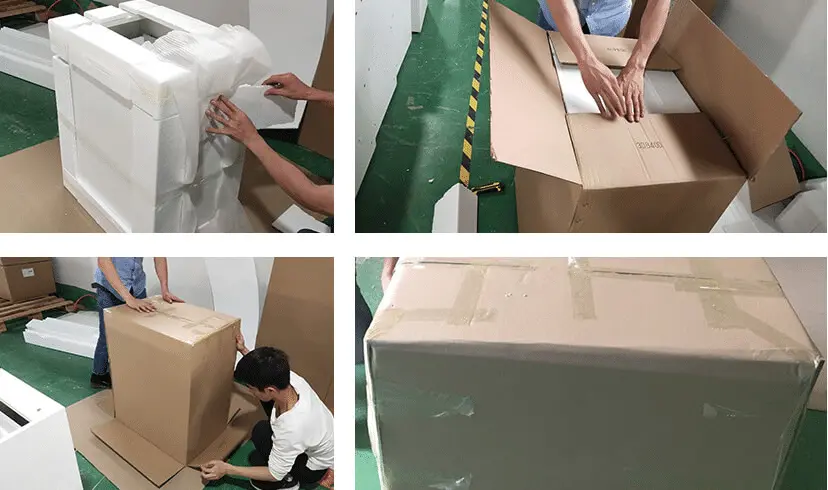
For flat pack furniture, packaging is not a small detail. It is part of the product. Good packaging reduces damage, improves warehouse handling, supports installation, and protects your brand reputation.
A low price with weak packaging may become expensive after transportation damage, missing parts, customer complaints, or project delays.
What Good Flat Pack Packaging Should Include
Buyers should discuss:
- Carton strength
- Foam or paper corner protection
- Panel separation
- Hardware bag labeling
- Assembly instruction placement
- Carton marks
- SKU labels
- Barcode requirements
- Drop-test expectations
- Pallet or non-pallet loading
- Container loading sequence
For retail and e-commerce buyers, carton appearance and labeling may be very important. For project buyers, organized carton marks and room-based packing can reduce installation confusion.
Carton Marks and Logistics Labels
If your business uses structured barcode or logistic label systems, the GS1 Logistic Label Guideline can be a useful reference when discussing carton labeling, shipment identification, and warehouse handling requirements. You do not need every project to use GS1 labels, but the concept of clear logistics identification is very useful for export furniture orders.
Assembly Instructions
Assembly instructions should be easy to understand, especially for flat pack wardrobes, cabinets, beds, desks, and storage furniture. Buyers should ask the factory to provide assembly instruction samples before mass production. If your market requires specific languages, icons, warnings, or installation steps, this should be confirmed early.
Container Loading
A professional factory should consider loading efficiency during packaging design. Flat pack furniture should be designed to reduce wasted space while protecting panels and hardware. For large project orders, container loading plans can help buyers estimate shipping cost more accurately.
7. Use Quality Standards and Documents to Reduce Sourcing Risk
B2B buyers do not need to turn every order into a complicated audit, but they should use basic standards and documents to reduce risk.
Quality Management
When discussing supplier management and quality systems, many buyers use ISO 9001 as a reference point. ISO describes ISO 9001 as a globally recognized quality management standard. Even when a specific factory certification is not the main requirement, the ideas behind quality management are useful: controlled processes, records, inspection, corrective action, and continuous improvement.
For furniture buyers, this means you should ask how the factory controls:
- Incoming material inspection
- Cutting accuracy
- Drilling accuracy
- Edge banding quality
- Surface defects
- Hardware matching
- Trial assembly
- Final inspection
- Packing verification
- Shipment documents
Responsible Wood Sourcing
If your brand or project has responsible sourcing requirements, the Forest Stewardship Council explains FSC Chain of Custody Certification as a way to verify forest-based materials along the supply chain. Buyers can use this as a reference when discussing board sourcing, documentation, and sustainability claims.
Do not simply put “eco-friendly” in the product description without evidence. For serious B2B buyers, environmental claims should be supported by documentation.
Commercial and Office Furniture Standards
For office furniture or commercial furniture programs, buyers may also review BIFMA’s furniture standards overview. BIFMA focuses on safety, performance, and sustainability standards for furniture. This is especially relevant for buyers sourcing desks, storage units, office furniture, institutional furniture, or commercial-use products.
Import Documentation
Import requirements vary by country and product type. Buyers importing from China should discuss documents such as commercial invoice, packing list, bill of lading, and other shipment documents. The International Trade Administration provides a useful reference on China import requirements and documentation. Buyers should also confirm requirements with their own customs broker or logistics provider.
The goal is not to make sourcing complicated. The goal is to make the supplier’s responsibility clear before production starts.
8. Ask for Samples Before Bulk Production
For OEM/ODM furniture, samples are not only for appearance. They are used to confirm structure, material, hardware, finish, packaging, assembly logic, and cost control.
A sample can help buyers check:
- Product dimensions
- Board thickness
- Color and texture
- Edge banding
- Drilling position
- Hardware fit
- Assembly difficulty
- Stability
- Packing method
- Instruction clarity
For project orders, buyers may request one sample room set or several key products before approving mass production. For retail programs, buyers may request a production sample with final packaging.
Do not approve bulk production based only on photos if the project is important. Photos can show appearance, but they cannot fully show assembly experience, board strength, hardware quality, or packaging safety.
A reliable flat pack furniture manufacturer should understand sample approval as part of the production process, not as an extra burden.
9. Compare Factories by Total Procurement Cost, Not Only Unit Price
Many buyers lose money because they compare only FOB unit price. In B2B furniture sourcing, total procurement cost is more important.
A cheaper supplier may create hidden costs through:
- Higher damage rate
- Poor assembly instructions
- Missing hardware
- Unstable color matching
- Weak carton quality
- Late shipment
- Poor communication
- Inconsistent repeat orders
- More customer complaints
- Higher inspection cost
A professional factory may not always be the cheapest, but it can help reduce risk and make your project or product line more stable.
When comparing suppliers, evaluate:
| Factor | Why It Matters |
|---|---|
| Factory capability | Determines whether the supplier can handle repeat production |
| Material clarity | Prevents unfair price comparison |
| OEM/ODM support | Helps with product development and customization |
| QC process | Reduces defects and complaints |
| Packaging logic | Reduces shipping damage and installation issues |
| Lead time control | Supports project schedules and retail launches |
| Communication | Reduces mistakes before production |
| Export experience | Helps with documents, packing, and shipment support |
For B2B buyers, the best supplier is not always the lowest quote. The best supplier is the one that can support stable business growth.
10. Why China Remains Strong for Flat Pack Panel Furniture
China remains an important sourcing base for flat pack panel furniture because of its mature supply chain, hardware availability, production equipment, export experience, and flexible OEM/ODM capability.
For buyers sourcing wardrobes, beds, cabinets, kitchen storage, desks, TV stands, shoe cabinets, bathroom cabinets, and apartment furniture packages, China factories can often support:
- Multiple product categories
- Custom sizes
- Custom finishes
- Private-label packaging
- Project-based furniture packages
- Mixed container planning
- Export documentation
- Long-term supply cooperation
However, the key is to choose the right type of factory. A buyer looking for hotel furniture, apartment furniture, and commercial project furniture should work with a factory that understands project requirements. A buyer looking for retail flat pack furniture should work with a factory that understands packaging, instructions, SKUs, and repeat orders.
That is why your supplier should not only be a general furniture seller. It should be a panel furniture export factory with real production experience and export-oriented service.
Why Work with Starwood as Your Flat Pack Furniture Manufacturer?
Starwood Industry Co., Ltd. is a China-based source factory focusing on flat pack panel furniture for global buyers. We support importers, wholesalers, furniture brands, retailers, e-commerce sellers, hotel projects, apartment projects, rental housing, student housing, and commercial furniture programs.
Our manufacturing scope includes:
- Bedroom furniture
- Wardrobes
- Storage beds
- Kitchen cabinets
- Bathroom cabinets
- TV stands
- Shoe cabinets
- Desks
- Kids’ room furniture
- Space-saving furniture
- Apartment furniture
- Hotel and serviced apartment furniture
- Project-based panel furniture
As a B2B factory partner, we support OEM/ODM customization, material selection, sample development, bulk production, quality control, flat pack packing, carton marks, and shipment support.
If you are looking for a reliable flat pack furniture manufacturer in China, you can start from our homepage: Flat-Pack Furniture Manufacturer in China.
For customized product development, review our OEM & ODM Furniture Manufacturing Services.
For hotels, apartments, rental housing, offices, and commercial spaces, visit our Project Furniture Manufacturing page.
Buyer Checklist Before Sending an Inquiry
Before contacting a factory, prepare the following information. This will help you receive a more accurate quotation and faster technical feedback.
Product Information
- Product name
- Product photos or reference links
- Drawings or dimensions
- Material requirements
- Board thickness
- Finish color
- Hardware requirements
- Assembly method
- Expected usage scenario
Business Information
- Target market
- Order quantity
- Project schedule
- MOQ expectation
- Packaging requirement
- Private label or carton mark requirement
- Inspection requirement
- Shipment destination
- Container type if known
Project Information
For hotel, apartment, rental, or commercial projects, also prepare:
- Room type
- Product list by room
- Quantity per item
- Floor plan if available
- Installation schedule
- Budget range
- Required delivery date
- Special compliance requirements
The more complete your information is, the easier it is for the factory to provide a realistic solution.
Final CTA: Send Your Furniture Project Details
Looking for a reliable flat pack furniture manufacturer for your next OEM/ODM program, hotel project, apartment project, or commercial furniture order?
Send us your drawings, product list, reference photos, dimensions, material requirements, target quantity, and packaging needs. Our team can help review your project, suggest suitable materials, provide quotation support, arrange samples, and prepare export-ready bulk production.
Contact Starwood Industry Co., Ltd.
Website: https://plywoodmfr.com
Factory Page: https://plywoodmfr.com/the-company/
OEM/ODM Service: https://plywoodmfr.com/oem-odm-furniture-manufacturing-services/
Project Furniture: https://plywoodmfr.com/project-furniture-manufacturing/
Send your inquiry today and tell us what you need to manufacture.
FAQ
What is a flat pack furniture manufacturer?
A flat pack furniture manufacturer produces furniture in knock-down or ready-to-assemble structures. Products are packed in cartons with panels, hardware, and assembly instructions. This manufacturing method is common for wardrobes, cabinets, storage beds, desks, TV stands, shoe cabinets, kitchen cabinets, and apartment furniture because it helps reduce shipping volume and improve export handling.
Why should B2B buyers choose a flat pack furniture manufacturer in China?
Many B2B buyers choose China because of mature panel furniture production, flexible OEM/ODM support, broad material supply, hardware availability, export packing experience, and competitive factory pricing. The key is to choose a real source factory that understands bulk orders, project schedules, quality control, and container loading.
What materials are commonly used for flat pack panel furniture?
Common materials include MDF, particle board, plywood, melamine board, and engineered panels. Buyers should confirm board thickness, surface finish, edge banding, hardware, and compliance requirements before quotation. Different markets and applications may require different material levels.
Can Starwood support OEM and ODM furniture manufacturing?
Yes. Starwood supports OEM manufacturing based on buyer drawings, samples, dimensions, or specifications. We also support ODM development for buyers who need new product ideas, market-fit collections, custom layouts, material suggestions, and production feasibility support.
What is the MOQ for flat pack furniture orders?
MOQ depends on product type, material, finish, hardware, packaging, SKU mix, and container loading plan. For export furniture orders, MOQ is often discussed by container, project quantity, or product category. Buyers can send a product list and estimated quantity for a more accurate MOQ recommendation.
How long does flat pack furniture production take?
Lead time depends on sampling, material preparation, production schedule, order quantity, packaging requirements, and shipment planning. Buyers should confirm sample time and bulk production time separately. For project orders, it is best to discuss the schedule early to avoid delay in hotel, apartment, or retail launch plans.
What packaging should buyers request for export flat pack furniture?
Buyers should request strong cartons, panel protection, hardware bag labeling, clear carton marks, assembly instructions, SKU labels, and loading planning. Good packaging helps reduce shipping damage, warehouse confusion, missing parts, and installation complaints.
Is flat pack furniture suitable for hotel and apartment projects?
Yes. Flat pack panel furniture is suitable for hotels, serviced apartments, rental housing, student housing, offices, and commercial spaces. It can help reduce shipping volume, support custom sizes, simplify installation, and control project cost.
How can buyers reduce quality risks before mass production?
Buyers should confirm drawings, materials, board thickness, finish, hardware, sample approval, QC process, packaging method, and inspection requirements before production. A pre-production sample is strongly recommended for OEM/ODM and project furniture orders.