Finding a reliable flat pack dressing table manufacturer is not simply about comparing factory prices. For furniture importers, wholesalers, private-label brands, hotel suppliers, and apartment developers, successful procurement depends on consistent panel quality, customization capability, manageable minimum order quantities (MOQ), predictable lead times, and export-ready packaging.
At Starwood Industry Co., Ltd., we support OEM and ODM panel furniture manufacturing in China, including customized dressing tables for international wholesale and project orders.
This factory-focused sourcing guide explains how buyers can develop dressing table programs, prepare accurate quotation requests, select suitable materials, control production risks, and coordinate bulk export shipments.
Table of Contents
- Why Source Flat Pack Dressing Tables Directly from a Manufacturer?
- Three OEM Dressing Table Programs for B2B Buyers
- Our Factory Manufacturing Capabilities
- Custom Dressing Table Specifications and Engineering
- Choosing Panel Materials and Surface Finishes
- MOQ and Factory-Direct Bulk Pricing
- Sampling and Bulk Production Lead Times
- Flat-Pack Packaging and Export Protection
- Quality Control and Product Inspection
- Hotel and Apartment Furniture Project Requirements
- OEM and ODM Manufacturing Workflow
- How to Prepare an Accurate RFQ
- Shipping Terms and Export Documentation
- Why Work with Starwood?
- Frequently Asked Questions
- Request a Factory-Direct Quotation
Why Source Flat Pack Dressing Tables Directly from a Manufacturer?
For international furniture buyers, sourcing directly from a flat-pack furniture factory can make product development and order execution more transparent.
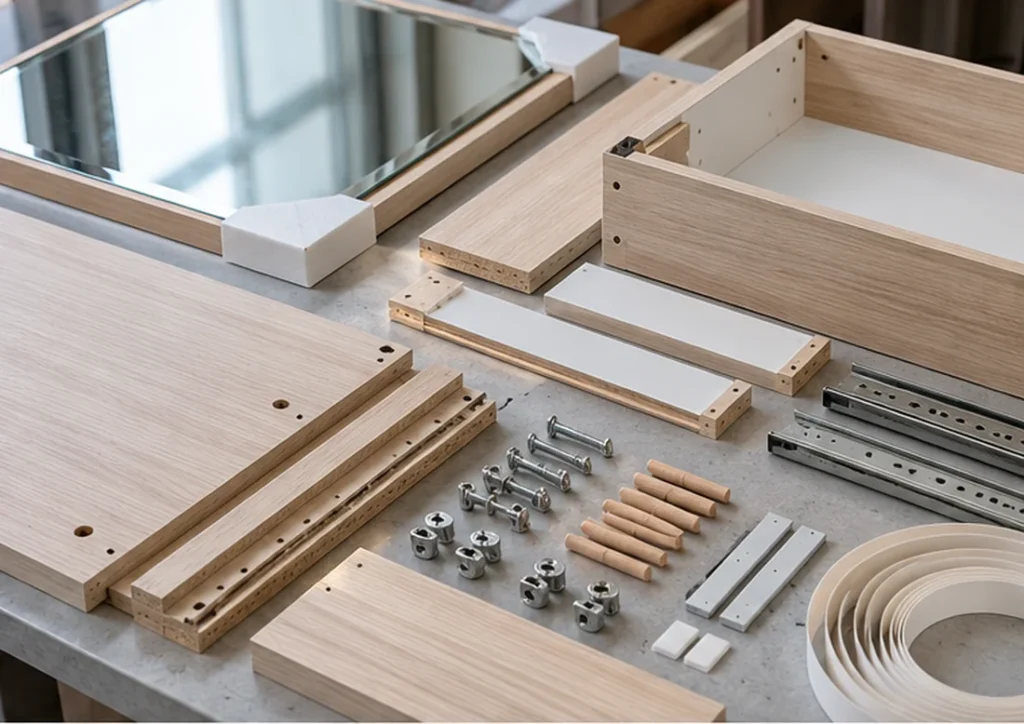
A dressing table may appear to be a relatively straightforward bedroom furniture item. In actual manufacturing, however, the finished product involves several connected specifications:
- Board dimensions, thickness, and material grades.
- Surface colors, textures, and edge-banding quality.
- Drawer slides, connectors, handles, and other hardware.
- Mirror dimensions, mounting systems, and protective packaging.
- Knock-down construction and assembly instructions.
- Carton dimensions, loading efficiency, and destination-market requirements.
A change in one component can affect other parts of the order.
For example, a buyer requesting a larger mirror may also need changes to panel reinforcement, mounting hardware, carton dimensions, and packaging protection. These adjustments should be reviewed before the final price and production schedule are approved.
Working with a manufacturer that understands both panel furniture processing and export packaging makes these decisions easier to coordinate.
Starwood specializes in flat-pack panel furniture production for international buyers. Our factory and manufacturing information provides an overview of our production background, material capabilities, and export-oriented operations.
For procurement teams, the objective is not simply to find the lowest quotation. It is to establish a repeatable furniture supply program with clearly controlled specifications.
Three OEM Dressing Table Programs for B2B Buyers
Different purchasing channels require different product structures, specifications, and packaging solutions. We recommend developing the dressing table around the buyer’s actual distribution or project requirements.
1. Wholesale and Private-Label Dressing Table Programs
Furniture importers, distributors, retailers, and online furniture brands often need competitive pricing across multiple product variations.
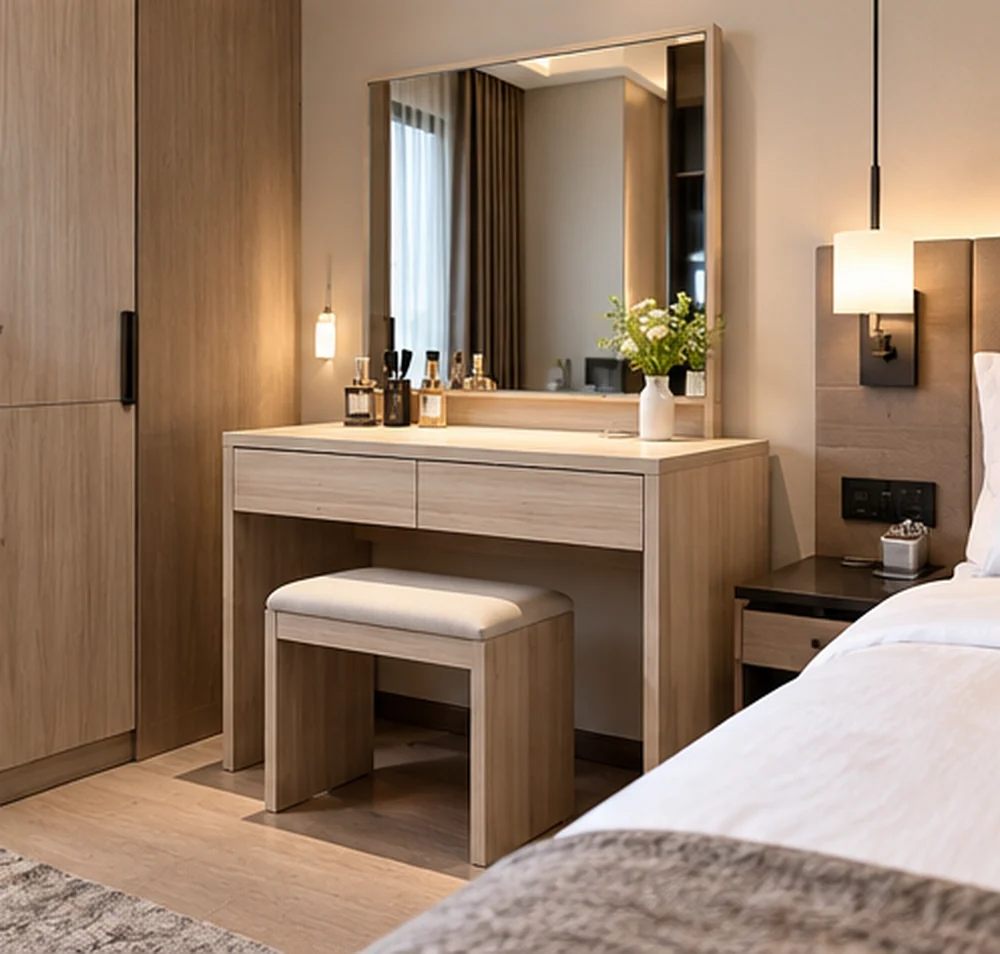
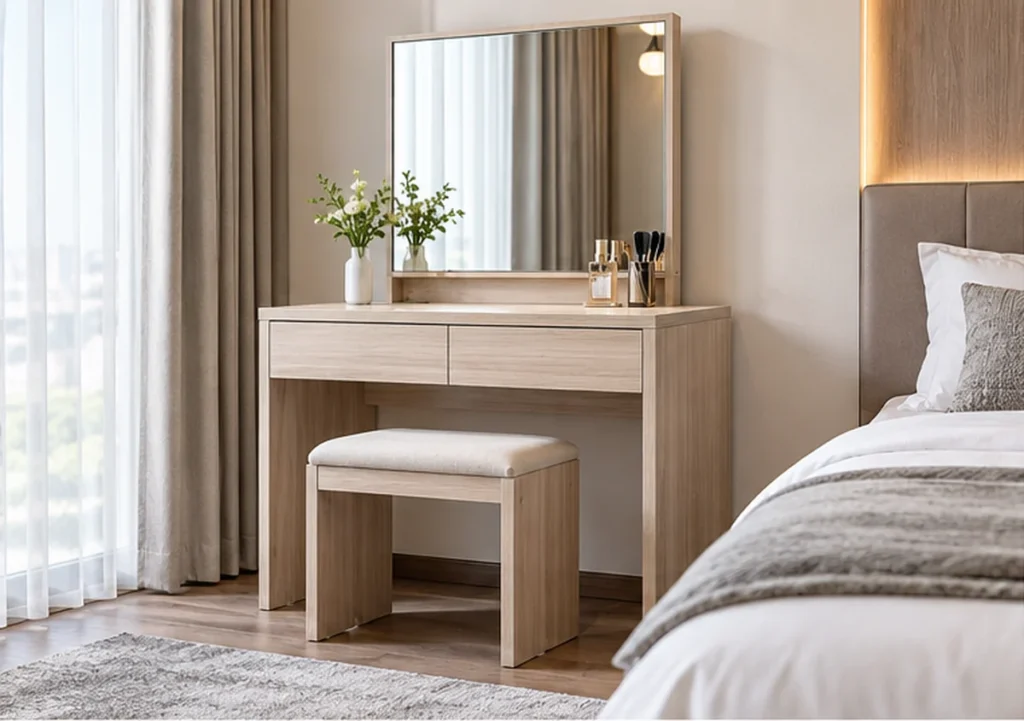
A wholesale dressing table program may include compact vanity desks, dressing tables with integrated mirrors, drawer storage, and matching stools.
Common OEM customization requirements include:
- Standardized dimensions across a product collection.
- White, oak, walnut, or buyer-selected decorative finishes.
- Single-drawer or multi-drawer configurations.
- Mirror options suited to different retail price points.
- Knock-down structures designed for repeat assembly.
- Private-label cartons, barcodes, and instruction manuals.
For this market, product consistency is particularly important.
When a distributor places repeat orders, changes in panel color, drawer-slide performance, or carton dimensions can create operational problems at the receiving warehouse.
A practical sourcing strategy is to establish an approved reference sample and maintain consistent materials, finishes, and hardware specifications across repeat orders.
Buyers planning a wider bedroom collection can also review our OEM and ODM bedroom furniture manufacturing services.
2. Apartment and Rental Property Dressing Table Programs
Property developers and apartment furniture procurement teams usually prioritize durability, available floor space, installation efficiency, and budget control.
Unlike a standard retail order, an apartment project may require coordinated furniture specifications across many residential units.
A dressing table for this application may need to function as both a vanity and a compact workstation.
Suitable configurations include:
- Space-saving dressing tables with integrated drawers.
- Combined vanity and writing-desk designs.
- Compact wall-positioned units.
- Coordinated finishes matching wardrobes and bedside cabinets.
- Simplified hardware systems for repeated installation.
For rental properties, easy replacement of damaged components can also influence procurement decisions.
A standardized panel and hardware system may make maintenance more practical than using multiple unrelated furniture designs.
Factory drawings should account for wall positions, electrical outlets, skirting boards, mirror clearance, and the overall room layout.
For buyers furnishing multiple apartments, we support customized panel furniture programs through our project furniture manufacturing service.
3. Hotel and Serviced Apartment Dressing Table Programs
Hotel furniture sourcing requires additional attention to appearance consistency, project schedules, daily-use durability, and installation coordination.
Depending on the room design, a dressing table may be specified as a separate vanity desk, an integrated writing and dressing surface, or part of a complete guestroom furniture package.
Hotel buyers may request:
- Custom sizes based on approved room drawings.
- Coordinated wood-grain or solid-color finishes.
- Durable drawer hardware.
- Mirror mounting and edge-protection details.
- Cable-management openings where required.
- Matching wardrobes, nightstands, and writing desks.
- Room-number or installation-batch carton identification.
The factory should also review whether components will be delivered to a central warehouse, stored at the construction site, or distributed directly to individual rooms.
This affects carton marking, packing sequence, and installation planning.
For large hospitality orders, sample approval should include both the assembled appearance and the practical installation process.
The best manufacturing solution is the one that meets the design intent while remaining repeatable across the entire project.
Our Flat Pack Dressing Table Manufacturing Capabilities
Starwood Industry Co., Ltd. is a panel furniture export manufacturer based in Jiangmen, Guangdong, China. Our manufacturing experience dates back to 2013, with a focus on OEM and ODM flat-pack furniture for international markets.
Our furniture manufacturing operations are organized around engineered wood panel processing, product development, quality inspection, and export preparation.
Panel Processing and Production
Typical dressing table manufacturing activities include CNC panel cutting, drilling, edge banding, component preparation, hardware matching, and assembly verification.
CNC processing is particularly useful for repeat production because the same approved component drawings can be used across a bulk manufacturing batch.
Correctly prepared drilling positions and consistent panel dimensions help reduce assembly problems at the customer’s warehouse or installation site.
OEM and ODM Development Support
For OEM orders, customers normally provide existing drawings, samples, specifications, or reference products.
For ODM development, buyers can provide their target market, desired functions, reference photographs, and price positioning.
Our team can review practical manufacturing options, including material selection, structure, hardware compatibility, and packaging requirements.
Export-Oriented Manufacturing
An export dressing table must be evaluated as a complete shipment-ready product.
That means engineering the furniture, checking assembly, protecting vulnerable components, preparing packing information, and coordinating container loading.
These activities are closely connected. A product should not be considered production-ready merely because the assembled sample looks satisfactory.
Custom Dressing Table Specifications and Engineering
A professional OEM quotation requires more than a product photograph.
The factory must understand the exact specification that the buyer intends to purchase.
Dimensions, Storage, and Functional Layout
The most frequently customized features include overall width, depth, height, tabletop clearance, drawer configuration, and mirror position.
A compact dressing table intended for a small apartment may prioritize shallow depth and efficient storage.
A hotel vanity may require a wider surface and a design coordinated with the guestroom furniture package.
Buyers should confirm whether stools, mirrors, lighting components, or additional accessories are included in the quoted product.
Otherwise, two quotations for visually similar dressing tables may represent different product scopes.
Hardware and Knock-Down Structure
Drawer slides, handles, cam-lock connectors, dowels, and mounting accessories influence both product performance and assembly efficiency.
For KD or RTA furniture, the factory should review the assembly sequence before approving the structure for production.
Ideally, components should be clearly identified, hardware should be organized into labeled bags, and assembly instructions should be understandable to the intended installer.
For installation-heavy projects, reducing unnecessary assembly steps can be just as valuable as reducing individual component costs.
Mirror and Optional Lighting Integration
Mirrors require particular attention because they introduce fragile surfaces and additional mounting requirements.
The mirror thickness, dimensions, edge treatment, attachment method, and packaging configuration should be confirmed during sampling.
Where buyers request LED lighting or electrical accessories, the electrical specifications and applicable destination-market requirements must be separately reviewed.
Custom features should be priced and approved before production rather than introduced as late-stage modifications.
Choosing Panel Materials and Surface Finishes
Material selection directly affects cost, appearance, weight, machining characteristics, and the suitability of a dressing table for its intended application.
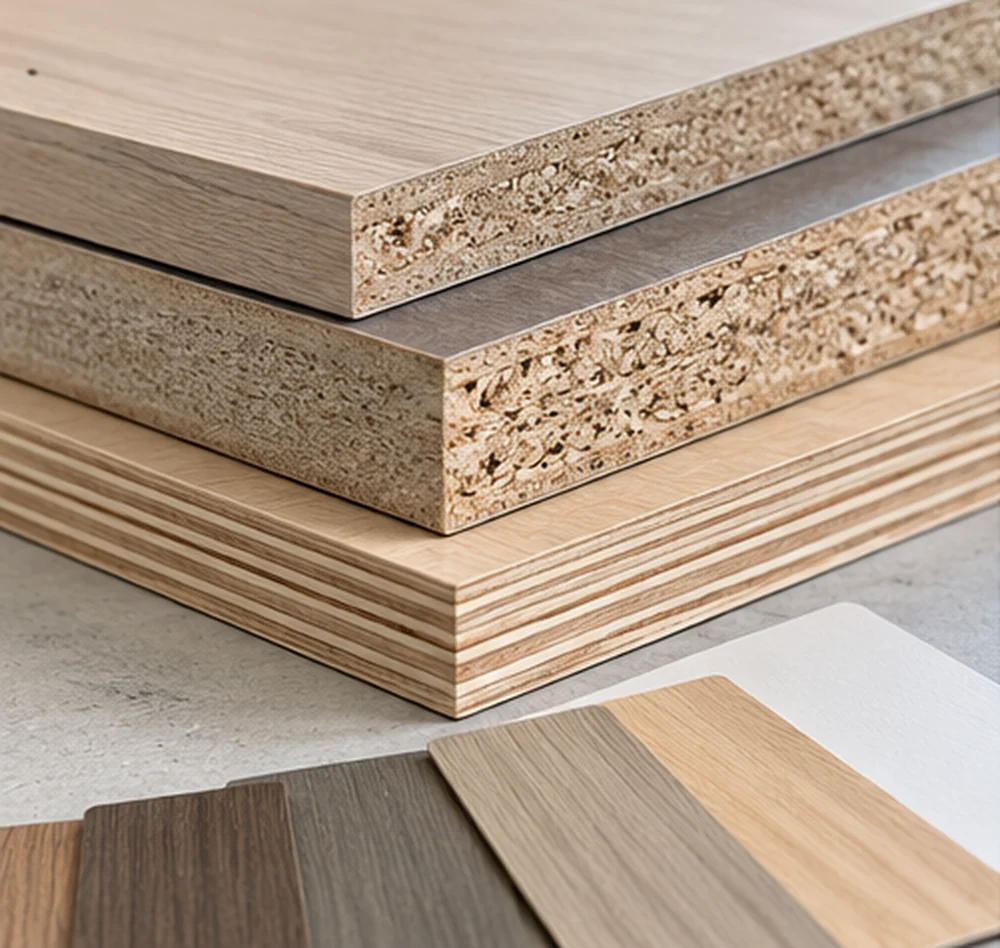
MDF, Particle Board, and Plywood
MDF is often considered for dressing table components requiring smooth decorative surfaces or painted finishes.
Particle board is commonly used for cost-controlled panel furniture, particularly with decorative melamine-faced surfaces.
Plywood may be selected for particular structural, fastening, or design requirements, subject to the grade and specification.
No single panel material is automatically the best choice for every dressing table.
A retail product competing on price may require a different board construction from a customized serviced-apartment furniture program.
The factory should confirm the panel thickness, density or grade, surface finish, edge treatment, and intended load requirements.
Melamine, Laminate, and Painted Surfaces
Melamine-faced panels are a practical option for many mass-produced dressing table programs because they offer a broad range of decorative surfaces.
Decorative laminate and painted finishes may be considered where the design, budget, and production requirements justify them.
Buyers should request physical finish samples whenever appearance consistency matters.
Digital photographs alone may not accurately represent color, texture, gloss, or surface reflection.
For hotel projects, all approved finishes should be recorded in the final specification schedule.
Material Compliance for Export Markets
Importers should identify applicable requirements before selecting a board supplier or approving the production specification.
For products entering the United States, the U.S. Environmental Protection Agency’s TSCA Title VI composite wood guidance explains requirements affecting regulated hardwood plywood, MDF, particleboard, and finished goods containing those materials.
Buyers should request relevant supporting documentation for the actual panels supplied rather than relying on general marketing statements.
Where certified forest-based materials are required, the Forest Stewardship Council’s chain-of-custody guidance provides information on material traceability and verified certification claims.
For European-market orders, buyers should also review the European Commission’s information on the EU Deforestation Regulation, including the applicability of the rules to their products, supply chains, and implementation dates.
Compliance documentation should always correspond to the actual materials, supplier chain, and destination market.
MOQ and Factory-Direct Bulk Pricing
One of the first questions international buyers ask is: What is the minimum order quantity for custom dressing tables?
The answer depends on whether the order is a standard export program, a customized product, or a multi-item furniture project.
Understanding Our MOQ Approach
Starwood’s published export inquiry guidance identifies one container as the standard MOQ reference.
However, this should not be interpreted as a guaranteed minimum quantity for every individual dressing table model.
The practical MOQ for a specific order depends on material availability, production batch efficiency, finish selection, hardware sourcing, packaging requirements, and the possibility of combining products in one shipment.
For a trial order, buyers can discuss the feasibility of combining suitable dressing table models with other bedroom furniture.
For a single customized finish, the factory may need to evaluate the minimum viable panel and hardware batch.
For hotel or apartment projects, the final quantity is normally determined by the approved room schedule and furniture specification.
What Determines the Unit Price?
A factory-direct quotation is affected by the complete approved product configuration.
The main cost factors include:
- Board material and thickness.
- Overall dimensions and panel consumption.
- Surface finish and edge-banding requirements.
- Number and quality level of drawers and hardware.
- Mirror specifications and optional accessories.
- Carton structure and protective materials.
- Order quantity and production complexity.
- Required inspection, labeling, and documentation.
Buyers should avoid comparing unit prices without reviewing these details.
A lower-priced quotation may exclude a mirror, upgraded drawer slides, stool, protective packaging, or other requested components.
Comparing the Total Delivered Cost
For importers, the purchasing decision should consider more than the factory unit price.
Carton volume, container utilization, destination freight, warehousing, assembly labor, and potential damage costs can materially affect the final landed cost.
Request carton dimensions, gross weight, net weight, and estimated loading quantity once the final packaging design is approved.
These details help purchasing teams evaluate the complete supply cost.
Sampling and Bulk Production Lead Times
Reliable scheduling begins with an agreed product specification.
A factory cannot provide a dependable production commitment when drawings, materials, mirror dimensions, or packaging requirements remain open.
Sample Development
For a new OEM or ODM dressing table, the sampling process may involve drawing review, material selection, structural development, component production, assembly, and packaging evaluation.
The sample schedule depends on the complexity of the design and the availability of specified materials or hardware.
The buyer should confirm the sample completion date, approval method, and any revision requirements before committing to a project delivery schedule.
Bulk Manufacturing
Bulk production timing is influenced by order quantity, production capacity, panel availability, surface finishing requirements, and packaging preparation.
Custom finishes, non-standard mirrors, and special hardware may require additional purchasing or development time.
Rather than assuming a universal production lead time, buyers should request a written schedule covering:
- Final drawing and sample approval.
- Material and hardware readiness.
- Planned production start.
- In-process inspection milestones.
- Final quality inspection.
- Packing completion and estimated shipment readiness.
For hotel projects, the factory and buyer should also agree on how any product revisions or approval delays will affect the delivery schedule.
Flat-Pack Packaging and Export Protection
Packaging is a major consideration when purchasing flat-pack dressing tables for international distribution.
Unlike assembled furniture, KD products arrive as separate panels, mirrors, hardware, and accessories.
Their protection depends on how these components are organized and secured inside the carton.
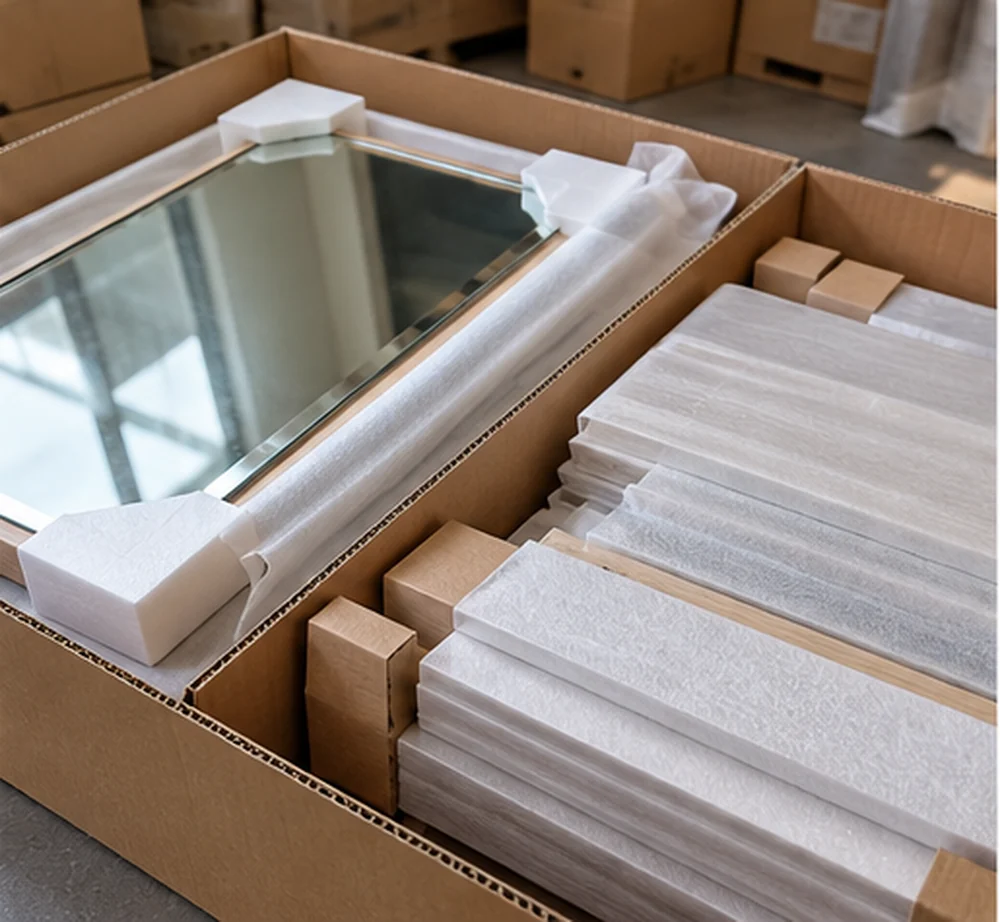
Protecting Mirrors and Decorative Panels
Mirror surfaces and panel corners require particular care.
A suitable packaging design may include protective sleeves, cushioning, separation layers, reinforced corner protection, and dedicated hardware compartments.
The mirror should be protected from direct contact with metal hardware and from movement against unfinished or exposed panel edges.
Packing methods must be reviewed against the product’s actual dimensions and expected distribution route.
Carton Engineering for Wholesale and E-Commerce
Export cartons should be designed around the handling conditions the product will experience.
A containerized wholesale shipment and an individual parcel-delivery order may require different packaging strategies.
The International Safe Transit Association’s packaging test procedures provide useful guidance on evaluating packaged products for different transport environments, including furniture and parcel distribution.
Where a customer requires specific transport testing, the applicable procedure and acceptance requirements should be agreed before testing.
Loading Efficiency and Shipment Preparation
Flat-pack design can improve the use of storage and shipping space when the cartons are appropriately engineered.
However, reduced carton volume should not come at the expense of insufficient protection.
For bulk export orders, buyers should review the final carton specification, packing quantity, labeling, and estimated container loading arrangement.
Starwood supports export-oriented flat-pack furniture packaging as part of our manufacturing workflow.
The final packaging plan should match both the product and the customer’s distribution channel.
Quality Control and Product Inspection
A dressing table that looks correct in a product photograph may still have manufacturing problems that become visible during assembly or daily use.
For this reason, quality control should cover more than surface appearance.
Critical Inspection Points
Typical inspection activities include checking panel dimensions, drilling positions, edge-banding adhesion, surface defects, drawer alignment, mirror condition, and hardware completeness.
A trial assembly helps identify practical problems such as incorrect connector positions, misaligned drawers, missing accessories, or unclear instructions.
For repeat orders, inspection criteria should remain consistent with the approved reference sample.
Buyers should define the acceptable quality level, inspection scope, and corrective-action process in advance.
Stability and Safety Considerations
Product stability should be evaluated according to the actual design and intended use.
Where a furniture design falls within a regulated product category, the applicable safety requirements must be identified rather than assumed.
For example, the U.S. Consumer Product Safety Commission’s clothing storage unit guidance explains the criteria for products covered by the relevant furniture stability requirements.
A conventional dressing table is not automatically classified as a clothing storage unit; classification depends on its design, intended use, and regulatory criteria.
For hotel and apartment projects, buyers should additionally specify any relevant project safety, installation, and durability requirements.
Hotel and Apartment Furniture Project Requirements
Project furniture procurement introduces coordination challenges that may not exist in ordinary wholesale orders.
A hotel or apartment developer may purchase dressing tables together with wardrobes, storage beds, bedside cabinets, desks, and other furniture.
The factory must therefore consider consistency across multiple products and delivery batches.
Coordinating a Complete Furniture Package
For project orders, we recommend preparing a room-by-room furniture schedule with approved dimensions, finishes, quantities, and installation requirements.
Each product should have a clear item code.
This helps the factory coordinate production and allows the project team to identify components during receiving and installation.
Sample Room Approval
Before mass production, a sample room or approved furniture mock-up can help verify practical details that are difficult to confirm from drawings alone.
These may include mirror height, drawer opening clearance, available electrical space, overall proportions, and the relationship between the dressing table and surrounding furniture.
Approval records should identify the final materials and finishes so that project-wide production is based on the same specification.
Phased Deliveries and Site Logistics
Some projects require furniture shipments to follow the construction or installation schedule.
In these cases, the buyer should provide the required delivery sequence early.
Carton identification by room type, building, or installation batch can reduce sorting work on site.
Our project furniture manufacturing solutions cover apartment, hospitality, rental housing, and commercial furniture requirements.
OEM and ODM Manufacturing Workflow
A structured development process helps buyers reduce misunderstandings between initial inquiry and final shipment.
Step 1: Submit Product Requirements
The buyer provides drawings, reference photographs, required dimensions, target quantity, destination market, and expected price positioning.
Step 2: Technical and Cost Review
Our team reviews the available specifications, material options, production feasibility, and packaging requirements.
Open technical questions are identified before a final production specification is established.
Step 3: Quotation and Specification Confirmation
The buyer and factory clarify the exact product scope, materials, hardware, optional accessories, packing method, and commercial terms.
Step 4: Sample Development and Approval
A sample is prepared according to the agreed requirements. Any necessary revisions should be documented.
Mass production should follow the approved specification rather than an unconfirmed reference image.
Step 5: Bulk Production and Inspection
Manufacturing proceeds according to the approved product details and agreed production schedule.
Relevant quality checks are conducted during manufacturing and before packing.
Step 6: Export Packing and Shipment Preparation
The finished components are packed according to the approved carton structure and prepared for the agreed shipment arrangement.
This workflow supports repeatability and helps purchasing teams maintain control over specification changes.
How to Prepare an Accurate Dressing Table RFQ
An effective request for quotation should allow the manufacturer to understand the product without making assumptions.
A well-prepared RFQ can also make it easier to compare competing suppliers.
Product and Technical Information
Include the dressing table type, reference photographs or drawings, overall dimensions, panel specifications, mirror details, storage layout, and required hardware.
Where applicable, identify the desired finish using a physical sample, supplier color reference, or approved material code.
Specify whether a stool, lighting kit, or other accessory must be included.
Quantity and Commercial Information
Provide the estimated order quantity for each model, finish, and configuration.
State whether the order is a trial shipment, recurring wholesale program, or one-time furniture project.
Include the destination market, required shipment window, and preferred quotation currency.
Packaging and Documentation
State whether the furniture will be distributed through warehouses, retail outlets, e-commerce channels, or direct-to-project installation.
If private-label cartons, specific barcodes, installation manuals, or transit testing are required, identify these conditions in the first inquiry.
Example RFQ Information
A practical buyer inquiry could include:
Product: Flat-pack dressing table with mirror and drawers
Application: Private-label bedroom furniture collection
Dimensions: Based on attached drawing
Main material: Melamine-faced engineered wood panels
Finish: Buyer-approved oak decorative finish
Hardware: Specified drawer slides and knock-down connectors
Mirror: Required, with protective export packing
Quantity: Estimated bulk order; final SKU allocation to be confirmed
Packaging: KD cartons with English assembly instructions
Destination: Buyer-specified import market
Quotation: Request available trade terms, MOQ, sample arrangements, and production schedule
This information gives the factory a much clearer starting point than simply asking, “What is your best price?”
Shipping Terms and Export Documentation
International furniture buyers should agree on the commercial shipment terms before placing an order.
An EXW quotation and an FOB quotation do not represent the same seller obligations or cost responsibilities.
The International Chamber of Commerce’s official Incoterms 2020 guidance explains the allocation of transportation responsibilities, costs, and risks under different trade terms.
Buyers should confirm the named location or port and the agreed Incoterms rule in the quotation and purchase contract.
Required commercial invoices, packing lists, shipping documents, and destination-specific paperwork should also be discussed early.
Special documentation, certificates, or third-party inspections should be included in the order requirements rather than assumed to be part of the standard price.
Why Work with Starwood for OEM Dressing Table Manufacturing?
Starwood focuses on practical panel furniture manufacturing for international B2B customers.
Our work covers product development, CNC panel processing, material and finish selection, hardware matching, sampling, bulk production, quality inspection, and export packing.
For dressing table buyers, these capabilities can support both individual product programs and coordinated bedroom furniture collections.
We work with furniture importers, wholesalers, retailers, private-label brands, and commercial project buyers who require factory-direct manufacturing support.
Our objective is to turn an approved furniture design into a repeatable production specification with clear manufacturing and shipment requirements.
Explore our bedroom furniture manufacturing range or view our dressing table with mirror product specifications to understand available OEM customization directions.
For new sourcing programs, we recommend starting with a complete product brief so that material, structure, MOQ, packaging, and delivery feasibility can be reviewed together.
Frequently Asked Questions
Can I order custom flat pack dressing tables directly from a manufacturer in China?
Yes. Starwood supports OEM and ODM panel furniture manufacturing for overseas importers, wholesalers, brands, and project buyers. Buyers can submit drawings, reference photographs, or product requirements for evaluation. Customization may include dimensions, finishes, mirrors, drawers, hardware, and export packaging.
What is the MOQ for wholesale dressing table orders?
Starwood’s published standard export inquiry reference is one container. The practical MOQ for a specific dressing table model depends on the design, material, finish, quantity, and production requirements. Mixed-product shipment options can be discussed individually, subject to manufacturing feasibility.
Can you manufacture dressing tables for hotel and apartment projects?
Yes. We support project-oriented panel furniture manufacturing for hospitality and residential applications. Dressing table specifications can be reviewed alongside other bedroom furniture requirements, including approved dimensions, finishes, hardware, room schedules, and packaging arrangements.
What materials are available for OEM dressing tables?
Common options include MDF, particle board, plywood, and other engineered wood panels. The appropriate material depends on the design, budget, surface finish, destination-market requirements, and intended application. Final material specifications are confirmed during product development and quotation.
Can dressing tables be supplied in KD or RTA packaging?
Yes. Knock-down or ready-to-assemble packaging is available for suitable product structures. Packaging details are developed around the approved components, mirror configuration, accessories, and expected shipping channel. Carton quantity, protective materials, and assembly instructions should be confirmed before bulk production.
How long does OEM dressing table production take?
Production timing depends on design complexity, sample approval, material availability, order quantity, and packaging requirements. Customized mirrors, special hardware, and non-standard finishes may affect the schedule. A specific lead time should be confirmed in the written quotation after the requirements are reviewed.
Can I order a sample before mass production?
Sample development is available for approved OEM and ODM requirements. Sampling provides an opportunity to review dimensions, appearance, structure, hardware, assembly, and packaging before confirming the bulk specification. Sample timing, cost, and approval arrangements are discussed according to the individual project.
Do you support private-label dressing table manufacturing?
Yes. Private-label requirements may include buyer-approved product specifications, branded carton markings, barcodes, assembly instructions, and customized packaging. The final scope depends on the order and should be included in the RFQ so that pricing and production requirements can be evaluated accurately.
Request a Factory-Direct Flat Pack Dressing Table Quotation
Are you sourcing a reliable flat pack dressing table manufacturer for wholesale distribution, a private-label furniture collection, or a hotel and apartment furniture project?
Starwood Industry Co., Ltd. supports overseas buyers with OEM and ODM product development, customized panel furniture manufacturing, sampling, bulk production, quality control, and export-oriented flat-pack packaging.
To begin your inquiry, send us your product drawings or reference photographs, desired dimensions, material and finish requirements, mirror and drawer specifications, estimated order quantity, and destination market.
Our team can review your requirements and discuss manufacturing feasibility, MOQ, sample development, packing options, and the quotation process.
Starwood Industry Co., Ltd.
Email: info@plywoodmfr.com
WhatsApp / Phone: +86 136 9199 4727
Factory Location: Jiangmen, Guangdong, China
Request a Factory-Direct Dressing Table Quotation
Explore Our OEM & ODM Furniture Manufacturing Services
Build your next dressing table collection or commercial furniture project with a manufacturing partner focused on repeatable quality, clear specifications, and export-ready production.