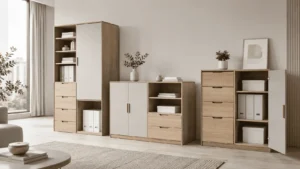
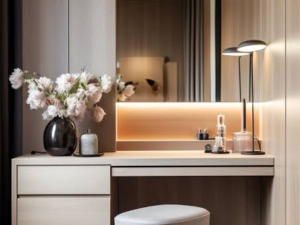
When buyers search for a dressing table manufacturer in China, they are usually not looking for a generic bedroom furniture vendor. They are looking for a partner that can handle OEM/ODM development, bulk production, export packaging, cost control, and project execution for retail, hospitality, apartment, and contract furniture programs. That is especially true for panel furniture categories such as dressing tables and vanity sets, where the final buying decision depends on more than appearance alone.
For B2B buyers, a dressing table is rarely a single-product purchase. It is often part of a broader sourcing decision involving matching bedroom furniture collections, flat-pack logistics, material specifications, lead times, and market positioning. A stylish vanity table that looks good in a photo is not enough. Buyers need a factory that can convert design intent into repeatable production quality, protect margins through efficient packaging, and support customization at scale.
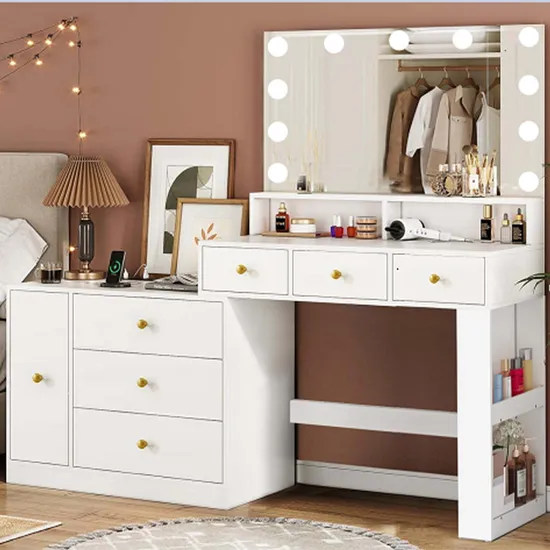
This matters even more in the current market. Many importers, wholesalers, project buyers, and private-label brands are moving toward space-efficient flat-pack furniture, more standardized component systems, and more careful supplier qualification. On your website, the current dressing table category already reflects that market direction by emphasizing modern design, customizable sizes/colors/finishes, eco-friendly materials, and bulk purchase benefits for hotels, student housing, and apartment complexes. The site also positions the company as a professional flat-pack furniture manufacturer in China with OEM & ODM panel furniture capabilities. Flat-Pack Furniture Manufacturer+2Flat-Pack Furniture Manufacturer+2
In this guide, we will walk through 7 smart buyer checks that help you evaluate a dressing table manufacturer in China more professionally—whether you are sourcing for a furniture brand, a wholesaler, an e-commerce program, a hotel fit-out, or an apartment furnishing project.
Table of Contents
- Why China remains competitive for dressing table sourcing
- Check #1: Confirm the factory’s real product focus
- Check #2: Review OEM/ODM and customization capability
- Check #3: Verify materials, compliance, and sustainability claims
- Check #4: Assess flat-pack structure and packaging logic
- Check #5: Understand MOQ, lead time, and capacity planning
- Check #6: Evaluate project experience for hotel and apartment programs
- Check #7: Compare total cost, not only unit price
- A practical buyer shortlist before placing an order
- FAQ
- Conclusion and CTA
Why China Remains Competitive for Dressing Table Sourcing
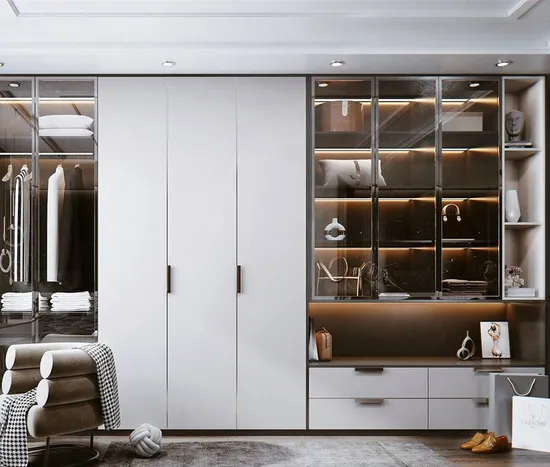
China remains highly competitive for panel furniture sourcing because it combines large-scale supply chains, board material availability, hardware ecosystems, export experience, and flexible OEM/ODM production. For categories like dressing tables, that combination is important because buyers often need variations in finish, dimensions, mirror options, storage layouts, and packaging methods while still controlling cost.
For B2B buyers, the advantage is not “cheap furniture.” The real advantage is manufacturing coordination. A capable Chinese dressing table manufacturer can help align product engineering, board sourcing, surface finish selection, carton structure, and mass production planning in one workflow. That is particularly useful when the product must fit a broader bedroom collection or project specification.
The key point is simple: if you want to rank for dressing table manufacturer china, your content must speak to buyers with purchase responsibility, not consumers browsing for home décor inspiration.
Check #1: Confirm the Factory’s Real Product Focus

The first smart check is to confirm whether the supplier is truly focused on the product category you want to buy.
Many suppliers can quote a dressing table. Fewer can manufacture it efficiently as part of a repeatable B2B program. That distinction matters. A genuine factory partner should be able to discuss:
- typical dressing table structures
- flat-pack optimization
- drawer and mirror configurations
- hardware compatibility
- finish consistency across collections
- carton protection for export
- matching bedroom programs for hotels, apartments, or retail sets
Why Product Focus Matters
A factory that already works in bedroom panel furniture will usually handle dressing tables more smoothly than a generalist supplier. Product familiarity reduces errors in board cutting, mirror packing, storage proportions, and knock-down design. It also improves communication when buyers need variant development for different markets.
What Buyers Should Ask
Ask the supplier:
- Do you mainly produce bedroom panel furniture?
- Can you show dressing table variants for different markets?
- Do you support mirror, lighting, and storage customization?
- Is the product usually shipped flat-pack or assembled?
- Can the dressing table match wardrobes, nightstands, or desks in the same collection?
A serious manufacturer will answer with structure, not vague sales language.
Check #2: Review OEM/ODM and Customization Capability
For many B2B buyers, the real decision is not whether the supplier can make a dressing table. It is whether the supplier can make your version of the dressing table.
That is where OEM/ODM capability becomes a core qualifier.
OEM vs ODM in Practical Terms
In real sourcing work:
- OEM usually means the buyer provides the design direction, dimensions, branding, or technical requirements.
- ODM usually means the supplier offers an existing model that can be adjusted through finish, size, packing, hardware, or visual details.
If your target customers include retailers, wholesalers, hotels, apartment developers, or online brands, these options matter because the same product category often needs different specifications for different sales channels.
What Should Be Customizable
A qualified dressing table manufacturer in China should be able to discuss customization across at least these areas:
- dimensions and proportions
- board material and thickness
- finish and color
- mirror type
- drawer layout
- handle or hardware choice
- logo or private-label packaging
- carton marks and shipment labeling
What Buyers Should Check Before Sampling
Before approving a sample, buyers should lock down:
- target market requirements
- size tolerances
- finish reference
- hardware standard
- packaging expectation
- loading plan
- assembly method
- photo approval process for mass production
The more precise the pre-sample communication, the lower the risk in bulk production.
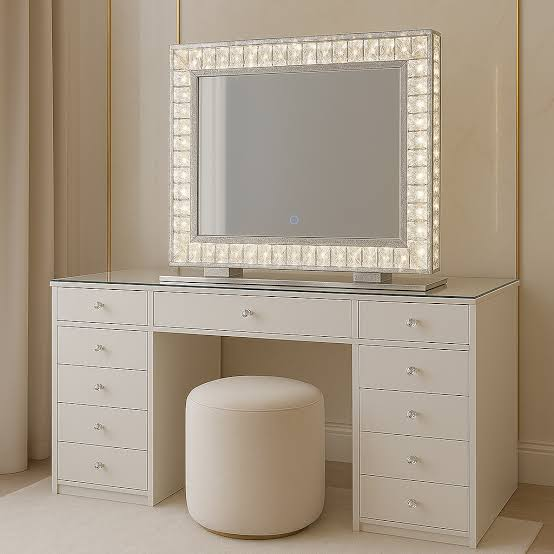
Check #3: Verify Materials, Compliance, and Sustainability Claims
In panel furniture export, material claims are not a minor detail. They affect product positioning, compliance, durability, and buyer trust.
For dressing tables, the common board options often include plywood, MDF, particle board, melamine-faced panels, and laminated board structures, depending on price tier, finish needs, and target market. Your current category page explicitly highlights eco-friendly materials and mentions sustainable plywood and eco-friendly finishes, so buyers will expect these claims to be supported with clear sourcing and specification logic. Flat-Pack Furniture Manufacturer
Formaldehyde and Composite Wood Compliance
For buyers selling into the U.S. market, composite wood products are closely tied to EPA formaldehyde standards under TSCA Title VI, which sets formaldehyde emission requirements for certain composite wood products. US EPA+1
This means buyers should ask a supplier:
- Which composite wood panels are used?
- Are the panels suitable for the target market’s emission requirements?
- Can you provide panel test records or supplier documentation?
- Is the board sourcing consistent across repeat orders?
Sustainability and Responsible Sourcing
If a buyer wants to market eco-friendly or responsible-sourcing claims, the factory should be ready to discuss material origin and certification pathways. The Forest Stewardship Council states that FSC certification is tied to responsible forest management and supply chain credibility. 森林管理委员会+2森林管理委员会+2
That does not mean every project requires the same certification path, but it does mean the supplier should be able to explain:
- where the board comes from
- whether FSC options are available
- whether finishes align with the buyer’s sustainability positioning
- how material consistency is managed over time
Safety and End-Use Context
If a dressing table is designed as part of a broader clothing storage or bedroom system, buyers should also be aware of furniture safety expectations in their destination market. The U.S. CPSC notes ongoing standards activity around furniture stability and tip-over risk, especially for clothing storage units. U.S. Consumer Product Safety Commission+1
For buyers, the lesson is practical: never treat safety, material compliance, and sustainability language as marketing decoration. These points belong in the quotation, sample review, and specification file.
Check #4: Assess Flat-Pack Structure and Packaging Logic
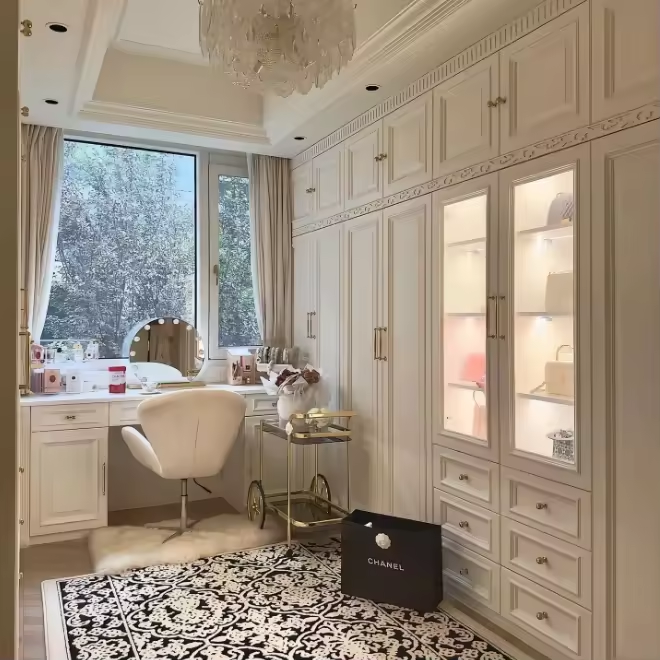
For a panel furniture exporter, packaging is not a back-office issue. It is part of the product design.
This is especially important for dressing tables because the product may include fragile elements such as mirrors, lighting components, drawer systems, edge-sensitive panels, and visible finishes. A good supplier should not only sell a flat-pack concept; it should explain why that packaging structure works in your channel.
Why Flat-Pack Matters in B2B Programs
For B2B buyers, flat-pack dressing tables can deliver four important benefits:
- lower freight and warehousing cost
- better carton efficiency for wholesale and e-commerce handling
- easier project staging for apartment and hotel delivery
- more scalable SKU management for multi-market programs
What Buyers Should Review in Packaging
Review these points before approval:
- carton size and gross weight
- edge and corner protection
- mirror protection method
- hardware bag structure
- assembly instruction quality
- drop-test logic or damage-prevention measures
- container loading efficiency
If a supplier cannot explain how its flat-pack design protects margins and reduces damage claims, the buyer is taking unnecessary risk.
Wood Packaging and Export Handling
Where wood packaging material is involved in international trade, ISPM 15 remains a key phytosanitary reference. Official guidance from the IPPC explains how ISPM 15 addresses risks associated with wood packaging material in international trade, while processed wood such as plywood is treated differently from raw wood packaging material in the standard’s scope. ippc.int+1
That matters for buyers because export packaging decisions should be made early, not after mass production is complete.
Check #5: Understand MOQ, Lead Time, and Capacity Planning
A dressing table quote is only useful if it aligns with real production conditions.
Buyers should never approve a supplier based only on unit price and sample appearance. The real questions are:
- What is the MOQ for each finish or model?
- How does MOQ change for OEM customization?
- What is the realistic production lead time in peak season?
- Can the supplier manage repeat orders with consistent board and finish sourcing?
- What happens if the buyer needs mixed products in one container?
MOQ Is a Supply Chain Signal
MOQ is not just a sales condition. It is a sign of how the factory organizes board procurement, hardware batching, line efficiency, and carton planning.
For example, a buyer requesting a hotel dressing table program with matching bedside tables and wardrobes should expect MOQ to reflect the logic of shared materials, finish runs, and packaging efficiency. A supplier that can explain this clearly usually has better production control.
Lead Time Must Match Market Reality
Lead time should reflect:
- board purchase cycle
- sample approval speed
- production queue
- finishing process
- packaging preparation
- inspection timing
- shipping window coordination
This is one reason factory-direct cooperation often outperforms loose channel sourcing. A manufacturer with real production control can explain where the time goes.
Check #6: Evaluate Project Experience for Hotel and Apartment Programs
Not every furniture supplier understands projects.
Hotel, apartment, student housing, and contract buyers have different concerns from pure retail buyers. They care about:
- standardized dimensions
- repeatability
- installation sequencing
- space efficiency
- damage control
- delivery timing by phase
- compatibility with other bedroom furniture
Hotel Projects
For hotels, buyers should focus on:
- finish durability
- housekeeping-friendly surfaces
- compact but useful storage
- style consistency with the room program
- carton protection for large installation runs
Apartment Projects
For apartments, the priorities often shift to:
- footprint efficiency
- cost-performance balance
- assembly convenience
- matching furniture collections
- scalable volume planning for multiple units
Student Housing and Rental Programs
For student housing or rental-focused programs, the buyer should ask for:
- robust flat-pack structure
- simplified assembly
- standard replacement parts
- durable surface choices
- packaging designed for bulk repetitive handling
A supplier with real project experience will discuss these details naturally. A weaker supplier will fall back on generic “high quality” language.
This is one of the most common buying mistakes in panel furniture sourcing.
Check #7: Compare Total Cost, Not Only Unit Price
A lower ex-works unit price does not necessarily create a better landed cost result. Buyers should compare:
- board specification
- finish durability
- packaging efficiency
- loading rate
- damage risk
- rework risk
- sample accuracy
- communication speed
- documentation quality
- repeat-order stability
This is exactly why B2B furniture sourcing content should sound different from consumer content. Professional buyers do not buy a dressing table the way a household shopper buys a vanity online. They buy a supply solution.
The Real Cost Equation
In practical terms, a slightly higher unit price may still be the better choice if it delivers:
- better carton efficiency
- fewer breakage claims
- faster assembly
- better finish consistency
- fewer production delays
- smoother repeat ordering
For importers and project buyers, those factors often matter more than a narrow price comparison.
A Practical Buyer Shortlist Before Placing an Order
Before you move from supplier search to quotation or sample approval, make sure your shortlisted dressing table manufacturer in China can answer these questions clearly:
- Do you focus on bedroom panel furniture and dressing tables?
- Can you support OEM, ODM, and private-label needs?
- What board materials and finishes do you use for export orders?
- Can you explain compliance and material documentation clearly?
- Is your flat-pack and mirror packaging designed for real export handling?
- What is your MOQ and lead time logic for bulk orders?
- Have you supplied hotels, apartments, or project-based programs before?
- Can you coordinate mixed-product bedroom collections?
- How do you manage repeat-order consistency?
- What makes your total cost better, not just your unit price?
If a supplier answers these points with clarity and evidence, you are closer to a dependable sourcing partner.
Conclusion
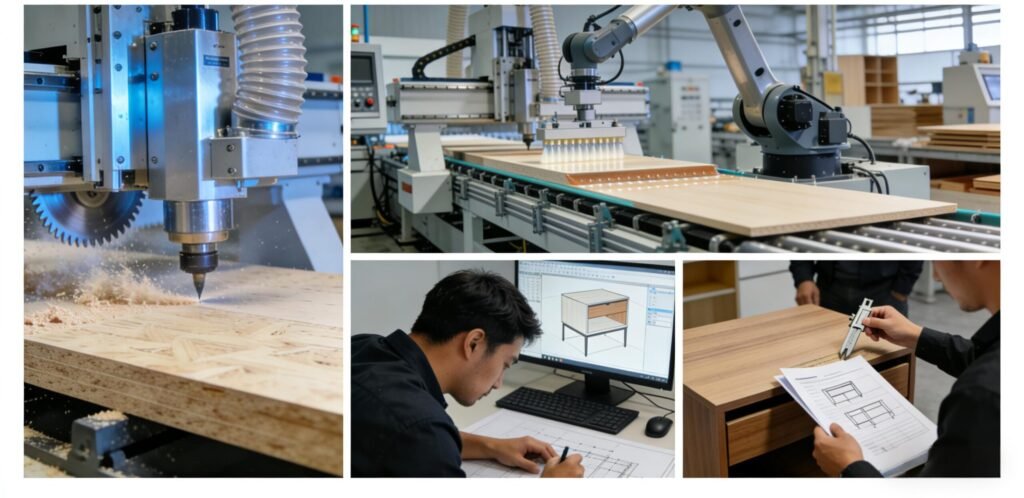
Choosing the right dressing table manufacturer in China is not about finding the cheapest quote or the most attractive photo. It is about finding a supplier that can combine product specialization, OEM/ODM flexibility, material control, export packaging, flat-pack efficiency, and project execution in a way that supports your market.
For importers, wholesalers, furniture brands, hotel buyers, apartment developers, and contract procurement teams, that combination is what turns a quote into a viable long-term program.
If your buying strategy includes modern dressing tables, vanity sets, custom sizes, sustainable panel materials, or bulk supply for commercial projects, the most effective next step is not to ask for “price only.” It is to request a structured quotation with product specs, packaging details, material options, and production expectations from the factory side.
Request a bulk quote if you want to evaluate a factory-ready dressing table solution for OEM/ODM, flat-pack export, wholesale distribution, or hotel and apartment furnishing programs.
FAQ
What should I check before choosing a dressing table manufacturer in China?
Check the factory’s real product focus, OEM/ODM capability, board material options, packaging method, MOQ, lead time logic, and project experience. A reliable supplier should be able to explain how its dressing table program fits wholesale, retail, hotel, or apartment orders.
Do Chinese dressing table manufacturers support OEM and ODM orders?
Yes, many do. In practice, OEM usually supports buyer-led requirements, while ODM lets buyers modify existing models faster through finish, size, hardware, or packaging changes. Your supplier should explain clearly which parts of the product are customizable and how sampling is managed. Your site’s OEM/ODM page is already positioned around these services for global B2B clients. Flat-Pack Furniture Manufacturer+1
What materials are commonly used for export dressing tables?
Common materials include plywood, MDF, particle board, melamine-faced panels, and laminated board structures. The best choice depends on target market, finish quality, durability needs, and price positioning. Your category page specifically highlights eco-friendly materials and sustainable plywood. Flat-Pack Furniture Manufacturer
Can I order flat-pack dressing tables in bulk?
Yes. Flat-pack dressing tables are often preferred in export programs because they can improve carton efficiency, reduce freight cost, and support bulk handling for wholesale, e-commerce, hotel, and apartment projects. Your site’s positioning as a flat-pack furniture manufacturer supports this direction. Flat-Pack Furniture Manufacturer+1
What should I check before choosing a dressing table manufacturer in China?
Check the factory’s product specialization, OEM/ODM capability, panel material options, flat-pack packaging logic, MOQ, lead time, and project experience in hotel, apartment, or wholesale programs.
Do Chinese dressing table manufacturers support OEM and ODM orders?
Yes. Many manufacturers support OEM and ODM services, including custom dimensions, finishes, hardware, packing, and private-label requirements, depending on the project scope and MOQ.
What materials are commonly used for export dressing tables?
Common materials include plywood, MDF, particle board, melamine-faced panels, and laminated board structures. The choice depends on target market standards, cost targets, finish expectations, and durability requirements.
Can I order flat-pack dressing tables in bulk?
Yes. Flat-pack dressing tables are well suited to bulk export because they can improve loading efficiency, reduce freight costs, and support hotel, apartment, wholesale, and retail distribution programs.
Ready to source from a reliable dressing table manufacturer in China?
Whether you need OEM/ODM development, flat-pack packaging, wholesale supply, or project-based production, our team can help you build the right dressing table program for your market. Contact us to discuss specifications, material options, finishes, MOQ, and lead time.