
A custom dressing table manufacturer should help purchasing teams turn a product concept into a repeatable, export-ready furniture program—not merely offer an attractive vanity at a low unit price. For importers, wholesale distributors, private-label brands, hotel procurement teams and apartment developers, the key questions are practical: Can the factory engineer your design, control panel and hardware specifications, meet the order structure, protect mirrors in transit and maintain consistency across repeat shipments?
Starwood Industry Co., Ltd. supports OEM/ODM panel furniture manufacturing in China, from drawings and samples to bulk production and flat-pack export preparation. This guide explains how professional buyers can specify, cost and purchase custom dressing tables with fewer surprises.
Need a factory quotation now? Share your drawings, target quantity and destination market through our OEM & ODM furniture manufacturing service or request a custom furniture quote.
Table of Contents
- What B2B buyers expect from a custom dressing table manufacturer
- Product applications: retail, hotels, apartments and projects
- OEM versus ODM: what can actually be customized?
- Panels, finishes, mirrors and hardware: practical specifications
- Factory engineering and quality control before bulk production
- Custom dressing table manufacturer MOQ, pricing and landed cost
- Sampling, mass-production lead times and order planning
- Flat-pack packaging, container loading and damage prevention
- Compliance, testing and responsible material sourcing
- The OEM/ODM purchasing workflow from brief to shipment
- RFQ checklist: what to send for an accurate price
- Why choose Starwood as your custom dressing table manufacturer?
- Frequently asked questions
- Request a custom dressing table quotation
What B2B Buyers Expect From a Custom Dressing Table Manufacturer
There is a major difference between buying a finished vanity from a catalog and developing a repeatable SKU with a custom dressing table manufacturer.
In an OEM program, the buyer may own the drawing, dimensions, finish reference, packaging artwork and brand. In an ODM program, the buyer may arrive with competitor references, a price target and a retail or project application, then ask the factory to help convert those requirements into a manufacturable specification.
For procurement teams, the supplier’s job begins before the first panel is cut. A useful factory discussion should cover the product’s intended selling channel, target retail or project price, likely order volume, carton dimensions and destination-market requirements.
It should also identify risks such as mirror breakage, uneven drawer gaps, color variation between production batches and difficulty assembling the product at the destination.
The most useful purchasing question is not simply, “What is your best price?” It is, “What specification, production method and packing solution can you supply consistently at our required volume?”
A slightly different drawer construction or knock-down joint may reduce returns, simplify installation or improve loading efficiency enough to outweigh a small unit-price difference.
Starwood’s factory and company profile describes its focus on engineered-panel furniture, OEM/ODM manufacturing and export-oriented production. Buyers can use that background when assessing whether the operation fits a long-term program rather than a one-off decorative item.
Product Applications: Retail, Hotels, Apartments and Projects
Retail, Wholesale and Private-Label Bedroom Collections
For a furniture importer or wholesale buyer, a vanity usually sits within a coordinated bedroom assortment.
The dressing table may need to match a wardrobe, bedside cabinet, chest of drawers or study desk. Common requirements include a stable finish reference, consistent handle family, carton barcode, multilingual assembly instructions and a structure suitable for repeat orders.
A private-label program may also require exclusive dimensions, a revised drawer arrangement or retailer-specific packaging.
Instead of adding design elements that raise cost without improving customer value, buyers should prioritize features shoppers notice immediately: useful storage, a stable mirror, smooth drawers, easy assembly and a finish that matches the photographs.
For an example of a customizable product, review our dressing table with mirror for bedroom and hotel programs. It illustrates the specification areas that can be adjusted during OEM/ODM development.
Hotels and Serviced Apartments
Hotel procurement is driven by room layout, maintenance access and consistency across properties.
A dressing table may double as a writing desk, or it may need to fit within a wall panel or narrow dressing zone. The brief should specify clear widths around seating, electrical outlet locations, mirror placement and the expected cleaning routine.
Hotel buyers should also clarify whether the vanity is free-standing, anchored to a wall or part of an integrated furniture package.
A finish chosen for visual appearance alone may not be the easiest to maintain. Likewise, concealed handles may look attractive but need to be checked for usability and cleaning access.
Starwood’s project furniture manufacturing service covers drawing-based furniture development for hospitality and accommodation projects.
This makes the dressing table a possible component of a wider room package rather than an isolated purchase.

Rental Apartments, Student Housing and Developer Packages
For apartment operators and developers, consistent dimensions and easy installation are particularly important.
Project teams may need dozens or hundreds of similarly specified units delivered by building, floor or installation phase.
Room measurements must be checked against doorways, access routes, skirting boards, power outlets and final flooring levels.
A compact vanity with storage and a mirror can help furnish smaller units without requiring a separate dressing area.
For this application, practical engineering matters more than elaborate decoration: easy-to-replace hardware, consistent drilling positions, standard panels and clear part identification can make site installation easier.
OEM Versus ODM: What Can Actually Be Customized?
OEM Manufacturing From Your Drawings
OEM is the most direct route when your product team already has dimensional drawings, a bill of materials or a physical reference sample.
A custom dressing table factory can review panel sizes, joining methods, tolerances, drawer clearances, material availability and packing feasibility before preparing a quotation.
Critical dimensions should not be left to interpretation.
Identify the overall width, depth and height; clear legroom; drawer internal dimensions; mirror height and position; panel thickness; and the distance between drilling centers for specified hardware.
If the vanity will be installed against a wall, include the wall condition and fixing responsibility in the drawing package.
ODM Development From a Reference and Target Cost
ODM is appropriate when a buyer has a market concept but needs manufacturing input.
Begin with two or three reference images, a target price level, expected quantity and functional requirements.
The factory can then discuss whether an engineered-panel construction, alternative finish, simplified mirror support or standardized drawer system is a better fit.
Changes must be documented.
A finish name such as “natural oak” is not a production specification by itself. Use an approved physical sample or a specific board supplier code, and record any permitted variation.
The same principle applies to mirror tint, LED color temperature, handles and drawer slides.
Private-Label and Project Customization
The normal customization conversation can include sizes, drawer count, shelving, mirror shape, material, finish, edge banding, hardware, knock-down construction, assembly instructions, carton artwork and labeling.
Integrated lighting can be explored separately where electrical design, testing and destination-market requirements are established.
Buyers should confirm which modifications require new tooling, special hardware, revised packaging or an additional sample cycle.
Request a revision history so the factory and your purchasing team are quoting the same version of the product.
Panels, Finishes, Mirrors and Hardware: Practical Specifications
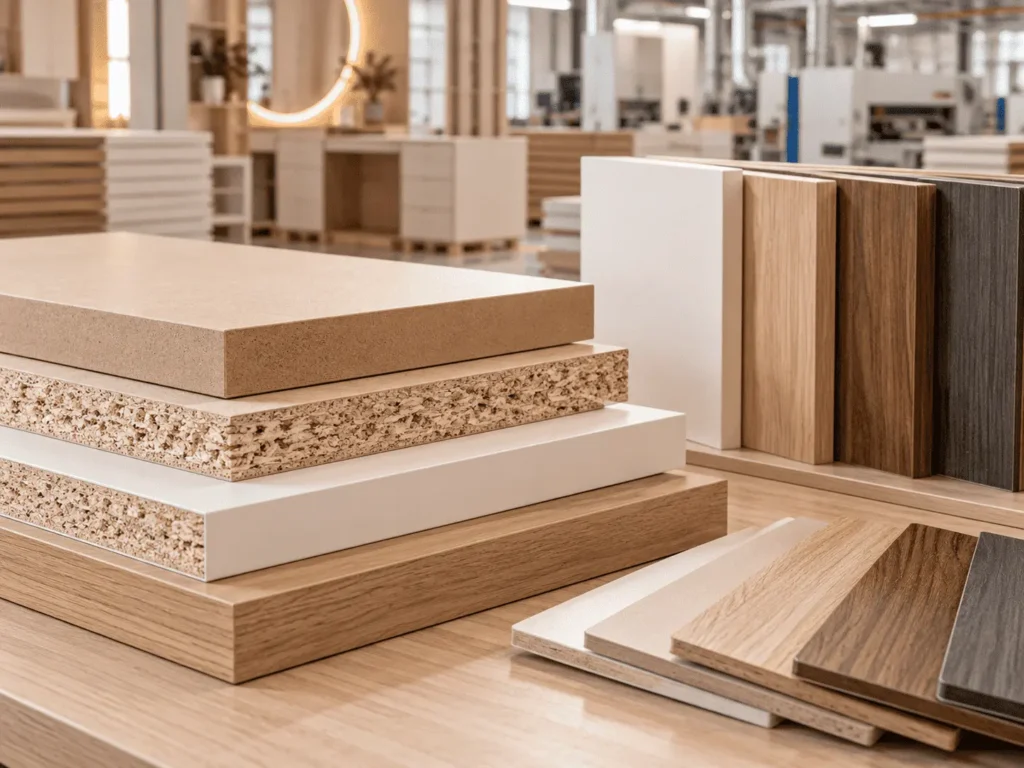
MDF, Particleboard and Plywood
A panel furniture export factory can build dressing table programs around MDF, particleboard, plywood or combinations of these materials.
The correct selection depends on the design, budget, screw-holding requirements, weight and finish system—not simply which material sounds more premium.
MDF provides a relatively uniform substrate and is often considered where painted or detailed surfaces are required.
Melamine-faced particleboard can suit cost-sensitive, repeatable flat-pack ranges with factory-applied decorative surfaces.
Plywood may be considered for specific structural or detailing needs where its properties justify the cost.
In many programs, the best solution uses more than one material in different components.
A complete board specification should include nominal thickness, density or grade as applicable, surface finish, edging, color reference and any required emissions documentation.
Do not substitute one board construction for another after sample approval without buyer authorization.
Melamine, Laminate, Painted and Wood-Look Finishes
The finish affects scratch behavior, cleaning, consistency and pricing.
For everyday retail ranges, wood-look or solid-color melamine can be a practical option.
Higher-design collections may specify decorative laminate or painted faces.
The choice should be validated against the intended use and the buyer’s actual sample, not only a screen image.
Procurement teams should ask for a physical finish board, an approved color record and a process for comparing production against the master sample.
Specify edge-band thickness and color matching, particularly at visible drawer fronts and tabletop corners.
A well-matched edge often matters more to perceived quality than a costly design accent.
Mirror Construction and Drawer Hardware
Mirrors require their own line in the bill of materials: size, thickness, edge treatment, backing, fixing method and protective packaging.
If the mirror is detachable for shipping, confirm how it attaches during final assembly and how incorrect installation will be prevented.
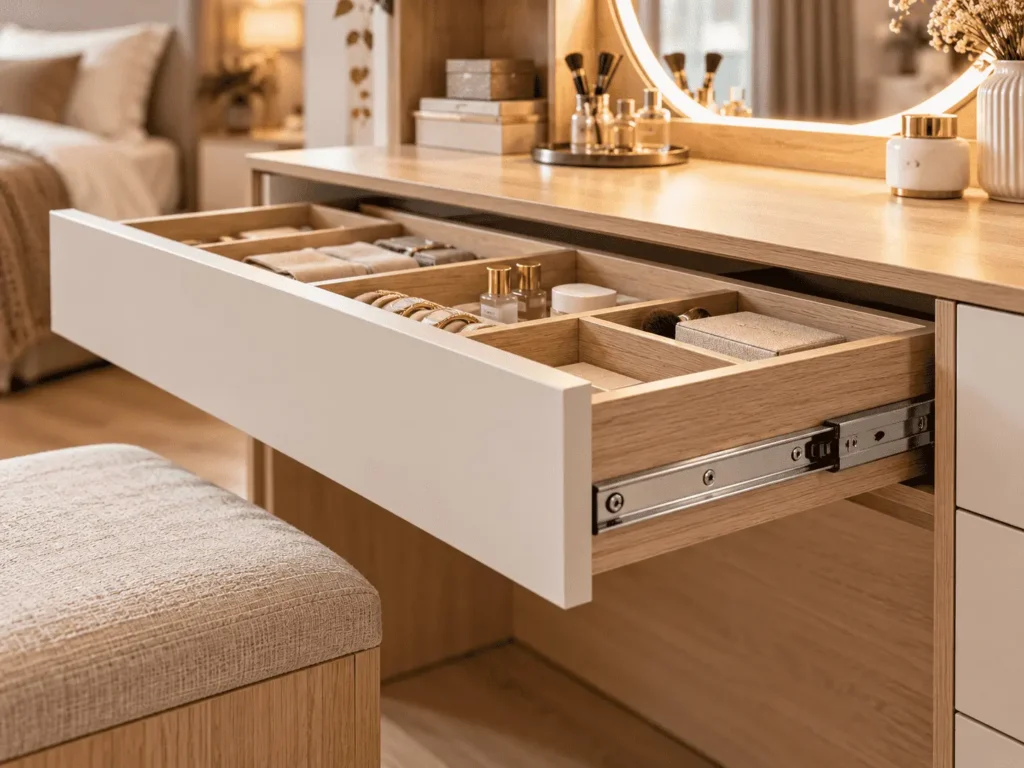
For drawers, ask whether standard slides, soft-close slides or a different runner system is proposed.
Define required extension, load assumptions and opening-cycle expectations where relevant.
Check handle screw spacing, cam-lock locations and the accessibility of replacement parts.
In a high-volume program, standardizing these components across several SKUs may simplify after-sales service.
Factory Engineering and Quality Control Before Bulk Production
Design for Repeatable Panel Processing
A good custom dressing table manufacturer considers the production route early.
Starwood describes an engineered-panel workflow involving CNC processing, edge banding, drilling, assembly checks and export packaging.
For dressing tables, repeatability depends on accurate part files, controlled drilling references, consistent edging and careful hardware kitting.
When buyers request unusually thin panels, deep drawers, oversized mirrors or long unsupported spans, the factory should review the structure before it reaches the purchase order.
Engineering changes made on paper are generally easier to control than corrections introduced after panels have been processed.

The Golden Sample and Technical Sign-Off
A pre-production sample should establish the agreed reference for appearance, fit and assembly.
Ask for sample photographs and, where practical, inspect or independently verify the actual sample.
Review drawer alignment, mirror stability, exposed edges, gap consistency, wobble, surface marks and overall dimensions.
Sample approval should document at least five elements: the drawing revision, bill of materials, finish board or approved color reference, hardware list and packing method.
Do not treat a beauty photograph as the complete approval record.
If a sample is changed, clarify whether the new version requires a fresh signed approval.
Incoming, In-Process and Pre-Shipment Checks
A practical inspection plan can include panel and finish checks before machining; drilling and edge-band checks during production; trial assembly of selected units; and carton, quantity and labeling checks before shipping.
For mirror models, include a defined breakage and handling inspection.
Buyers should agree on inspection criteria, sampling approach and responsibility for nonconforming goods before production begins.
The goal is not to promise “zero defects.” It is to identify defects early, establish acceptance rules and make corrective action traceable for repeat orders.
Custom Dressing Table Manufacturer MOQ, Pricing and Landed Cost
What Is the MOQ for a Custom Dressing Table?
The public ordering reference on Starwood’s homepage is one container.
That describes the general export-order framework, not a guaranteed minimum for every individual vanity model or finish.
The practical MOQ for a specific SKU depends on panel purchasing, surface availability, hardware requirements, sample development, carton printing and whether several suitable items can be combined into one program.
If you are launching a new line, state the forecast for the first order and repeat orders.
Ask whether a mixed-SKU container is feasible and what minimum quantities apply by model, color and hardware specification.
Do not assume that a sample order or a trial quantity is available on standard mass-production terms.
How the Factory Should Break Down a Quotation
A meaningful factory quotation should state the drawing revision, materials and thicknesses, surface finish, mirror and hardware specification, assembly structure, packing method, order quantity, unit price, payment assumptions and the named shipping term.
It should also separate one-time development, special packaging or tooling charges if applicable.
Compare equivalent specifications across suppliers.
A quote for a lower-grade board, simpler drawer slide or weaker mirror protection is not directly comparable with a fully specified alternative.
Ask suppliers to identify any exclusions rather than discovering them after the purchase order.
Compare Cost Beyond the Unit Price
Total sourcing cost includes the furniture, packaging, inland handling, international transport, customs and local distribution, installation, damage claims and potential replacements.
One package design may cost slightly more per unit but reduce returns or improve the number of units loaded in a container.
When evaluating international purchase terms, use the International Chamber of Commerce’s official Incoterms® 2020 guidance to clarify where delivery obligations, risk and costs shift between buyer and seller.
Always specify the agreed rule and named place in the contract, rather than relying on a three-letter term alone.
Sampling, Mass-Production Lead Times and Order Planning
Buyers often search for “custom dressing table manufacturer MOQ and lead time” because timing determines whether a new range can meet a retail launch or hotel handover.
There is no responsible universal production promise: a standard finish with approved components can be scheduled differently from a new painted surface, custom mirror, printed carton or electrical accessory.
Request the timetable as separate milestones: technical review and quotation, drawing confirmation, sample manufacture, sample inspection and revision, purchase-order approval, procurement of key materials, mass production, final inspection and container booking.
Each phase should have an owner and a clear condition for release to the next phase.
Starwood states a 24-hour quotation response target on its site.
That is a response target, not a guarantee of full technical costing for a complex new product.
Confirm the actual sample and shipment dates against your approved specification and the factory’s current capacity.
Hotel and apartment programs should also allow for phased shipment, installation sequencing and spare hardware.
If the buyer needs a fixed site delivery date, provide that date with the inquiry so the factory can work backward through production, loading, transit and local receiving.
Flat-Pack Packaging, Container Loading and Damage Prevention
KD/RTA Versus Assembled Supply
Knock-down or ready-to-assemble construction can reduce shipping volume and support overseas warehouse handling.
It also shifts some quality responsibility to the design of connectors, instructions and hardware kits.
Ask the factory to validate assembly sequence, component labeling and the strength of repeated connections in the approved structure.
For a hotel installation team, semi-assembled supply may sometimes be preferable if it reduces labor or handling risks.
The correct decision depends on shipping economics, installation resources, room access and the mirror assembly—not on a blanket assumption that flat-pack is always best.
Mirror and Surface Protection
A dressing table carton has different vulnerabilities from a plain cabinet carton.
Mirror corners, exposed painted edges, projecting handles and narrow drawer fronts deserve special attention.
Packaging may include internal separators, corner guards, surface protection, separated hardware bags and clear carton orientation marks, as appropriate to the approved design.
Ask to see both the packed unit and the unpacking process.
Confirm whether the mirror ships in the same carton or separately, whether replacements can be identified by part number and whether the package remains manageable for the intended distribution channel.
The International Safe Transit Association’s package-testing procedures provide a useful reference for selecting transport tests based on distribution conditions.
ISTA lists Procedure 2C for individual packaged furniture products, among other options.
A buyer should agree with the testing provider on which procedure actually fits the shipment; simply using the term “ISTA packaging” does not demonstrate that testing was performed.
Container and Warehouse Information
Before approving the carton, request its external dimensions, gross and net weights, units per carton, palletization plan if used and expected container loading quantity.
Retailers may also need scannable labels, country-of-origin markings, SKU codes and multilingual instructions.
Final loading figures should be calculated from the approved carton dimensions and actual loading arrangement, not from an optimistic early estimate.
Compliance, Testing and Responsible Material Sourcing
Requirements depend on destination market, product design and distribution channel.
A serious supplier discussion should distinguish documented compliance from a general statement such as “eco-friendly boards.”
Buyers should specify the required standards and ask for applicable evidence for the exact material or finished product involved.
Composite-Wood Emissions for the United States
For composite wood products entering the US market, review the US Environmental Protection Agency’s TSCA Title VI formaldehyde-emission requirements.
The EPA explains requirements covering regulated hardwood plywood, MDF, particleboard and finished goods containing those products, including relevant labeling and certification provisions.
Ask the supplier which supplied panels are covered and what documentation is available; do not infer compliance from the appearance of a board.
Furniture Strength and Stability
Where a vanity’s drawers and storage elements warrant a furniture-testing plan, the ISO 7170:2021 standard overview is a relevant reference for strength, durability and stability test methods for storage units.
It describes methods, not a universal pass/fail specification for every dressing table.
The buyer and testing laboratory must determine which tests, loads and acceptance criteria are appropriate for the actual product and market.
Mirror safety, tip-over risks, electrical lighting and local product safety obligations may require additional review depending on the final configuration.
Agree on responsibility for testing and documentation during development, not after shipment.
Responsible Wood-Based Material Claims
If your retail program requires a traceable certified wood-based supply chain, review the Forest Stewardship Council’s chain-of-custody certification explanation.
FSC explains how certification tracks eligible forest-based materials through the supply chain.
Do not place FSC logos or make FSC-certified finished-product claims unless the relevant certificate scope, transaction documentation and trademark permissions support them.
For all markets, keep material specifications, test reports and labeling evidence tied to the particular ordered product.
A generic certificate belonging to an unrelated supplier or material is not an adequate substitute for traceability.
The OEM/ODM Purchasing Workflow From Brief to Shipment
Step 1: Share the Commercial and Technical Brief
Identify the application, sales market, quantity, target price, product images or drawings, desired finish and delivery window.
Include the intended retail, wholesale or project channel because that affects assembly, labeling and packaging decisions.
Step 2: Review Feasibility and Value Engineering
The manufacturer checks the likely panel layout, component availability, mirror support, hardware selection and packing concept.
When cost targets are difficult, ask for itemized alternatives that show what changes—and what performance or appearance may change with them.
Step 3: Approve Drawings and a Physical Sample
Confirm all visible finishes and hidden structural details.
Use a shared revision number for the CAD drawing, bill of materials and approval sheet.
Trial-assemble the unit and photograph issues before closing the sample stage.
Step 4: Confirm the Purchase Order and Production Plan
The purchase order should refer to the approved sample and revision, specify quantity and permitted tolerances, include packing artwork, define inspection arrangements and state shipping terms.
For projects, establish the delivery sequence and a contact person for technical changes.
Step 5: Inspect, Pack and Coordinate Shipment
Check finished goods against the approved reference, complete agreed inspections, verify carton marks and reconcile the packing list before loading.
Save the final production documents so repeat orders begin from a controlled baseline rather than from a fresh interpretation of an old photograph.
RFQ Checklist: What to Send for an Accurate Price
A strong request for quotation is detailed enough that the factory can compare options without guessing.
Send the following information in one email or project brief:
- Buyer details: company, destination country, sales channel and preferred contact.
- Product: dressing table reference photo or drawing, intended use and required quantity by model.
- Dimensions: overall width/depth/height, mirror size, stool inclusion and room constraints.
- Materials: panel type and thickness, finish sample or code, edge-band requirements.
- Hardware: drawers, slides, handles, hinges, connectors, anchors and any lighting requirements.
- Commercials: target budget, first-order volume, expected annual demand and desired shipping term.
- Packaging: KD/RTA or semi-assembled, private-label artwork, barcodes, carton requirements and test needs.
- Quality: destination regulations, testing, inspection plan, approval method and special documentation.
- Schedule: required sample date, production release target, shipment window and final delivery location.
Ask the factory to reply with a quotation by specification, clearly identifying assumptions, exclusions, sample costs, MOQ basis, expected carton data and the milestones needed to confirm production timing.
This is more useful than collecting an unqualified “factory best price.”
Why Choose Starwood as Your Custom Dressing Table Manufacturer?
Starwood Industry Co., Ltd. is a Jiangmen, Guangdong-based panel furniture export manufacturer.
Its website describes experience in engineered-panel and flat-pack furniture since 2013, with production support spanning CNC processing, edge finishing, sample development, quality control and export packing.
The business serves brands, importers, wholesalers and commercial project buyers rather than focusing only on single-piece retail sales.
For a custom dressing table manufacturer relationship, that manufacturing approach matters when the buyer wants coordinated materials across multiple bedroom SKUs, repeatable hardware choices and a practical balance between unit cost and shipping efficiency.
Starwood can discuss OEM manufacturing from your drawings or ODM development from your reference designs and market objectives.
Explore our OEM/ODM furniture manufacturing capabilities, read about the factory and production background, browse the dressing table with mirror product example and review our commercial project furniture services.
These pages explain the available starting points for an actual specification discussion.
Frequently Asked Questions
Can you manufacture a custom dressing table from my drawings?
Yes. Starwood supports OEM panel furniture production based on buyer drawings, dimensions, samples and technical requirements.
The factory reviews structural feasibility, materials, hardware, finish and packaging before final specification approval.
Do you offer ODM dressing table design development?
Yes. Buyers can share reference images, functional requirements, target market and budget for an ODM discussion.
The engineering and sampling scope depends on the required design changes and is confirmed during project review.
What is the minimum order quantity for wholesale dressing tables?
Starwood publishes a one-container MOQ as its general ordering reference.
The applicable quantity by individual model, finish or mixed-SKU program must be confirmed by quotation; it is not automatically one fixed number of dressing tables.
How long does custom dressing table production take?
The actual schedule depends on approved drawings, new or existing components, sampling, materials, order volume and factory loading.
Request separate sample, production and shipment milestones rather than relying on an unconfirmed standard lead time.
Can dressing tables be supplied in flat-pack or KD packaging?
Yes, subject to the approved structure.
Starwood supports export-oriented KD/RTA packaging, assembly documentation and labeling.
Mirror protection and distribution requirements should be specified before cartons are approved.
Can I customize mirrors, drawers, finishes and private-label cartons?
These are typical customization areas.
Include exact mirror and drawer dimensions, materials, surface references, hardware requirements, carton artwork and target quantities in the inquiry so feasibility and costs can be assessed.
Do you supply hotel and apartment furniture projects?
Starwood supports project furniture development for hotels, serviced apartments, rental housing and similar environments.
Share room drawings, quantity schedules, installation requirements and target delivery stages so the dressing table can be reviewed in the context of the wider project.
What compliance documents should an importer request?
The required evidence depends on the destination and specification.
Buyers may need regulated composite-wood emissions documentation, relevant furniture test reports, packaging test results or material traceability records.
Confirm exact applicability before approving the order.
Request a Custom Dressing Table Quotation
A successful purchasing program starts with an accurate brief and a factory conversation grounded in your actual sales or project requirements.
Whether you are building a new bedroom furniture line, specifying vanities for serviced apartments or seeking a consistent wholesale partner, Starwood can review your concept for OEM/ODM feasibility, materials, hardware, packaging and bulk export supply.
Send your drawings or reference photos, dimensions, finish requirements, destination market, quantity per SKU and target shipment date.
Our team can discuss sample development, the applicable MOQ, a specification-based quotation and the next steps toward production.
Ask for customization and request an OEM/ODM quotation
Email: info@plywoodmfr.com
Learn more: OEM & ODM manufacturing | Project furniture supply