Finding a reliable bulk dressing table supplier is an important sourcing decision for furniture importers, wholesalers, private-label brands, hotel procurement teams, and apartment developers. The right supplier must provide more than competitive unit prices. Buyers need consistent panel materials, clear minimum order quantities (MOQ), practical OEM customization, reliable production schedules, and export packaging that protects products during international distribution.
Starwood Industry Co., Ltd. is a China-based OEM and ODM panel furniture manufacturer serving international B2B customers. We manufacture engineered wood furniture using materials such as MDF, particleboard, and decorative melamine-faced panels.
This procurement guide explains five critical checks for comparing factory quotations, planning wholesale orders, managing quality, and purchasing customized dressing tables for commercial furniture programs.
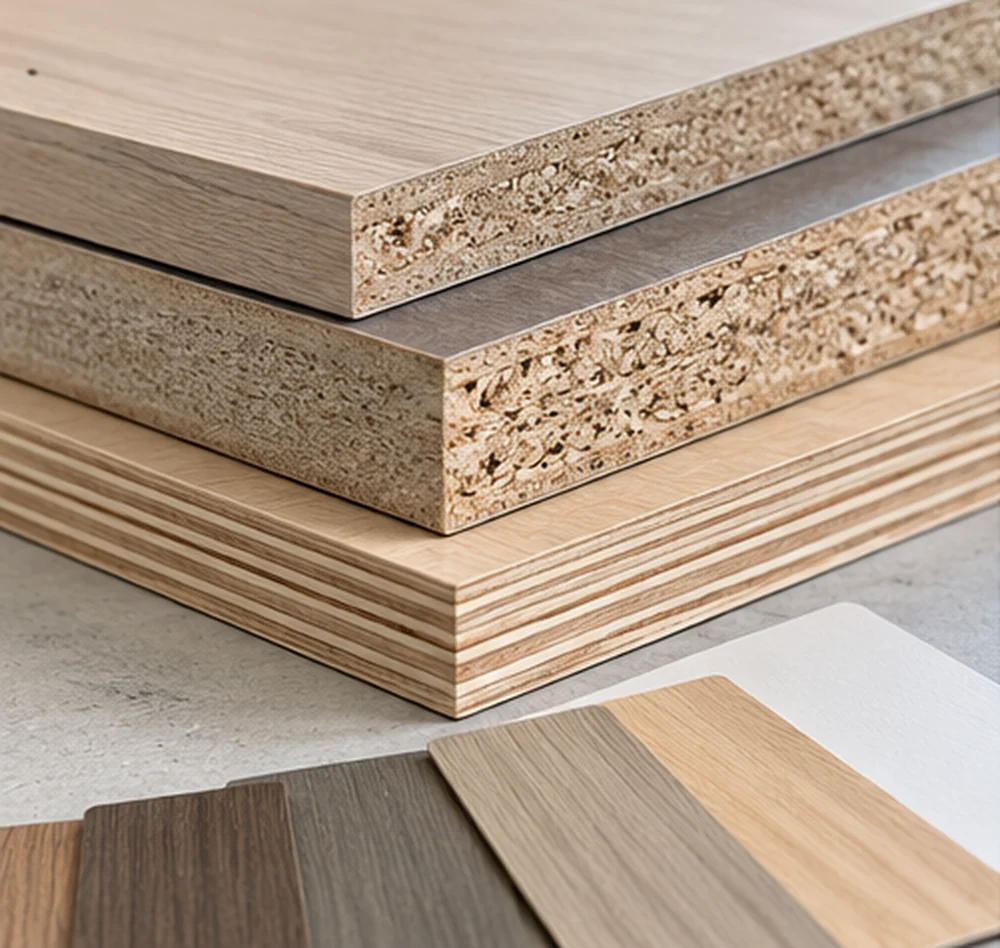
Table of Contents
- What Professional Buyers Expect from a Bulk Dressing Table Supplier
- Five Proven MOQ and Price Checks Before Ordering
- Starwood’s Factory-Direct Panel Furniture Manufacturing Capabilities
- Which Dressing Tables Are Suitable for Bulk Purchasing?
- Engineered Wood Materials and Surface Specifications
- MOQ, Mixed SKUs and Container Order Planning
- Understanding Factory-Direct Bulk Dressing Table Pricing
- OEM and ODM Customization Options
- Sample Approval and Bulk Production Lead Times
- Quality Control for Repeat Wholesale Orders
- Flat-Pack Packaging and Export Protection
- Material Compliance and International Market Requirements
- Hotel and Apartment Furniture Project Purchasing
- Our OEM/ODM Manufacturing and Order Workflow
- How to Prepare a Professional Bulk Dressing Table RFQ
- Export Shipping Terms and Documentation
- Frequently Asked Questions
- Request a Bulk Dressing Table Quotation
What Professional Buyers Expect from a Bulk Dressing Table Supplier
A professional buyer does not purchase dressing tables in the same way as an individual consumer.
Importers and wholesalers must consider purchase quantities, inventory turnover, retail margins, product consistency, transportation costs, and the risk of receiving damaged or nonconforming goods.
For hotel and apartment developments, the purchasing process may involve customized dimensions, matching finishes across several furniture categories, installation requirements, and strict delivery schedules.
A reliable supplier therefore needs to understand the complete purchasing program, not simply the appearance of a single vanity table.
Factory Manufacturing Versus Product Trading
A furniture trading company may offer products sourced from multiple factories. A direct manufacturer can provide closer coordination between product engineering, panel processing, material selection, quality control, and export packaging.
For custom panel furniture, these activities are interconnected.
Changing the number of drawers may affect material consumption, hardware quantities, CNC programming, carton dimensions, and assembly procedures.
Changing the surface finish may influence material sourcing, production scheduling, and minimum batch requirements.
These details should be reviewed before a final purchase order is accepted.
What Makes a Bulk Order Successful?
Successful bulk purchasing requires an approved product specification, an agreed commercial scope, a realistic production schedule, and a clear inspection process.
The supplier should be able to explain how drawings become production components, how material consistency is maintained, and how finished products are packed for shipment.
For international purchasing teams, transparent communication is just as important as competitive pricing.
Five Proven MOQ and Price Checks Before Ordering
Before confirming a bulk dressing table purchase, professional buyers should evaluate the following five areas.
1. Confirm the Complete Quoted Product Specification
The most common quotation problem is comparing products that do not have identical specifications.
Two dressing tables may look similar in photographs but differ substantially in manufacturing cost.
One may use a basic particleboard construction with standard drawer slides. Another may include thicker panels, additional storage compartments, premium hardware, or a more complicated mirror structure.
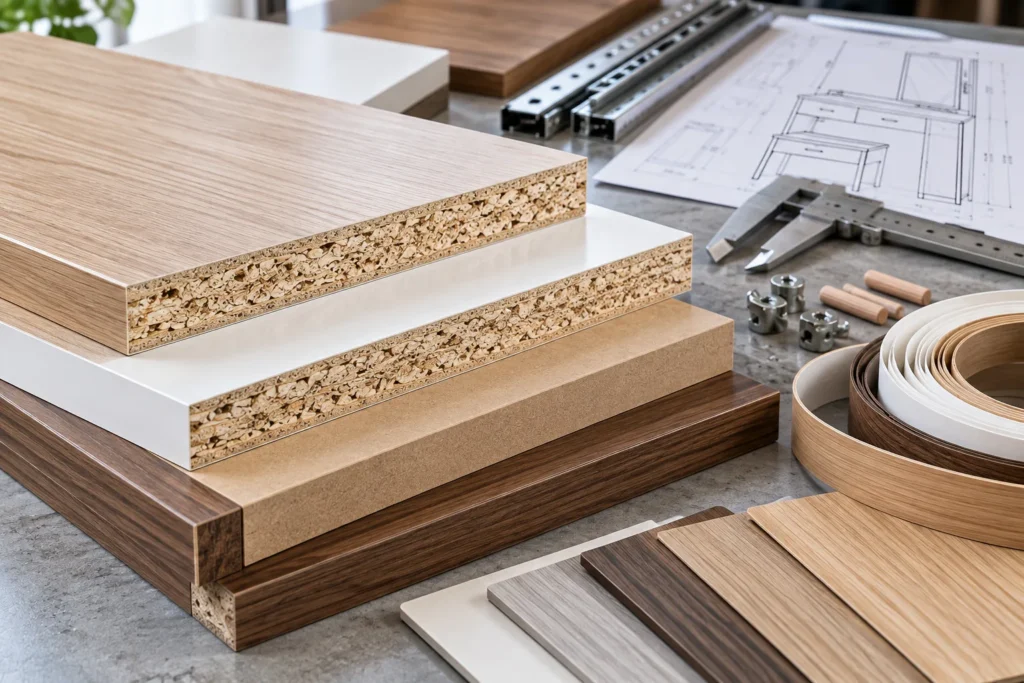
For an accurate factory quotation, confirm the overall dimensions, panel material, board thickness, decorative surface, mirror details, hardware, storage layout, and included accessories.
Also clarify whether the price includes a matching stool, electrical lighting, assembly hardware, branded cartons, or protective packing.
A lower quotation is not necessarily more competitive when important components are excluded.
For bulk purchasing, every quoted item should correspond to an agreed technical specification.
2. Verify the MOQ for Each Model and Finish
MOQ should be discussed according to the actual product structure and order composition.
A single dressing table model in one finish may have different production requirements from several customized models in multiple colors.
Panel purchasing, hardware availability, production batching, and packaging requirements can influence the minimum economical order quantity.
Ask whether the MOQ is calculated per model, per color, or across an entire order.
If you need multiple SKUs, provide the estimated quantity for each variation.
Do not assume that an advertised low MOQ applies to every customized product.
Starwood supports flexible OEM and ODM sourcing discussions, but final MOQ arrangements depend on the approved product specification and manufacturing feasibility.
3. Review the Full Factory-Direct Price
Factory pricing should be evaluated using the same commercial and technical basis across suppliers.
The quotation must identify the furniture specification, quantity, included accessories, packing method, currency, payment terms, and applicable shipping terms.
A price based on EXW conditions is not directly equivalent to an FOB quotation.
Likewise, a basic export carton may not provide the same level of protection as packaging developed for individual e-commerce distribution.
Ask whether special components, inspections, labels, sample costs, or destination-market testing are included.
A clear quotation helps purchasing teams avoid unexpected charges after production begins.
4. Calculate Carton Efficiency and Landed Cost
Bulk furniture purchasing is affected by shipping and distribution expenses.
Flat-pack dressing tables can improve space utilization when panels, mirrors, and accessories are arranged into an efficient KD carton.
However, the final cost depends on the relationship between carton volume and protective packaging.
Request carton dimensions, carton quantities per product set, gross and net weights, and estimated container loading information after packaging is finalized.
Your purchasing calculation should consider freight, receiving, warehousing, handling, assembly labor, and potential damage claims.
A slightly higher factory unit price can sometimes be commercially preferable when packaging and product consistency reduce downstream costs.
5. Confirm Lead Time, Quality Control and Shipment Readiness
A competitive price has limited value if the products cannot meet the required delivery schedule.
Ask when the quoted production lead time begins.
For OEM products, the starting point may depend on final drawing approval, sample confirmation, agreed payment arrangements, or material readiness.
The production plan should identify manufacturing milestones, inspection requirements, packing completion, and expected shipment readiness.
Hotel and apartment buyers should also communicate site delivery restrictions and installation schedules.
Production timing and quality acceptance requirements should be confirmed in writing before the order is finalized.
Starwood’s Factory-Direct Panel Furniture Manufacturing Capabilities
Starwood Industry Co., Ltd. is a flat-pack furniture manufacturer located in Jiangmen, Guangdong, China.
Since 2013, we have focused on OEM and ODM panel furniture manufacturing for international importers, furniture brands, wholesalers, e-commerce businesses, and commercial project buyers.
Our manufacturing activities cover engineered panel processing, customized furniture development, sample preparation, production coordination, quality inspection, and export packing.
CNC Panel Cutting and Drilling
Modern dressing table production depends on consistent board dimensions and accurately positioned connector holes.
CNC cutting and drilling allow approved component specifications to be reproduced during batch manufacturing.
This is important for knock-down furniture, where panels must fit correctly during customer assembly.
Incorrect drilling positions can create assembly delays even when the individual panels appear acceptable.
Edge Banding and Decorative Surface Processing
Edge banding affects the appearance and usability of melamine-faced particleboard and MDF furniture.
For dressing tables, visible tabletop edges, drawer fronts, side panels, and storage compartments require particular attention.
Consistent decorative finishes are also important when products are supplied as part of a coordinated bedroom furniture collection.
Sampling, Quality Control and Export Preparation
A manufacturing program should not move into bulk production until the relevant drawings, materials, hardware, and packaging specifications have been approved.
Sample evaluation allows buyers to review the assembled structure and identify changes before a larger production commitment.
Learn more about our background, production capabilities, and overseas customer focus through the Starwood factory and company profile.
Which Dressing Tables Are Suitable for Bulk Purchasing?
Different buying channels require different furniture configurations.
The ideal product for an online furniture brand may not be the best solution for a hotel guestroom or a serviced apartment.
Wholesale Dressing Tables for Furniture Distributors
Wholesale distributors often need several compatible models within a coordinated furniture collection.
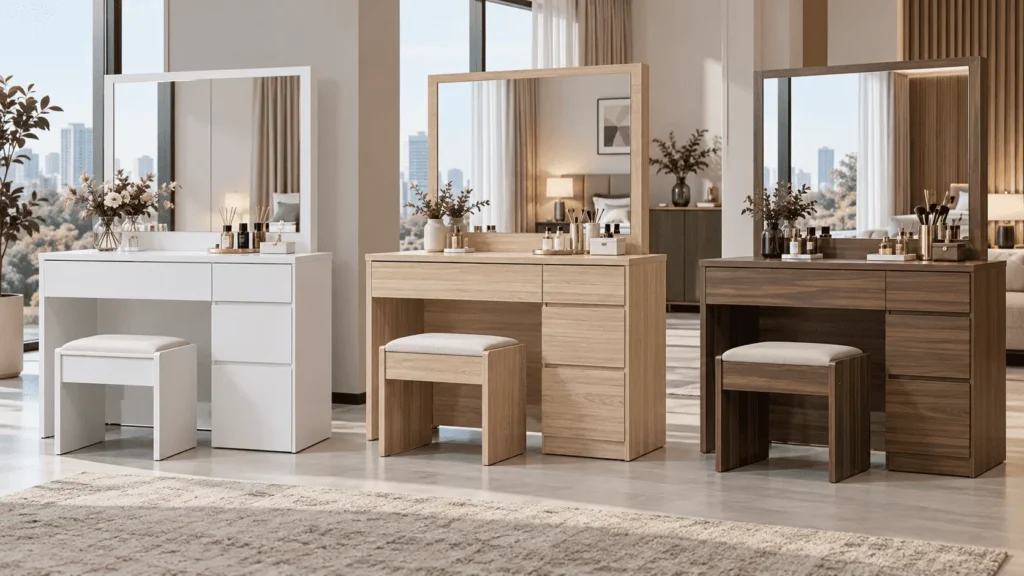
Practical options may include compact vanity tables, drawer-storage dressing tables, dressing tables with integrated mirrors, and multi-functional vanity desks.
For repeat purchasing, standardized materials and hardware can make order management more straightforward.
Distributors should also confirm whether color references and important replacement components can be maintained between production batches.
Private-Label Vanity Tables
Private-label customers may require customized dimensions, distinctive drawer fronts, selected handles, mirror designs, and branded packaging.
The product needs to support the brand’s target price positioning while remaining practical for mass manufacturing.
A useful approach is to identify which design elements create recognizable retail value and which internal components can remain standardized.
This can help control unnecessary manufacturing complexity.
Hotel and Apartment Dressing Tables
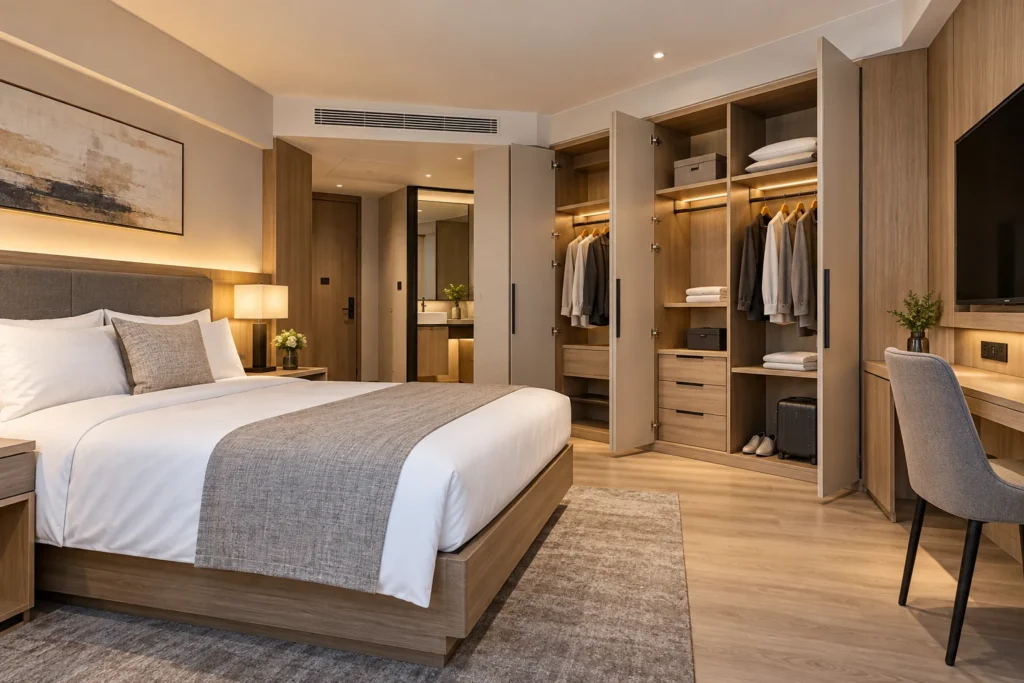
Commercial projects often require dressing tables that also function as writing desks or compact work surfaces.
Important considerations include room clearance, drawer operation, mirror placement, coordinated finishes, and installation efficiency.
The product may need to match wardrobes, beds, nightstands, or other contract furniture.
Our dressing table with mirror product page outlines available product structures, material options, and customization directions for wholesale and project inquiries.
Engineered Wood Materials and Surface Specifications
Material selection is a major part of bulk dressing table purchasing.
Starwood specializes in panel furniture manufactured using engineered wood materials.
The wood-grain appearance used on many decorative panels should not be confused with solid wood construction.
Melamine-Faced Particleboard
Melamine-faced particleboard is widely used in cost-controlled panel furniture programs.
It is available in decorative finishes that can reproduce the visual appearance of oak, walnut, or other wood patterns.
Solid-color surfaces such as white, grey, beige, and black are also available depending on material sourcing.
For professional orders, specify the board grade, thickness, decorative finish, edge banding, and relevant performance requirements.
MDF for Customized Designs
Medium-density fiberboard may be suitable for selected dressing table components requiring particular surface finishes or machining characteristics.
For some designs, MDF can be considered for painted panels or decorative components.
The appropriate grade and processing method depend on the actual product specification.
Plywood and Alternative Engineered Panels
Plywood may also be considered for particular structural requirements where the design and target cost justify its use.
However, using plywood does not automatically mean a dressing table has better performance than a correctly engineered MDF or particleboard product.
Panel grades, hardware connections, construction details, and intended usage must be evaluated together.
Decorative Finishes and Approval Samples
Color consistency is an important requirement for furniture importers and project buyers.
A digital image is not always sufficient to evaluate decorative surface color, gloss, or texture.
We recommend confirming physical material samples before bulk production.
For coordinated hotel furniture, the same approved material reference should be used across applicable furniture categories.
MOQ, Mixed SKUs and Container Order Planning
Bulk dressing table suppliers often receive inquiries from importers who want multiple designs in one shipment.
A mixed-SKU purchasing program can help a distributor introduce a collection without committing the entire order to one product.
However, mixed orders need careful manufacturing planning.
How Mixed SKUs Affect Production
Different finishes may require separate panel sourcing and production batches.
Different mirror sizes may require individual packaging designs.
Variations in drawer hardware can also complicate component preparation.
Buyers should submit their proposed SKU breakdown rather than providing only the total order quantity.
The factory can then evaluate whether selected specifications can be shared across models.
Standardizing Components Across a Collection
Using common panel thicknesses, compatible drawer slides, and repeated hardware types may simplify production and after-sales management.
Where the design allows, a collection can share internal construction methods while retaining different external appearances.
This is particularly useful for importers planning recurring wholesale orders.
Avoiding Unverified MOQ Promises
There is no responsible universal MOQ that applies to every custom dressing table.
The order quantity must match the material, product structure, finish, and factory production requirements.
Buyers should request a written MOQ quotation for their actual product mix.
Understanding Factory-Direct Bulk Dressing Table Pricing
A professional bulk furniture quotation should be built around a defined bill of materials and approved product scope.
Material and Component Cost
Panel consumption is affected by product dimensions, thickness, cutting utilization, and construction.
Additional drawers, larger mirrors, specialized fittings, and custom hardware increase the number of components required.
The quotation should clarify any optional accessories that materially affect cost.
Quantity-Based Pricing
Larger quantities may create purchasing and production efficiencies, but reductions are not guaranteed to be linear.
Special finishes or low-volume custom hardware may continue to carry individual purchasing minimums.
For practical decision-making, buyers can request comparable quotations for several proposed quantity levels.
Each quotation should use the same product specification and clearly identify the associated MOQ and commercial terms.
Cost Optimization Without Reducing Quality
Effective cost control does not necessarily mean selecting the lowest-grade material.
It can involve optimizing panel dimensions, reducing unnecessary component variation, choosing suitable hardware, and engineering practical carton layouts.
Changes should be evaluated against the required function, appearance, and performance of the furniture.
A proposed cost reduction should not compromise approved safety, structural, or destination-market requirements.
OEM and ODM Customization Options
Starwood provides OEM and ODM furniture manufacturing services for international B2B furniture programs.
We support buyers who provide established product drawings as well as those developing a new private-label collection.
OEM Manufacturing
OEM projects generally begin with customer-provided drawings, existing samples, specifications, or detailed design requirements.
The factory reviews the structure, materials, hardware, and packaging before developing the production plan.
ODM Product Development
ODM projects may begin with reference photographs, functional requirements, intended selling price, or target customer information.
The design can then be evaluated for dimensions, panel structure, storage layout, accessories, and manufacturing feasibility.
Common Dressing Table Customization Requests
Typical customization directions include overall dimensions, mirror size and position, drawer quantity, surface colors, decorative panel textures, handles, drawer slides, and KD construction.
Private-label requirements may include logo labels, barcodes, carton artwork, product instructions, and buyer-specific packaging information.
All customization details should be documented before sample approval.
Sample Approval and Bulk Production Lead Times
Sample development is an important step when establishing a new OEM dressing table program.
The sample is used to verify the technical and visual requirements before bulk production begins.
What Buyers Should Check During Sampling
Review the overall dimensions, surface appearance, edge finishing, mirror installation, drawer movement, hardware compatibility, and furniture stability.
For knock-down products, trial assembly is particularly useful.
It can identify incorrect drilling positions, missing accessories, unclear instructions, or unnecessarily complicated installation steps.
Packaging should also be reviewed where mirror protection or distribution requirements are critical.
Factors Affecting Production Lead Time
Production schedules depend on material availability, approved drawings, sample revisions, hardware purchasing, order quantity, manufacturing capacity, and packing requirements.
Customized finishes, non-standard mirrors, and special accessories can affect the preparation period.
The buyer and factory should agree on when production timing begins and what approvals must be completed first.
Repeat Orders and Scheduling
For recurring wholesale orders, retaining approved drawings, component references, and packing specifications supports better consistency.
Nevertheless, material availability and manufacturing capacity should be reconfirmed before every new purchase order.
Quality Control for Repeat Wholesale Orders
Quality consistency becomes more important as purchasing volume increases.
A defect affecting one sample may be inconvenient. The same defect across an entire container can create significant commercial problems.
Important Inspection Points
For panel dressing tables, buyers should consider inspection requirements covering:
- Panel dimensions and drilling accuracy.
- Edge-banding appearance and consistency.
- Decorative surface scratches and defects.
- Drawer alignment and sliding performance.
- Mirror condition and installation.
- Structural stability and safe operation.
- Hardware quantity and compatibility.
- Assembly instructions and component identification.
- Carton condition and packing completeness.
Approved Samples and Inspection Standards
The final production specification should refer to approved drawings, materials, and sample records.
The buyer and factory should agree on acceptable quality criteria and inspection arrangements before manufacturing.
Independent inspection may be requested according to the purchasing contract.
A clear process for identifying and correcting nonconforming products is valuable for long-term supply relationships.
Flat-Pack Packaging and Export Protection
Export packaging is not simply an additional box around a finished product.
For KD dressing tables, the packaging design must account for individual engineered wood panels, mirrors, hardware, drawer components, and assembly instructions.
Protecting Decorative Panels
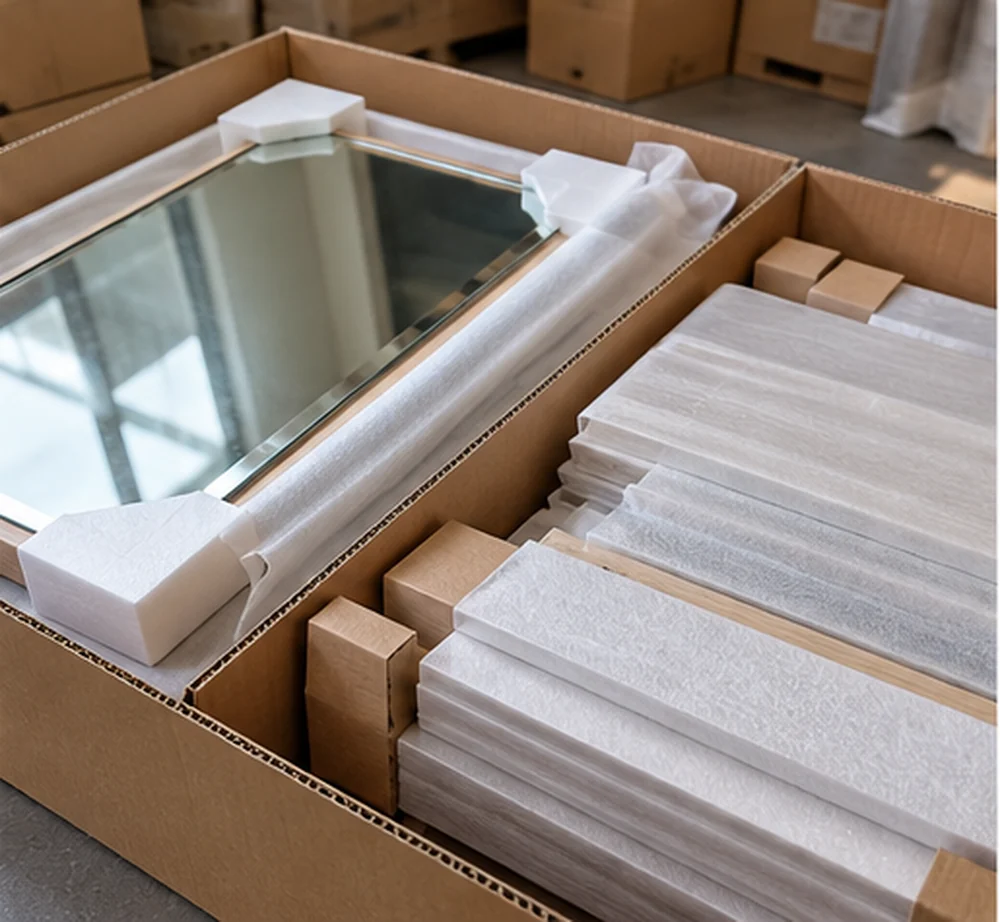
Melamine-faced panels can be vulnerable to edge damage and surface abrasion during transport.
Suitable separation materials, protective corners, and correct carton arrangement can help reduce these risks.
Protective requirements should be matched to the distribution channel rather than selected solely to minimize carton cost.
Mirror Protection
A dressing table mirror must be protected from movement and direct contact with metal fittings or exposed panel edges.
Packaging options may involve protective sleeves, cushioning, corner materials, or separated compartments.
The exact method should be evaluated against the approved mirror size and carton structure.
Packaging Tests for International Distribution
International buyers can use the International Safe Transit Association’s packaging test procedures when considering how packaged furniture may perform during distribution.
ISTA includes procedures relevant to furniture packages and other transport environments.
Any customer-required test method should be agreed before testing, and testing claims should be supported by actual reports.
For more information, see our flat-pack furniture export packaging capabilities.
Material Compliance and International Market Requirements
International furniture purchasing must account for destination-market regulations and the actual materials used in the finished product.
Compliance requirements should be identified before production rather than being addressed only when the shipment is ready.
U.S. Composite Wood Requirements
For U.S.-bound furniture, the Environmental Protection Agency’s TSCA Title VI formaldehyde emission standards are an important reference for regulated composite wood products, including MDF, particleboard, and certain plywood products.
Importers should obtain applicable supplier records and material documentation for the actual production order.
Responsible Forest-Based Materials
Where certified forest-based materials are required, buyers can review the Forest Stewardship Council’s chain-of-custody certification requirements.
FSC certification claims must be supported by a valid certification and applicable chain-of-custody documentation.
Using engineered wood panels alone does not establish FSC certification.
European Union Supply Chain Requirements
EU buyers should review the European Commission’s guidance on the EU Deforestation Regulation, including the applicability of the rules to relevant wood-based products.
As of October 2026, the European Commission lists application dates of December 30, 2026, for large and medium operators and June 30, 2027, for many micro and small operators, subject to the stated exceptions.
Buyers should confirm the applicable requirements, product classification, and documentation obligations for their own imports.
Stability and Applicable Furniture Safety Rules
Product safety requirements depend on the furniture’s structure, intended use, and destination market.
The U.S. Consumer Product Safety Commission’s clothing storage unit guidance is relevant where a design meets the regulated category’s criteria.
A dressing table is not automatically a regulated clothing storage unit. Buyers should assess the specific product rather than assuming all vanity desks fall under the same rule.
Hotel and Apartment Furniture Project Purchasing
Hotel and apartment buyers typically require coordinated specifications across multiple rooms or properties.
The dressing table may be purchased together with wardrobes, nightstands, storage cabinets, desks, and other bedroom furniture.
Custom Furniture for Different Room Types
Room dimensions, mirror placement, electrical outlets, furniture clearances, and available floor space should be considered during design approval.
A single hotel may have several room types requiring different furniture dimensions while maintaining a consistent appearance.
For these projects, approved furniture schedules and finish references can simplify purchasing coordination.
Mock-Up Rooms and Project Approval
A sample room or furniture mock-up can help verify how the dressing table functions within the actual room layout.
Buyers should review tabletop height, drawer clearance, mirror positioning, accessibility, and compatibility with adjacent furniture.
After approval, important specification changes should be documented to avoid differences between the mock-up and delivered products.
Phased Project Deliveries
Large projects may require deliveries by building, floor, room type, or installation phase.
The buyer should communicate these requirements before the factory finalizes carton labels and shipment planning.
Our project furniture manufacturing service supports OEM and ODM panel furniture programs for apartments, hotels, serviced residences, rental housing, and commercial developments.
Our OEM/ODM Manufacturing and Order Workflow
A structured manufacturing process helps overseas buyers manage specifications, approval responsibilities, and production schedules.
Step 1: Submit the Purchasing Brief
The buyer provides drawings or reference photographs, dimensions, expected quantity, destination market, finish preferences, and packaging requirements.
Step 2: Technical Review and Factory Quotation
The factory reviews the specification and identifies material, structural, hardware, packaging, or production issues requiring clarification.
A quotation is prepared according to the available confirmed requirements.
Step 3: Sample Development and Approval
The buyer reviews sample appearance, structure, components, operation, and relevant packaging details.
Revisions are documented and approved before the bulk specification is finalized.
Step 4: Material Preparation and Bulk Production
Manufacturing proceeds according to the agreed product drawings and commercial arrangements.
Production activities may include panel cutting, drilling, edge banding, component matching, inspection, and preparation for packing.
Step 5: Quality Inspection and Export Packing
The order is checked against the approved specification and packed according to the agreed export requirements.
Any required third-party inspection should be scheduled according to the purchasing contract.
Step 6: Shipping Coordination and Repeat Order Planning
Shipment readiness, carton quantities, commercial documents, and agreed shipping arrangements are coordinated with the buyer.
For repeat orders, previous approved specifications can provide a useful starting point for maintaining consistency.
How to Prepare a Professional Bulk Dressing Table RFQ
A detailed request for quotation helps the factory understand what the buyer actually needs.
Providing complete information can reduce clarification time and make quotations easier to compare.
Product Information to Include
Specify the required dressing table style, dimensions, panel material, surface finish, mirror configuration, drawer arrangement, hardware, and accessories.
Attach drawings or clear reference photographs.
If several models or colors are required, provide the expected quantities for each SKU.
Commercial and Logistics Information
Include the destination country, target purchasing quantity, expected shipment window, preferred trade terms, packaging requirements, and any special labeling or compliance conditions.
Mention whether the order is intended for wholesale distribution, private-label retail, e-commerce fulfillment, or a commercial furniture project.
Example Bulk Purchasing Inquiry
Product: Flat-pack dressing table with mirror and storage drawers.
Application: Wholesale bedroom furniture distribution.
Material: Melamine-faced particleboard or buyer-approved MDF construction.
Finish: Approved decorative oak-look or solid-color melamine.
Dimensions: According to attached product drawing.
Mirror: Required, with appropriate protective packaging.
Hardware: Specified drawer slides and KD connectors.
Quantity: Buyer-provided quantity breakdown by model and color.
Packaging: Flat-pack export carton with assembly instructions.
Destination: Buyer-specified import market.
Quotation requested: MOQ, quantity-based prices, sample arrangements, carton dimensions, estimated loading quantity, and production lead time.
This type of inquiry provides a more useful starting point than asking only for a product price.
Export Shipping Terms and Documentation
Before confirming an international order, buyers and suppliers should agree on the quotation basis and respective logistics responsibilities.
EXW, FCA, FOB, and other applicable trade terms define different obligations and cost allocations.
The International Chamber of Commerce’s official Incoterms 2020 guidance explains the use of these trade rules in international contracts.
The selected rule and named location or port should appear clearly in the commercial agreement.
Buyers should also confirm the required commercial invoice, packing list, transport documents, and applicable origin or compliance documentation.
Special inspection, certification, or documentation requirements should be communicated before the order is placed.
Why Choose Starwood as Your Bulk Dressing Table Supplier?
Starwood Industry Co., Ltd. focuses on practical OEM and ODM panel furniture manufacturing for overseas B2B customers.
Our furniture production capabilities include engineered wood panel processing, customization support, sample development, CNC machining, edge banding, quality inspection, and export-oriented KD packaging.
We work with international importers, wholesalers, retailers, private-label brands, and commercial project buyers who need reliable manufacturing coordination.
For dressing table procurement, we understand the importance of approved specifications, competitive and transparent pricing, manageable MOQ arrangements, packaging protection, and repeat order consistency.
Whether you are developing a wholesale vanity collection or coordinating a complete bedroom furniture program, we can review the technical and commercial requirements of your order.
Explore our OEM and ODM manufacturing services and commercial furniture manufacturing solutions for more information.
Frequently Asked Questions
What is the MOQ for a bulk dressing table order?
The MOQ depends on the product dimensions, panel materials, selected finishes, hardware, mirrors, packaging, and production requirements. Buyers should submit their proposed quantity by model and color so the factory can assess a practical production arrangement.
Can I order different dressing table models in one container?
Mixed-SKU order requests can be evaluated according to material availability, production batching, product compatibility, and container loading requirements. The factory must confirm whether the proposed quantities and specifications are feasible.
Does Starwood manufacture solid wood or engineered panel dressing tables?
Our focus is engineered wood panel furniture. Common options include MDF, particleboard, melamine-faced panels, and selected plywood constructions. Decorative oak-look and walnut-look finishes do not mean the furniture is made from solid wood.
Can I customize dressing tables for my furniture brand?
Yes. OEM and ODM customization may include dimensions, mirror designs, drawer layouts, decorative finishes, hardware, assembly structure, labels, and private-brand cartons. Final options depend on technical feasibility and order requirements.
How can I get factory-direct bulk dressing table prices?
Send the factory your product drawings or reference photographs, dimensions, material specifications, mirror details, required finishes, hardware, packaging needs, estimated quantity, and destination market. A complete RFQ supports a more accurate quotation.
What is the lead time for wholesale dressing table manufacturing?
Lead time depends on the design, material procurement, sampling and approval requirements, production quantity, and factory scheduling. The specific production schedule should be confirmed in the quotation or purchase agreement.
Can you manufacture dressing tables for hotels and apartments?
Yes. Starwood supports OEM and ODM panel furniture manufacturing for commercial projects, including hotels, serviced apartments, rental properties, and other residential developments. Custom dimensions and finishes can be reviewed against approved project drawings and furniture schedules.
How are mirrors and panels protected during export shipping?
Flat-pack packaging may include foam cushioning, corner protection, separated panels, protected mirrors, hardware bags, and assembly instructions. The exact carton design should be developed according to the final product specification and distribution requirements.
Request a Factory-Direct Bulk Dressing Table Quotation
Are you sourcing a dependable bulk dressing table supplier for furniture wholesale, a private-label collection, hotel guestrooms, or apartment furniture procurement?
Starwood Industry Co., Ltd. supports international buyers with OEM and ODM panel furniture manufacturing, customized dressing tables, sample development, bulk production, quality control, and export-ready flat-pack packaging.
Send us your product drawings or reference images, desired dimensions, panel material and finish specifications, mirror and drawer requirements, estimated order quantity, destination market, and packaging needs.
Our team can review your purchasing brief and discuss manufacturing feasibility, MOQ, customization options, sampling arrangements, and quotation requirements.
Starwood Industry Co., Ltd.
Factory Location: Jiangmen, Guangdong, China
Email: info@plywoodmfr.com
WhatsApp / Phone: +86 136 9199 4727
Request a Bulk Dressing Table Quotation
View Our OEM and ODM Furniture Manufacturing Services
Explore Our Hotel and Apartment Project Furniture Solutions
Build your next wholesale dressing table program with a China-based panel furniture export manufacturer focused on consistent specifications, practical OEM development, and reliable manufacturing coordination.