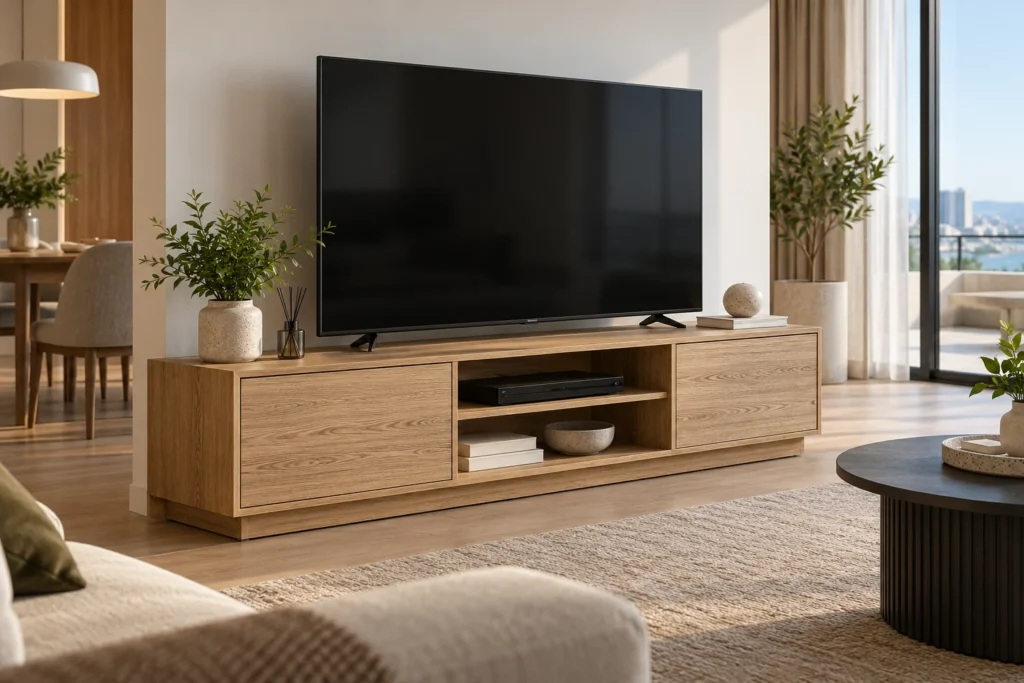
Buying a TV stand for resale or a hotel project is not simply a choice between MDF and plywood. For furniture importers, wholesalers, private-label brands, and FF&E procurement teams, the material specification determines the quoted price, structural performance, container utilization, assembly experience, and risk of customer claims.
A low-cost board can become expensive if the cabinet arrives with chipped corners, sagging shelves, or inconsistent finishes.
This factory-side TV stand materials guide explains how to specify reliable flat-pack TV cabinets, compare OEM and ODM manufacturing options, and request quotations that can actually be compared.
If you are planning a new range or a bulk project, start with the intended application, target market, and delivered-cost requirements—not a board name alone.

Table of Contents
- How Professional Buyers Should Compare TV Stand Materials
- Five Material Specifications Used in OEM and ODM TV Stands
- Match the TV Stand Material to the Business Model
- Structural Details That Matter More Than Board Thickness
- Export Compliance and Responsible Material Sourcing
- What a Capable OEM/ODM TV Stand Factory Should Provide
- OEM/ODM Customization Process: From Brief to Repeat Order
- MOQ, Sampling, and Production Lead Times
- Flat-Pack Packaging and the Real Landed Cost
- Quality Control Points Before Shipment
- TV Stand RFQ Checklist for Importers and Project Buyers
- Frequently Asked Questions About TV Stand Materials and OEM Supply
- Request an OEM/ODM TV Stand Quotation
How Professional Buyers Should Compare TV Stand Materials
A purchase order should define the complete material construction, not only “18 mm MDF” or “wood-look TV stand.” Ask suppliers to confirm the panel core, surface treatment, backing board, edging, hardware, fastening method, shelf spans, packaging and required supporting documents. Two visually similar TV cabinets can have very different production costs and service life.
Consider the operating environment first. A compact retail TV bench used in a dry living room has different performance requirements from a hospitality media cabinet installed in hundreds of guest rooms.
An e-commerce brand must also plan for repeated parcel handling, clear assembly instructions, and replacement-part logistics. These differences should be written into the specification before factories prepare prices.
Use the Starwood TV stand manufacturing collection as a starting point for configurations such as media consoles, storage TV benches, wall units, and flat-pack TV cabinets.
Request a separate bill of materials for every construction alternative so that quotations show what changed—not just the final unit price.
Five Material Specifications Used in OEM and ODM TV Stands
The following five choices are commercial construction specifications. Some combine a panel core with a finish; melamine, lacquer, veneer, and high-pressure laminate are surface systems rather than independent structural cores.
This distinction matters when evaluating a TV stand supplier’s quotation.
1. Melamine-Faced Particleboard for Competitive Wholesale Programs
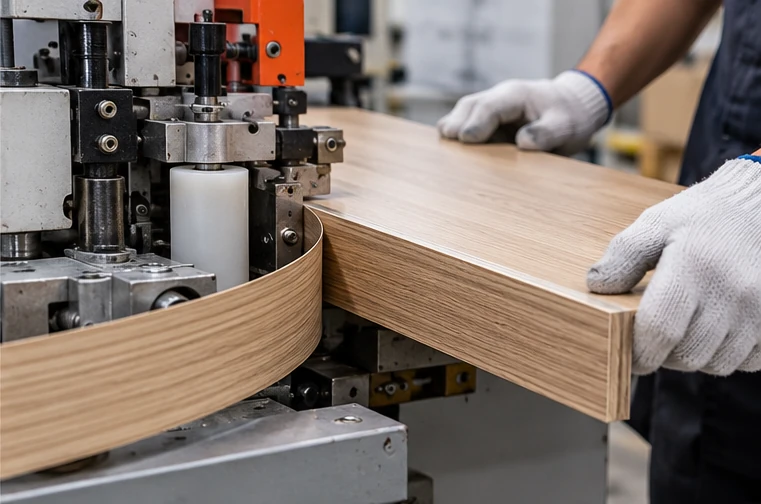
Melamine-faced particleboard is a practical specification for price-sensitive flat-pack TV stands, ready-to-assemble furniture, and large retail collections.
Its decorative surface can be produced in coordinated woodgrains and solid colors, making it suitable for repeat SKUs and matching bedroom or living-room ranges. Standardized board dimensions also support efficient nesting and cutting.
The main purchasing risks are poor edge protection, inadequate screw-holding at frequently assembled joints, and shelf deflection on long spans.
Specify the panel grade and density where relevant, the minimum edge-banding thickness for exposed areas, suitable knock-down fittings, and reinforcement where design calculations or testing require it.
Do not assume every particleboard panel performs identically.
Best fit: Budget-to-midrange wholesale TV stands, retail-ready collections, and cost-controlled apartment furnishing where the design is engineered for the intended load.
2. Melamine-Faced MDF for Smooth, Consistent Cabinet Components
MDF offers a fine, uniform surface and can be a useful core for decorative doors, painted components, or detailed shapes.
Melamine-faced MDF provides a ready-finished surface when a consistent appearance matters.
However, its weight, edge behavior, and fastener performance should be evaluated in the complete cabinet design rather than compared by appearance alone.
For OEM orders, ask whether the quote uses MDF throughout or only on doors and visible panels.
Mixed-core construction can be sensible when it is documented clearly.
Confirm the finished carton weight, hardware choice, and any protective measures around cut edges and cable apertures.
Best fit: TV cabinets with refined doors, controlled surface appearance, or designs that benefit from MDF machining.
3. Plywood for Selected Structural and High-Use Components
Plywood can be specified for components requiring a different strength-to-weight or fastening profile, including selected shelves, internal supports, and cabinets intended for demanding service.
The term “plywood” is not enough: species, veneer quality, ply construction, bonding, face grade, thickness tolerance, and applicable emissions requirements must be agreed.
Plywood is not automatically the best choice for every project.
A premium plywood specification may increase material cost without solving a problem if the original TV stand design lacks sufficient support or uses unsuitable connectors.
Evaluate the complete structural system and request a sample before approving a material upgrade.
Best fit: Selected load-bearing components, more demanding contract applications, and programs where the buyer values a particular engineered panel construction.
4. Lacquered MDF for Premium-Look TV Consoles
Lacquered MDF is frequently evaluated when a brand needs smooth painted faces, contemporary colors, or more design freedom than standard melamine decors offer.
The procurement challenge is finish consistency across production batches and the potential for visible shipping damage.
A useful RFQ specifies color reference, gloss level, acceptable variation, coating performance expectations, protected edges, and the sample approval procedure.
Ask whether the finish involves additional curing, handling, or protective-film requirements.
Such processes can affect sampling time and factory scheduling.
Best fit: Modern premium-look retail lines and coordinated room packages where visual finish is a leading purchase criterion.
5. Veneer- or HPL-Faced Engineered Panels for Design-Led Projects
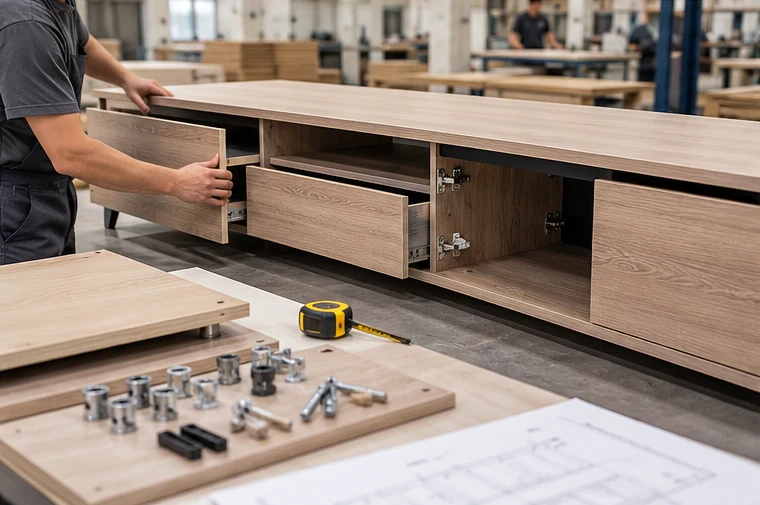
Natural veneer offers a wood appearance that may suit upscale hotel rooms or higher-positioned collections.
High-pressure laminate (HPL), applied over a suitable engineered core, can be considered where specified surface durability and decorative consistency are priorities.
These are different finishes with different visual and performance characteristics; they should not be quoted as interchangeable products.
For veneer, agree on wood species, grain direction, color range, matching method, and approved master sample.
For HPL, confirm the laminate specification, bonding system, edging detail, and how corners and cutouts are finished.
The base panel and surface must be specified together.
Best fit: Design-led hospitality casegoods, premium apartments, and OEM projects with an approved materials board and detailed room standard.
Match the TV Stand Material to the Business Model
Furniture Importers and Wholesale Distributors
For a repeat wholesale range, prioritize stable board decors, consistent hardware, replaceable parts, and efficient carton dimensions.
A carefully engineered melamine-faced construction can be more commercially useful than a costly material selected only for marketing language.
Ask the supplier to identify which parts can remain consistent across two or three sizes to simplify purchasing and inventory.
Online and Private-Label Furniture Brands
For e-commerce, packaging is part of the product specification.
Analyze individual parcel weight, carton dimensions, vulnerable long panels, assembly sequence, labeling, and the cost of sending replacement components.
The lowest ex-factory price may not be the lowest cost after damage claims, returns, and fulfillment fees.
A flat-pack TV stand must survive the actual distribution route.
Hotels, Serviced Apartments, and Rental Housing
Project buyers should evaluate daily-use durability, cleanability, maintenance access, finish matching, and ease of room-by-room installation.
A TV cabinet may need concealed cable routing, easy-access storage, or coordination with wall panels and desks.
Lock the finish approval and installation tolerances before production.
For room packages and bulk schedules, see Starwood’s project furniture manufacturing services.
Student Housing and High-Turnover Properties
In furnished rentals and student accommodation, replacement cost and predictable assembly are often more important than decorative complexity.
Use straightforward geometry, well-supported shelves, common fasteners, and finishes appropriate to the cleaning routine.
Ask whether a damaged side panel or door can be replaced without replacing the entire unit.
Structural Details That Matter More Than Board Thickness
Buyers often request “18 mm board” and assume the specification is complete.
In production, the relationship between panel thickness, shelf span, load, connector positions, cabinet bracing, and wall-fixing requirements determines how the assembled TV stand behaves.
Top Panels, Shelves, and Load Paths
Confirm whether the television rests on the furniture or is wall-mounted.
For a TV-supporting unit, require a defined maximum load, the intended contact area, and evidence that the design is suitable for that configuration.
Review long unsupported shelves, wide tops, and cutouts that may reduce stiffness.
Where needed, the factory may propose partitions, thicker components, concealed reinforcement, or a revised support layout.
Edge Banding, Drilling, and Hardware
Exposed board edges are common areas for handling damage and moisture entry.
Specify edging materials, adhesion expectations, color matching, and visible-joint quality.
Check pilot-hole accuracy, cam-and-dowel alignment, hinges, drawer slides, door gaps, and adjustable feet.
For repeat-order furniture, hardware changes should require buyer approval rather than silent substitution.
Ventilation, Cable Access, and Stability
Media consoles often carry routers, streaming devices, and other electronics.
Confirm rear ventilation, cable-hole placement, wire management, and clearance requirements for the intended devices.
Tall or narrow configurations may need anti-tip provisions or wall anchoring appropriate to the destination market, design, and installation method.
A floating unit also requires a separate wall and fixing-system review.
Export Compliance and Responsible Material Sourcing
Compliance should be assessed for the actual destination and product construction.
A generic “eco-friendly board” statement does not replace regulated product documentation, component traceability, or buyer-specific testing requirements.
For goods placed on the U.S. market, review the U.S. EPA guidance on TSCA Title VI formaldehyde emission standards.
It addresses regulated composite wood products and finished goods containing them.
Ask your supplier which panel categories are used, who supplies them, what supporting documentation is available, and how compliant batches are identified.
A declaration should match the actual production materials.
Responsible forest sourcing is another separate question.
The Forest Stewardship Council’s chain-of-custody guidance explains how certified forest-based materials and claims are tracked.
If your product requires an FSC claim, request a valid chain-of-custody pathway and ensure the quoted product is eligible; do not assume an attractive woodgrain finish proves certification.
For EU-bound furniture, the European Commission’s deforestation-free products guidance explains due-diligence obligations and application dates for products in scope.
Buyers should confirm current requirements, customs classification, and their role in the supply chain before contracting.
The rules and timelines can change, so compliance planning should be revisited before shipment.
Structural performance is distinct from emissions compliance.
ISO 7170:2021 describes test methods for the strength, durability, and stability of storage units, including relevant furniture configurations; it does not establish universal pass/fail criteria.
Agree on appropriate tests, loads, acceptance levels, and evidence with the buyer’s laboratory or compliance team.
What a Capable OEM/ODM TV Stand Factory Should Provide
A manufacturing partner should help turn a market brief into a repeatable, inspectable product.
Starwood Industry Co., Ltd., a panel furniture manufacturer based in Jiangmen, Guangdong, China, describes its capabilities in sampling, engineered-wood manufacturing, customization, quality control, and export-ready flat-pack packing.
Buyers can review its factory and company information and OEM/ODM manufacturing services before sending drawings.
For an OEM order, the customer typically provides drawings, dimensions, target construction, and performance requirements.
The factory reviews feasibility and prepares a material and hardware proposal.
For an ODM development, the buyer may begin with a reference image, sales price target, preferred style, market requirements, and shipping restrictions.
The manufacturer then helps develop the configuration and sample for approval.
In both cases, insist on controlled technical information: revision numbers, drawings, bill of materials, finish codes, hardware lists, approved packaging, and a signed sample.
The ability to document changes is often more valuable than a vague promise that “any customization is possible.”
OEM/ODM Customization Process: From Brief to Repeat Order
Step 1: Submit a Purchase-Focused Brief
State the destination market, sales channel, target retail or project budget, estimated order quantity, desired delivery window, and TV stand dimensions.
Include images or CAD files if available.
Identify whether you require a floor-standing console, media cabinet, wall unit, or floating configuration.
Step 2: Compare Material and Construction Proposals
Ask for at least two viable material specifications when costs are under review.
Each proposal should identify substrate, decorative surface, backing, edging, hardware, finished dimensions, estimated carton measurements, and known technical trade-offs.
Compare specifications side by side before negotiating price.
Step 3: Approve a Physical Sample
Inspect a fully assembled sample, not only color swatches.
Verify door gaps, shelf support, assembly sequence, finish color under realistic lighting, packing method, and instructions.
Record changes in a revision-controlled approval sheet; a photograph alone may not capture a technical requirement.
Step 4: Freeze the Production Specification
Approve the final bill of materials, dimensions, finish master sample, fittings, artwork, carton marks, QC checkpoints, and delivery terms.
Changes after material ordering can affect both price and lead time, especially for special finishes or custom hardware.
Step 5: Confirm Production, Inspection, and Shipping
Agree on milestones, inspection responsibilities, defect classifications, carton testing needs, labeling, packing lists, and loading requirements.
For repeat orders, maintain the same approved reference specification and manage any proposed substitutions formally.
MOQ, Sampling, and Production Lead Times
There is no responsible universal MOQ for custom TV stands.
Minimum order quantities depend on the board decor, surface treatment, panel yield, hardware purchasing quantities, printed cartons, production setup, and whether the order can share materials with other SKUs.
A standard melamine program may allow a different minimum from a custom lacquered or veneered design.
When requesting MOQ, ask the factory to separate MOQ per design, MOQ per color, and total mixed-container quantity.
Also ask whether pilot orders, combined SKUs, shared finishes, or plain cartons can reduce the entry requirement.
A small test run may have a higher unit price because setup and purchasing costs are spread over fewer cabinets.
Lead time should be quoted from an agreed trigger, such as confirmed drawings, approved samples, deposit receipt, or receipt of special materials.
A sample schedule is not a mass-production schedule.
Request individual milestones for technical review, sampling, sample revisions, material purchasing, production, inspection, packaging, and container loading.
Book vessel space using the confirmed shipment plan rather than an unverified “standard factory lead time.”
Flat-Pack Packaging and the Real Landed Cost
For a panel furniture exporter, packaging has a direct effect on delivered profitability.
A TV stand with long, narrow panels and heavy fittings can be vulnerable to impact, vibration, corner compression, and incorrect assembly.
Buyers should specify the expected route: container shipment, warehouse handling, retail distribution, or direct-to-consumer parcel delivery.
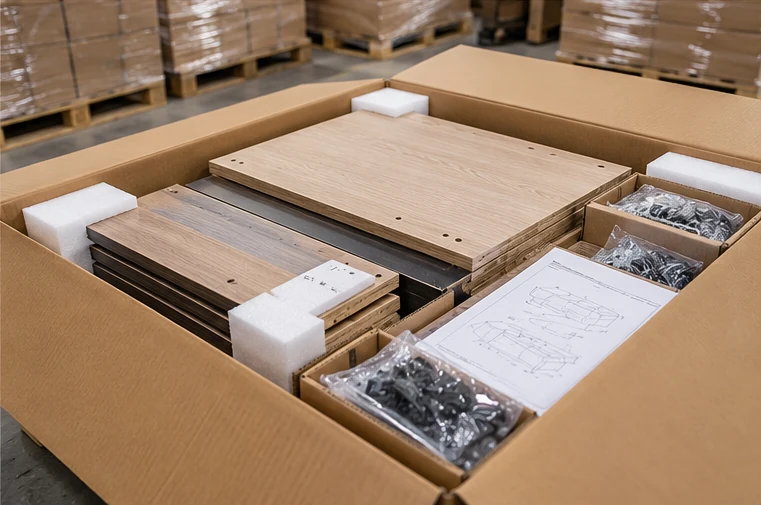
A practical packing specification covers individual panel protection, corner guards, separation of finished surfaces, contained hardware bags, clear assembly instructions, carton strength, barcode placement, and replacement-part identification.
Flat-pack design can improve container utilization, but excessive carton weight or poorly distributed components can offset the benefit.
For packaging validation, the International Safe Transit Association’s test-procedure guidance helps buyers identify different approaches for furniture packages, parcel distribution, and other transport environments.
Select a procedure appropriate to your actual logistics route; do not claim “ISTA tested” unless testing was performed and documented.
Evaluate total landed cost, not only FOB price.
Include packaging, freight, import duties and taxes where applicable, inspection, warehousing, installation labor, claims, and replacement parts.
Ask the supplier for carton length, width, height, gross weight, net weight, carton count per set, and a preliminary loading plan to support the calculation.
Quality Control Points Before Shipment
A factory-side inspection plan should match the risks of the selected construction.
For incoming panels, verify material identification, thickness tolerance where specified, surface appearance, and relevant traceability documents.
During production, monitor cutting accuracy, edge-banding quality, drilling position, finishing, and hardware compatibility.
Inspect an assembled TV stand from the production batch to check stability, alignment, doors and drawers, support points, and the intended load configuration.
Confirm that the assembly instructions reflect the actual hardware pack.
Finally, review carton identification, protective packing, shipping marks, and loading condition.
Agree on sampling method, defect categories, and acceptance criteria before inspectors arrive; no single generic checklist replaces the approved buyer specification.
TV Stand RFQ Checklist for Importers and Project Buyers
To receive a useful OEM/ODM quotation, send a compact but complete buying brief.
Include:
- Buyer profile: Importer, distributor, retail brand, e-commerce seller, contractor, or property developer.
- Product: Reference photos or drawings, size, storage layout, TV-support requirements, and intended installation.
- Materials: Preferred panel cores, surfaces, edge banding, hardware, and alternate specifications for comparison.
- Market: Destination country, required documents, testing, labeling, and language for assembly instructions.
- Volume: Target quantity per SKU and finish, mixed-container plan, and potential repeat-order forecast.
- Packing: Flat-pack or assembled, retail or mail-order distribution, branding, barcode, and carton limitations.
- Commercial terms: Target price level, Incoterm, destination port, sample deadline, and requested delivery date.
If you are sourcing coordinated hotel or apartment room packages, attach the room schedule and installation drawings.
Clarify whether the quote should cover TV stands only or related wardrobes, desks, bedside units, and storage cabinets.
Frequently Asked Questions About TV Stand Materials and OEM Supply
What is the best material for a wholesale TV stand?
There is no single best material.
Melamine-faced particleboard can serve cost-focused ranges; MDF is useful for particular finish and machining requirements; plywood may suit selected structural components.
The best choice meets the agreed load, finish, cost, compliance, and shipping requirements.
Is MDF or plywood better for a hotel TV cabinet?
Choose based on the actual design and performance requirement.
MDF may be preferred for smooth finished components, while plywood can be evaluated for selected high-use components.
The finished cabinet, hardware, installation, and approved tests matter more than the material label alone.
Can an OEM TV stand manufacturer produce my own design?
Yes, subject to feasibility and final agreement.
Provide drawings, dimensions, material specifications, hardware expectations, market requirements, and packaging details.
Sampling and documented approval should come before volume production.
What is the MOQ for custom TV stands from China?
MOQ varies by construction, finish, hardware, cartons, and the number of SKUs.
Request a written MOQ per design and color, plus options for shared materials, a pilot run, or a mixed-container shipment.
Avoid relying on a generic advertised number.
How long does OEM/ODM TV stand manufacturing take?
Timing depends on technical readiness, sample revisions, material availability, production capacity, finish complexity, and shipping arrangements.
Ask for a milestone-based schedule with clear start conditions and a confirmed ex-factory date.
Can TV stands be supplied flat-packed with private labeling?
Yes.
Flat-pack design, assembly guides, labeled hardware bags, carton marks, barcodes, and private-label artwork can be included in an approved OEM specification.
Confirm package testing expectations and the actual distribution route.
What documents should a TV stand exporter provide?
Depending on the destination and the contract, ask for a commercial invoice, packing list, material records, applicable compliance documentation, testing records, and shipping documents.
Requirements vary; buyers should confirm them with their customs and regulatory advisers.
How do I compare two TV cabinet factory quotations fairly?
Compare the exact panel cores, board thicknesses, finishes, edging, hardware, packaging, quantities, terms, testing scope, and shipping assumptions.
Request a line-by-line specification comparison when prices differ significantly.
Request an OEM/ODM TV Stand Quotation
The most competitive TV stand is not necessarily the one using the cheapest panel.
It is the design that meets your sales channel, target cost, product performance, and delivery requirements with a specification the factory can repeat consistently.
Starwood supports customized flat-pack TV stands and related panel furniture for importers, brands, wholesalers, and hospitality or apartment projects.
Explore our OEM TV stand product range, discuss a new model through our OEM/ODM furniture manufacturing service, or review our commercial furniture project capabilities.
Please include your reference image or drawings, destination market, target quantity, and preferred finish so we can review the project on a practical manufacturing basis.