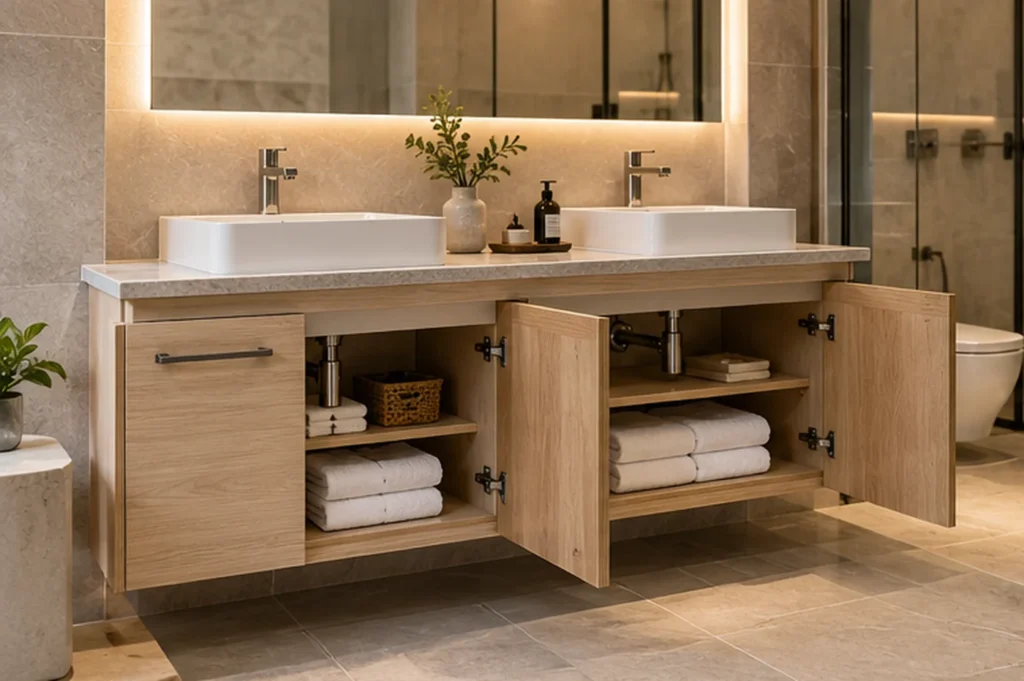
For furniture importers, hotel developers, apartment contractors, and private-label bathroom furniture brands, sourcing a marine plywood bathroom cabinet is more than selecting a moisture-resistant board. Buyers must evaluate plywood specifications, cabinet construction, waterproofing details, manufacturing consistency, minimum order quantities, and international delivery requirements.
A poorly specified bathroom vanity can create installation delays, maintenance costs, and warranty claims across an entire property development.
At Starwood Industry Co., Ltd., we focus on OEM and ODM panel furniture manufacturing for international B2B buyers. This practical procurement guide explains how to source marine plywood bathroom cabinets from a China furniture factory, compare material options, control production quality, and prepare reliable specifications for hotel, apartment, and wholesale furniture projects.
Table of Contents
- Why Commercial Buyers Choose Marine Plywood Bathroom Cabinets
- What Marine Plywood Actually Means for Cabinet Manufacturing
- 5 Proven Checks Before Ordering Marine Plywood Bathroom Cabinets
- Marine Plywood vs. MDF and Other Bathroom Cabinet Materials
- Recommended Specifications for OEM Bathroom Cabinets
- Bathroom Cabinet Applications in Hotels and Apartments
- OEM & ODM Bathroom Cabinet Manufacturing Process
- Factory Pricing and Cost Optimization
- MOQ and Bulk Order Requirements
- Sampling, Quality Control, and Production Lead Time
- Export Packaging and Container Shipping
- Material Compliance and Documentation
- Why Source From Starwood?
- How to Request a Factory Quotation
- Frequently Asked Questions
Why Commercial Buyers Choose Marine Plywood Bathroom Cabinets
Bathrooms are among the most demanding environments for engineered wood furniture.
Cabinets may be exposed to high humidity, water splashes, plumbing condensation, cleaning chemicals, and repeated temperature changes.
For a residential homeowner, cabinet failure may affect only one bathroom. For a hotel chain or apartment developer, a similar problem across hundreds of installations can result in significant replacement costs.
This is why many professional buyers evaluate marine plywood when developing premium bathroom furniture collections.
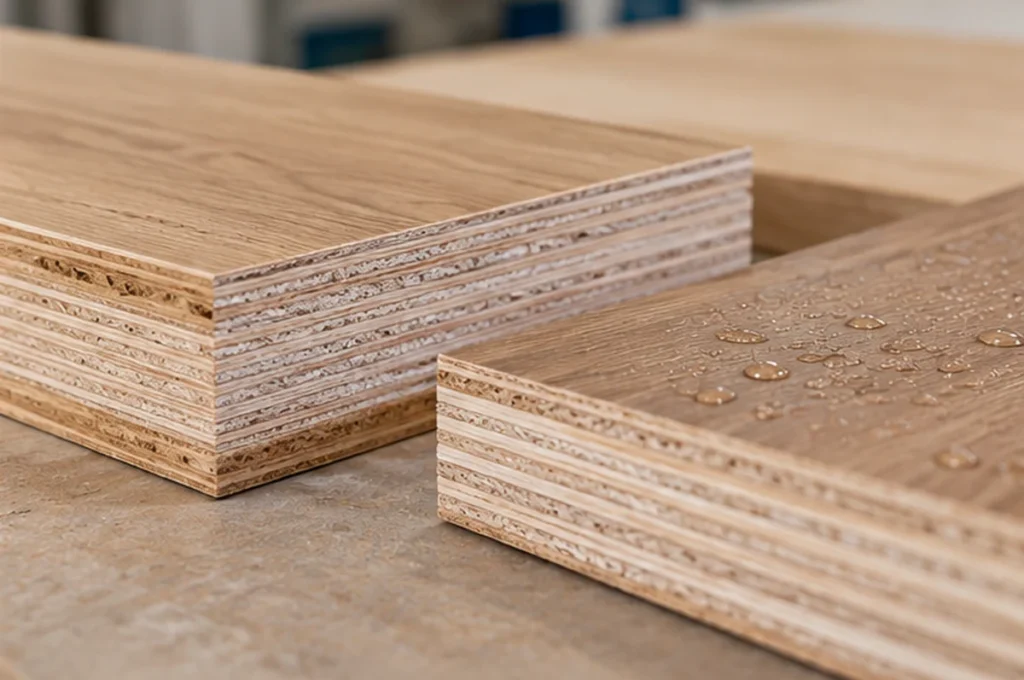
Moisture Resistance and Structural Stability
Marine plywood is manufactured with bonding and construction characteristics intended for demanding moisture conditions.
When appropriately specified, it can provide a suitable substrate for bathroom vanity carcasses, storage cabinets, and selected structural components.
However, marine plywood does not automatically make a finished bathroom cabinet completely waterproof.
Performance depends on the entire cabinet system, including:
- Plywood quality and construction
- Surface laminate or coating
- Edge sealing
- Sink and plumbing cutouts
- Hardware corrosion resistance
- Cabinet assembly
- Installation and ventilation
A factory must consider every potential water-entry point rather than relying entirely on the plywood grade.
Lower Long-Term Project Risk
Commercial buyers should evaluate more than the initial factory price.
Bathroom furniture that performs reliably can help reduce replacement frequency, maintenance disruption, and customer complaints.
For hotels, the cost of replacing a vanity may include room downtime, labor, plumbing work, and damage to adjacent finishes.
For apartment developments, standardized and well-documented cabinet construction makes maintenance and replacement easier.
The purchasing objective should therefore be consistent performance at an appropriate total project cost.
What Marine Plywood Actually Means for Cabinet Manufacturing
The term “marine plywood” is widely used in international furniture sourcing, but its meaning must be clarified before purchase.
A buyer should not assume that every supplier uses the same panel construction simply because the quotation contains this term.
Marine-Grade Plywood Specifications
The APA – The Engineered Wood Association provides technical guidance on marine-grade plywood, including veneer quality, exterior bonding, and core construction.
Buyers considering a recognized British marine plywood specification can also consult BS 1088:2018 — Marine Plywood Requirements.
These references help purchasing teams understand why marine plywood grades cannot be judged by appearance alone.
BS 1088 was primarily developed for marine applications, and its requirements should not be presented as a universal guarantee of bathroom furniture performance.
For a commercial bathroom cabinet, the manufacturer still needs to evaluate the final furniture design.
Questions to Ask Your Plywood Supplier
Before approving the material, request information about the plywood’s veneer species, core composition, thickness, bonding system, applicable grade, and available test documentation.
Inspecting a cut panel sample can reveal core gaps, inconsistent veneer layers, or other defects that may be hidden after surface finishing.
If a supplier claims compliance with a particular standard, request supporting documentation identifying the actual product.
Factory procurement recommendation: Specify the required plywood grade in the approved bill of materials. Avoid accepting an unverified description such as “100% waterproof marine board” without technical details.
5 Proven Checks Before Ordering Marine Plywood Bathroom Cabinets
The following purchasing checks help importers and project contractors compare manufacturers using measurable requirements.
1. Verify Plywood Core Quality and Thickness
The cabinet’s structure begins with its substrate.
Plywood thickness should be selected according to cabinet dimensions, shelf loads, hardware requirements, and installation method.
For many bathroom vanity designs, approximately 15–18 mm plywood may be considered for main cabinet panels, subject to engineering approval.
Back panels and internal components may use different thicknesses depending on their function.
A factory should explain how the material specification supports the proposed cabinet structure.
For wide floating vanities, additional reinforcement or specialized mounting systems may be necessary.
Thickness alone does not determine structural quality. Core construction, fastener performance, span, and loading conditions must also be reviewed.
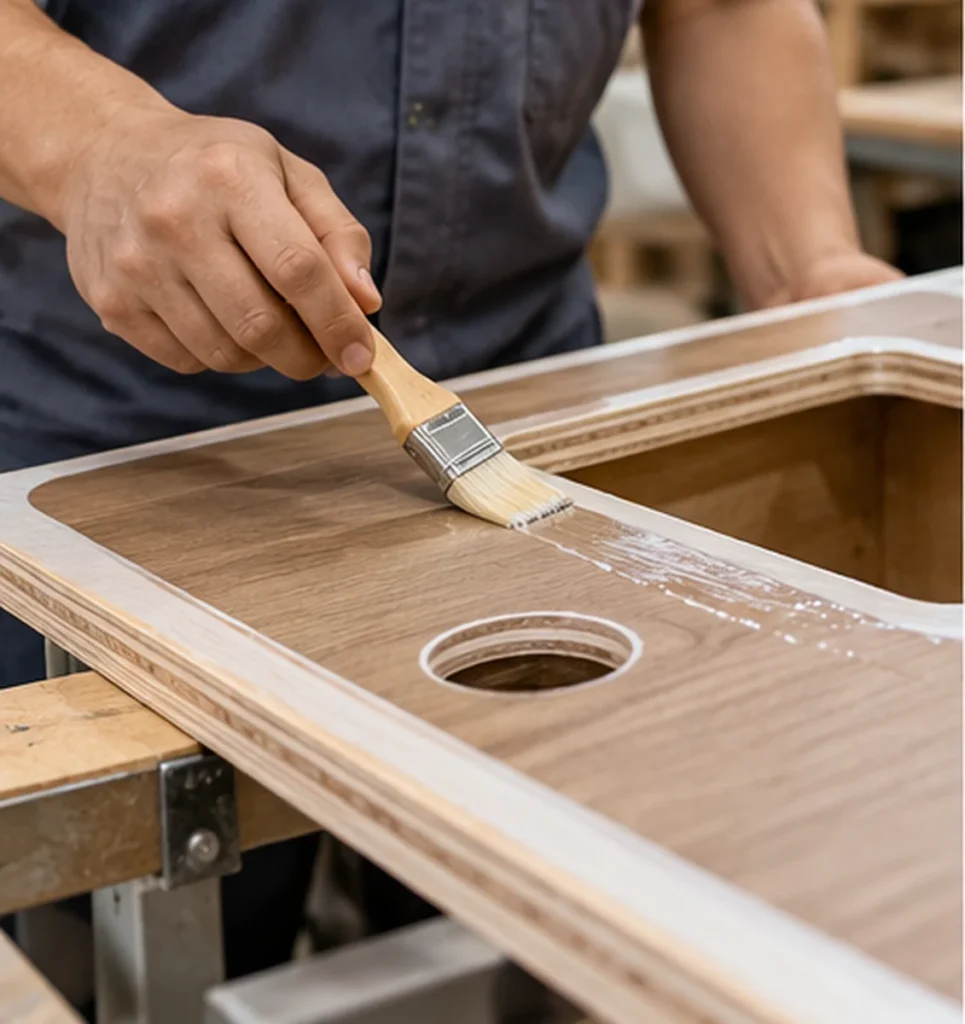
2. Inspect Edge Sealing and Surface Finishing
In bathroom furniture manufacturing, exposed plywood edges are frequent potential moisture-entry points.
Important locations include sink openings, plumbing access holes, cabinet bottoms, door edges, and fastening positions.
Depending on the design, manufacturers may use protective coatings, suitable edge banding, sealed cutouts, and appropriate adhesive systems.
Buyers should request a sample showing the actual production finishing method.
Pay particular attention to areas hidden during normal use.
A visually attractive cabinet can still have poorly protected cutouts behind the sink.
For a waterproof plywood vanity, the water-resistance requirement should cover both visible and concealed surfaces.
3. Confirm Cabinet Hardware and Load Requirements
Hardware selection affects the service life of commercial bathroom cabinetry.
Hotel vanities often require frequent drawer opening and closing, while apartment furniture must remain practical over extended periods of occupancy.
Specify hinge models, drawer runners, handles, fasteners, and mounting accessories.
For coastal developments or other demanding environments, appropriate corrosion resistance should be considered.
Wall-mounted cabinets require particular attention to load-bearing design.
A floating vanity must be compatible with the actual wall construction and support system.
The responsible project professional should approve mounting arrangements and installation loads.
4. Evaluate Factory Production Consistency
One successful sample does not prove that a supplier can manufacture hundreds of identical cabinets.
Professional procurement teams should ask how the factory manages repeatability.
Important production controls include CNC cutting accuracy, drilling positions, edge treatment, hardware installation, color matching, and assembly inspection.
The approved sample should become the reference for bulk production.
Any changes to plywood, hardware, surface finish, or structure should require buyer approval before implementation.
For projects involving several production batches, consistent material identification and documented specifications help reduce variations.
5. Check Export Packaging and Delivery Readiness
Packaging should be reviewed during product development, not after manufacturing is complete.
A bathroom vanity may require protection against panel abrasion, corner damage, carton compression, and movement during transportation.
Flat-pack designs can improve container utilization, while assembled cabinets may reduce on-site assembly work.
However, the correct solution depends on product construction and destination requirements.
For international shipments, request carton dimensions, gross weights, packaging drawings, and a preliminary loading estimate.
A factory quotation becomes more meaningful when the supplier explains what is included in the packaging cost.
Marine Plywood vs. MDF and Other Bathroom Cabinet Materials
Buyers often compare marine plywood, exterior-bonded plywood, moisture-resistant MDF, and laminated particleboard.
These materials serve different purchasing requirements.
| Material | Main Advantage | Purchasing Consideration |
|---|---|---|
| Marine-grade plywood | Defined panel properties for demanding applications | Verify grade, bonding and documentation |
| Exterior-bonded plywood | Potentially suitable moisture-resistant construction | Confirm actual performance and edge protection |
| Moisture-resistant MDF | Uniform surface for selected decorative components | Requires appropriate sealing and moisture control |
| Standard MDF | Competitive cost and easy processing | Less suitable for repeated wet exposure |
| Laminated particleboard | Economical for suitable panel furniture applications | Edge treatment and exposure conditions are critical |
Which Material Offers the Best Value?
There is no single answer for every project.
Premium hotel bathrooms may justify a higher plywood specification, while a cost-controlled apartment program may use a carefully engineered combination of materials.
For example, a project might specify plywood for the cabinet carcass and a suitable painted panel for decorative door fronts.
The objective is to choose materials based on exposure conditions, product design, expected service life, and budget.
An experienced panel furniture manufacturer should help the buyer identify unnecessary material costs without weakening essential quality requirements.
Recommended Marine Plywood Bathroom Cabinet Specifications
A complete technical specification allows suppliers to quote comparable products.
The following table is a practical starting point for OEM bathroom furniture enquiries.
These are reference options, not confirmed Starwood stock specifications.
| Specification | Recommended RFQ Details |
|---|---|
| Product | Marine plywood bathroom vanity cabinet |
| Cabinet width | 600 / 800 / 900 / 1200 mm or customized |
| Cabinet depth | Approximately 450–550 mm or customized |
| Cabinet body | Specified plywood, commonly 15–18 mm |
| Back panel | Thickness according to structural design |
| Door and drawer fronts | Plywood or approved decorative panel |
| Surface finish | Laminate, veneer, paint or custom finish |
| Edge protection | Defined sealing and edge treatment |
| Hardware | Specified hinges, runners and handles |
| Installation | Floor-standing or wall-mounted |
| Sink arrangement | Countertop, integrated or other approved configuration |
| Cabinet construction | Assembled, semi-assembled or KD |
| OEM branding | Labels, carton printing and instructions |
| Packaging | Export carton with protective components |
| Order quantity | According to project and factory confirmation |
Confirm Plumbing and Installation Dimensions
A bathroom vanity drawing should identify more than width, depth, and height.
Buyers should provide sink position, drainage clearance, water supply openings, wall fixing locations, countertop requirements, and service access.
Plumbing interference is a common source of installation difficulty.
For large property developments, minor dimensional problems can become expensive when repeated across multiple units.
The factory should therefore review installation drawings before approving production.
Clarify the Scope of Supply
A bathroom cabinet quotation does not always include the countertop, basin, faucet, mirror, mounting brackets, or drainage components.
Buyers must identify exactly which accessories are included.
This avoids comparing a cabinet-only quotation with another supplier’s complete vanity package.
Explore our bathroom furniture manufacturing solutions for additional OEM product possibilities.
Bathroom Cabinet Applications in Hotels and Apartments
Different commercial markets require different cabinet specifications and purchasing arrangements.
Hotel Bathroom Vanity Projects
Hotel buyers often prioritize appearance consistency, cleaning convenience, hardware reliability, and service access.
A hotel may require several vanity sizes while maintaining the same surface finish throughout the property.
Standardizing material specifications and hardware can simplify maintenance and spare-parts management.
Before mass production, many project teams approve a representative mock-up bathroom.
This enables designers, contractors, and purchasing managers to review the cabinet’s appearance and installation details together.
For coordinated hospitality furniture programs, explore our project furniture manufacturing services.
Apartment and Multifamily Developments
Apartment developers frequently work with multiple unit layouts and phased construction schedules.
Bathroom cabinets must fit specific plumbing arrangements and installation conditions.
Standardizing cabinet depths, finishes, and hardware across different widths can improve manufacturing efficiency.
For example, a development might use two or three standard vanity widths across several apartment types.
The factory can then plan production around repeatable components while maintaining the required model differences.
Bathroom Furniture Wholesalers and Brands
Wholesale buyers focus on product consistency, repeat orders, competitive pricing, and efficient distribution.
Private-label programs may require branded cartons, product labels, assembly instructions, and consistent SKU identification.
An OEM manufacturer should review these requirements before production.
For branded furniture collections, buyers may also request matching bathroom storage cabinets or complementary designs.
A coordinated product range can be easier to market than unrelated individual items.
OEM & ODM Marine Plywood Bathroom Cabinet Manufacturing Process
Starwood supports international furniture buyers through OEM and ODM furniture manufacturing services.
The development process depends on whether the buyer already has approved drawings or needs support turning a concept into a manufacturable product.
Step 1: Product Brief and Drawing Review
The buyer provides dimensions, reference images, technical drawings, material requirements, quantities, and target market information.
The factory reviews the cabinet structure and identifies specifications requiring clarification.
For marine plywood cabinets, particular attention should be given to panel grade, sink cutouts, protective finishing, and hardware.
Step 2: Material and Cost Evaluation
The manufacturing team evaluates suitable panels, finishes, hardware, and construction methods.
Different material combinations may be compared against the target cost.
At this stage, buyers should specify which requirements are mandatory and which can be optimized.
Changes affecting moisture resistance or structural performance should not be made solely to reduce price.
Step 3: Engineering and Sample Development
After preliminary agreement, drawings and component specifications are confirmed.
A sample allows the buyer to evaluate dimensions, appearance, finish, assembly, and functionality.
The sample should use the agreed materials wherever practical.
If a substitute is necessary, it must be clearly identified before approval.
Step 4: Sample Approval and Production Confirmation
Buyer feedback is incorporated into the final design.
The approved specification should identify materials, dimensions, color references, hardware, packaging, and inspection requirements.
The factory can then confirm production planning and the order’s commercial terms.
Step 5: Bulk Manufacturing and Inspection
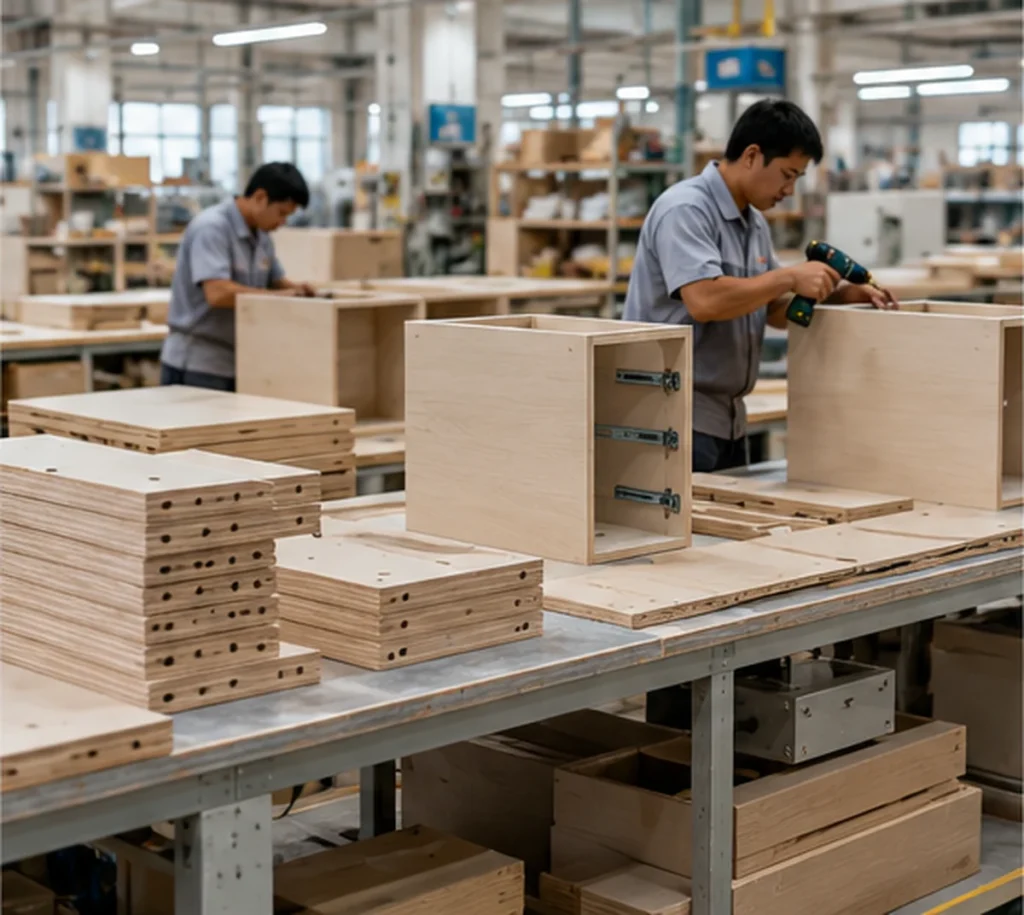
Manufacturing may involve CNC panel cutting, drilling, edge processing, finishing, hardware preparation, trial assembly, and packaging.
Inspection should take place at appropriate production stages.
Final checks compare finished components with the approved drawings and sample.
Step 6: Export Packing and Shipment
Products are packed according to the agreed method.
Cartons, hardware, labels, and assembly instructions are checked before loading.
The shipment is then coordinated according to the agreed trade terms and delivery schedule.
This structured process helps reduce misunderstandings between overseas purchasing teams and factory production departments.
Factory Pricing and Cost Optimization
The cost of a marine plywood bathroom cabinet depends on more than the board price.
Important cost factors include plywood grade, cabinet size, material thickness, finish complexity, hardware, machining requirements, order quantity, and packaging method.
How Buyers Can Improve Factory Pricing
A well-organized purchasing program creates opportunities for manufacturing efficiency.
Standardizing components across multiple cabinet sizes may improve material utilization and simplify production.
Using common hinges, drawer systems, and finishes can also reduce unnecessary complexity.
For hotel projects, repeated cabinet modules can help control both factory costs and installation labor.
However, buyers should not reduce cost by omitting essential sealing details or substituting unapproved materials.
Compare Total Landed Cost
The lowest FOB or factory price is not always the lowest final cost.
International purchasing teams should consider freight, import charges, unloading, warehousing, installation, and possible replacement expenses.
A more expensive but efficiently packed cabinet may deliver a lower landed cost than a cheaper product with poor container utilization.
Request enough packing information to compare realistic shipping scenarios.
MOQ and Bulk Order Requirements
Minimum order quantity is an important question for furniture importers and project contractors.
Starwood’s general export-order reference is one container, as stated on our company website.
However, individual product programs may have different requirements depending on design, materials, model quantity, and production planning.
Specific marine plywood bathroom cabinet MOQ must therefore be confirmed through quotation.
Can Buyers Combine Several Vanity Models?
A mixed-model container may be considered when products share compatible materials, finishes, and hardware.
For example, a hotel development may require 600 mm, 800 mm, and 1200 mm vanities.
The purchasing team should provide quantities for each model rather than only the total project volume.
The factory can then evaluate production feasibility and container loading.
What About Trial Orders?
New furniture brands may require samples or a limited initial order before launching a collection.
Sample availability and commercial production MOQ are separate questions.
Buyers should communicate their initial requirements and estimated repeat-order potential.
This allows the manufacturer to evaluate a practical arrangement.
Sampling, Quality Control, and Production Lead Time
Reliable bathroom cabinet manufacturing depends on clear approvals and inspection criteria.
Quality should be managed throughout production rather than checked only before shipment.
Incoming Material Inspection
The approved plywood specification should guide incoming material checks.
Depending on the contract, inspection may include panel thickness, appearance, core quality, bonding documentation, and required moisture-related characteristics.
Materials that do not match the approved specification should be reviewed before use.
In-Process Quality Control
During manufacturing, important checks include panel dimensions, machining positions, edge finishing, surface consistency, hardware compatibility, and assembly accuracy.
For bathroom furniture, protected plumbing cutouts and correctly finished concealed edges are especially important.
Trial assembly may reveal drilling errors or interference between drawers and drainage components.
Pre-Shipment Inspection
Before shipment, the inspection plan may cover appearance, measurements, hardware operation, packing completeness, carton labels, and comparison with the approved sample.
The buyer and manufacturer should agree on inspection methods and acceptance criteria before mass production.
How Long Does Production Take?
Custom bathroom cabinet lead time depends on the final order requirements.
For preliminary planning, approximately 35–60 days after final approval may be discussed for some customized bulk furniture programs.
This is an illustrative planning range, not a guaranteed lead time for marine plywood cabinets.
Special materials, custom finishing, extensive sample revisions, or third-party testing can extend the schedule.
Buyers should also allow time for sample approval, inspection, ocean freight, customs clearance, and destination delivery.
For apartment and hotel projects, always communicate the required installation date and shipment phases before placing the order.
Export Packaging and Container Shipping
A good bathroom cabinet must arrive at its destination in suitable condition.
International shipments involve repeated handling, container loading, unloading, and warehouse movement.
Flat-Pack Bathroom Cabinet Packaging
Flat-pack or knock-down construction can improve container utilization and reduce storage volume.
A typical arrangement may include separately protected panels, identified hardware bags, assembly instructions, and reinforced cartons.
However, KD construction must be compatible with the bathroom cabinet’s structural and moisture-protection requirements.
Not every design is suitable for complete knock-down assembly.
Some premium vanity products may require partially assembled or fully assembled packaging.
Packaging Protection
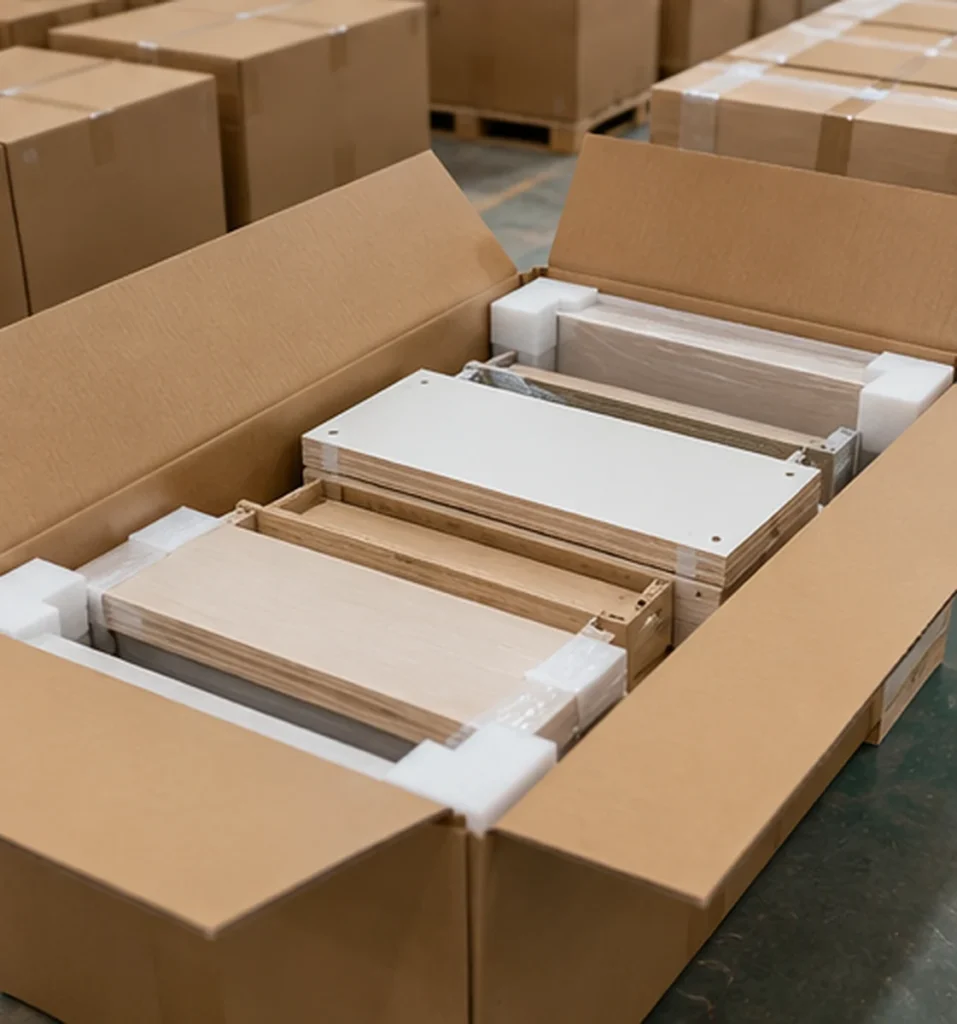
Depending on product requirements, export packaging may include protective foam, corner guards, protective films, hardware separation, and reinforced cartons.
The International Safe Transit Association publishes packaging test procedures that can help buyers evaluate transport performance.
The appropriate procedure depends on the actual distribution environment.
See our flat-pack furniture export packaging page for an overview of Starwood’s packaging approach.
International Shipping Terms
Furniture quotations should identify the delivery terms and named location.
The International Chamber of Commerce’s Incoterms rules explain how responsibilities, delivery costs, and risks are allocated between buyers and sellers.
Purchasing teams should confirm whether the quotation covers factory collection, shipment arrangements, freight, or destination delivery.
Carton markings and loading lists should also match the buyer’s warehouse or project installation requirements.
Material Compliance and Documentation
International furniture buyers may require technical documents for product approval, customs procedures, or retail distribution.
Documentation requirements vary by destination market and product construction.
Plywood Bonding and Performance
Where plywood bonding performance must be verified, buyers can refer to recognized methods such as ISO 12466-1, Plywood Bonding Quality Test Methods.
The actual testing program should be agreed according to the specified panel and project requirements.
A supplier should not claim compliance without supporting evidence.
Formaldehyde Emission Requirements
For furniture entering the United States, buyers should review the applicable requirements of the US Environmental Protection Agency’s TSCA Title VI program.
These rules address specified composite wood products, including regulated hardwood plywood, MDF, particleboard, and certain finished products containing them.
Applicability depends on the actual material construction.
Buyers should request appropriate compliance documents rather than assuming every marine plywood product has identical regulatory treatment.
Responsible Timber Sourcing
For procurement programs requiring certified forest-based materials, the Forest Stewardship Council explains chain-of-custody certification requirements.
Any FSC-related material claim must be supported by the relevant certified supply chain and documentation.
Confirm certification requirements at the beginning of the project because they may affect material sourcing and quotation.
Why Source Marine Plywood Bathroom Cabinets From Starwood?
Starwood Industry Co., Ltd. is a panel furniture manufacturer based in Jiangmen, Guangdong Province, China.
Since 2013, we have specialized in flat-pack engineered panel furniture for international brands, importers, wholesalers, and commercial project buyers.
Our manufacturing approach focuses on repeatable production, practical furniture engineering, and export-oriented delivery.
Panel Furniture Manufacturing Capabilities
Our production scope includes plywood, MDF, particleboard, and other engineered panel furniture.
Manufacturing activities include product development, CNC panel processing, drilling, edge processing, assembly checks, quality inspection, and export preparation.
For marine plywood bathroom cabinet enquiries, we review the specified materials, construction, finishes, hardware, order quantity, and project requirements before confirming manufacturing feasibility.
OEM and Project Furniture Support
We work with buyers requiring custom sizes, private-label products, hotel furniture, apartment furniture, and wholesale collections.
Our OEM/ODM furniture manufacturing services support product development and repeat production.
For projects involving bathroom storage alongside wardrobes, bedroom furniture, or other cabinet products, our commercial project furniture manufacturing solutions provide a broader sourcing option.
The objective is to help buyers establish clear specifications and manageable production programs rather than simply purchase an attractive sample.
How to Request a Marine Plywood Bathroom Cabinet Factory Quotation
A complete RFQ helps the factory provide a more accurate quotation and identify potential technical risks early.
Please include the following information when contacting our team:
- Product type: Marine plywood bathroom cabinet or custom vanity
- Drawings: Dimensions, structure, and plumbing cutouts
- Material: Required plywood grade and thickness
- Finish: Laminate, veneer, paint, or custom surface
- Hardware: Hinges, drawer runners, and handles
- Quantity: Total units and quantity per model
- Installation: Wall-mounted or floor-standing
- Packaging: Flat-pack, assembled, or private-label requirements
- Destination: Country and receiving port
- Schedule: Required shipment or project delivery date
Buyers with an existing product can send drawings and specifications.
For new ODM developments, reference photos, target dimensions, price expectations, and market positioning are useful starting points.
The more complete the information, the easier it is to prepare comparable quotations and reduce unnecessary revisions.
Frequently Asked Questions About Marine Plywood Bathroom Cabinets
Is marine plywood better than MDF for bathroom cabinets?
Marine plywood can be preferable when the project requires specific plywood bonding and construction characteristics. However, suitable moisture-resistant MDF may still be practical for selected decorative components. The correct material depends on exposure conditions, cabinet structure, finishing, and budget.
Is a marine plywood bathroom cabinet completely waterproof?
No. Marine plywood does not make a finished cabinet completely waterproof. Surface protection, edge sealing, plumbing connections, installation, and maintenance all influence moisture performance.
Can Starwood manufacture custom marine plywood bathroom cabinets?
Starwood supports OEM and ODM bathroom furniture development. Buyers can submit custom dimensions, drawings, material requirements, finishes, and hardware specifications for evaluation. The requested marine plywood grade and final manufacturing feasibility must be confirmed before order acceptance.
What is the MOQ for marine plywood bathroom cabinets?
Starwood’s general export-order reference is one container. Specific cabinet models and project quantities may have different arrangements. Please provide your quantity breakdown for an individual quotation.
Can you supply bathroom cabinets for hotel projects?
Yes. Starwood supports project-based panel furniture manufacturing for hotels, apartments, and commercial developments. Buyers should provide drawings, quantities, specifications, and delivery schedules for evaluation.
Can bathroom cabinets be shipped flat-packed?
Many panel furniture designs can be engineered for flat-pack or knock-down supply. The final structure depends on cabinet dimensions, hardware, sealing requirements, and installation method.
What is the typical production lead time?
Production time depends on material availability, sample approval, customization, quantity, and factory scheduling. Final lead time is confirmed during quotation and order approval.
What information is needed for an OEM quotation?
Please provide drawings or reference photos, dimensions, plywood requirements, finishes, hardware, quantities, packaging preferences, destination market, and delivery expectations.
Can different bathroom vanity sizes be combined in one order?
Mixed-model orders may be possible depending on shared materials, finish requirements, production quantities, and container loading. Each combination must be reviewed during quotation.
Which documents should importers request?
Depending on the destination market and product specification, importers may require approved drawings, material details, relevant test reports, applicable compliance documents, inspection records, and packing information.
Request a Marine Plywood Bathroom Cabinet Quotation From Our Factory
A reliable marine plywood bathroom cabinet supplier should offer more than competitive pricing.
Professional buyers need clear material specifications, practical cabinet engineering, consistent manufacturing quality, suitable packaging, and dependable communication throughout the purchasing process.
For hotel developments, apartment projects, wholesale distribution, and private-label bathroom furniture collections, early technical coordination helps create a more predictable production and delivery program.
Looking for a marine plywood bathroom cabinet manufacturer in China?
Starwood Industry Co., Ltd. welcomes enquiries from furniture importers, bathroom vanity brands, wholesalers, commercial contractors, and project developers.
Send your drawings, cabinet dimensions, required marine plywood specification, order quantity, destination market, and planned delivery schedule.
Our team can review your requirements and discuss suitable OEM/ODM manufacturing options.
Contact Starwood for a Marine Plywood Bathroom Cabinet Factory Quotation
Email: info@plywoodmfr.com
WhatsApp / Phone: +86 136 9199 4727
Factory Location: Jiangmen, Guangdong, China
Related Product: Marine Plywood Vanity and OEM Bathroom Furniture
Manufacturing Services: OEM & ODM Furniture Supplier
Commercial Projects: Hotel and Apartment Furniture Manufacturing