
Quality control for a custom cabinet should include more than checking the surface of individual panels.
During factory trial assembly, the completed cabinet can be operated as a functional unit so that the door, drawers, hinges, clearances and overall alignment can be checked together.
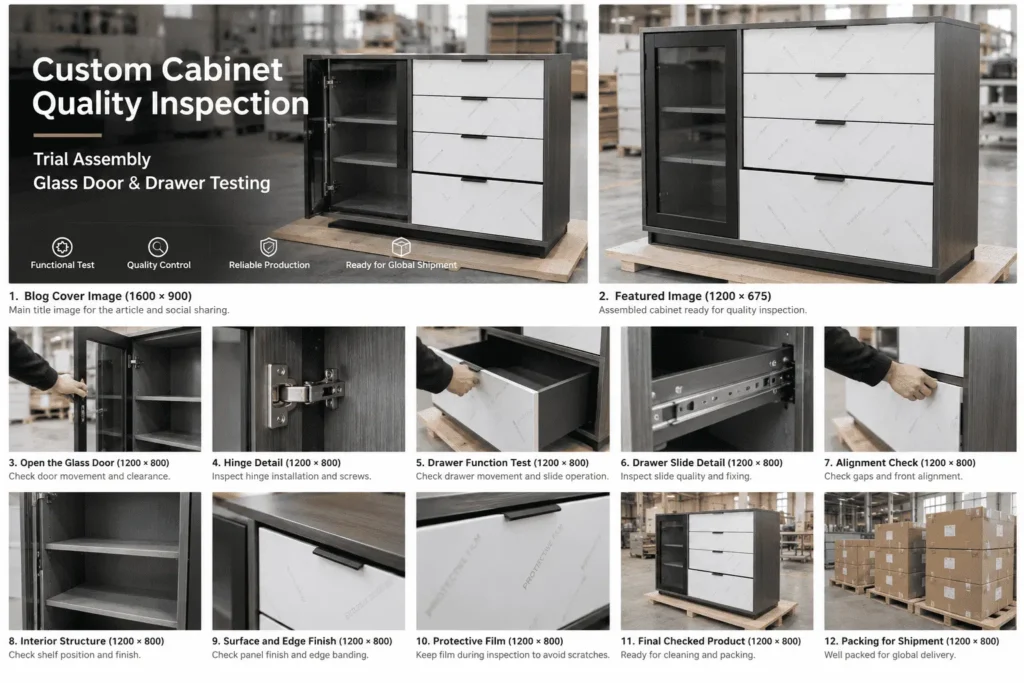
This custom cabinet quality inspection shows a real trial assembly in our factory. The inspection includes opening the framed glass door, checking the installed hinges, operating the large drawer and reviewing the relationship between the moving components and the cabinet structure.
These functional checks help identify assembly or hardware issues before the cabinet moves to final approval, cleaning and packing.
Custom Cabinet Quality Inspection During Trial Assembly
Trial assembly gives the production and quality-control teams an opportunity to inspect the cabinet in its assembled condition rather than evaluating separate panels individually.
Once the door, drawers and hardware are installed, we can check how the components actually interact.
In this cabinet, the main functional areas include a framed glass door on the left, three upper drawers on the right and a larger drawer below.
The protective film remains on the drawer fronts during the inspection to help protect the finished surfaces while the cabinet is being handled and tested.
Glass Door Opening and Hinge Check
The left side of the cabinet uses a framed glass door.
During trial assembly, we open the door through its normal movement range instead of inspecting it only in the closed position.
This allows several details to be checked at the same time.
The door should move without rubbing against the cabinet frame or nearby components. The hinges should remain securely positioned and support smooth movement. When the door returns toward the closed position, its relationship with the surrounding cabinet frame should also remain consistent.
For glass-front cabinets, alignment is especially noticeable because the frame around the glass creates clear visual reference lines.
Even a relatively small installation difference may affect the appearance of the door gap or how the door sits against the cabinet body.
Opening the door during factory inspection therefore provides more useful information than a static photograph of the finished cabinet.
It also gives the team a direct view of the hinge installation and internal mounting points.
Why Hinge Position Matters
A cabinet hinge is a small component, but its installation affects several parts of the finished product.
Poor hinge positioning may lead to uneven gaps, limited opening movement, poor closing alignment or unnecessary pressure on the door and frame.
During the custom cabinet quality inspection, we therefore look at both hardware installation and actual movement.
The objective is not simply to confirm that a hinge has been installed.
The objective is to confirm that the installed hardware works correctly with the cabinet structure.
For OEM and ODM projects, hinge type, opening angle and hardware specification can also be reviewed according to the approved product requirements.
Internal link here: OEM & ODM Panel Furniture Manufacturing Services

Drawer Function Test
The large lower drawer is another important part of this factory trial assembly.
A drawer can appear correctly aligned when it is closed but still reveal problems once it starts moving.
For this reason, drawer inspection includes actual opening and closing rather than visual inspection alone.
During a drawer function test, useful inspection points can include:
- opening movement and running clearance;
- drawer position inside the cabinet;
- relationship between the drawer front and cabinet frame;
- slide operation;
- interference with surrounding components;
- closing position and front alignment;
- general stability during movement.
In the factory footage, the drawer is opened so its movement and internal relationship with the cabinet can be seen clearly.
This type of functional check is especially useful for cabinets with wide or relatively deep drawers because movement places different demands on the drawer box and slide system than a static closed position.
Checking Door and Drawer Alignment Together
One advantage of trial assembly is that the cabinet can be judged as one complete front elevation.
The glass door, smaller drawer fronts and large lower drawer are separate components, but visually they all belong to the same cabinet.
The inspection therefore considers their relationship together.
The team can compare horizontal lines, vertical spacing, gaps between components and the position of the drawer fronts relative to the surrounding frame.
This is important because accurate individual parts do not automatically guarantee a visually consistent finished cabinet.
Small differences in drilling, fitting or hardware adjustment can influence the final assembled appearance.
Trial assembly helps make those relationships visible before the product is packed.
Protective Film During Factory Inspection
The white protective film visible on the drawer fronts has intentionally been left in place during this inspection.
Factory trial assembly involves repeated handling.
Doors may be opened several times, drawers may be operated repeatedly and the cabinet may be repositioned while different details are checked.
Keeping suitable surface protection in place during these stages can help reduce unnecessary scratches, dust contamination and handling marks.
The protective film also makes it clear that this footage documents a genuine production-stage inspection rather than a styled showroom display.
After the required functional and assembly checks have been completed, the cabinet can proceed to subsequent inspection, cleaning and packing according to the project requirements.
For international furniture orders, packaging is another part of the product-control process.
Internal link here: Flat-Pack Furniture Export Packaging
Why Trial Assembly Matters Before Packing
Final inspection should not be limited to checking whether the cabinet looks clean.
Products containing doors, drawers, hinges and slides need to be operated.
Trial assembly can help expose issues that might not be visible when components are inspected separately.
For example, it may reveal that a drawer has insufficient clearance, a hinge requires adjustment, a door gap is inconsistent or an installed component interferes with another part.
Finding this type of issue while the furniture is still in the factory is generally much easier than discovering it after packing or shipment.
This is why functional checks are an important part of furniture factory quality control.
Depending on the product and order requirements, trial assembly may be used during sample development, pre-production confirmation, production inspection or final quality control.
The exact inspection plan should follow the approved specifications for each project.
Quality Control Is More Than Final Inspection
Reliable quality control does not begin only when a finished cabinet reaches the packing area.
It starts much earlier in production.
Panel processing, edge finishing, drilling, hardware preparation, assembly and packaging all influence the finished product.
For example, accurate drilling positions affect hinge installation and drawer hardware. Edge processing affects the way panels meet during assembly. Hardware selection affects the movement of doors and drawers.
This means the final functional result depends on several earlier production stages working together.
You can see other examples of these factory processes in our updates on Edge Banding Process in Panel Furniture Production and Panel Drilling Process & Pre-Drilling Protection.
Those processes happen earlier in production, while this cabinet trial assembly shows how the processed parts and hardware perform after they have been brought together as a finished unit.
What We Check During Cabinet Trial Assembly
Although inspection requirements vary by design, a practical cabinet trial-assembly check may include:
- overall cabinet dimensions and structure;
- panel and component alignment;
- door movement;
- door gap consistency;
- hinge installation;
- drawer opening and closing;
- drawer slide operation;
- drawer-front alignment;
- interaction between moving components;
- internal fitting positions;
- surface condition;
- protective film condition;
- cabinet stability;
- hardware completeness;
- readiness for final cleaning and packing.
The purpose is not to create an unnecessarily long checklist for every product.
Instead, the inspection should focus on the details that are critical to the specific cabinet design and its intended use.
Supporting OEM and ODM Cabinet Projects
Custom furniture programs often involve more than changing a cabinet size or finish.
Different buyers may require different dimensions, internal layouts, materials, hardware specifications, surface treatments, labels and packaging methods.
Trial assembly gives the factory an opportunity to verify the physical result against the approved requirements.
For new products, it can also provide useful feedback before the same structure is repeated across a larger production quantity.
If adjustments are required, they are easier to discuss when both the buyer and factory can refer to an assembled product rather than only drawings.
Internal link here: OEM & ODM Panel Furniture Manufacturing Services
For completed project examples, buyers can also review our Furniture Manufacturing Case Studies.
From Production Details to Finished Furniture
A cabinet that opens, closes and aligns correctly is the result of multiple production steps.
Cutting accuracy, edge finishing, drilling position, hardware preparation and assembly all contribute to the final result.
That is why our Factory Updates focus on real manufacturing activities rather than only showing finished product photography.
The goal is to give buyers a clearer view of what happens during actual furniture production and quality control.
You can explore more real workshop content in our Factory Updates section, including panel processing, edge banding, drilling, inspection, packaging and other manufacturing activities.
Frequently Asked Questions
What is custom cabinet quality inspection?
Custom cabinet quality inspection is the process of checking a cabinet against its approved specifications and functional requirements. Depending on the design, it may include dimensions, surface condition, door alignment, drawer movement, hinge installation, hardware fitting and overall assembly.
Why is trial assembly important for custom cabinets?
Trial assembly allows the factory to inspect the cabinet as a complete functional unit. It can reveal alignment, clearance or hardware issues that may not be visible when individual panels are checked separately.
Why should a glass cabinet door be opened during inspection?
Opening the glass door allows the inspector to check hinge movement, clearance, opening range and the relationship between the door frame and cabinet body. It also helps identify rubbing or alignment problems.
What is checked during a drawer function test?
A drawer function test can include opening and closing movement, slide operation, running clearance, front alignment, closing position and interference with surrounding cabinet components.
Why is the protective film still on the drawer fronts?
The protective film helps protect finished surfaces while the cabinet is being handled, assembled and functionally tested in the factory. It can remain in place until the required inspection stages are complete.
Can trial assembly be included in OEM and ODM cabinet production?
Yes. Depending on the product and project requirements, trial assembly can be included during sample development, production confirmation or quality inspection to verify structure, hardware and functionality.
See More From Our Furniture Factory
This custom cabinet quality inspection shows one stage of the manufacturing process: checking how the assembled product actually functions.
The glass door is opened, the hinges are observed and the drawer is operated so that the cabinet can be evaluated as a working piece of furniture rather than only as a group of finished panels.
If you are developing a custom cabinet, storage furniture or other OEM/ODM panel furniture program, send us your drawings, reference images, dimensions, materials, hardware requirements, quantity and packaging requirements for review.