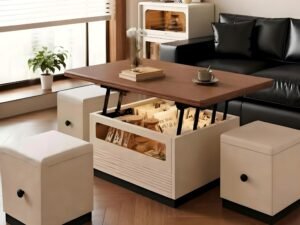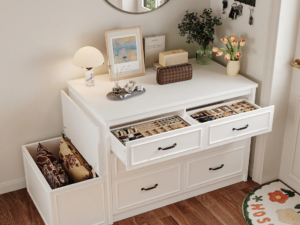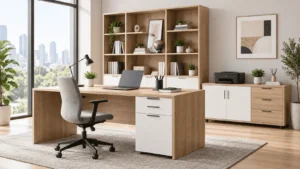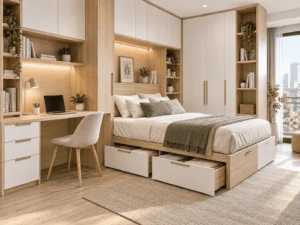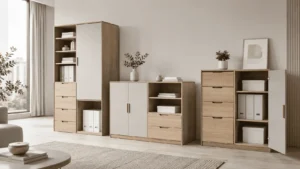
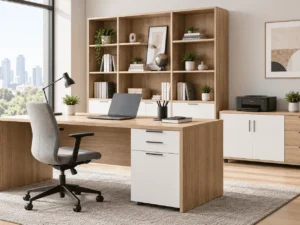
For importers, furniture brands and project procurement teams, sourcing OEM home office furniture is not simply a matter of sending a desk photo to a factory and asking for the lowest price. A commercially successful program requires clear product specifications, suitable panel materials, controlled hardware, realistic MOQ planning, approved samples, export-ready packaging and repeatable production quality.
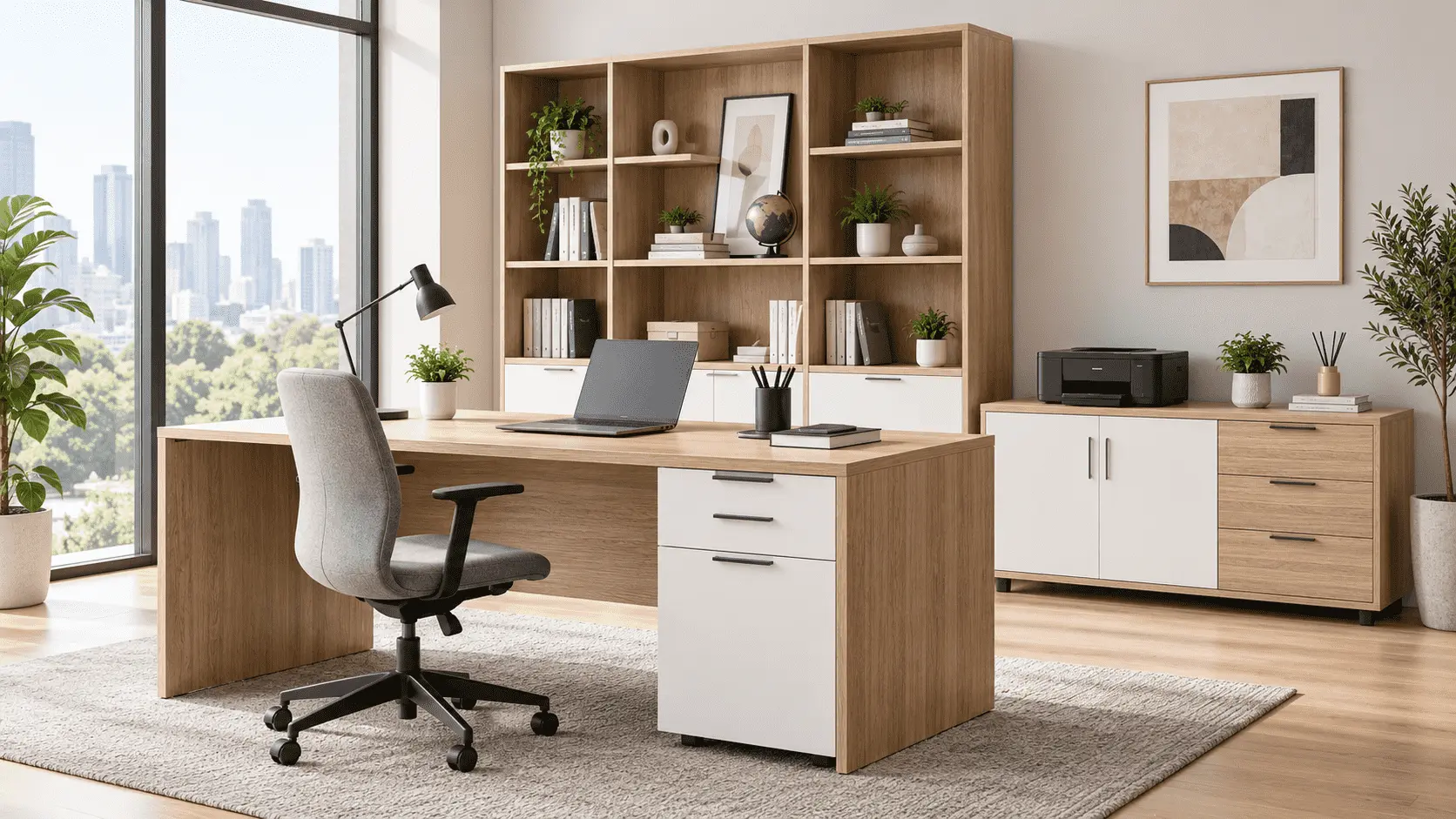
The real purchasing question is not, “Can this factory make a desk?” It is, “Can this factory reproduce the same product, finish, assembly experience and packaging standard across hundreds or thousands of units?”
This guide is written from a panel furniture manufacturing perspective for professional buyers preparing an OEM, ODM, private-label, apartment, hospitality or wholesale program.
If you are currently developing a home office collection, you can also review our home office furniture manufacturing capabilities before sending an RFQ.
Table of Contents
- Define the commercial project before requesting a quotation
- Match the product specification to the actual application
- Select panel materials according to performance and market requirements
- Lock down engineering details before sampling
- Understand MOQ as a production issue, not only a sales number
- Use the sample stage to eliminate mass-production risk
- Build a realistic production and delivery schedule
- Treat export packaging as part of product engineering
- Audit quality control and factory capability before ordering
- Send a procurement-ready RFQ instead of a general inquiry
- Why work with an OEM/ODM panel furniture factory
- FAQ
- Start Your OEM Home Office Furniture Project
1. Define the Commercial Project Before Requesting a Quotation
One of the most common problems we see in OEM enquiries is that buyers request pricing before the project itself has been properly defined.
A reference photo is useful, but it is not a manufacturing specification.
Before an OEM home office furniture factory can give a meaningful quotation, the buyer should establish the intended sales channel, target customer, expected order volume, destination market and desired retail positioning.
A home office desk developed for an online furniture brand may need parcel-friendly flat-pack packaging, easy consumer assembly and strong visual presentation. A desk developed for a furnished apartment project may prioritize fast installation, standardized dimensions and coordinated finishes. A wholesale importer may need several products to share the same board colors, hardware and carton specifications so the collection can be reordered efficiently.
Start With the Commercial Target
A useful project brief should answer questions such as:
- Is the product intended for retail, wholesale, e-commerce or a project?
- Is it a single desk or part of a coordinated furniture collection?
- What retail or wholesale price level must the product support?
- What markets will the furniture be sold into?
- Will the product ship by container, pallet or parcel network?
- Is private-label packaging required?
- Is the product expected to remain in the range for several years?
This information affects almost every manufacturing decision.
For example, when buyers give us a target FOB cost early in development, engineering decisions can be made around that objective. Board thickness, drawer construction, hardware grade, edge banding, packing volume and decorative components can then be optimized together.
Trying to reduce costs only after the sample has been approved normally creates more work and can compromise the product.
2. Match the Product Specification to the Actual Application
“Home office furniture” is a broad sourcing category.
It can include computer desks, writing desks, L-shaped desks, bookcases, filing cabinets, printer cabinets, credenzas, wall-mounted workstations, desk-and-storage combinations and modular furniture systems.
The specification should therefore start with the application rather than the appearance.
Private-Label and Retail Programs
Retailers and furniture brands usually need products that are easy to merchandise and easy for consumers to understand.
Important considerations include:
- distinctive but manufacturable design;
- strong product photography potential;
- coordinated colors across several SKUs;
- simple assembly;
- replaceable hardware;
- compact cartons;
- clear model and SKU identification;
- private-label cartons and manuals.
A private-label buyer also needs repeatability. A successful SKU may be reordered several times, so the factory should be able to reproduce the approved board color, hardware specification, dimensions and packaging.
Apartment and Residential Project Furniture
Apartment, serviced residence and rental-property projects have different priorities.
A project desk may have to fit a predefined wall dimension, electrical outlet position or furniture layout. Buyers may require coordinated desks, wardrobes, bookcases, TV units and storage cabinets across many rooms.
That makes dimensional control and finish consistency particularly important.
Our project furniture manufacturing service is structured for buyers working from drawings, reference images, room schedules and project specifications rather than only standard catalogue products.
E-Commerce Furniture
For e-commerce, the factory must think beyond the furniture itself.
The product also has to survive handling, arrive with all hardware present and be straightforward for the final customer to assemble.
A visually attractive desk with weak carton engineering can become an expensive product once damaged shipments, missing parts and customer returns are included.
For this reason, experienced buyers evaluate OEM home office furniture as a combined product, assembly and logistics system.
3. Select Panel Materials According to Performance and Market Requirements
Material selection is one of the biggest drivers of cost, weight, durability, appearance and compliance.
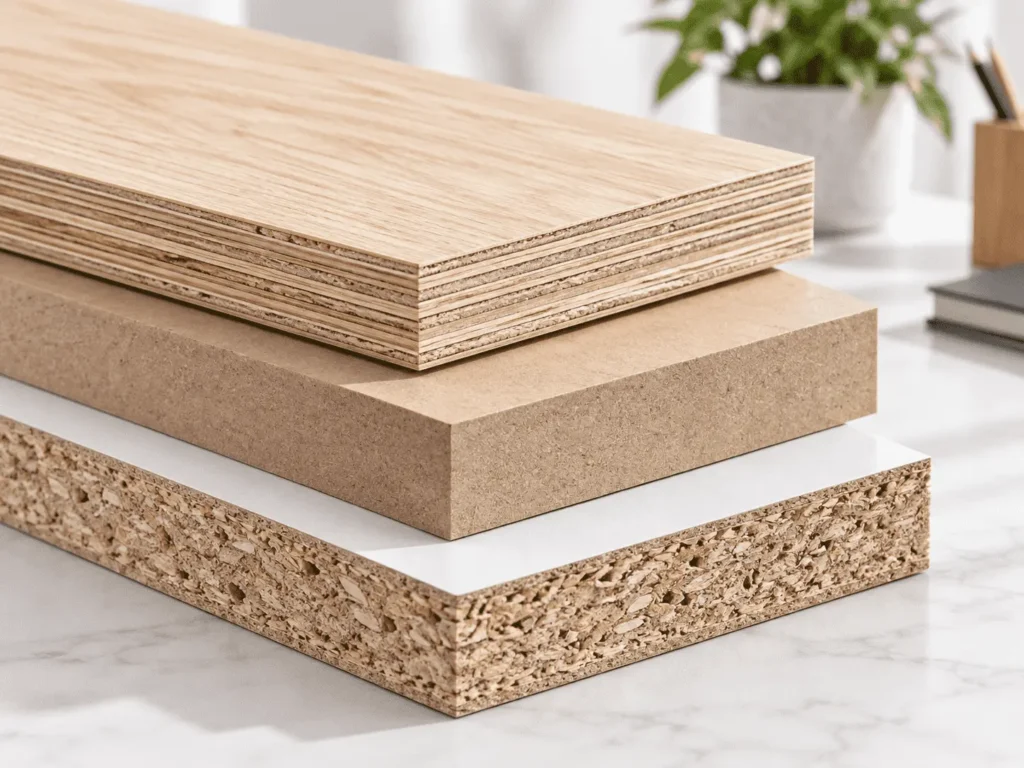
For flat-pack home office furniture, the most common engineered materials are particle board, MDF and plywood.
There is no single material that is automatically “best.” The correct choice depends on the product structure and commercial target.
Particle Board
Particle board is widely used for volume furniture because it offers stable dimensions, efficient machining and competitive material costs.
Melamine-faced particle board is particularly practical for desks, bookcases and storage furniture when buyers need consistent colors and easy-clean surfaces.
However, board density, screw-holding requirements, connector positions and edge sealing should be considered during engineering.
Using the cheapest available board without adjusting the structure is rarely a good purchasing strategy.
MDF
MDF provides a smooth, uniform surface and is useful when the design requires painting, routed details or certain decorative finishes.
It is often used for drawer fronts, doors and components where surface uniformity is important.
Because MDF can increase product weight, buyers should evaluate the effect on packaging and logistics rather than comparing board prices in isolation.
Plywood
Plywood may be selected when the project needs stronger screw holding, relatively high structural performance or specific material characteristics.
Its higher raw-material cost means it should normally be used where the product genuinely benefits from it rather than specified only because “plywood sounds better.”
Surfaces Matter Too
Core material is only one part of the specification.
Buyers should also define:
- melamine finish;
- laminate;
- wood-grain paper;
- veneer;
- painted surface;
- edge-band material and thickness;
- exposed-edge quality;
- finish color tolerance.
For larger collections, we recommend creating an approved material board before bulk production so that purchasing, production and inspection teams work from the same reference.
Formaldehyde and Destination-Market Requirements
For furniture entering the United States, composite wood compliance needs to be considered at the material-selection stage, not after production.
The U.S. Environmental Protection Agency explains that TSCA Title VI requirements apply to regulated hardwood plywood, MDF, particleboard and finished goods containing these composite wood materials. Buyers importing into the U.S. should review the official EPA Formaldehyde Emission Standards for Composite Wood Products guidance.
Importers should also understand their documentation responsibilities. The EPA’s TSCA requirements for imported regulated articles explain requirements applying to imported composite wood products and finished goods.
The practical factory lesson is simple: tell your supplier the destination market before approving the board specification.
“E1 board” alone should not replace confirmation of the actual compliance documentation required by your market.
Responsible Wood Sourcing
Sustainability requests are also becoming more common in retail and commercial procurement.
If FSC-certified material is required, buyers should specify this during RFQ and material sourcing rather than after the sample is completed. The Forest Stewardship Council’s Chain of Custody guidance explains how certified forest-based materials are tracked through manufacturing and distribution.
For European programs, buyers should also keep current wood traceability requirements in view. The European Commission’s official EU Deforestation Regulation information identifies wood and certain derived products, including furniture, within the regulatory framework and provides current implementation dates and guidance.
Regulatory scope depends on the product and destination, so compliance should always be confirmed for the actual SKU rather than assumed from a general furniture category.
4. Lock Down Engineering Details Before Sampling
The drawing stage is where many future quality problems can be prevented cheaply.
Once mass production begins, every unresolved detail becomes more expensive.
For OEM home office furniture, buyers should review dimensions, loading, storage functions, cable management, hardware, knock-down structure and assembly sequence before asking the factory to build a final sample.
Dimensions Must Reflect Real Use
A desk is not simply a top panel with legs.
The design has to accommodate monitors, laptops, cables, drawers, chairs and user movement.
For storage products, the internal dimensions are as important as the external appearance.
A filing cabinet may need to fit specific document formats. A printer cabinet needs cable access and ventilation. A desk hutch must leave sufficient usable workspace below it.
Design for Flat-Pack Manufacturing
A product that looks good in a rendering may be inefficient to manufacture or package.
Factory engineering should therefore review:
- panel orientation;
- connector positions;
- drilling patterns;
- hardware accessibility;
- maximum carton dimensions;
- carton weight;
- assembly sequence;
- number of unique components;
- left/right component identification.
Good OEM engineering simplifies production without making the furniture look simplified.
Hardware Should Be Specified, Not Assumed
Do not approve a quotation that simply says “standard hardware” if hardware performance matters to your brand.
Specify the required hinge, slide, cam, connector, handle, leg, lock, cable grommet or adjustable foot.
Where branded hardware is required, state the brand or approved equivalent.
Where a cost-effective generic component is acceptable, confirm material, finish and functional requirement.
This gives the factory a measurable purchasing standard.
Consider Recognized Furniture Performance Requirements
If the product will be used in commercial, institutional or office-related environments, performance expectations should be discussed during development.
BIFMA maintains recognized furniture standards addressing safety, durability and performance. Procurement and engineering teams can review the BIFMA Standards Overview to understand which standards may be relevant to desks, tables, storage units and other furniture categories.
A buyer does not need to demand every possible test for every residential SKU. The important point is to define appropriate performance requirements before mass production instead of discovering them after a failure.
5. Understand MOQ as a Production Issue, Not Only a Sales Number
Buyers frequently ask one question first:
“What is your MOQ?”
But one MOQ number rarely explains the real economics of a custom furniture project.
For OEM home office furniture, several different MOQs can affect the order:
- product MOQ;
- color MOQ;
- custom board MOQ;
- custom hardware MOQ;
- printed carton MOQ;
- instruction-manual MOQ;
- total order quantity;
- efficient container-loading quantity.
This is why buyers should ask how the MOQ is structured rather than only asking for the smallest possible number.
Why Customization Changes MOQ
If you select a standard melamine color already used in factory production, the material requirement may be easier to manage.
If you request a unique finish, specially plated handles and custom retail cartons, minimum purchasing quantities from upstream material suppliers may increase the viable order volume.
The same applies to special drawer slides, electrical components and packaging.
Can Several SKUs Share One Program?
This is a useful question for importers developing a collection.
A desk, filing cabinet and bookcase using the same panel finish and hardware family may allow more efficient material purchasing than three completely unrelated products.
For containerized orders, mixed-SKU planning can also make the overall collection commercially practical.
The Cheapest MOQ Is Not Always the Best MOQ
A very small test order can result in a high unit cost because setup, sampling, packaging and material purchasing are divided across fewer units.
For a new private-label collection, it is often more useful to ask:
“What order structure gives us the best balance between market-testing risk and production efficiency?”
That is a better B2B purchasing question than forcing every product to the lowest possible MOQ.
6. Use the Sample Stage to Eliminate Mass-Production Risk
A prototype should not be treated as a sales sample.
It is a technical approval tool.
The purpose of sampling is to find problems before those problems are multiplied across an entire production order.
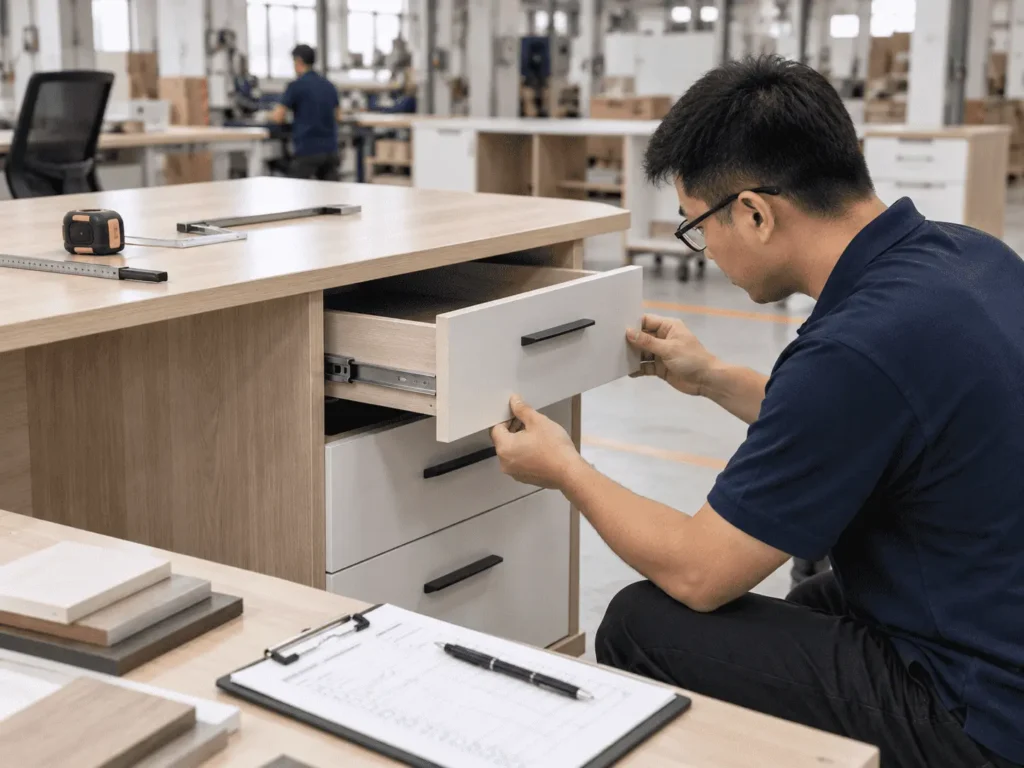
During sample approval, buyers should inspect appearance, dimensions, assembly, stability, hardware, color, packaging and user experience.
What Should Be Confirmed?
Start with the approved drawing and check the sample against it.
Verify:
- overall dimensions;
- panel thickness;
- hole positions;
- gaps and alignment;
- drawer movement;
- door adjustment;
- edge-banding quality;
- surface finish;
- hardware;
- cable-management details;
- stability;
- assembly time;
- carton configuration.
If the furniture will be assembled by consumers, someone unfamiliar with the design should also test the manual.
Factory engineers already know how the product works. A new customer does not.
Freeze the Approved Sample
Once corrections have been completed, the final approved sample or approved specification should become the production reference.
Changes after approval should be documented.
This sounds basic, but undocumented “small improvements” are one of the easiest ways for a custom furniture project to drift away from the buyer’s expectation.
Our OEM & ODM furniture manufacturing service covers the process from buyer drawings or concepts through technical review, sample development, mass production and export preparation.
7. Build a Realistic Production and Delivery Schedule
“Lead time” should never be discussed as one vague number.
An OEM project has several time stages:
product clarification → costing → engineering → material sourcing → sample → sample revision → approval → production → inspection → packing → shipment booking.
If the buyer looks only at factory production days, the overall project schedule will usually be underestimated.
Sampling Lead Time
A simple standard-material desk is easier to sample than a new modular workstation using custom colors, special hardware and several storage components.
Therefore, sample timing should be confirmed only after the specification is understood.
For repeat projects, keeping approved boards, drawings, hardware specifications and packaging files organized can significantly improve subsequent development efficiency.
Mass-Production Lead Time
The production schedule is affected by:
- order quantity;
- number of SKUs;
- material availability;
- custom finishes;
- outsourced components;
- packaging;
- peak production periods;
- inspection requirements.
Professional buyers should ask what conditions the quoted delivery date assumes.
For example, does the lead time begin after deposit, after final artwork, after sample approval or after all nominated materials arrive?
Put this definition on the purchase order.
Work Backward From the Required Arrival Date
Project buyers should calculate from the date furniture must arrive at the warehouse or project site.
Then allow for ocean freight, customs clearance, inland delivery, port conditions and buffer time before determining the required factory completion date.
This is especially important for apartment, hospitality and commercial projects where late furniture can affect an installation schedule.
8. Treat Export Packaging as Part of Product Engineering
Furniture packaging is not something to decide after production.
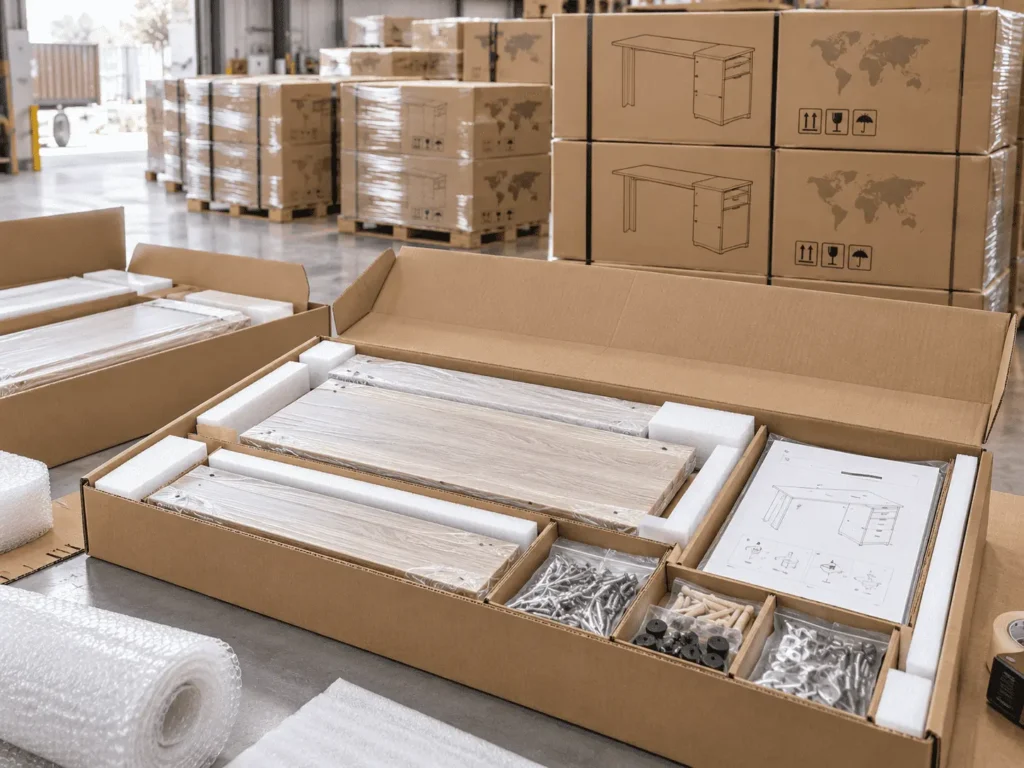
For flat-pack furniture, the carton is part of the product.
A desk can leave a factory in perfect condition and still become a quality complaint if packaging cannot protect it during international transport.
Container Export and E-Commerce Need Different Thinking
Traditional containerized wholesale shipments mainly need protection against loading pressure, long-distance transportation, moisture and warehouse handling.
E-commerce shipments can involve more individual handling events, sorting facilities and last-mile delivery.
That may require different carton strength, internal protection and allowable carton dimensions.
Tell the factory exactly how the furniture will move through your supply chain.
Important Packaging Details
A B2B buyer should review:
- carton size;
- gross and net weight;
- protective corner design;
- foam or alternative protective materials;
- panel separation;
- hardware bag position;
- moisture protection;
- carton markings;
- barcode labels;
- SKU identification;
- assembly instructions;
- spare hardware;
- private-label artwork.
For multi-SKU project orders, carton identification should also support installation teams.
A carton labeled only with an internal factory model number is less useful than one clearly identifying room, product and package sequence.
Optimize Cubic Volume, Not Just Product Cost
Two suppliers may quote almost the same FOB price while offering very different packing volumes.
The supplier with the slightly lower unit price may become more expensive after freight if each carton occupies substantially more space.
For export furniture, buyers should therefore compare:
FOB cost + packaging volume + container quantity + expected damage risk.
This is a better landed-cost comparison.
Flat-pack manufacturing is one of the core reasons panel furniture is well suited to global sourcing, and our home office furniture range is developed around export-oriented RTA and KD structures.
9. Audit Quality Control and Factory Capability Before Ordering
OEM sourcing requires more than evaluating a showroom sample.
You are buying a manufacturing process.
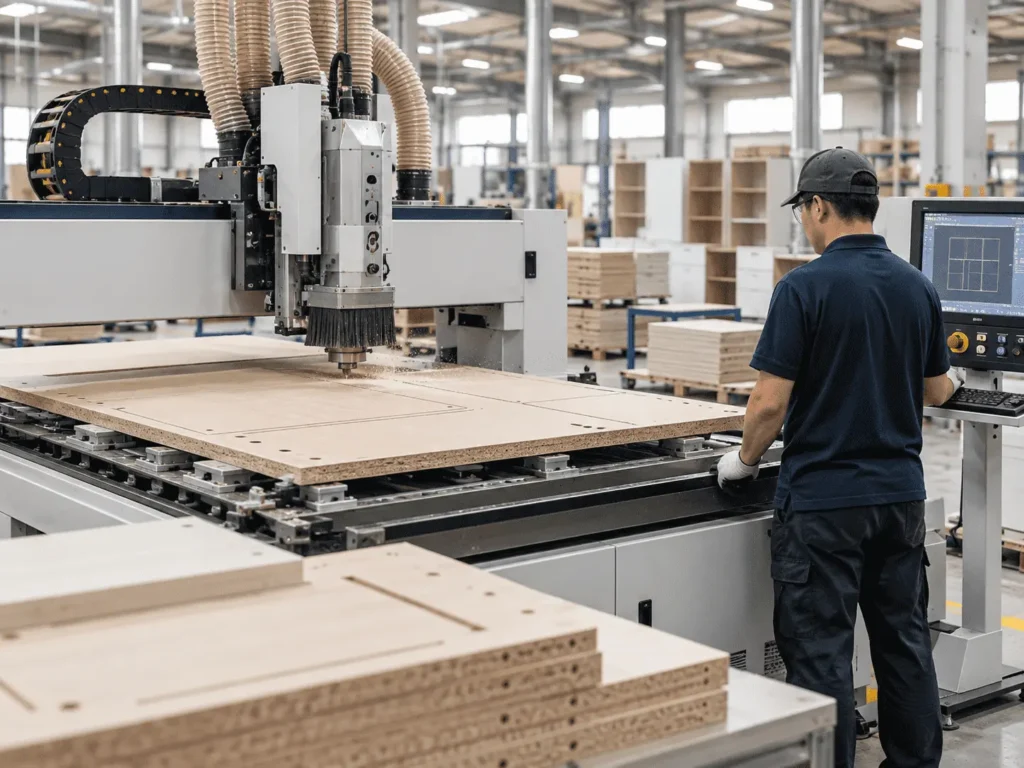
The supplier must be capable of controlling material purchasing, CNC cutting, drilling, edge banding, hardware preparation, inspection, packaging and repeat orders.
Starwood operates as a panel furniture factory in Jiangmen, Guangdong and focuses on OEM/ODM flat-pack furniture for importers, brands, wholesalers and projects. Buyers can review our factory and company information before starting a project.
Ask How Quality Is Controlled During Production
Final inspection alone is not enough.
If several hundred components have already been cut incorrectly, discovering the error during final inspection is late and expensive.
A more practical QC system checks critical points during manufacturing.
Examples include:
- incoming board and hardware;
- first-piece dimensional approval;
- drilling and machining;
- edge banding;
- finish and color;
- trial assembly;
- packing completeness;
- carton markings.
Ask How Repeat Orders Are Controlled
For private-label brands, repeatability may be more important than one perfect first shipment.
Ask whether the factory retains:
- approved drawings;
- BOM specifications;
- color references;
- hardware specifications;
- packaging artwork;
- inspection standards;
- revision records.
This information helps reduce variation when the same SKU is reordered months later.
Quality Systems Matter More Than Certificates Alone
Recognized management frameworks can be useful when buyers evaluate supplier systems. ISO describes ISO 9001 as a globally recognized quality-management standard focused on establishing, maintaining and continuously improving a quality management system. Buyers can review the official ISO 9001 overview when developing supplier-audit criteria.
However, do not select a furniture factory based on a certificate logo alone.
You still need to assess whether the actual factory process can control your specific product.
Ask to see production, inspection methods, material records and real packaging.
10. Send a Procurement-Ready RFQ Instead of a General Inquiry
If you want accurate pricing, give the factory information that can be priced accurately.
Compare these two enquiries:
“Please quote this desk.”
versus:
“We need a private-label flat-pack home office desk for the U.S. market. Approximate size is 1200 × 600 × 750 mm. Target material is melamine particle board with a wood-grain finish. Initial order is three SKUs in two colors. Please quote OEM options, sample cost, product MOQ, color MOQ, packaging dimensions and production lead time.”
The second request immediately creates a more productive supplier discussion.
What to Include in Your OEM RFQ
Ideally, send:
- product drawings, CAD files or reference photos;
- required dimensions;
- target materials;
- finish or color references;
- required hardware;
- estimated quantity by SKU;
- destination country;
- packaging requirements;
- required compliance or testing;
- target delivery schedule.
If your design is not yet finalized, send the information you do have.
An experienced OEM/ODM factory should then identify the missing technical information before quotation or sampling.
Why Work With an OEM/ODM Panel Furniture Factory?
The value of an OEM factory is not simply that it can manufacture someone else’s design.
The real value is turning a commercial product concept into a repeatable production specification.
For panel furniture, this involves integrating product design with material optimization, CNC processing, hardware, flat-pack engineering, assembly and export packaging.
A capable OEM home office furniture supplier should help buyers reduce manufacturing risk at each of these stages.
At Starwood, our focus is flat-pack panel furniture manufacturing for international B2B customers, including importers, distributors, furniture brands, e-commerce sellers and commercial project buyers. Our manufacturing scope includes desks, bookcases, filing cabinets, storage furniture and modular home office systems, along with furniture for bedrooms, living rooms, kitchens and other project applications.
For buyers managing wider apartment, rental, hospitality or office packages, working with a project furniture manufacturer can also simplify finish coordination and supplier management across multiple furniture categories.
Buyer Takeaway
The best OEM home office furniture quotation is not necessarily the cheapest quotation.
A commercially reliable offer should make the product specification clear enough that you know exactly what will be manufactured.
Before placing an order, confirm:
- application and sales channel;
- dimensions and engineering;
- board material and finish;
- hardware;
- destination-market compliance;
- MOQ;
- approved sample;
- production schedule;
- export packaging;
- QC and repeat-order controls.
If these ten areas are controlled before the purchase order, the project becomes easier to manufacture, inspect, ship and reorder.
That is the difference between simply buying furniture and building a reliable furniture supply program.
FAQ: OEM Home Office Furniture
What is OEM home office furniture?
OEM home office furniture is manufactured according to a buyer’s design, specifications, dimensions, material requirements, finish, branding and packaging. Typical products include desks, bookcases, filing cabinets, storage cabinets and modular office systems produced for importers, retailers, furniture brands and project buyers.
What information should I send to get an OEM furniture quotation?
Send product drawings or reference photos, dimensions, materials, finish requirements, estimated quantity, destination market, packaging requirements and required delivery date. Compliance or testing requirements should also be stated at the beginning of the project.
What is the MOQ for custom home office furniture?
MOQ depends on the product, materials, finish, hardware, packaging and number of SKUs. Buyers should ask both the MOQ per SKU and the total commercial order requirement. Custom colors, special hardware or private-label packaging may have separate upstream MOQs.
Which material is best for OEM home office furniture?
Particle board, MDF and plywood can all be suitable. Particle board is commonly used for cost-efficient volume furniture, MDF is useful for smooth or painted surfaces, and plywood may be selected where specific structural properties are required. The best material depends on product design, target price, finish, weight and destination-market requirements.
Can an OEM factory develop furniture from a reference photo?
Yes, but a photo should be treated as a starting point rather than a final manufacturing specification. Dimensions, construction, board thickness, hardware, finishes, assembly method and packaging still need to be defined before sampling and quotation can be finalized.
Should I approve a sample before mass production?
Yes. For custom furniture, sample approval is one of the most important risk-control steps. Buyers should confirm dimensions, finish, hardware, stability, assembly, functionality and packaging before authorizing bulk production.
Can OEM home office furniture be supplied as flat pack?
Yes. Desks, cabinets, bookcases and storage furniture are commonly engineered as KD or RTA products. Flat-pack construction can improve container utilization, warehousing and international transportation, but the connection system and packaging must be engineered correctly.
How should importers evaluate furniture packaging?
Ask for carton dimensions, gross weight, internal protection, hardware packing, assembly manual, carton markings and loading quantity. The correct packaging specification depends on whether the product will move by full-container wholesale distribution, warehouse networks or e-commerce parcel delivery.
START YOUR OEM HOME OFFICE FURNITURE PROJECT
Looking for a reliable factory for your next OEM home office furniture program?
Starwood supports importers, furniture brands, wholesalers and project buyers with product development, panel material selection, sampling, flat-pack engineering, mass production, quality control, private-label packaging and export preparation.
Send us your drawings, reference photos or current product specifications. Please include your target market, dimensions, expected quantity, material preference and packaging requirements so our team can review the project from a manufacturing and cost perspective.
Looking for OEM support? Send us your drawings or reference photos today.
Request an OEM Furniture Quotation
For more information about our production capabilities, visit our OEM & ODM manufacturing service, home office furniture range and project furniture manufacturing page.