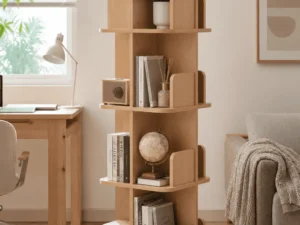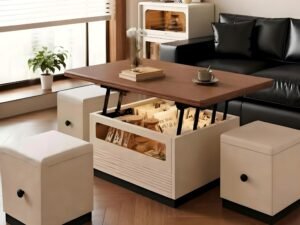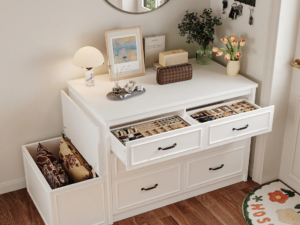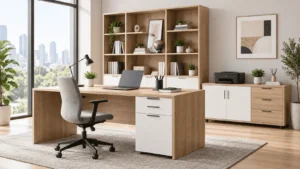
For importers, wholesalers, furniture brands, hotel developers, apartment operators, and project buyers, choosing an OEM furniture manufacturer is not just about getting a lower price. The real value is whether the factory can turn your drawings, samples, product ideas, room layouts, and packaging requirements into stable bulk production. A reliable factory should understand material selection, MOQ, lead time, sampling, quality control, flat pack packaging, carton marks, and export shipment. This guide is written from a factory sourcing perspective to help B2B buyers reduce risk before placing an OEM or ODM furniture order.
Table of Contents
- What an OEM furniture manufacturer should really do
- Check whether the supplier is a real panel furniture factory
- Confirm whether OEM or ODM is right for your order
- Match the factory with your project application
- Review materials, board thickness, finishes, and hardware
- Confirm MOQ, sample cost, and lead time before deposit
- Check quality control before mass production
- Review export packaging and carton requirements
- Confirm documents, compliance, and shipment support
- Why work with Starwood as your OEM/ODM furniture partner
- FAQ
What an OEM Furniture Manufacturer Should Really Do
An OEM furniture manufacturer produces furniture according to the buyer’s design, drawings, specifications, samples, or brand requirements. In the B2B furniture industry, OEM manufacturing is common for importers, wholesalers, furniture brands, hotel projects, apartment projects, student housing, retail furniture collections, and online furniture sellers.
However, OEM furniture manufacturing is not only “make what the buyer sends.” A professional factory should also help buyers check whether the design is suitable for mass production, whether the board thickness is strong enough, whether the hardware is easy to source, whether the carton size is suitable for export, and whether the assembly method is practical for the final user.
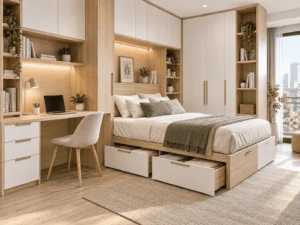
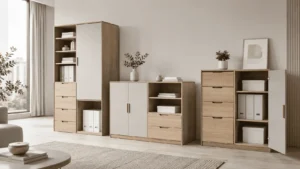
For panel furniture, this is especially important. Products such as wardrobes, storage beds, kitchen cabinets, bathroom cabinets, desks, TV stands, shoe cabinets, bookcases, kids’ room furniture, and space-saving cabinets depend heavily on cutting accuracy, drilling position, edge banding, hardware matching, and flat pack packaging.
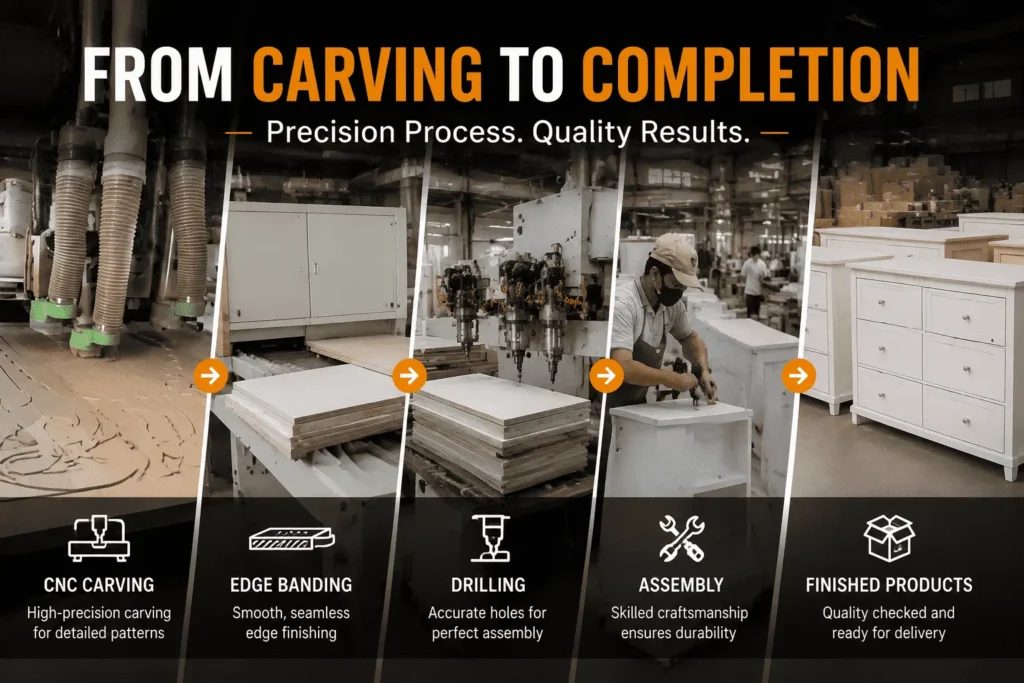
A reliable OEM factory should support:
- Technical review before quotation
- Material and finish suggestions
- Cost optimization
- Sample development
- Pre-production confirmation
- Bulk manufacturing
- Quality inspection
- Export-standard packaging
- Carton marks and private-label requirements
- Container loading support
- Shipment document coordination
If a supplier only sends a quick price without asking detailed questions, the risk may appear later during sampling, production, packing, or installation.
For buyers who need full customization support, our OEM & ODM Furniture Manufacturing Services page explains how we support product development, sampling, bulk production, QC, export packing, and shipment coordination.
1. Check Whether the Supplier Is a Real Panel Furniture Factory
Before placing an OEM order, first confirm whether the supplier is a real factory or mainly a trading company. A trading company may help with communication, but if you need long-term product development, private-label production, stable repeat orders, and project-based delivery, direct factory capability matters more.
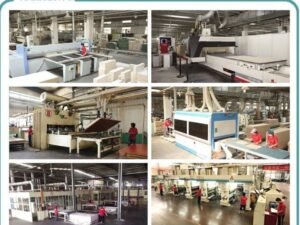
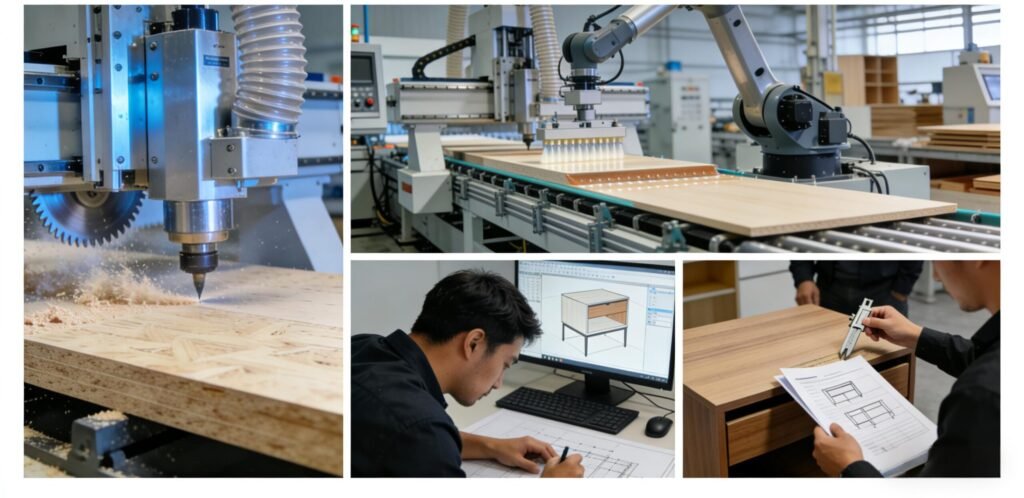
A real panel furniture export factory should be able to show production capacity, not only catalog photos. For flat pack panel furniture, buyers should ask about:
- CNC cutting machines
- Drilling equipment
- Edge banding machines
- Panel processing workflow
- Trial assembly area
- Hardware matching process
- QC inspection points
- Packing area
- Export carton handling
- Container loading experience
Panel furniture looks simple from the outside, but manufacturing accuracy is critical. If the hole position is wrong, the final user may not be able to assemble the product. If the edge banding is weak, panels may peel during use. If hardware bags are not clearly labeled, installation teams may waste time on site.
For importers and project buyers, factory capability directly affects after-sales cost. A low unit price can quickly become expensive if there are missing screws, damaged panels, unstable colors, or unclear assembly instructions.
You can review our factory positioning on the Starwood Factory Page. As a China-based flat pack panel furniture factory, we support global brands, importers, wholesalers, e-commerce sellers, and commercial projects with OEM and ODM production.
2. Confirm Whether OEM or ODM Is Right for Your Order
Many buyers use OEM and ODM as if they mean the same thing, but they are different in practical factory work.
OEM Furniture Manufacturing
OEM is suitable when the buyer already has a clear product design. You may have CAD drawings, reference samples, product photos, sizes, material specifications, or a current product that needs a new manufacturing partner.
In this case, the factory should follow your requirements while checking production feasibility. The factory may suggest adjustments to board thickness, connectors, hardware, structure, carton size, or packing method, but the product direction mainly comes from the buyer.
OEM is suitable for:
- Furniture brands with existing product lines
- Importers replacing an old supplier
- Wholesalers developing private-label SKUs
- Retailers needing custom packaging
- Hotel and apartment projects with confirmed drawings
- E-commerce sellers with product references
ODM Furniture Manufacturing
ODM is suitable when the buyer has a market idea but needs factory support to develop the product. You may have a target price, target market, reference style, room layout, or product function, but not a complete technical design.
In ODM development, the factory helps with structure, material selection, production feasibility, cost control, and sample development.
ODM is suitable for:
- New furniture brands
- Apartment furniture packages
- Hotel furniture collections
- Retail furniture programs
- Space-saving home furniture
- Kids’ room furniture development
- Kitchen or storage furniture lines
For B2B buyers, the best factory is not just a production workshop. It should be an OEM ODM furniture supplier that can review details before mass production and help avoid mistakes that are expensive to fix later.
3. Match the Factory with Your Project Application
An OEM furniture order should always start with the application scenario. The same cabinet may need different materials, finishes, hardware, and packaging depending on whether it is used for retail, hotel rooms, apartments, student housing, or commercial spaces.
Importers and Wholesalers
Importers and wholesalers usually need repeatable SKUs, competitive factory pricing, stable quality, and container loading efficiency. They care about product consistency, carton marks, private-label packaging, and long-term supply stability.
For this buyer type, the factory should be able to provide clear product specifications, stable pricing logic, and organized production scheduling.
Furniture Brands
Furniture brands need product identity. They may care about custom finishes, special handles, private labels, unique packaging, assembly instructions, and product line development. For brand buyers, OEM/ODM communication should include design protection, sample approval, packaging artwork, and long-term version control.
Hotel and Serviced Apartment Projects
Hotel and serviced apartment furniture requires matching style, durable structure, coordinated room layouts, stable finishes, and controlled delivery schedule. Products may include wardrobes, TV panels, desks, luggage racks, bedside tables, bathroom cabinets, storage cabinets, and kitchen units.
A project order is not only about product price. It is about whether the factory can support room-by-room planning, sample room approval, batch delivery, carton marks, and installation-friendly packing.
Apartment and Rental Housing Projects
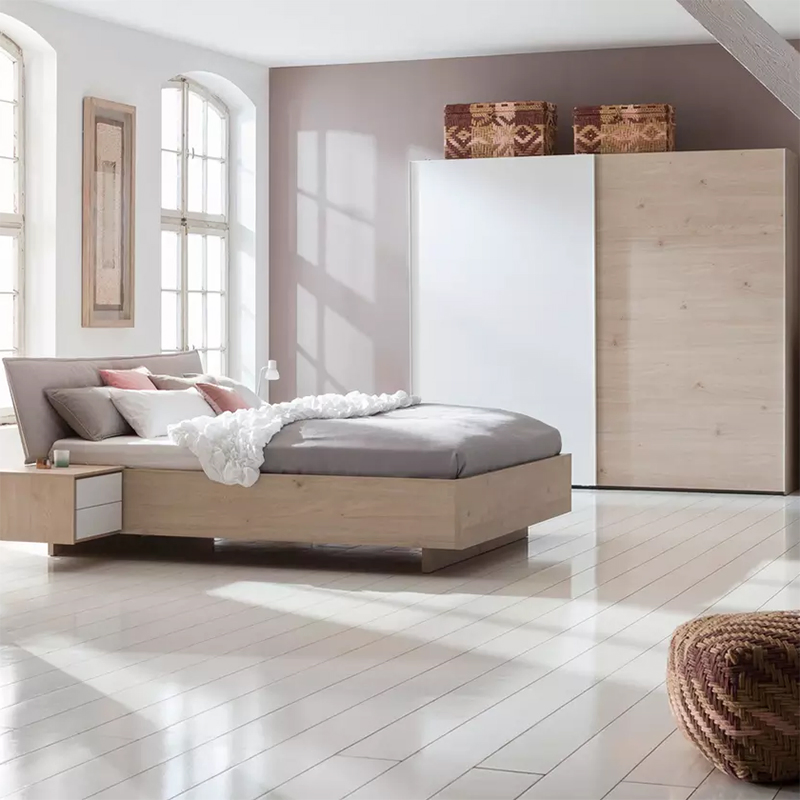
Apartment furniture requires durability, cost control, space efficiency, and easy replacement. Common products include wardrobes, storage beds, shoe cabinets, kitchen cabinets, bathroom storage, desks, TV stands, and multi-functional furniture.
For apartment projects, the factory should understand standardized production and consistent finish control across multiple units.
Commercial Furniture Projects
Commercial furniture may be used in offices, rental properties, dormitories, retail spaces, and public-use environments. Buyers usually need strong structure, stable hardware, simple maintenance, and reliable repeat production.
If you are sourcing for hotels, apartments, rental housing, offices, or commercial interiors, you can review our Project Furniture Manufacturing page for project-based panel furniture applications.
4. Review Materials, Board Thickness, Finishes, and Hardware
Material details must be confirmed before quotation. If a buyer asks five suppliers for a price but does not give material specifications, the five prices may not be comparable.
For panel furniture, common materials include:
- MDF
- Particle board
- Plywood
- Melamine board
- Engineered panels
- Laminated panels
- Veneer or printed surface panels
Each material has different cost, weight, screw-holding strength, surface effect, and market suitability.
Board Thickness
Board thickness affects product strength, cost, packaging weight, and buyer perception. A wardrobe side panel, bed frame panel, cabinet shelf, or kitchen cabinet door may require different thickness levels. Common thickness options may include 12 mm, 15 mm, 16 mm, 18 mm, 25 mm, or customized specifications.
Before approving a quotation, confirm:
- Main panel thickness
- Back panel thickness
- Shelf thickness
- Door panel thickness
- Drawer panel structure
- Load-bearing parts
- Hardware fixing points
Surface Finish
Surface finish affects appearance, durability, cleaning, and market positioning. For B2B projects, finish consistency is especially important. If one hotel room uses a different shade from another, the whole project may look unprofessional.
Buyers should confirm:
- Color code or sample
- Texture direction
- Gloss level
- Scratch resistance expectations
- Edge banding color match
- Batch color control
Edge Banding
Edge banding is a key quality point for panel furniture. Poor edge banding may cause peeling, rough edges, visible glue lines, or moisture problems. Before mass production, buyers should check edge banding thickness, color matching, corner finishing, and glue quality.
Hardware
Hardware controls function and user experience. Hinges, slides, handles, connectors, cam locks, screws, wall fixing kits, and adjustable feet should be confirmed before production.
For bulk orders, use standardized hardware as much as possible. This reduces installation mistakes and makes after-sales replacement easier.
For buyers shipping composite wood products or finished goods containing composite wood into the United States, it is useful to review the U.S. EPA page on Formaldehyde Emission Standards for Composite Wood Products. This helps buyers discuss MDF, particle board, plywood, labeling, and documentation with suppliers more clearly.
5. Confirm MOQ, Sample Cost, and Lead Time Before Deposit
MOQ and lead time should be discussed early, not after sample approval.
An OEM furniture manufacturer needs to plan materials, hardware, surface finish, machine time, packing cartons, labor, and container loading. If the order quantity is too small, the factory may not be able to control cost efficiently. If the order involves custom color, private-label cartons, or special hardware, MOQ may be affected.
What Affects MOQ?
MOQ may depend on:
- Product size
- Material type
- Custom finish
- Hardware selection
- Number of SKUs
- Private-label carton printing
- Packaging structure
- Sample approval requirements
- Container loading plan
- Production line setup
For standard flat pack panel furniture, MOQ may be more flexible. For hotel projects, apartment packages, and custom furniture collections, MOQ depends on product list and project quantity.
On our website, Starwood states a minimum order quantity of one container for flat-pack furniture projects. For mixed product orders, buyers can send the product list first so the factory can review container planning and SKU combination.
Sample Cost
Sampling is necessary for OEM/ODM furniture. A sample helps confirm structure, dimensions, finish, hardware, assembly method, and packing. The sample cost may be higher than mass production cost because it uses individual labor, material preparation, and special handling.
Before paying for a sample, confirm:
- Sample price
- Sample lead time
- Freight method
- Whether sample cost can be refunded after bulk order
- What details the sample will include
- Whether packaging sample is included
- Whether hardware and instructions are final
Lead Time
Lead time should be separated into sample lead time and bulk production lead time.
A practical OEM timeline includes:
- Buyer sends drawings, reference photos, or product list
- Factory reviews technical details
- Materials and finishes are confirmed
- Quotation is prepared
- Sample is produced
- Buyer checks and approves the sample
- Deposit is paid
- Bulk materials are purchased
- Mass production starts
- QC inspection is arranged
- Packing is completed
- Container is loaded
- Shipment documents are prepared
For project orders, buyers should also confirm installation schedule, site delivery sequence, and whether packing needs to be grouped by room, unit, floor, or building.
6. Check Quality Control Before Mass Production
Quality control should not happen only at the end of production. For OEM furniture, QC starts from drawings and material confirmation.
A practical factory QC process should include:
- Material inspection
- Board thickness checking
- Color and finish confirmation
- Cutting accuracy check
- Drilling position check
- Edge banding inspection
- Hardware matching
- Trial assembly
- Surface defect inspection
- Carton packing verification
- Final random inspection
- Loading supervision if required
Pre-Production Sample
Before mass production, buyers should approve a pre-production sample or at least a confirmed sample with final materials, finish, hardware, and structure.
Do not approve mass production only based on a photo if the order is important. Photos may show appearance, but they cannot fully show assembly fit, board strength, connector quality, or packaging safety.
Inspection Standard
Buyers should define what is acceptable and what is not acceptable. For example:
- Small color difference: acceptable or not?
- Minor scratches on hidden surfaces: acceptable or not?
- Carton denting: acceptable or not?
- Hardware replacement: allowed or not?
- Panel tolerance: how many millimeters?
- Trial assembly: required for every SKU or random only?
When quality expectations are written clearly, the factory can control production more effectively.
When discussing quality management systems, buyers may refer to ISO 9001, which is a globally recognized quality management standard. Even when certification is not the only selection factor, the principles of process control, inspection, documentation, corrective action, and continuous improvement are useful for OEM furniture sourcing.
7. Review Export Packaging and Carton Requirements
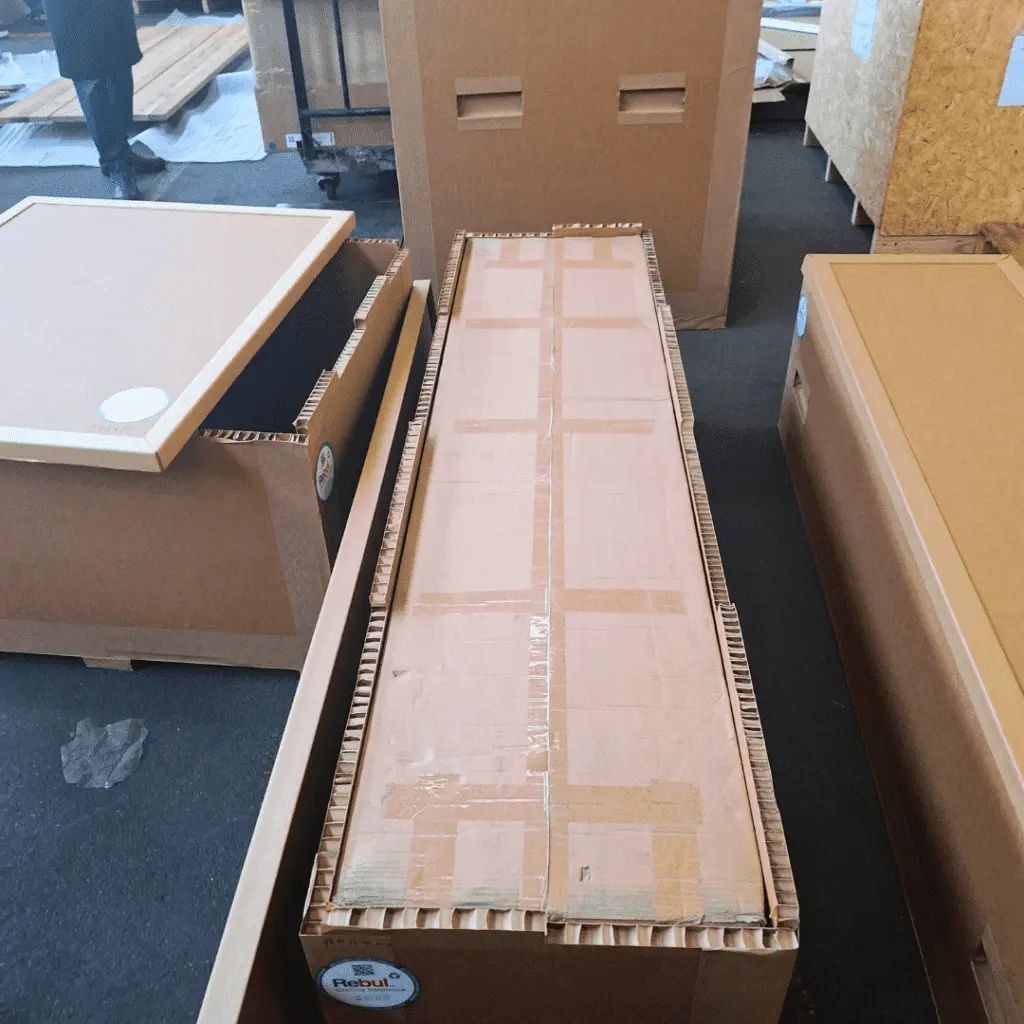
For flat pack panel furniture, packaging is part of the product. Poor packaging can create high damage rates, missing hardware, customer complaints, and project delays.
A professional panel furniture export factory should understand how to protect panels, hardware, corners, surfaces, and carton labels during long-distance shipping.
Export Packaging Should Confirm
Buyers should check:
- Carton strength
- Inner protection method
- Foam, paper corner, or honeycomb protection
- Panel separation
- Hardware bag labeling
- Assembly instruction placement
- Barcode or SKU label
- Carton marks
- Shipping marks
- Pallet or non-pallet packing
- Drop-test expectations
- Container loading plan
Hardware Bags
Hardware bags should be clearly labeled. For wardrobes, beds, desks, and cabinets, small hardware confusion can create big installation problems.
A good hardware bag system may include:
- Screws separated by type
- Connectors packed by product
- Extra hardware if required
- Clear installation sequence
- Matching assembly instruction numbers
Carton Marks
Carton marks are important for wholesalers, warehouses, project installers, and distributors. A good carton mark should help the buyer identify product code, color, quantity, carton number, destination, and room or project information.
For structured logistics labeling, buyers can review the GS1 Logistic Label Guideline. Not every furniture order needs GS1 labels, but the concept of clear logistic unit identification is helpful for export furniture, warehouse management, and project delivery.
8. Confirm Documents, Compliance, and Shipment Support
For importers and project buyers, export support is part of the factory service. A supplier that can manufacture furniture but cannot support packing lists, carton information, loading photos, and shipment coordination may create problems at the logistics stage.
Common shipment-related information includes:
- Commercial invoice
- Packing list
- Bill of lading information
- Carton quantity
- Gross weight and net weight
- CBM
- HS code discussion
- Product description
- Country of origin information
- Loading photos
- Container number
- Seal number
Import requirements vary by country and product type. Buyers can use the International Trade Administration’s page on China Import Requirements and Documentation as a reference for understanding how import documents may vary by product and shipment.
Responsible Material Sourcing
For buyers with sustainability requirements, material sourcing documentation may be important. The Forest Stewardship Council explains FSC Chain of Custody Certification as a system used to verify forest-based materials along the product’s path from forest to finished goods.
If your brand needs FSC-related claims, discuss this before quotation. Do not add sustainability claims to packaging or product pages without proper documentation.
Commercial Furniture Standards
For office furniture, commercial furniture, hospitality furniture, or institutional-use furniture, buyers may also review BIFMA’s furniture standards overview. BIFMA is widely referenced for safety, performance, and sustainability standards in the furniture industry.
A factory does not need to overload every buyer with unnecessary documents. But for serious B2B orders, clear documentation helps reduce customs risk, quality risk, and buyer-side confusion.
Why Work with Starwood as Your OEM/ODM Furniture Manufacturer?
Starwood Industry Co., Ltd. is a China-based flat pack panel furniture manufacturer supporting global brands, importers, wholesalers, e-commerce sellers, and commercial projects.
We focus on OEM and ODM panel furniture manufacturing for:
- Bedroom furniture
- Wardrobes
- Storage beds
- Kitchen cabinets
- Bathroom cabinets
- TV stands
- Shoe cabinets
- Desks
- Kids’ room furniture
- Space-saving furniture
- Hotel furniture
- Apartment furniture
- Project-based panel furniture
As an OEM furniture manufacturer, we support buyers through product review, material selection, sampling, production planning, quality control, export packing, and shipment preparation.
As an ODM furniture supplier, we help buyers develop new product ideas based on market needs, target price, materials, structure, and flat pack production feasibility.
As a commercial furniture manufacturer, we support hotel projects, apartment projects, rental housing, student housing, office spaces, and other project-based furniture needs.
You can start from our homepage: Flat-Pack Furniture Manufacturer in China
For factory background, visit: About Starwood Factory
For customization support, visit: OEM & ODM Furniture Manufacturing Services
For hotel, apartment, and commercial projects, visit: Project Furniture Manufacturing
Buyer Checklist Before Sending an OEM Furniture Inquiry
To get a faster and more accurate quotation, prepare the following details before contacting a factory.
Product Details
- Product name
- Product photos or reference links
- CAD drawings or dimensions
- Material requirement
- Board thickness
- Surface finish
- Edge banding requirement
- Hardware requirement
- Assembly method
- Packing requirement
Business Details
- Target market
- Estimated order quantity
- Number of SKUs
- MOQ expectation
- Target price range
- Private label requirement
- Carton mark requirement
- Inspection requirement
- Shipment destination
Project Details
For hotel, apartment, office, rental housing, or commercial furniture projects, also prepare:
- Project type
- Room layout
- Product list by room
- Quantity per item
- Required finish
- Installation schedule
- Delivery deadline
- Site packing requirement
- Budget range
The more complete your information is, the easier it is for the factory to provide a practical solution.
Final CTA: Send Your OEM Furniture Project Details
Looking for a reliable OEM furniture manufacturer in China for your furniture brand, wholesale program, hotel project, apartment project, or commercial furniture order?
Send us your drawings, reference photos, product list, dimensions, material requirements, target quantity, packaging needs, and delivery schedule. Our team can review your project, suggest suitable materials, prepare a quotation, arrange samples, and support export-ready bulk production.
Contact Starwood Industry Co., Ltd. today and start your OEM/ODM furniture project with a reliable panel furniture export factory.
FAQ
What is an OEM furniture manufacturer?
An OEM furniture manufacturer produces furniture according to the buyer’s drawings, samples, specifications, dimensions, materials, finishes, packaging, and brand requirements. It is suitable for importers, wholesalers, furniture brands, hotel projects, apartment projects, and private-label furniture programs.
What is the difference between OEM and ODM furniture manufacturing?
OEM means the buyer provides the design or specification, and the factory manufactures according to those requirements. ODM means the factory helps develop the product based on the buyer’s market idea, target price, application scenario, and customization needs.
What products can Starwood manufacture for OEM orders?
Starwood manufactures flat pack panel furniture, including wardrobes, storage beds, kitchen cabinets, bathroom cabinets, desks, TV stands, shoe cabinets, kids’ room furniture, bedroom furniture, apartment furniture, hotel furniture, and project furniture.
What should importers confirm before placing an OEM furniture order?
Importers should confirm drawings, dimensions, materials, board thickness, finish, edge banding, hardware, MOQ, sample cost, lead time, packaging method, carton marks, QC process, and shipment documents before placing an order.
What materials are commonly used for OEM panel furniture?
Common materials include MDF, particle board, plywood, melamine board, laminated panels, and engineered panels. Buyers should choose materials based on product function, target market, budget, durability requirements, and compliance needs.
Is OEM furniture suitable for hotel and apartment projects?
Yes. OEM furniture is suitable for hotels, serviced apartments, rental housing, student housing, offices, and commercial projects because the furniture can be customized by size, material, finish, structure, and room layout.
What is the MOQ for OEM furniture manufacturing?
MOQ depends on product category, material, finish, hardware, packaging, SKU quantity, and container loading plan. For export flat pack furniture, MOQ is often planned by container or project quantity.
How long does OEM furniture production take?
Lead time depends on sample development, sample approval, material preparation, production schedule, order quantity, packaging requirements, inspection, and shipment arrangement. Buyers should confirm sample lead time and bulk production lead time separately.
Why choose a China OEM furniture manufacturer?
China has a mature panel furniture supply chain, flexible OEM/ODM capability, broad material options, hardware availability, export packing experience, and competitive manufacturing cost. The key is to choose a real factory with stable quality control and export experience.