Bedroom Side Tables with Drawers: Size, Height and Layout Guide
Table of Contents
- Why “Wrong Height” Is the No.1 Complaint About Bedside Cabinets
- Matching Bed Heights with Bedroom Side Tables with Drawers
- Standard mattress and bed frame combinations
- Quick height reference table for bedroom stand and bedside cabinets
- Big Nightstand vs Thin Bedside Drawers: Size Strategy for Different Room Types
- Small-Space Heroes: Bedside Tables Thin, Dorm Nightstand and Compact Layouts
- Essential Size Information for Online Sellers (Including Carton Size)
- From the Factory Side: Modular Design for Multi-Size Nightstands Bedside Tables
- Conclusion: Use Correct Sizing to Cut Returns and Increase 5-Star Reviews
- FAQ: Common Questions on Bedside Table Size and Layout
1. Why “Wrong Height” Is the No.1 Complaint About Bedside Cabinets
If you read reviews carefully on Amazon or in hotel guest comments, you’ll notice a recurring complaint about nightstands bedside tables:
“The bedside cabinet is too low.”
“The bedroom stand is higher than the mattress.”
“I always hit my arm on the corner when I reach for my phone.”
Most of these issues are not about material or color. They are about ergonomics and proportion. Bedroom side tables with drawers can present issues if they are too low. Guests have to bend and twist when this occurs. Alternatively, a big nightstand that is too tall becomes a hard edge at elbow level.
For B2B buyers, hotel owners, serviced apartment operators and OEM/ODM furniture factories, getting the height and footprint right is one of the simplest ways to:
- Reduce negative reviews and claims,
- Improve perceived quality even on mid-range products,
- Standardise design across multiple room types.
The right height also makes bedside table decor look better. A beige nightstand with a lamp, book and small vase looks balanced only when the tabletop is around mattress level. The same is true for a black modern nightstand, or even colorful nightstands in youth or co-living projects.
Before you choose style, you should consider the correct height. This applies to mid century nightstands, blue bedside cabinets, or bedside tables ikea white. Also, make sure to choose the right size.
2. Matching Bed Heights with Bedroom Side Tables with Drawers
2.1 Typical Bed & Mattress Heights
Modern beds vary a lot in height, especially between markets:
- Low European platforms (no box spring):
- Frame + slats: 25–30 cm
- Mattress: 20–25 cm
- Total height: ~45–55 cm
- Standard beds:
- Frame: 30–35 cm
- Mattress: 22–28 cm
- Total height: ~52–63 cm
- Pillow-top / hotel-style beds:
- Frame or base: 35–40 cm
- Thick mattress: 28–35 cm
- Total height: ~63–75 cm
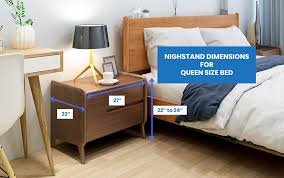
For comfort and safety, the top of your bedside cabinets should align with the mattress. Your bedroom stand’s top should also be at this level. Keep it at this level generally. It can also be up to 5 cm above. Any mismatch beyond this tends to trigger complaints.
2.2 Quick Reference Table: Bed vs Nightstand Height
Below is a practical reference for B2B use (homes, hotels, serviced apartments):
| Bed Total Height (floor to top of mattress) | Recommended Nightstand Height (floor to top) |
|---|---|
| 45–50 cm | 45–50 cm |
| 50–55 cm | 50–55 cm |
| 55–60 cm | 55–60 cm |
| 60–65 cm | 58–65 cm |
| 65–70 cm | 60–70 cm |
For big nightstand styles used in hotels or premium apartments, consider going slightly taller to add presence. However, try to keep the difference within 3–5 cm of the mattress height.
When you design or select bedroom side tables with drawers, always specify:
- Bed height range the product is optimised for;
- Whether the piece is intended for low platform beds, standard beds or hotel beds.
This makes it easier for buyers and project managers to choose the best nightstands option for their portfolio.
3. Big Nightstand vs Thin Bedside Drawers: Size Strategy for Different Room Types
Beyond height, footprint is the second major factor people complain about—“too big”, “too small”, “cannot open wardrobe door”, etc.
3.1 When to Use a Big Nightstand
In master bedrooms, suites and showrooms, a big nightstand can:
- Visually balance a king or queen bed,
- Provide generous storage in 2–3 drawers,
- Offer a stable base for more ambitious bedside table decor.
A typical big nightstand might measure:
- Width: 55–70 cm
- Depth: 40–45 cm
- Height: 55–65 cm (depending on bed)
This format works very well for:
- Boutique hotel rooms with statement lamps,
- High-end apartments where clients expect generous storage,
- Retail showrooms where impact is more important than space-saving.
3.2 When to Use Thin Bedside Drawers
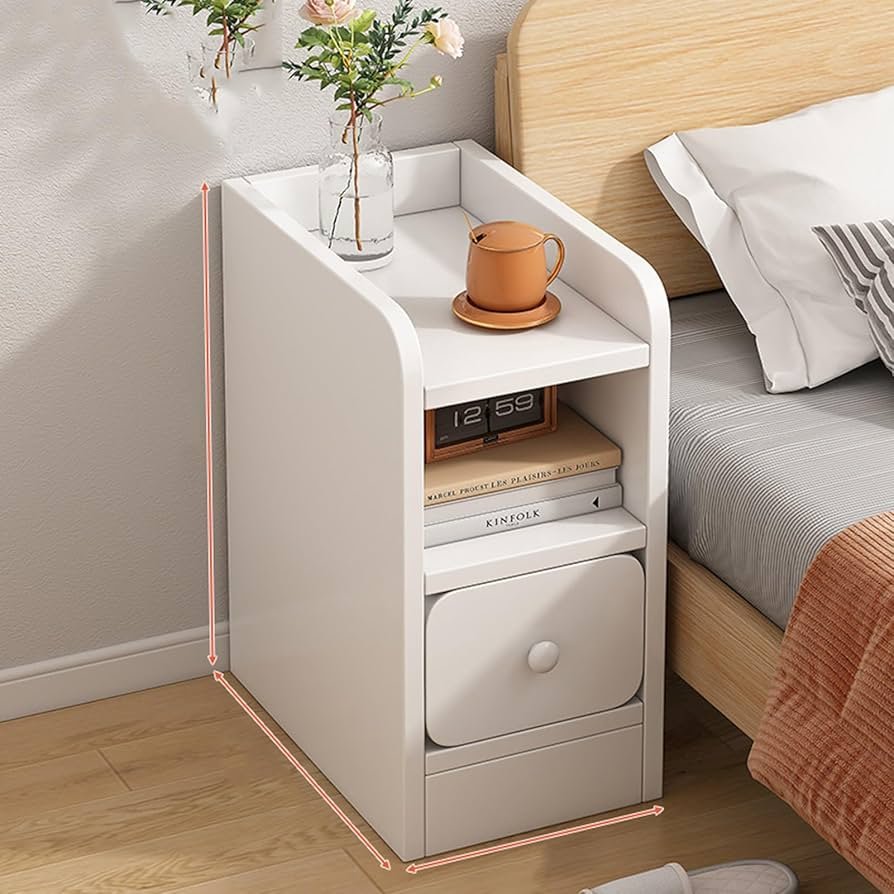
In small urban apartments or narrow hotel rooms, big nightstands become inefficient. That is where bedside tables thin and thin bedside drawers come in.
A slim bedroom stand might be:
- Width: 30–40 cm
- Depth: 30–40 cm
- Height: still matched to the bed (50–60+ cm)
These thin bedside drawers are ideal:
- Between bed and wall in compact apartments,
- Next to sliding door wardrobes,
- In twin rooms where two nightstands must fit between beds and side walls.
From a design perspective, you can often use the same design language as a big nightstand. Use the same handles and finishes. Scale the width and depth down. This approach keeps your range consistent while covering more room types.
3.3 Styling and Style Families
Within both size families, you can further position your products:
- Mid century nightstands with angled legs and warm wood tones,
- Black modern nightstand with slim metal frame and push-to-open drawers,
- Beige nightstand for neutral, hotel-like interiors,
- Blue bedside cabinets and colorful nightstands for youth and co-living projects.
In a well-designed range, one style family can exist as:
- Big nightstand for master rooms,
- Thin bedside drawers for secondary or guest rooms,
- Matching bedroom side tables with drawers for hotel and serviced apartments.
4. Small-Space Heroes: Bedside Tables Thin, Dorm Nightstand and Compact Layouts

4.1 Single Rooms, Co-Living and Micro-Apartments
In small bedrooms, the challenge is to fit everything: bed, wardrobe, desk and some storage. For these spaces, bedside tables thin and dorm nightstand designs are particularly valuable.
A dorm nightstand might:
- Combine one drawer with an open shelf for books and electronics,
- Include cable routing holes and a small niche for a power strip,
- Use a compact footprint like 35 × 30 cm but retain full-height structure.
For student housing projects and co-living spaces, these compact nightstands must still feel robust. They need to be easy to clean. Laminate or melamine surfaces over engineered wood are often a smart choice here.
4.2 Layout Tricks for Small Spaces
When planning small bedrooms for hotels or apartments:
- Consider one bedroom stand fixed to the wall as a floating shelf for extremely tight spaces;
- Use a bedside cabinets design with open shelves instead of many drawers to save depth;
- Keep corners rounded to avoid injuries in narrow passageways.
Even in a compact room, bedside table decor is important. A small lamp can make the space feel warm. A plant or a book stack can also enhance the ambiance. Just make sure the tabletop size matches the layout, or guests will knock items over when turning off the light.
4.3 Avoiding Lost Space
One common mistake in small rooms is leaving a gap between the wardrobe and bed. This gap is often too narrow for any furniture. Plan bedside tables to be thin from the start. For example, they should be 30–32 cm in width. This approach allows you to turn that gap into usable, comfortable storage instead of dead space.
5. Essential Size Information for Online Sellers (Including Carton Size)
If you are selling on Amazon or other online platforms, you likely know this already. Incomplete or unclear dimensions lead straight to returns. They also result in bad reviews.
5.1 Dimensions You Must Show Clearly
At minimum, every product page for bedroom side tables with drawers or bedside cabinets should include:
- Overall width, depth and height;
- Height from floor to bottom of drawer or shelf (important for cleaning robots);
- Internal drawer width, depth and height;
- Height of open shelves;
- Clearance between bed and wall required for drawers to open.
Use clear, labelled diagrams with lines and measurements. This is especially critical for bedside tables thin and dorm nightstand products, where customers are often measuring tight spaces.
5.2 Carton Size, Weight and Safety
For shipping and logistics, also list:
- Carton dimensions and gross weight – important for B2B buyers and warehouse planning;
- Maximum load for the top (e.g. 30 kg) and drawers (e.g. 5–8 kg each).
To build credibility on strength and safety, you can reference guidelines from recognised organisations such as:
- BIFMA – Business and Institutional Furniture Manufacturers Association
(for strength/durability guidance)
https://www.bifma.org/ - FSC – Forest Stewardship Council
(for responsible wood sourcing in bedside cabinets and blue bedside cabinets ranges)
https://www.fsc.org/ - U.S. EPA – Environmental Protection Agency
(for indoor air quality and formaldehyde/VOC information)
https://www.epa.gov/ - ECHA – European Chemicals Agency
(for REACH-related chemical safety in finishes and adhesives)
https://echa.europa.eu/ - UL GREENGUARD
(for low-emission product and material certifications)
https://www.ul.com/resources/ul-greenguard-certification-program
These authority links can be added in your technical or sustainability section. They can support claims about low emissions, safe finishes, and responsible wood use.
5.3 Photos and Scale
Photos should clearly convey scale:
- Show a person sitting on the bed and reaching comfortably to the nightstand;
- Show bedside table decor items like lamps and books to indicate capacity;
- For larger models marketed as best nightstands, include a king bed in the frame so buyers see proportion.
For models similar to bedside tables ikea white, keep the styling clean and minimal. Focus on the product’s geometry and fit.
6. From the Factory Side: Modular Design for Multi-Size Nightstands Bedside Tables
From an OEM/ODM manufacturer’s perspective, managing many different sizes and styles can become complex and expensive. The solution is to design modular platforms.
6.1 One Structural Platform, Multiple Sizes
A smart platform strategy for nightstands bedside tables might:
- Use a shared internal structure for drawer boxes (common height and runner type);
- Define a standard panel thickness (e.g. 16 or 18 mm);
- Offer multiple widths: 35 cm, 45 cm, and 55 cm. Offer depths: 35 cm, 40 cm, and 45 cm, using the same hardware.
This allows you to offer:
- A thin bedside drawers version for small spaces,
- A standard bedroom stand for regular rooms,
- A big nightstand variant for master bedrooms or suites.
All while sharing parts and production processes.
6.2 Style Layers on Top of Structure
On top of the shared structure, you can create style “skins”:
- Mid century nightstands with angled legs and warm veneer;
- Black modern nightstand with metal frame and matt finish;
- Beige nightstand with rounded edges and soft-touch laminate;
- Colorful nightstands with painted fronts and neutral bodies;
- Blue bedside cabinets with accent color drawers.
In data-driven brands, you might even develop unique nightstands -ai collections. AI-driven trend analysis informs color combinations. It guides handle design and bedside table decor suggestions. The structure stays the same; the style evolves quickly.
6.3 Benefits for B2B Buyers and Project Clients
For B2B buyers, OEM/ODM modular design means:
- Easier reorders and spare parts management;
- Consistent quality across sizes and styles;
- Faster development when you need a new width or a custom height.
For hotel and apartment projects specifically, you can:
- Use the same family of bedroom side tables with drawers in different room categories,
- Offer both bedside tables thin and standard nightstands in one design language,
- Control cost by reusing most of the same components.
7. Conclusion: Use Correct Sizing to Cut Returns and Increase 5-Star Reviews

Style trends will change. One year the market prefers bedside tables in Ikea white. The next year, it favors black modern nightstands or mid-century nightstands. But ergonomics and proportion are constant.
If you get the basics right:
- Height aligned with mattress;
- Width adapted to room type (big nightstand vs thin bedside drawers);
- Depth balanced between storage and circulation space;
- Clear size information on product pages;
- Modular design from the factory side;
—then your bedroom side tables with drawers will be perceived as the best nightstands options. This is true no matter whether they are beige nightstand, colorful nightstands, or blue bedside cabinets.
For B2B buyers and project owners, correct sizing is crucial. It is one of the most cost-effective levers to reduce returns. It also improves guest satisfaction. Furthermore, it helps build a long-term, scalable product range with your OEM/ODM factory.
8. FAQ: Common Questions on Bedside Table Size and Layout
Q1. Should the top of the nightstand be higher or lower than the mattress?
Ideally, the top of the nightstand should be level with or 0–5 cm higher than the top of the mattress. If it is much lower, guests must bend down to reach items. If it is significantly higher, hard corners may hit elbows and shoulders. This rule applies to bedroom stand units, bedroom side tables with drawers and big nightstand designs.
Q2. What is a good width for bedside tables thin in small bedrooms?
For small bedrooms and narrow spaces, bedside tables thin are usually 30–40 cm wide. Anything narrower than 30 cm becomes unstable or useless; anything wider than 40 cm often interferes with doors or walkways. For dorm nightstand and co-living applications, 35 cm width is a practical compromise.
Q3. How deep should bedroom side tables with drawers be?
Most bedroom side tables with drawers work well with a depth between 35 and 45 cm. At around 35–38 cm, you get enough storage without taking too much floor space. Deeper nightstands may be suitable for large rooms and big nightstand models. However, they must be carefully checked against circulation and door swings.
Q4. Can one design work for both home retail and hotel projects?
Yes, if you use a modular approach. A single design can be scaled into thin bedside drawers for compact rooms. It can also be made into standard bedside cabinets for regular bedrooms. Additionally, big nightstand versions are suitable for suites. By sharing structure and hardware, you can serve multiple channels. This is especially true in mid century nightstands or modern ranges. This allows for one consistent design language.
Q5. What dimensions should online sellers always show to reduce returns?
Online sellers should always show:
- Overall width, depth and height;
- Internal drawer dimensions;
- Shelf heights;
- Floor clearance for cleaning;
- Carton size and weight.
This is critical for all nightstands bedside tables. This applies whether you offer bedside tables ikea white, black modern nightstand, or colorful nightstands.