If you are searching for a wardrobe exporter China buyers can rely on, the purchasing decision should go far beyond comparing a unit price or choosing a wardrobe from a catalog. Importers, furniture brands, hotel procurement teams, apartment developers, wholesalers, contractors, and project buyers need a factory that can control specifications, materials, OEM/ODM development, production, quality inspection, KD packaging, container loading, and export documentation as one coordinated process.
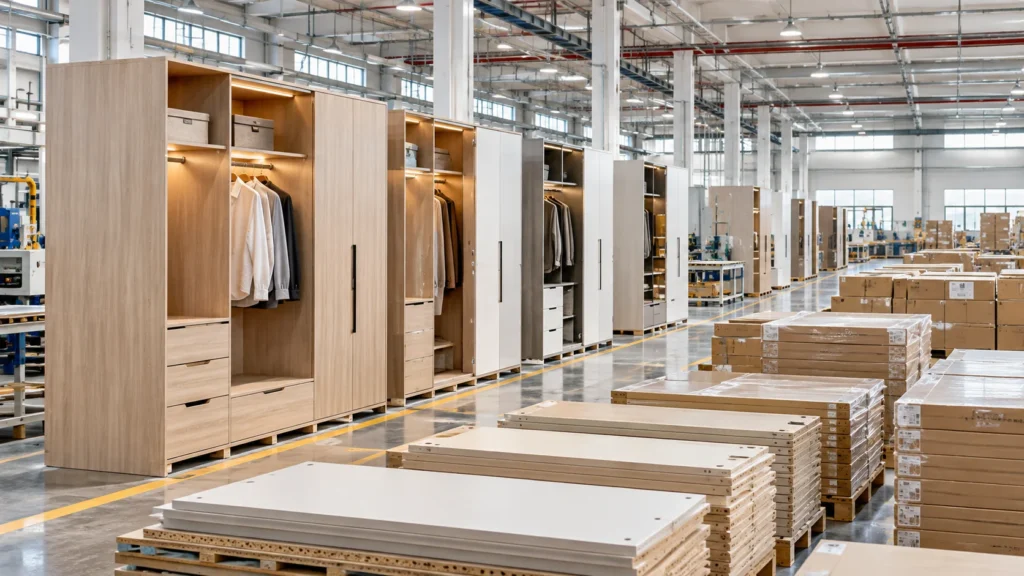
Starwood Industry Co., Ltd. is a China-based panel furniture export factory specializing in flat-pack furniture for global B2B buyers. Since 2013, we have supported OEM/ODM furniture programs for retail, wholesale, hotel, apartment, rental housing, student accommodation, and commercial projects.
This guide explains the factory-side purchasing issues professional buyers should clarify before placing a wardrobe order.
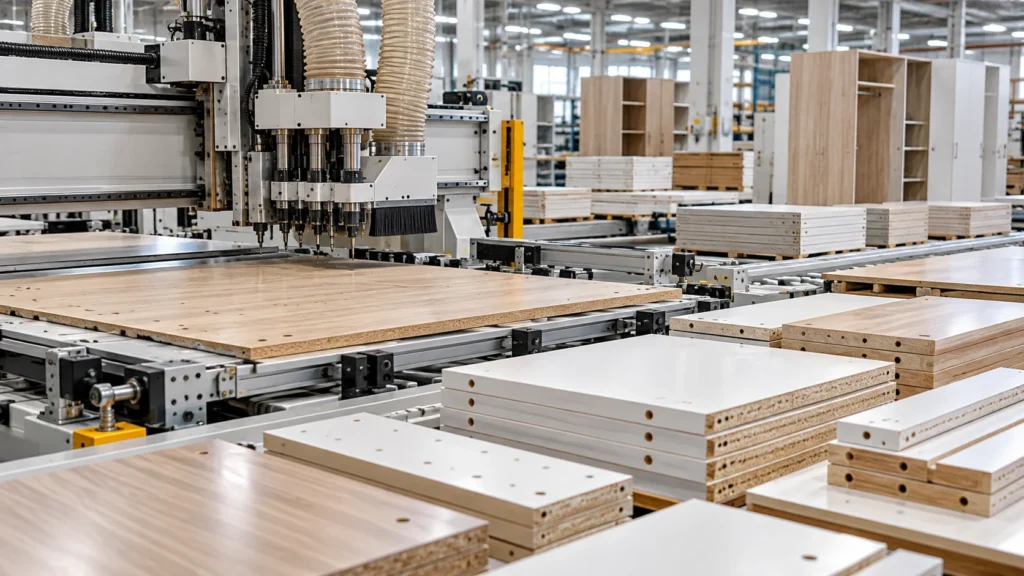
Table of Contents
- What Professional Buyers Need From a Wardrobe Exporter in China
- Factory Capability Behind a Reliable Wardrobe Program
- Commercial Wardrobe Applications
- Wardrobe Materials and Construction Specifications
- OEM vs ODM Wardrobe Manufacturing
- MOQ Planning for Export Wardrobe Orders
- Lead Time and Project Scheduling
- Quality Control Before Shipment
- Flat-Pack Packaging and Container Loading
- Compliance for Different Export Markets
- How to Prepare a Professional Wardrobe RFQ
- How to Compare Factory Quotations
- Our Wardrobe Customization Process
- Why Work With Starwood
- Frequently Asked Questions
What Professional Buyers Need From a Wardrobe Exporter in China
A professional wardrobe sourcing program involves much more than manufacturing four panels, doors, shelves, and a hanging rail.
The export factory needs to understand what happens before production, during production, inside the container, and after the goods reach the buyer.
A commercial wardrobe order may involve:
- several wardrobe sizes;
- different room types;
- multiple internal layouts;
- buyer-specific finishes;
- custom hinges and drawer slides;
- private-label packaging;
- installation instructions;
- destination-market compliance;
- mixed-container loading;
- replacement parts;
- phased project deliveries.
This is why the word exporter matters.
A factory that is experienced only in local production may be able to manufacture a wardrobe but still have limited experience with carton optimization, long-distance transport protection, container utilization, international documentation, destination-market requirements, or repeat B2B purchasing.
For international buyers, a reliable supplier should therefore operate as three things at the same time:
a commercial furniture manufacturer,
an OEM ODM furniture supplier, and
a panel furniture export factory.
Buyers who want to verify our manufacturing background can first review the Starwood factory and company information:
Starwood Factory & Manufacturing Capability
Starwood currently presents more than 13 years of manufacturing experience, export business across more than 20 markets, and production supporting more than 100 containers per year.
Those numbers matter because repeat export work requires manufacturing discipline, not simply product photography.
Factory Capability Behind a Reliable Wardrobe Program
A buyer cannot evaluate wardrobe manufacturing capability only by looking at finished product images.
From our factory experience, the more important question is whether the supplier can repeatedly control the same specification across sampling, pilot production, bulk production, packing, and repeat orders.
CNC Panel Processing
Modern panel wardrobes depend heavily on machining accuracy.
The cutting size, drilling pattern, connector position, hinge cup location, shelf holes, drawer clearances, and back-panel dimensions all influence final assembly.
If panel machining is inconsistent, the problems may not appear until the wardrobe is assembled at the destination.
This is especially expensive for hotel and apartment projects because one small dimensional mistake can repeat across hundreds of rooms.
Edge Finishing
Edge banding is not merely cosmetic.
Buyers should define:
- edge material;
- edge thickness;
- matching or contrasting color;
- visible versus hidden edges;
- adhesive requirement;
- moisture exposure;
- acceptable glue-line appearance.
Visible wardrobe doors normally require higher cosmetic control than hidden carcass edges.
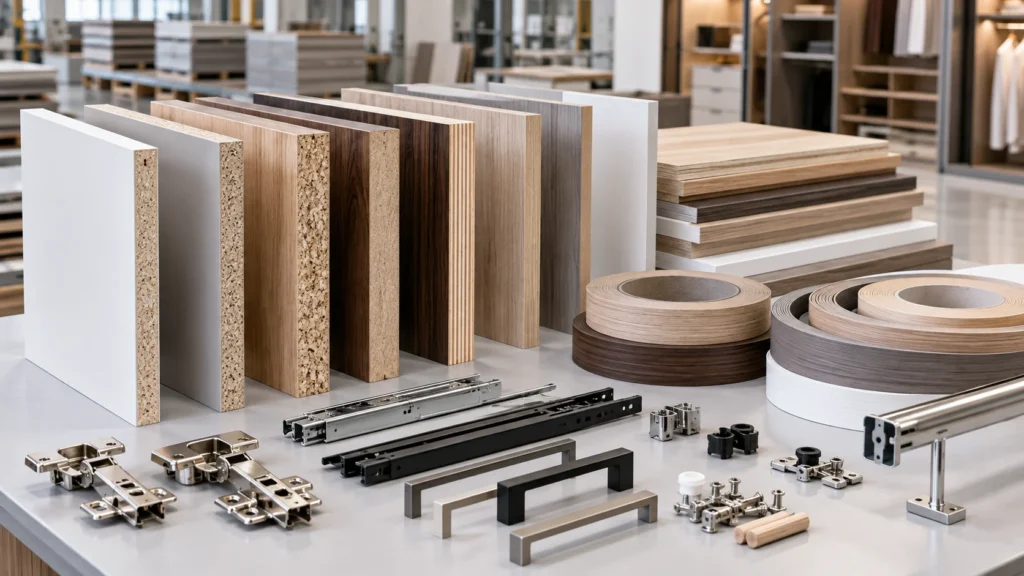
Hardware Matching
Wardrobe hardware can include:
- concealed hinges;
- soft-close hinges;
- drawer slides;
- handles;
- hanging rails;
- connectors;
- shelf supports;
- adjustable feet;
- mirrors;
- lighting;
- wall-fixing hardware.
The hardware specification should be confirmed before quotation instead of being left as “standard hardware.”
A USD 3–5 difference between two quotations may simply mean that one factory is using a different hinge, thinner panel, lighter drawer slide, or simpler packaging.
Repeatable Production
The goal of B2B furniture sourcing is not to produce one excellent prototype.
The real goal is to reproduce the approved sample across the entire purchase order.
That requires control over materials, drilling programs, finishes, hardware, assembly references, carton contents, and labeling.
Our broader manufacturing workflow is explained on the OEM & ODM Furniture Manufacturing Services page.
Commercial Wardrobe Applications
Different buyers use wardrobes in completely different commercial environments. The application should therefore be defined before the material and price are finalized.
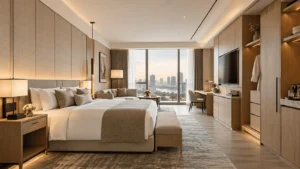
Hotel and Serviced Apartment Wardrobes
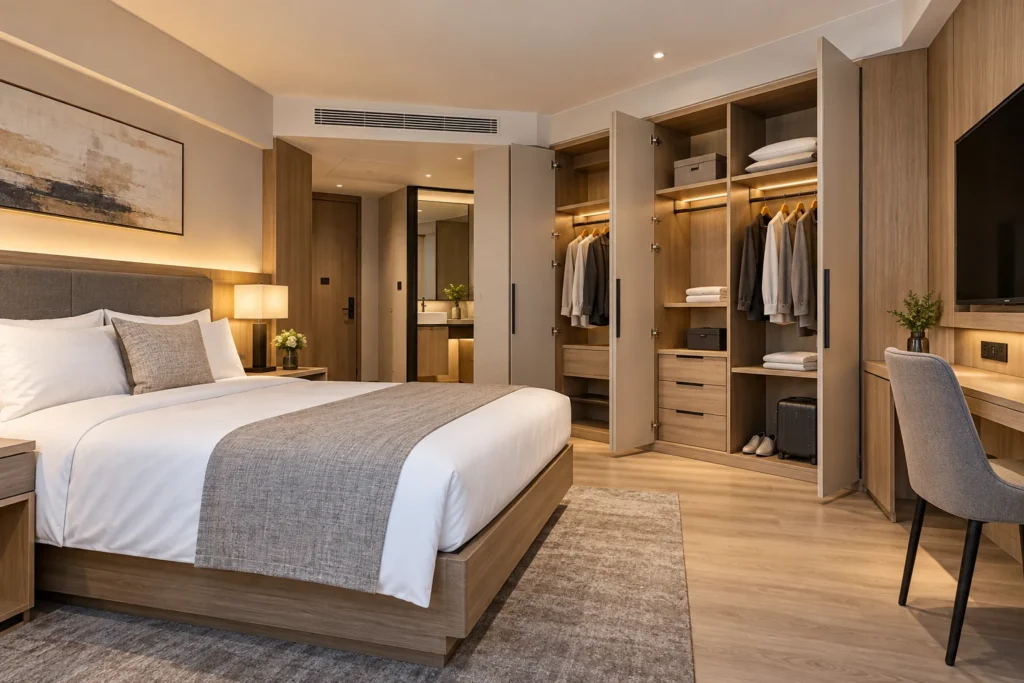
Hospitality wardrobes are normally part of a coordinated room package rather than an isolated product.
A hotel wardrobe may need to integrate:
- hanging storage;
- shelving;
- drawers;
- luggage storage;
- a safe;
- minibar space;
- mirror panels;
- LED lighting;
- open storage;
- adjacent desks or TV panels.
The factory must review room drawings, skirting, power positions, floor conditions, door clearances, wall fixing, installation access, and surrounding furniture.
A design that works perfectly in a catalog may create installation problems if room conditions were never considered.
Hotel projects also require finish consistency.
A slight difference between two walnut finishes may be acceptable when products are sold separately, but it becomes obvious when the wardrobe, bed, desk, nightstand, and TV panel are installed in one room.
Apartment and Rental Housing Wardrobes
Apartment developers usually place more emphasis on cost control, usable storage, durability, installation efficiency, and replacement availability.
Common requirements include:
- hinged-door wardrobes;
- sliding-door wardrobes;
- wardrobes with drawers;
- wardrobes with open niches;
- compact wardrobes for studios;
- full-height wardrobes;
- modular wardrobe systems;
- wardrobe-and-desk combinations.
Several unit types may use the same finish while requiring different dimensions.
For the factory, this means production must be organized by SKU without losing finish and hardware consistency.
Student Housing and Staff Accommodation
Student housing furniture normally needs compact dimensions, practical internal storage, repeatable hardware, easy installation, and straightforward replacement.
KD or RTA construction can be particularly useful because the product can be delivered room by room and assembled on site.
Wholesale, Retail and Private-Label Programs
Wholesalers and furniture brands normally care about something different from project contractors.
They need:
- SKU consistency;
- barcode placement;
- carton dimensions;
- carton weight;
- brand labels;
- assembly manuals;
- spare hardware;
- repeat-order consistency;
- warehouse-friendly packaging.
For e-commerce buyers, the packaging itself becomes part of product performance because transport damage and difficult assembly can directly affect reviews and returns.
For complete hotel, apartment, rental and commercial programs, buyers can also review our Project Furniture Manufacturing capability.
Wardrobe Materials and Construction Specifications
Material names alone are not enough for professional sourcing.
Writing “MDF wardrobe” or “particle board wardrobe” in an RFQ still leaves many unanswered questions.
Buyers should define panel thickness, density or grade where relevant, surface treatment, edge banding, back panel, hardware, internal structure, and destination-market requirements.
Particle Board
Melamine-faced particle board is widely used for flat-pack wardrobes, apartment programs, wholesale furniture, rental properties, and value-focused retail.
Its commercial advantages include:
- efficient CNC processing;
- consistent decorative surfaces;
- good cost control;
- broad color availability;
- efficient flat-pack production.
However, price should not be compared only by the words “particle board.”
Board density, screw-holding performance, thickness, surface quality, edge sealing, and formaldehyde requirements may differ.
MDF
MDF is frequently selected for wardrobe doors and components that require a smooth painted, wrapped, laminated, or routed surface.
It works particularly well for:
- painted doors;
- decorative profiles;
- smooth matte finishes;
- PVC-wrapped surfaces;
- laser-edge designs.
MDF is generally heavier than comparable particle board, so panel size, hardware selection, carton weight, and container loading must also be considered.
Buyers interested in a more refined MDF wardrobe specification can review this example:
Laser Edge MDF Wardrobe – OEM Wardrobe Supplier
Plywood
Plywood can be specified for projects requiring stronger structural performance, different moisture performance, premium positioning, or buyer-specific construction.
However, “plywood” also covers many different products.
Professional buyers should confirm:
- plywood species or core construction;
- thickness;
- face material;
- adhesive requirement;
- surface finish;
- edge treatment;
- emission requirement;
- visual grade.
The correct choice depends on market position and project conditions rather than assuming plywood is automatically necessary for every wardrobe.
Back Panels
Back panels are frequently overlooked when comparing quotations.
A thin back panel and a stronger engineered back system can have very different cost and structural performance.
The RFQ should state:
- material;
- thickness;
- installation method;
- groove or surface fixing;
- color requirement.
Finishes
Wardrobe finishes may include:
- melamine;
- laminate;
- painted MDF;
- woodgrain surfaces;
- natural veneer;
- matte finish;
- gloss finish;
- buyer-specified colors.
For hotel and apartment projects, we recommend approving physical finish samples whenever color matching is critical.
A computer monitor is not a reliable final approval method for a large room package.
OEM vs ODM Wardrobe Manufacturing
OEM and ODM are often used as marketing terms, but for procurement teams the difference affects the entire development process.
OEM Wardrobe Manufacturing
OEM is normally the better route when the buyer already controls the specification.
You may provide:
- CAD drawings;
- technical drawings;
- BOQ/BOM files;
- an existing sample;
- confirmed dimensions;
- panel specifications;
- hardware models;
- approved colors;
- packaging requirements.
The factory’s role is to review manufacturability, quote the confirmed specification, develop a sample where required, and reproduce it consistently in mass production.
ODM Wardrobe Development
ODM is useful when the commercial requirement is clear but the technical specification is not yet complete.
For example, a buyer may know:
- target retail price;
- target FOB cost;
- market style;
- room dimensions;
- preferred finish;
- number of drawers;
- storage functions;
- required carton size.
The factory then helps translate those commercial requirements into a manufacturable product.
This can involve value engineering around:
- panel thickness;
- internal configuration;
- hinge level;
- drawer slides;
- door structure;
- number of shelves;
- edge banding;
- packaging;
- loading quantity.
In practice, many B2B programs combine both approaches.
The buyer controls branding, appearance, market positioning, and commercial requirements, while the factory contributes production engineering.
That is the type of relationship buyers should expect from an experienced OEM ODM furniture supplier.
MOQ Planning for Export Wardrobe Orders
One of the most common purchasing mistakes is asking only:
“What is your MOQ?”
A useful MOQ discussion should separate development quantity, SKU quantity, and export-order quantity.
Sample Quantity
A new wardrobe may begin with one prototype or a small development batch.
The purpose is to verify:
- dimensions;
- assembly;
- finish;
- door alignment;
- drawer operation;
- hardware;
- packaging.
This is not the same as the mass-production MOQ.
MOQ per SKU
A unique color, special laminate, custom handle, or exclusive packaging may require a minimum production quantity.
Several wardrobe sizes using the same material may be easier to combine than several models using completely different finishes.
Container-Based MOQ
For export furniture, container efficiency matters.
Starwood currently presents one container as a general factory-level order reference on its main manufacturing website, while actual SKU combinations, samples, finishes and project quantities are reviewed individually.
A buyer may therefore be able to combine compatible SKUs such as:
- wardrobes;
- beds;
- bedside tables;
- desks;
- storage cabinets.
This is more commercially useful than forcing every item into an arbitrary identical MOQ.
When requesting a quotation, send the estimated quantity for every SKU and the destination port.
That allows the factory to evaluate both production and loading.
Lead Time and Project Scheduling
Professional buyers should never treat lead time as one isolated number.
A new wardrobe program normally contains several timelines:
RFQ → technical review → quotation → drawing confirmation → material approval → sample → buyer approval → bulk production → QC → packing → loading.
Some existing Starwood wardrobe and panel-furniture programs use approximately 35–45 days as a mass-production reference after specification confirmation, while new ODM programs require additional development and sampling time.
The final schedule depends on:
- product complexity;
- finish availability;
- hardware;
- quantity;
- number of SKUs;
- packaging;
- testing;
- production season.
For project furniture, the correct planning method is to work backward from the installation date.
A buyer should leave time for:
- ocean freight;
- customs clearance;
- warehouse receiving;
- site delivery;
- installation;
- snagging;
- replacement components.
Saving several days in factory production provides little value if the project misses its opening or handover date.
Quality Control Before Shipment
Quality control should start before the final carton is closed.
From a factory perspective, wardrobe QC is most effective when it is divided into several stages.
Incoming Material Inspection
The factory should confirm key materials against the approved order specification.
Typical checks include:
- panel thickness;
- surface color;
- finish consistency;
- visible damage;
- edge material;
- key hardware.
In-Process Inspection
Machining errors are much easier to correct before hundreds of panels have been produced.
Important controls include:
- cutting dimensions;
- drilling;
- edge banding;
- hole positions;
- labeling;
- component quantity.
Trial Assembly
Trial assembly is especially important for new OEM and ODM designs.
A completed sample can expose issues that are difficult to see on individual panels, including:
- uneven doors;
- drawer interference;
- incorrect drilling;
- missing holes;
- poor gaps;
- hardware conflicts;
- difficult assembly sequence.
For buyers developing storage furniture performance requirements, the international ISO 7170:2021 standard provides test methods for determining the strength, durability and stability of storage units.
Official reference:
ISO 7170:2021 – Furniture, Storage Units
ISO explains that the standard covers test methods for fully assembled storage units and their movable and non-movable parts.
The exact testing requirement should still be defined according to the destination market, buyer specification and intended use.
Pre-Shipment Packing Check
Before shipment, the factory should confirm:
- correct panels;
- hardware bags;
- instructions;
- labels;
- carton quantities;
- SKU codes;
- packaging protection.
This final stage is where many avoidable claims can be prevented.
Flat-Pack Packaging and Container Loading
For a wardrobe exporter, packaging is part of product engineering.
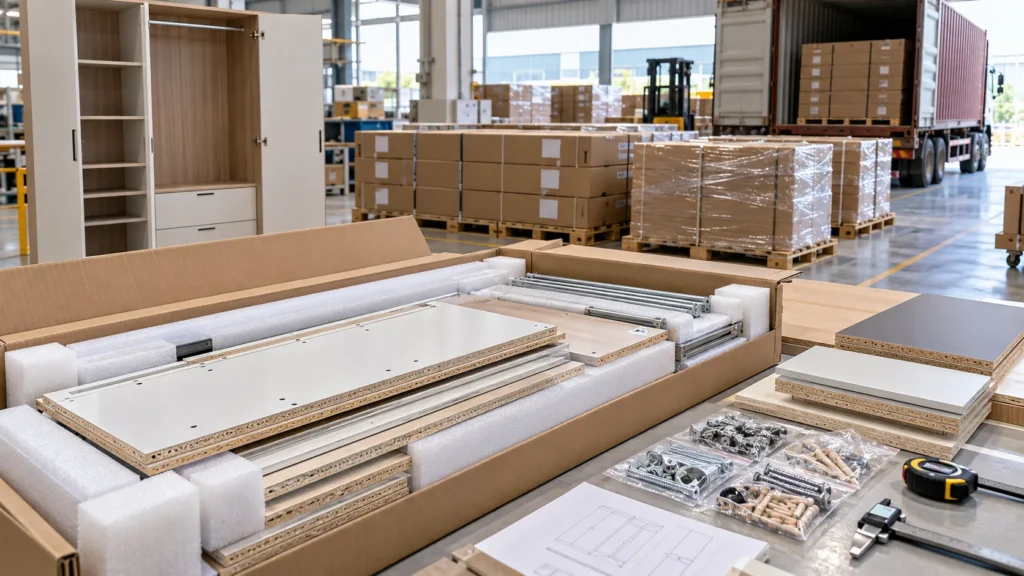
Wardrobes contain large finished surfaces, long panel edges, mirrors, rails and hardware. Poor packaging can destroy a correctly manufactured product before it reaches the buyer.
A typical export packing solution may include:
- individual panel protection;
- foam or protective sheets;
- corner protection;
- reinforced cartons;
- separated hardware bags;
- clearly identified fittings;
- assembly instructions;
- carton numbers;
- SKU labels;
- private-label marks;
- barcode information.
Why KD / RTA Construction Matters
Knock-down or ready-to-assemble wardrobes can improve international logistics in several ways.
First, disassembled panels normally allow better use of container volume than fully assembled cabinets.
Second, cartons are easier to stack, warehouse and distribute.
Third, project contractors can organize room-by-room installation rather than moving large finished wardrobes through completed buildings.
However, flat-pack furniture only works well when the connector positions, drilling logic, panel numbering, hardware kits and assembly instructions have been engineered properly.
The target should not simply be “make it flat pack.”
The target should be make it efficient to ship and predictable to assemble.
Container Loading
Experienced exporters should review loading before production is finished.
Important information includes:
- carton dimensions;
- gross weight;
- CBM per set;
- cartons per wardrobe;
- number of units per container;
- mixed-SKU ratio;
- unloading sequence.
A slightly cheaper wardrobe may create a higher landed cost if the carton is significantly larger and fewer units fit into each container.
This is why professional importers compare landed value, not only FOB unit price.
Wood Packaging Requirements
When solid-wood pallets, crates or dunnage are used, the packaging may need to meet phytosanitary requirements.
The International Plant Protection Convention publishes ISPM 15, which addresses wood packaging material used in international trade.
Official reference:
IPPC – ISPM 15 Regulation of Wood Packaging Material
The IPPC notes that ISPM 15 concerns raw-wood packaging such as dunnage, while processed products such as plywood are excluded from the covered raw-wood packaging definition.
Buyers and factories should still confirm the exact packing solution and destination-country requirements before shipment.
Compliance for Different Export Markets
A professional wardrobe exporter should never promise that one generic certificate makes a wardrobe compliant everywhere.
Requirements vary according to market, material, product type, customer and contract.
Compliance information should therefore be included in the RFQ before materials are ordered.
United States – Composite Wood Formaldehyde Requirements
For furniture containing MDF, particleboard or regulated hardwood plywood entering the U.S., buyers should review the U.S. Environmental Protection Agency’s requirements for composite wood products.
Official reference:
U.S. EPA – Formaldehyde Emission Standards for Composite Wood Products
The EPA explains that TSCA Title VI covers regulated hardwood plywood, MDF and particleboard as well as finished goods containing those materials.
For U.S. orders, buyers should therefore clarify the panel source, applicable documentation, labeling, import responsibility and record requirements before production.
FSC and Responsible Wood Sourcing
If a contract requires FSC-certified material or an FSC claim, chain-of-custody requirements must be handled correctly.
The Forest Stewardship Council explains how certified forest-based material is identified and tracked through manufacturing and distribution.
Official reference:
FSC – Chain of Custody Certification
A buyer should specify whether the requirement is simply FSC-sourced material or whether a valid FSC claim must appear on sales documents or finished products.
Those are not automatically the same requirement.
European Union – EUDR
European buyers should also follow the latest requirements under the EU Regulation on Deforestation-free Products.
Official reference:
European Commission – Regulation on Deforestation-free Products
The European Commission specifically identifies wood and certain derived products, including furniture, within the regulation’s broader scope and publishes current implementation dates and guidance on the official page.
Because the regulatory timetable and product scope can be updated, buyers should confirm the current requirements and their legal role before each program rather than relying on an old sourcing checklist.
EU Ecolabel and Environmental Purchasing
Where a European project includes environmental procurement requirements, buyers may also consult the European Commission’s furniture-specific EU Ecolabel documentation.
Official reference:
European Commission – EU Ecolabel Furniture User Manual
The official documentation provides guidance and supporting materials for the furniture product group.
Again, the purpose of these links is not to claim that every wardrobe automatically carries these certifications.
The correct purchasing practice is to state the required standard in the RFQ and confirm evidence before order approval.
How to Prepare a Professional Wardrobe RFQ
Good quotations begin with good information.
If two factories receive different assumptions, their prices cannot be compared fairly.
For an accurate quotation, provide the following information whenever possible.
Product and Dimension Information
Send:
- technical drawings;
- room drawings;
- reference images;
- width, depth and height;
- door quantity;
- internal layout;
- shelves;
- hanging sections;
- drawers;
- mirror requirement;
- wall fixing;
- quantity per SKU.
Material Specification
Define:
- particle board, MDF, plywood or alternative;
- panel thickness;
- finish;
- back panel;
- edge banding;
- visible edge requirements;
- target emission standard if applicable.
Hardware
Specify:
- hinge type;
- soft-close requirement;
- drawer slide;
- handle;
- hanging rail;
- connector system;
- preferred hardware brand if necessary.
Packaging
Tell the factory whether the product is intended for:
- project installation;
- wholesale distribution;
- retail;
- e-commerce;
- private label.
The correct packaging for a hotel contractor may be different from the correct packaging for parcel delivery.
Commercial Information
Include:
- destination country;
- destination port;
- required quantity;
- target FOB price if available;
- inspection requirement;
- required testing;
- target shipment date;
- preferred Incoterm;
- private-label requirements.
A clear RFQ allows the exporter to quote the product you actually want to purchase rather than a low-cost assumption that changes later.
How to Compare Factory Quotations
Never compare only the final price column.
Create a line-by-line specification comparison.
A proper comparison should cover:
- panel material;
- panel thickness;
- back panel;
- finish;
- edge banding;
- hinges;
- drawer slides;
- handles;
- storage accessories;
- packaging;
- cartons per set;
- CBM per set;
- loading quantity;
- private labeling;
- testing;
- QC requirement;
- sample approval;
- lead time;
- payment terms.
For example, Supplier A may quote USD 5 less per wardrobe.
But Supplier B may provide:
- stronger packaging;
- better hardware;
- lower carton volume;
- more units per 40HQ;
- more detailed assembly instructions.
After ocean freight, claims and installation labor are considered, Supplier B may be the lower-cost commercial solution.
That is why professional purchasing departments compare landed cost and execution risk, not only factory price.
Our Wardrobe Customization and Export Process
At Starwood, an OEM/ODM wardrobe program normally moves through a structured sequence.
1. Buyer Brief
Send drawings, product references, dimensions, required quantities, target materials, finishes, destination market and packaging requirements.
2. Technical Review
We review manufacturability, panel structure, materials, hardware, packaging and major cost drivers.
When appropriate, we may suggest changes to improve production efficiency or container loading.
3. Quotation
The quotation should define the specification clearly enough that both buyer and factory understand what is included.
4. Drawings and Sample Development
For a new product, drawings and samples allow the buyer to approve dimensions, appearance, hardware, assembly and finish before mass production.
5. Specification Freeze
Once the sample and specification are approved, changes should be controlled.
Late changes to hardware, colors or drilling can affect cost and delivery.
6. Bulk Production
Production moves through panel preparation, CNC processing, drilling, edge finishing, hardware preparation and other required processes.
7. QC and Trial Assembly
Critical products or new models can be assembled and checked before packing.
8. Flat-Pack Packaging
Panels, fittings and accessories are organized according to the confirmed packing method.
9. Container Planning
Carton quantity and SKU ratios are reviewed before loading.
10. Shipment
The order is prepared according to the agreed export and shipping requirements.
This process allows buyers to work with one panel furniture export factory from development through shipment instead of coordinating several disconnected suppliers.
Why Work With Starwood as Your Wardrobe Export Partner
Starwood Industry Co., Ltd. is a professional flat-pack furniture manufacturer based in Jiangmen, Guangdong, China.
Our current factory positioning is built around B2B manufacturing rather than consumer retail.
We support:
- furniture brands;
- importers;
- distributors;
- wholesalers;
- hotel buyers;
- apartment developers;
- contractors;
- project companies;
- e-commerce brands.
Our manufacturing scope includes wardrobes as well as beds, storage furniture, desks, bathroom cabinets, kitchen storage, TV units and other engineered-panel products.
Current factory capabilities presented on our website include:
13+ years manufacturing experience since 2013
20+ export markets
100+ containers per year
OEM and ODM development
MDF, particle board, plywood and engineered panels
custom dimensions and finishes
KD / RTA export packaging
quality control and container-loading support
You can review our broader manufacturing positioning here:
Flat-Pack Furniture Manufacturer in China
For factory details:
For OEM and ODM development:
OEM & ODM Furniture Manufacturing Services
For hotel, apartment and commercial orders:
Project Furniture Manufacturing
Start Your Wardrobe Sourcing Project
If you need a wardrobe exporter China buyers can work with for OEM production, ODM development, private-label programs, hotel rooms, apartments, student housing, wholesale distribution or flat-pack retail furniture, send us your project information.
For a faster quotation, include your:
- drawing or reference image;
- required dimensions;
- quantity per SKU;
- panel material;
- finish;
- hardware specification;
- destination country;
- destination port;
- packing requirement;
- target delivery schedule.
We can review the product from both a manufacturing and export perspective, including structure, material, cost, MOQ, packaging, loading and production scheduling.
Send your wardrobe RFQ to Starwood Industry Co., Ltd. and let our factory team evaluate your next OEM/ODM or commercial furniture project.
Frequently Asked Questions
Is Starwood a wardrobe manufacturer or a trading company?
Starwood Industry Co., Ltd. is a panel furniture manufacturing factory based in Jiangmen, Guangdong, China. Our factory supports OEM and ODM furniture development, sampling, CNC panel production, bulk manufacturing, quality control, flat-pack packaging and export shipment preparation for international B2B buyers.
What types of buyers do you supply?
We work primarily with furniture importers, wholesalers, distributors, private-label brands, e-commerce companies, hotel procurement teams, apartment developers, contractors and commercial project buyers. The factory is structured around B2B and project supply rather than individual consumer orders.
What materials can be used for custom wardrobes?
Available options can include particle board, MDF, plywood, melamine-faced engineered panels and other buyer-specified materials. The correct material depends on the target price, finish, structure, destination market, compliance requirement and intended application.
What is the MOQ for an export wardrobe order?
MOQ depends on the wardrobe design, material, finish, hardware, packaging and number of SKUs. Starwood currently uses one container as a general factory-level export-order reference, while samples, product development and mixed-SKU programs can be evaluated separately. Buyers should provide expected quantities per SKU so the factory can propose the most practical loading plan.
How long does wardrobe production take?
Some standard Starwood wardrobe and panel-furniture programs use approximately 35–45 days as a mass-production reference after specifications and order details are confirmed. New ODM products require additional time for drawings, sampling, revisions and buyer approval. Final production time is confirmed according to the actual project.
Can you manufacture wardrobes from our drawings?
Yes. OEM buyers can provide CAD drawings, technical drawings, BOQ/BOM files, samples, dimensions, materials and hardware requirements. The factory can review manufacturability, prepare quotations and develop samples before mass production where required.
Can you develop a wardrobe from a reference image or room plan?
Yes. ODM buyers can provide room plans, reference images, target dimensions, required storage functions, finish direction, target price and market positioning. We can help convert these requirements into a production-ready panel wardrobe specification.
Can you produce wardrobes for hotels and apartments?
Yes. Wardrobes can be produced for hotels, serviced apartments, rental housing, student accommodation, staff housing and residential developments. They can also be coordinated with beds, nightstands, desks, TV units, bathroom cabinets and other panel furniture within one project program.
Do you provide flat-pack packaging?
Yes. Depending on the product, packaging can include KD/RTA construction, individual panel protection, foam, reinforced cartons, hardware bags, carton marks, SKU labels, barcodes, assembly instructions and private-label packaging.
Can you support U.S. or European compliance requirements?
Compliance depends on the exact product and destination market. Buyers should state required formaldehyde, testing, sustainability, labeling or documentation standards in the RFQ. For U.S.-bound composite wood products, buyers should review applicable U.S. EPA TSCA Title VI requirements. European buyers should review the latest EUDR and other applicable market requirements before order confirmation.