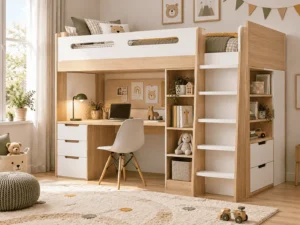
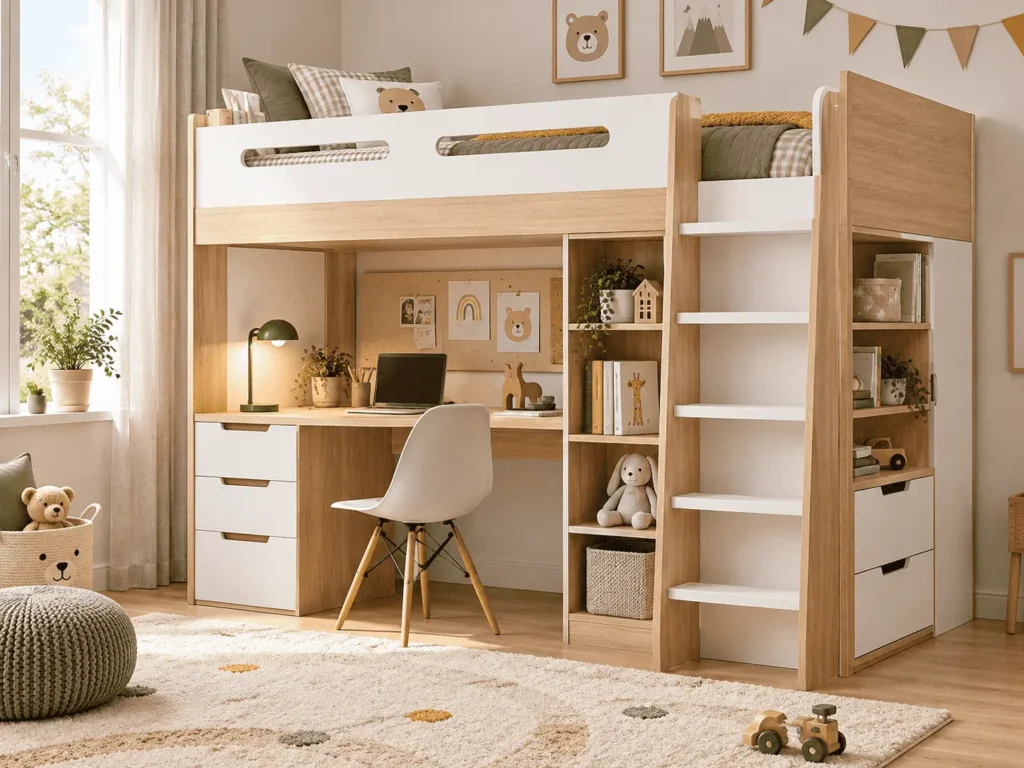
Finding the right kids loft bed with desk manufacturer is not simply about locating a factory that can produce an attractive bed at a competitive FOB price. For importers, furniture brands, retailers, e-commerce sellers and project buyers, the real purchasing decision involves structural engineering, panel materials, hardware, safety requirements, carton dimensions, assembly logic, MOQ, lead time, quality control and repeat-order consistency.
A loft bed with an integrated desk is especially attractive for compact bedrooms because it combines sleeping, studying and storage functions within one footprint. But from a B2B sourcing perspective, adding more functions also increases manufacturing complexity.
The key question for a professional buyer is therefore not:
“Can this factory make a loft bed?”
It is:
“Can this manufacturer turn our design into a commercially viable product that can be produced consistently, packed efficiently, shipped internationally and reordered at scale?”
This guide explains how buyers should evaluate a kids loft bed factory from RFQ and sampling through bulk production and export shipment.
Table of Contents
- Why buyers source loft beds with desks
- Which B2B programs are suitable
- How to evaluate the manufacturer
- Product structure and engineering
- Materials and panel specifications
- Safety and destination-market requirements
- OEM and ODM customization
- MOQ and quotation strategy
- Sampling and pre-production approval
- Production lead time
- Flat-pack packaging and logistics
- Quality control
- How to compare factory quotations
- Project furniture applications
- What information to include in an RFQ
- FAQ
- Request a quotation
Why Buyers Are Sourcing Loft Beds with Desks for Small Rooms
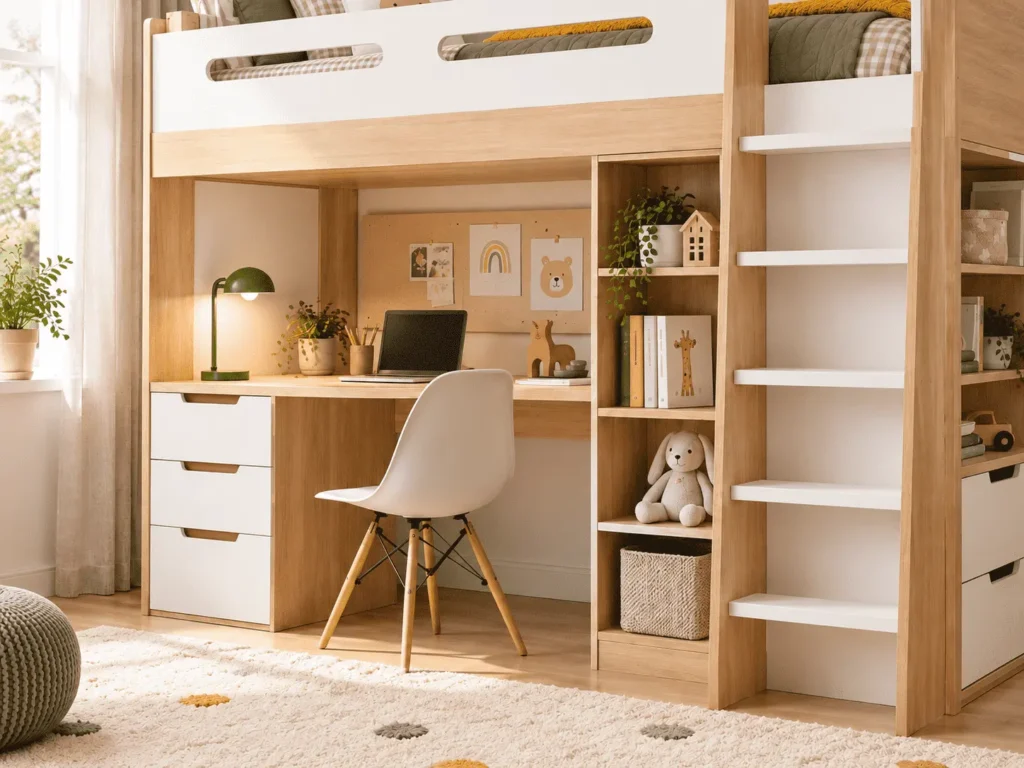
The commercial value of a loft bed comes from vertical space utilization.
In a conventional bedroom layout, a bed, study desk, bookshelf and storage cabinet each require separate floor space. In compact apartments and children’s bedrooms, that can quickly make the room difficult to use.
A loft bed changes the layout by placing the sleeping platform above the floor and creating usable space underneath.
Depending on the market and design brief, the lower area can include a desk, drawers, shelving, wardrobe storage or open study space.
For B2B furniture programs, this creates a clear selling proposition:
sleep + study + storage within a compact footprint.
That proposition works particularly well for urban apartments, small bedrooms, rental properties, e-commerce furniture collections and private-label kids furniture programs.
However, the most complicated design is not always the most commercially successful.
From a manufacturing perspective, every additional cabinet, drawer, shelf, staircase or moving component increases material consumption, hardware quantity, machining operations, assembly time, carton weight and possible after-sales issues.
A professional space saving loft bed supplier should therefore help buyers balance product features with production cost and logistics efficiency.
Which B2B Buyers Are a Good Fit for This Product?
Kids loft beds with desks can be developed for several purchasing channels, but each channel has different priorities.
Furniture Importers and Wholesalers
Importers usually focus on repeatability.
Once a product has passed sampling and entered their catalog, they need future orders to maintain the same dimensions, finish, panel thickness, hardware specification and packaging format.
For an importer, changing a drawer runner, decor color or drilling pattern without approval can create serious problems even when the replacement component appears “similar.”
A reliable factory should therefore control approved specifications and use them as the basis for repeat production.
Furniture Retailers
Retail buyers normally require the product to be visually attractive while remaining practical to deliver and assemble.
Retail programs may also need:
- private-label cartons;
- barcode labels;
- multilingual manuals;
- replacement hardware packs;
- consistent finish matching;
- coordinated furniture collections.
The loft bed can also be combined with matching wardrobes, nightstands, bookshelves and storage cabinets.
For related products, buyers can review:
https://plywoodmfr.com/kids-room-furniture/kid-bed-set
E-Commerce Furniture Brands
For e-commerce sellers, packaging can be almost as important as the furniture itself.
A loft bed may look excellent after installation but still perform poorly commercially if cartons are oversized, hardware becomes loose in transit, panels arrive damaged or the assembly manual is confusing.
E-commerce buyers should therefore evaluate:
- carton dimensions;
- carton weight;
- internal protection;
- package sequence;
- assembly time;
- replacement-part identification.
For this market, product engineering and packaging engineering should be considered together.
Apartment and Project Furniture Buyers
Apartment and project buyers usually focus more on standardization and installation efficiency.
A project may require the same loft-bed configuration across tens or hundreds of rooms.
In that situation, excessive customization between units creates unnecessary site complexity.
Project buyers generally benefit from a standardized structure, controlled hardware system, clearly numbered components and repeatable installation procedures.
For apartment, rental, hotel and commercial furniture programs, see:
How Should Buyers Evaluate a Kids Loft Bed with Desk Manufacturer?
A professional sourcing process should evaluate the supplier as a manufacturing partner rather than only as a quotation source.
Several capabilities are particularly important.
Engineering Capability
The supplier should be able to review whether a drawing is practical for panel production.
This includes:
- panel thickness;
- span length;
- connection positions;
- hardware selection;
- drawer clearance;
- ladder construction;
- desk support;
- guardrail construction;
- carton division.
A factory that accepts every drawing without asking technical questions is not necessarily more capable.
In many OEM projects, useful engineering feedback before sampling can prevent expensive revisions later.
Panel Processing Capability
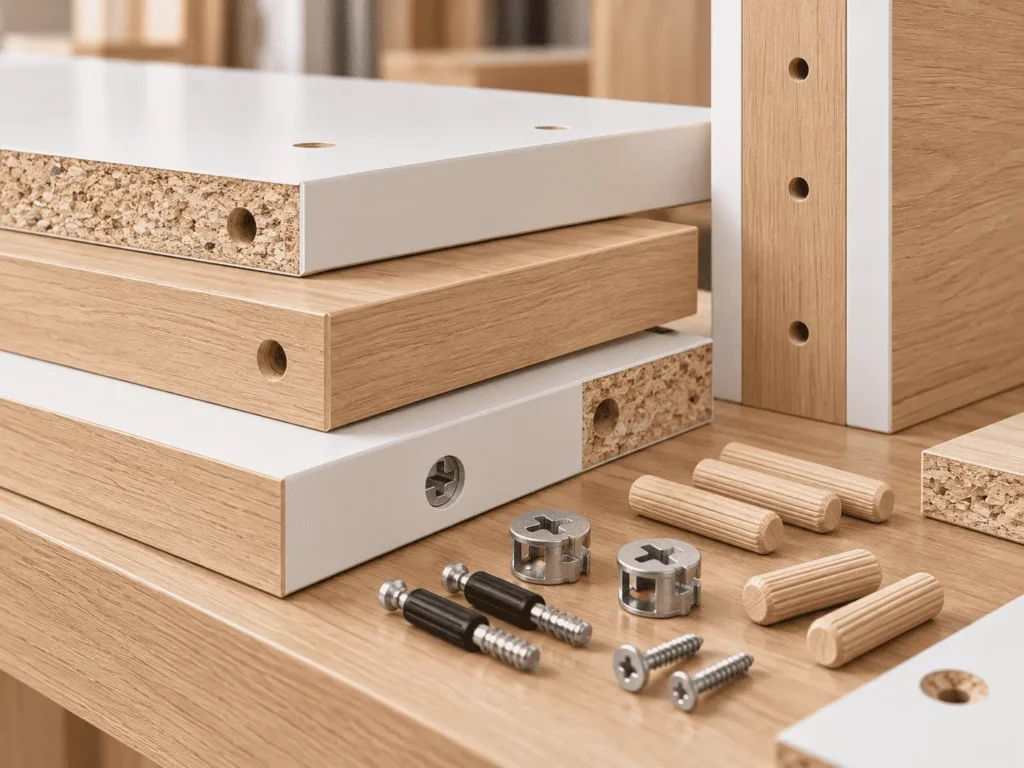
Flat-pack panel furniture depends heavily on machining accuracy.
Typical processes include cutting, CNC machining, drilling, edge banding and component identification.
A few millimeters of error at a key joint can turn into a major assembly problem when several panels connect in the final product.
The manufacturer should therefore be able to maintain repeatable machining positions across bulk production.
Hardware Management
Loft beds normally use more hardware than simple bed frames.
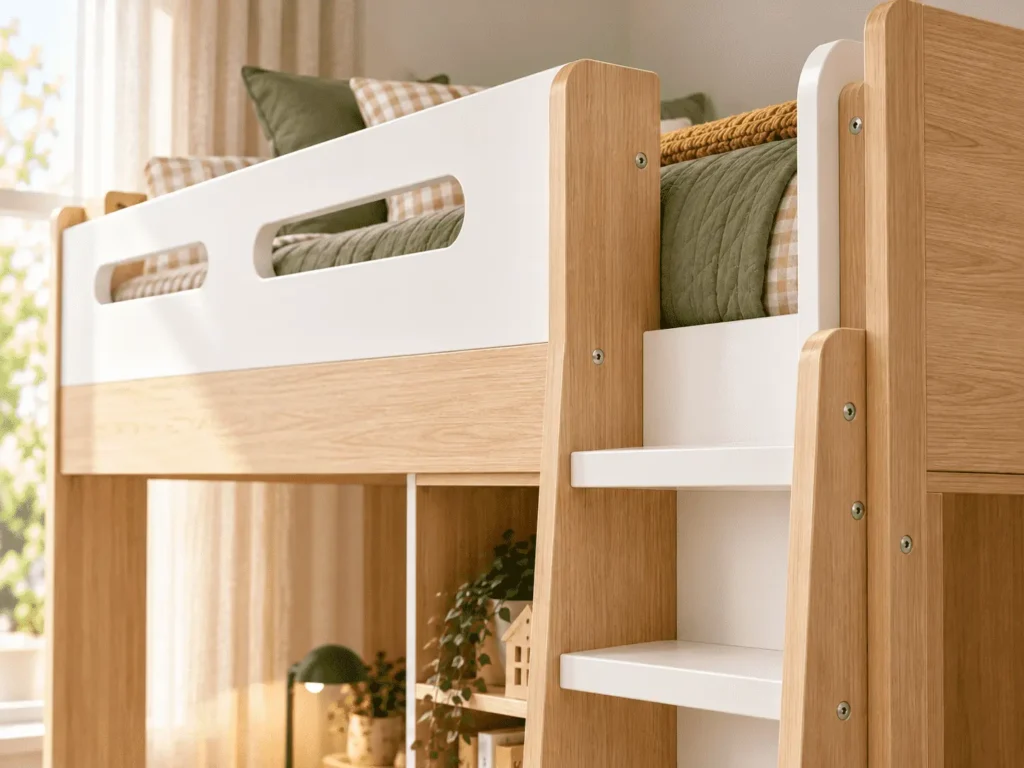
Depending on the structure, hardware can include bolts, cam fittings, dowels, confirmat screws, barrel nuts, brackets, drawer runners, hinges, handles and wall-fixing components.
Hardware should be specified, counted and packed systematically.
For buyers with several furniture models, standardizing hardware across multiple SKUs can also reduce spare-part complexity.
Export Packaging Experience
A domestic furniture factory and an export-oriented flat-pack factory may approach packaging very differently.
International shipments involve longer handling chains, multiple loading and unloading stages, warehouse movement and sometimes parcel delivery.
The factory should understand how to protect long panels, finished surfaces, corners, hardware and high-risk components during transportation.
Start With the Product Structure, Not the Product Photo
One of the most common RFQ mistakes is sending a reference picture and requesting:
“Please quote this model.”
A photo can communicate the appearance, but it does not fully define the product.
Before a reliable quotation can be prepared, buyers should confirm key dimensions and construction requirements.
These typically include overall width, depth and height, mattress size, desktop size, ladder position, guardrail configuration, shelving layout, cabinet dimensions and storage functions.
Mattress size is particularly important for international programs.
Different countries use different standard mattress dimensions, and a loft bed designed around one mattress size may not be suitable for another market.
For OEM development, mattress dimensions should therefore be confirmed before structural drawings are finalized.
Load-Bearing Structure Requires More Than Thick Panels
Buyers sometimes compare loft beds mainly by panel thickness.
Panel thickness matters, but it is only one part of the structural system.
Performance also depends on:
- panel material;
- span length;
- support position;
- hardware specification;
- joint design;
- drilling accuracy;
- bed-base construction;
- assembly quality.
For example, increasing a panel from 16 mm to 18 mm does not automatically solve a weak connection point.
Likewise, a structurally efficient design may use different materials in different locations instead of simply increasing every panel thickness.
When reviewing a quotation, buyers should therefore ask which parts are structural and how those components are reinforced.
Choosing Panel Materials for OEM Loft Bed Production
A kids loft bed with desk manufacturer may use particleboard, MDF, plywood or combinations of engineered panels depending on design requirements.
Particleboard
Particleboard is widely used for flat-pack furniture because it is suitable for efficient panel machining and standardized production.
It is commonly used for:
- desks;
- cabinets;
- shelving;
- drawer components;
- storage units;
- decorative panels.
Its commercial advantage is predictable panel processing combined with competitive cost.
However, panel grade, density, thickness and hardware design still need to match the intended function.
MDF
MDF has a smooth and consistent surface, making it particularly useful when the design requires painted components, shaped edges or routed decorative details.
It may be selected for:
- painted panels;
- decorative headboards;
- shaped guardrail details;
- routed fronts;
- feature panels.
Plywood
Plywood can be considered for selected structural parts or programs requiring different performance characteristics.
The best material strategy is not necessarily to use one board type for the entire product.
Instead, materials should be chosen according to component function, target price and destination-market requirements.
Surface Finish and Color Consistency Matter for Repeat Orders
Melamine-faced panels are commonly used in OEM panel furniture because they provide repeatable woodgrain and solid-color finishes.
Typical commercial combinations include:
- oak and white;
- light wood and grey;
- natural wood tones;
- white with pastel accents;
- walnut-look finishes;
- neutral beige tones.
For B2B programs, finish-code control becomes important after the first order.
If a retailer adds a matching wardrobe or desk six months later, visible color differences between production batches can create problems.
The approved sample should therefore become the reference for future production.
Compliance Should Be Discussed Before Sampling
Destination-market requirements should be confirmed at the RFQ stage, not after production.
For U.S.-market loft or bunk-bed programs, the U.S. Consumer Product Safety Commission provides specific business guidance for bunk beds. The rules address issues including guardrails and entrapment hazards, and children’s bunk beds are covered under 16 CFR Part 1513.
Buyers developing products for the U.S. can review the official guidance here:
U.S. CPSC Bunk Beds Business Guidance
ASTM also publishes ASTM F1427, a consumer safety specification covering design, performance, labeling and instructional requirements for bunk beds.
ASTM F1427 Standard Consumer Safety Specification for Bunk Beds
The practical sourcing lesson is important:
Do not freeze the structure before confirming the destination market and applicable requirements.
Compliance may influence guardrails, openings, mattress specifications, labeling, warnings and testing.
Composite Wood Requirements for U.S. Buyers
Furniture made with particleboard, MDF or hardwood plywood may also fall under formaldehyde-emission requirements.
The U.S. Environmental Protection Agency identifies hardwood plywood, MDF and particleboard as composite wood products generally regulated under TSCA Title VI, including finished goods containing covered materials.
Importers and retailers can review the EPA guidance here:
U.S. EPA TSCA Title VI Composite Wood Guidance
For California programs, the California Air Resources Board also applies composite-wood requirements to covered materials and finished goods such as furniture, cabinets and shelving.
California Air Resources Board Composite Wood Guidance
This is why professional buyers should ask:
“Which board specification and supporting documentation are proposed for my destination market?”
That is more useful than requesting a vague board description without connecting it to the actual market requirement.
FSC and Responsible Material Sourcing
Some retailers and furniture brands require FSC-certified materials or documented chain-of-custody sourcing.
FSC explains that its Chain of Custody standard covers requirements related to sourcing, processing, labeling and sale of forest-based products represented as FSC certified.
Buyers can review FSC information here:
FSC Chain of Custody Standards
If FSC-related sourcing is required, tell the manufacturer during quotation.
The requirement can affect material availability, documentation and final cost.
OEM Manufacturing: When the Buyer Already Has a Design
OEM production is normally suitable when the buyer already has a clear design direction.
This may include:
- CAD drawings;
- detailed dimensions;
- an existing sample;
- material specifications;
- color references;
- hardware requirements;
- packaging specifications.
However, good OEM manufacturing should involve more than copying a drawing.
The factory should review the design for manufacturability.
For example, a buyer may specify a long unsupported desk panel because it looks clean in a rendering. The factory may recommend modifying the support structure to improve stability or packaging.
That engineering discussion can prevent problems before tooling, sampling and mass production.
For Starwood’s OEM/ODM process, see:
ODM Development: Start From Commercial Requirements
ODM is useful when a buyer understands the market opportunity but has not finalized the product.
A useful development brief might look like this:
Target market: Europe
Mattress size: 90 × 200 cm
Room type: compact children’s bedroom
Functions: sleeping + desk + storage
Finish: oak + white
Sales channel: furniture retail
Packaging: flat-pack
Positioning: mid-market
Expected quantity: container program
This information gives the factory a much stronger starting point than simply saying:
“We need a modern kids loft bed.”
From a factory perspective, good product development begins with commercial constraints.
The target retail level, order quantity, freight model and room dimensions should influence the design from the beginning.
What Can Be Customized?
A capable kids loft bed with desk manufacturer should be able to discuss several levels of customization.
Dimensions
Possible modifications include:
- mattress dimensions;
- overall width;
- total height;
- desktop width;
- desk depth;
- cabinet width;
- ladder location;
- shelving dimensions.
Functional Layout
The lower area can be configured as:
- open desk;
- desk with drawers;
- desk with shelving;
- wardrobe + desk;
- storage cabinets;
- open study zone.
Finish
Buyers may specify standard factory decors or custom finish directions depending on project volume.
Hardware
Handles, drawer slides, hinges and connecting hardware can be selected according to price level and buyer requirements.
Branding and Packaging
OEM programs may require:
- logo labels;
- printed cartons;
- model numbers;
- barcodes;
- customized manuals;
- retailer carton marks;
- private-label packaging.
These details should be confirmed before the final quotation because they can influence cost and MOQ.
MOQ: Why There Is No Useful Universal Number
Buyers frequently ask:
“What is your MOQ?”
For custom panel furniture, a more useful question is:
“What production quantity is practical for this specification?”
MOQ can be affected by:
- board decor;
- custom edge banding;
- hardware;
- printed packaging;
- paint color;
- custom dimensions;
- material sourcing;
- production setup.
A model using standard factory materials and hardware may have a more flexible starting quantity than a product requiring a unique decor, special paint and custom-printed cartons.
For first orders, buyers can often reduce sourcing complexity by limiting color options and standardizing hardware.
When requesting a quotation, provide both the trial order quantity and expected repeat-order volume.
That helps the factory evaluate the project commercially rather than quoting only a one-time sample quantity.
Sampling Is Part of the Purchasing Process
For a new loft-bed program, physical sampling is strongly recommended before mass production.
A rendering confirms appearance.
A physical sample confirms whether the product actually works.
During sample evaluation, buyers should review dimensions, panel finish, joint alignment, desk usability, ladder position, guardrails, drawer movement, door alignment, hardware fit and assembly sequence.
The sample should also be used to improve packaging.
For e-commerce programs, it can be valuable to pack the sample using the intended production carton arrangement and evaluate how components are protected.
A product should not be considered fully approved until both the furniture and packaging solution are acceptable.
Lead Time Should Be Calculated From Final Approval
Another common sourcing mistake is treating the date of quotation as the start of production lead time.
Customized furniture normally passes through several stages:
RFQ → drawing review → quotation → material confirmation → sampling → sample revision → final approval → material preparation → bulk production → QC → packing → shipment.
The better question is:
“What is the sample lead time, and what is the mass-production lead time after final approval?”
This distinction is especially important for apartment projects, retail launches and seasonal programs.
Buyers should work backward from the required arrival date and allow time for ocean freight, customs clearance and inland delivery.
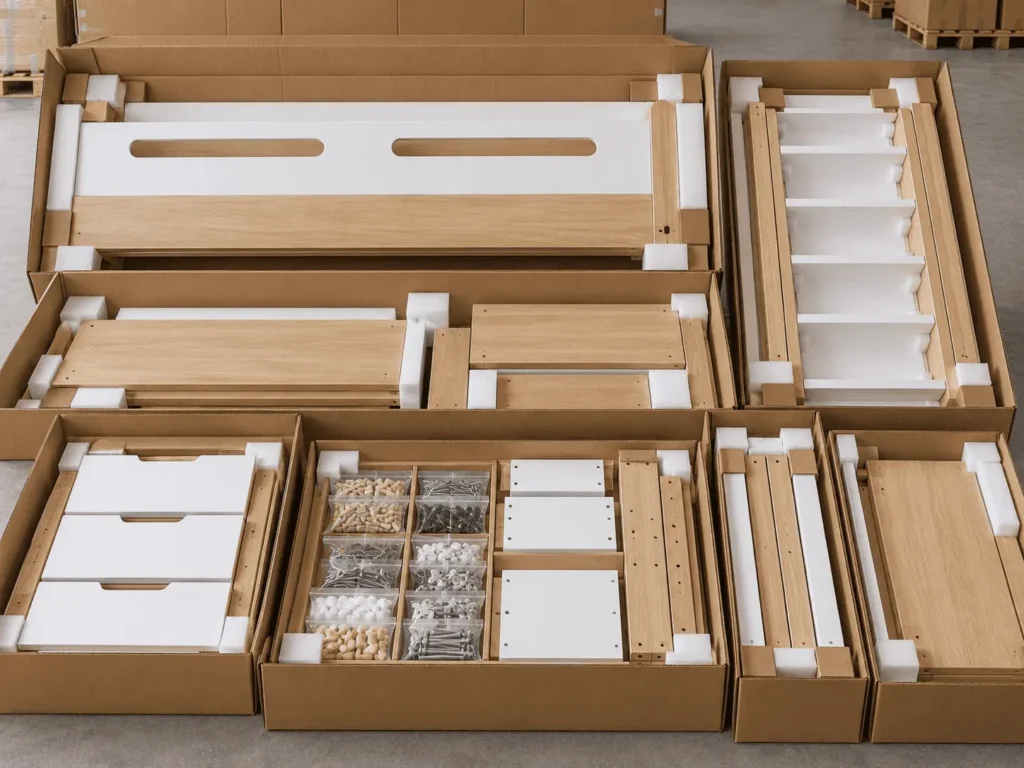
Flat-Pack Packaging Is Part of Product Engineering
A loft bed with desk is not only a piece of furniture.
For an export factory, it is also a set of components that must fit efficiently into cartons and shipping containers.
Flat-pack engineering directly affects:
- carton volume;
- carton weight;
- container loading;
- freight cost;
- warehouse handling;
- product damage;
- installation efficiency.
Long side panels and guardrails require careful protection.
Hardware should be packed securely and clearly identified.
Finished panels should be protected from abrasion.
When one product is divided into several cartons, package identification should be clear—for example, Carton 1/4, 2/4, 3/4 and 4/4.
This reduces warehouse mistakes and makes it easier for the final customer or installer to confirm that all packages have arrived.
Assembly Instructions Affect Return Rates
For flat-pack furniture, an unclear instruction manual can turn a correctly manufactured product into a poor customer experience.
Every major component should be numbered consistently.
Hardware should correspond directly to the manual.
The manual should make orientation obvious so that similar-looking left and right panels are not installed incorrectly.
For e-commerce programs, assembly testing should ideally be completed by someone who was not involved in product development.
An engineer already knows how the product fits together.
A first-time assembler reveals whether the instructions are actually clear.
Quality Control Should Follow Product Risk
The strongest QC process is not simply inspecting finished appearance.
A loft bed has several production stages where mistakes can create downstream problems.
Incoming Material Inspection
Confirm board thickness, decor, surface quality and key hardware before production.
CNC and Drilling Inspection
Hole positions are critical in knock-down furniture.
Incorrect drilling can make final assembly impossible even when all panels look visually acceptable.
Edge-Banding Inspection
Check adhesion, trimming, corner finishing and color matching.
Trial Assembly
Selected units should be assembled to verify:
- drilling alignment;
- structural fit;
- ladder installation;
- guardrail installation;
- desk alignment;
- door function;
- drawer movement;
- hardware compatibility.
Packing Inspection
Before shipment, verify panel quantity, hardware packs, manuals, labels, carton marks and protective materials.
Quality management is relevant because repeatable export manufacturing depends on controlled processes rather than relying only on final inspection. ISO describes ISO 9001 as a globally recognized quality-management standard focused on consistent processes, customer requirements and continual improvement.
More information:
ISO 9001 Quality Management Systems
Certification status should always be verified for the specific supplier rather than assumed.
How to Compare Quotations From Different Loft Bed Factories
A quotation comparison is useful only if every supplier is quoting the same specification.
For example, Factory A may appear significantly cheaper than Factory B.
But after detailed comparison, Factory A may be quoting thinner panels, simpler drawer runners, less protective packaging and a different hardware system.
The quotations are therefore not equivalent.
Before selecting a supplier, buyers should align:
- overall dimensions;
- panel material;
- panel thickness;
- finish;
- edge banding;
- structural reinforcements;
- hardware;
- drawer slides;
- hinges;
- mattress dimensions;
- carton specification;
- carton quantity;
- labeling;
- manuals;
- testing requirements;
- MOQ;
- lead time.
The lowest FOB price does not necessarily produce the lowest total purchasing cost.
Damage, replacements, customer complaints and assembly problems can quickly eliminate a small unit-price saving.
Why Factory Capability Matters for Integrated Kids Furniture
Loft beds with desks combine several furniture functions in one structure.
That makes them especially suitable for a manufacturer experienced in panel furniture processing.
The same production program may involve:
- bed components;
- desk panels;
- drawers;
- cabinets;
- shelving;
- doors;
- hardware packs.
Starwood’s kids-room manufacturing range includes loft beds, bunk beds, desks, wardrobes and storage furniture for OEM, retail, e-commerce and project applications.
Buyers can review the company and manufacturing positioning here:
OEM/ODM manufacturing service:
Project furniture manufacturing:
Main factory website:
For B2B buyers, the goal is to work with a commercial furniture manufacturer and panel furniture export factory capable of managing development, production, QC, packaging and repeat orders—not simply a supplier offering one attractive product photo.
Loft Beds for Apartment and Project Furniture Programs
Loft beds can also be relevant to apartment and rental projects where space efficiency is important.
Project sourcing, however, requires a slightly different approach from retail sourcing.
The buyer may need:
- room-by-room dimensions;
- standardized finishes;
- fixed hardware specifications;
- installation sequencing;
- replacement components;
- phased shipment;
- coordination with wardrobes and desks.
If several furniture categories are produced together, using coordinated panel finishes and standardized hardware can simplify both manufacturing and project installation.
For large programs, buyers should also clarify whether furniture will be assembled in a warehouse, on site or inside individual rooms.
That decision can influence carton labeling and installation planning.
What Information Should Buyers Send in an RFQ?
A professional RFQ helps both buyer and manufacturer.
Instead of sending only a product photo, provide:
Target market — United States, Europe, Middle East, Australia or another destination.
Mattress size — confirm the exact dimensions.
Overall size limits — especially important for compact-room projects.
Required functions — desk, drawers, wardrobe, shelving or staircase storage.
Material expectation — if already specified.
Finish direction — woodgrain, white, painted accents or other combinations.
Order quantity — trial order plus expected future volume.
Sales channel — retail, e-commerce, wholesale or project.
Testing/compliance requirements — where applicable.
Packaging requirements — standard export packing, parcel shipping or retailer-specific requirements.
Branding — private label, printed cartons or customized manuals.
Required delivery date — particularly important for projects and launches.
Destination port — useful for commercial planning.
If the project also has a target FOB price, sharing it can help the factory recommend a realistic specification.
A clear target does not mean the supplier should automatically reduce quality.
It helps determine whether the original design is commercially realistic or whether the structure should be optimized.
Factory-Side Procurement Conclusion
For professional buyers, sourcing a loft bed should never be based only on catalog appearance.
The strongest programs result from aligning five commercial factors:
design, manufacturing, compliance, packaging and logistics.
A good kids loft bed with desk manufacturer should be able to discuss all five.
The factory should understand how product dimensions affect materials, how materials affect structure, how structure affects packaging and how packaging affects international shipping.
That interconnected thinking is especially important for multifunctional furniture.
A loft bed that looks impressive but is expensive to pack, difficult to assemble or inconsistent in bulk production is not a successful B2B product.
By contrast, a well-engineered design can become a repeatable retail SKU, a private-label furniture collection or a standardized apartment furniture solution.
FAQ
What should I look for in a kids loft bed with desk manufacturer?
B2B buyers should evaluate engineering capability, panel processing, hardware control, sampling, quality control, flat-pack packaging and experience with export orders. The factory should also be able to review destination-market requirements before bulk production.
Can a loft bed with desk be customized for my market?
Yes. OEM/ODM customization can include mattress dimensions, overall size, desk configuration, storage layout, colors, panel materials, hardware, packaging and private-label requirements.
What is the MOQ for customized loft beds?
MOQ depends on material, board decor, hardware, custom colors, packaging and production setup. A standard finish with standard hardware normally provides more flexibility than a completely customized specification. Buyers should provide both trial quantity and expected repeat volume when requesting a quotation.
What materials are commonly used for loft beds with desks?
Particleboard, MDF, plywood and selected reinforcement materials can be used depending on the design. Different materials may be used for different components based on structural function, surface requirements and target cost.
Can you manufacture loft beds for e-commerce furniture programs?
Yes. E-commerce models should be engineered around both product function and packaging. Carton dimensions, carton weight, internal protection, component numbering, assembly manuals and spare hardware are particularly important.
Can loft beds be supplied for apartment projects?
Yes. Apartment and rental projects can use customized loft beds where compact room layouts require integrated sleeping, study or storage functions. Project buyers should provide room dimensions, quantities, finish schedules and installation requirements.
How long does OEM loft bed production take?
The schedule depends on whether the design already exists, sample complexity, materials, customization and order quantity. Buyers should request separate schedules for sample development and bulk production after sample approval.
Should I approve a physical sample before placing a bulk order?
For a new customized loft bed, physical sampling is strongly recommended. Buyers can use the sample to verify dimensions, structure, hardware, finish, assembly and packaging before bulk production begins.
Can a manufacturer provide private-label packaging?
Yes. Depending on quantity and project requirements, OEM programs may include branded cartons, labels, barcodes, model numbers and customized assembly instructions.
What information should I send for a quotation?
Send the target market, mattress size, overall dimensions, reference drawing or image, required functions, materials, color direction, quantity, packaging requirements, compliance requirements and destination port.
Request a Kids Loft Bed with Desk Quotation
If you are sourcing a kids loft bed with desk manufacturer for an import program, retail collection, e-commerce brand, apartment project or private-label furniture range, send us your project information for manufacturing review.
Please include your:
- target market;
- mattress size;
- reference drawing or product image;
- room dimensions;
- required desk and storage functions;
- target materials and finish;
- first-order quantity;
- expected annual quantity;
- packaging requirements;
- destination port.
Our team can review the design from the perspective of panel production, structural feasibility, OEM/ODM customization, flat-pack packaging and bulk manufacturing.
Ask for loft bed with desk designs and a factory quotation for your market.
Kids furniture products:
https://plywoodmfr.com/kids-room-furniture/kid-bed-set/
OEM/ODM furniture manufacturing:
https://plywoodmfr.com/oem-odm-furniture-manufacturing-services/
Project furniture manufacturing:
https://plywoodmfr.com/project-furniture-manufacturing/
Factory profile:
https://plywoodmfr.com/the-company/
Commercial panel furniture manufacturer:
https://plywoodmfr.com/