OEM Kitchen Cabinets: Importer Ordering Guide
For importers, wholesalers, private label cabinet brands, apartment developers, hotel project buyers, contractors, and distributors, choosing the right OEM kitchen cabinets manufacturer is not simply about finding a low unit price. A reliable factory must understand drawings, cabinet structure, material standards, sample approval, MOQ, bulk production, export packaging, container loading, and repeat orders. This guide explains what B2B buyers should confirm before placing an OEM kitchen cabinet order with a panel furniture export factory.
Table of Contents
- Why Importers Need an OEM Kitchen Cabinets Manufacturer
- Common B2B Applications for OEM Kitchen Cabinets
- OEM Ordering Process Overview
- Drawings, Specifications, and Buyer Requirements
- Material Confirmation for Export Kitchen Cabinets
- Sample Order Before Bulk Production
- MOQ, Lead Time, and Production Planning
- Bulk Production Control in a Panel Furniture Factory
- Flat-Pack Packaging and Shipping Preparation
- 7 Ordering Checks Before You Confirm a Supplier
- Common Mistakes Importers Should Avoid
- Inquiry Checklist for a Faster OEM Quote
- Why Work With Starwood as Your Kitchen Cabinet Factory
- FAQ
- Final CTA
Why Importers Need an OEM Kitchen Cabinets Manufacturer
Kitchen cabinets are one of the most specification-driven categories in panel furniture. Unlike simple storage furniture, kitchen cabinets must coordinate dimensions, carcass structure, door style, finish, hinges, slides, drawer boxes, hardware holes, countertop compatibility, packaging, and installation requirements.
This is why professional buyers usually search for terms such as OEM kitchen cabinets manufacturer, OEM kitchen cabinets factory, private label kitchen cabinets supplier, RTA kitchen cabinets manufacturer, and custom kitchen cabinet manufacturer. They are not looking for a general furniture blog. They are looking for a factory that can support procurement decisions.
From the factory side, a successful OEM kitchen cabinet order depends on four things.
First, the buyer’s technical requirements must be clear. Cabinet size, door style, material, finish, hardware, edge banding, drilling position, packing method, and labeling rules must be confirmed before production.
Second, the factory must convert the buyer’s requirements into stable production. This includes CNC cutting, edge banding, drilling, hardware matching, trial assembly, inspection, and export packing.
Third, the product must fit the buyer’s business model. An importer, private label brand, contractor, hotel buyer, and apartment developer may need different MOQ, packaging, finish level, and delivery schedule.
Fourth, the supplier must be able to repeat the same quality in bulk production. For kitchen cabinet programs, consistency matters more than one attractive sample.
For buyers comparing suppliers, the best partner is usually not the factory that gives the fastest price, but the factory that asks the right questions before quoting.
Common B2B Applications for OEM Kitchen Cabinets
Importers and Wholesale Cabinet Distributors
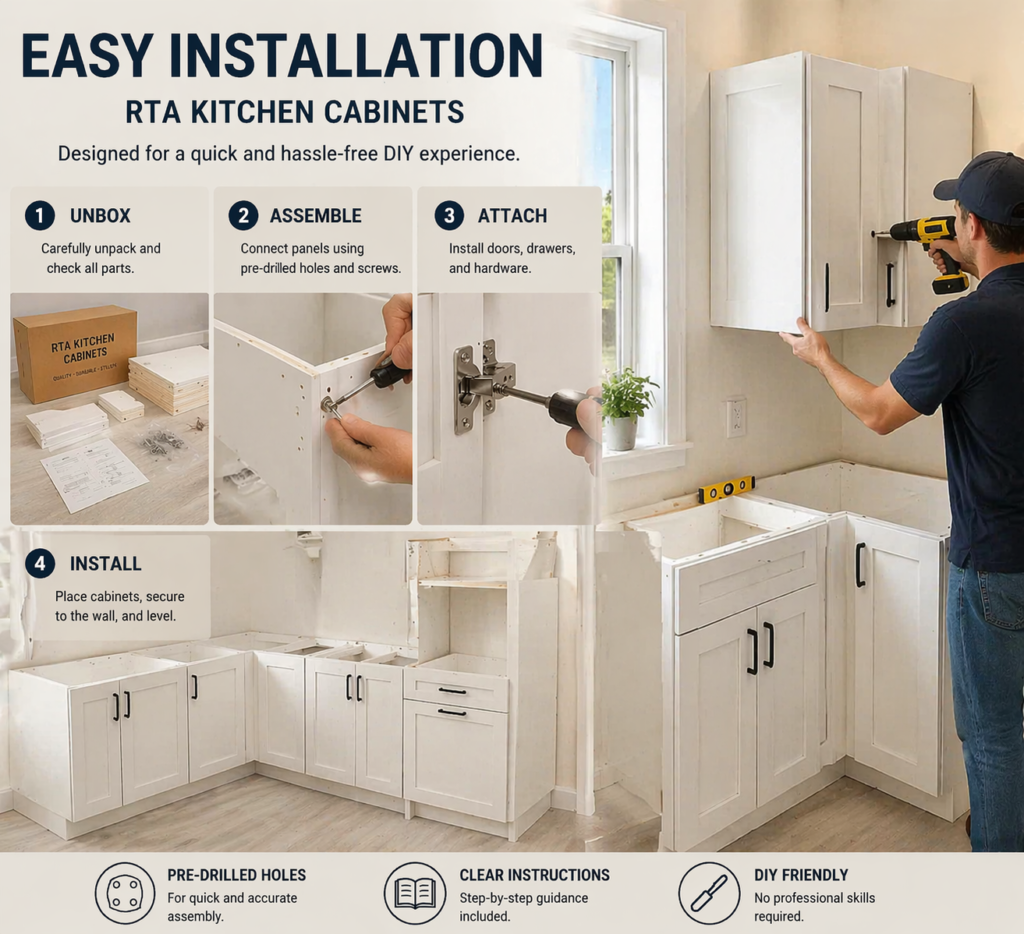
Importers and wholesalers usually need stable cabinet programs that can be repeated across multiple containers. Their main concerns are cost control, SKU planning, carton size, hardware consistency, private label packaging, and after-sales replacement parts.
For this buyer group, OEM kitchen cabinets should be easy to stock, easy to explain, and easy to reorder. A factory should help the buyer confirm whether the program will be sold as RTA kitchen cabinets, flat-pack kitchen cabinets, modular kitchen storage, or project-based cabinet sets.
A useful internal landing page for this category is: OEM kitchen cabinets manufacturer.
Private Label Kitchen Cabinet Brands
Private label buyers usually care about product differentiation. They may request custom colors, door profiles, branded cartons, barcode labels, installation manuals, specific hinge brands, special drawer slides, or market-specific cabinet sizes.
For private label kitchen cabinets, the factory should support:
- Custom cabinet dimensions
- Custom door finish
- Custom carton marks
- Logo labels
- Branded instruction manuals
- Hardware bag labeling
- SKU management
- Sample approval before bulk production
- Stable repeat orders
Private label projects should not start directly with mass production. A sample order is necessary to verify the structure, packaging, finish, and installation process.
Apartment and Rental Housing Projects
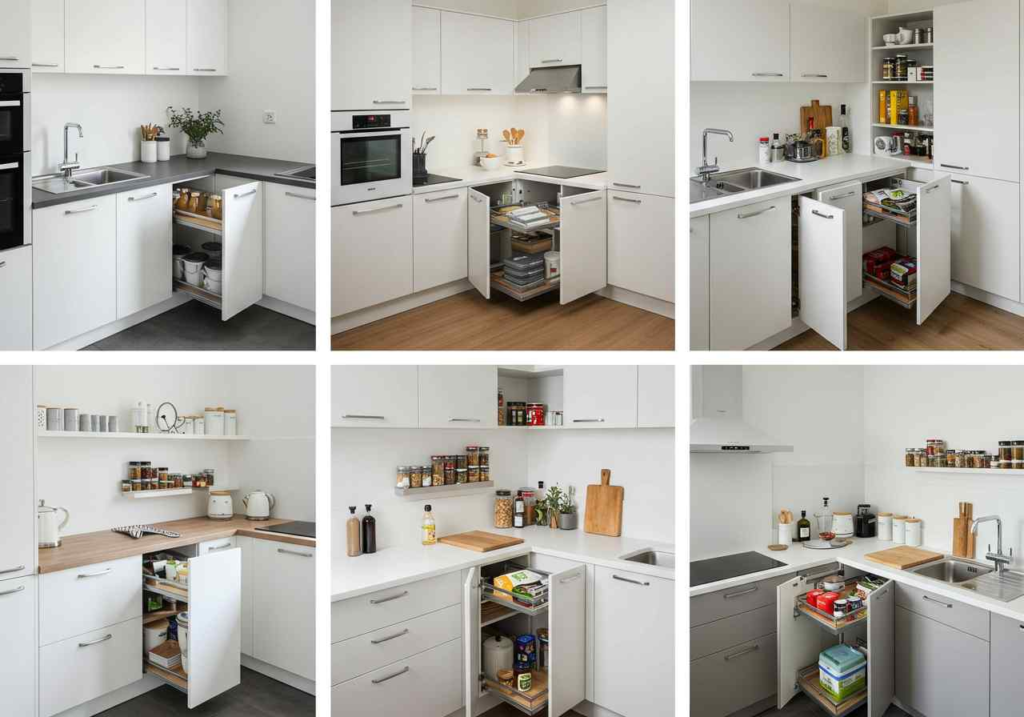
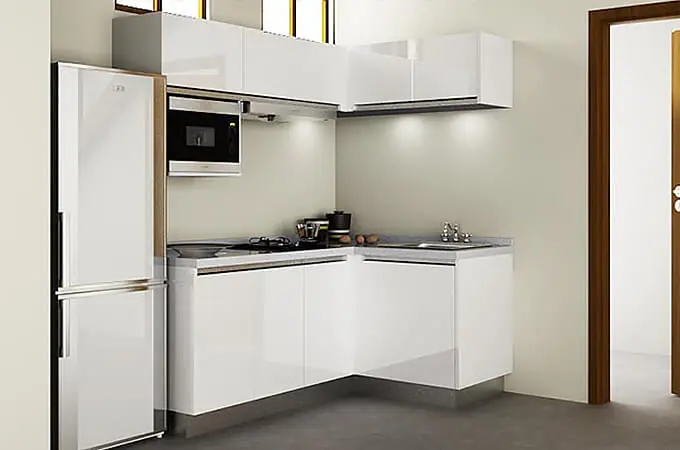
Apartment projects require kitchen cabinets that are durable, cost-controlled, easy to install, and suitable for repeated daily use. Buyers usually need base cabinets, wall cabinets, pantry cabinets, sink cabinets, drawer units, corner units, and kitchen storage modules.
For apartment developers and rental housing operators, cabinet design should avoid over-complex decorative details. The better solution is often a clean flat-pack or modular cabinet system with stable panels, practical hinges, durable surfaces, and clear installation drawings.
For broader project supply, buyers can also review: Project Furniture Manufacturing.
Hotel and Serviced Apartment Projects
Hotel and serviced apartment projects need cabinet systems that look consistent across many rooms. Buyers may require compact kitchenettes, pantry cabinets, minibar storage, base cabinets, wall cabinets, and simple cooking-zone storage.
The factory must understand that hospitality buyers care about finish consistency, easy replacement, installation speed, and long-term maintenance. A low price is not enough if the cabinet surface is unstable or the packaging creates damage during shipment.
Contractors and Commercial Project Buyers
Contractors need clear drawings, reliable schedules, installation-friendly packaging, and predictable supply. A contractor may not want a complicated retail-style product line. They need a cabinet package that arrives correctly, installs smoothly, and reduces on-site adjustment.
For this reason, a project-focused commercial furniture manufacturer should discuss cabinet drawings, site dimensions, packing sequence, label system, spare parts, and delivery schedule before production.
OEM Ordering Process Overview
A professional OEM kitchen cabinet order usually follows a clear workflow.
Step 1: Buyer Sends Drawings or Target Specifications
The buyer provides product drawings, reference photos, cabinet sizes, material requirements, finish requirements, hardware expectations, quantity, packaging requirements, and destination market.
If drawings are not available, the buyer can provide reference images, target cabinet dimensions, room layout, or market examples. The factory can then recommend a practical structure based on production experience.
Step 2: Factory Reviews Structure and Quotation Conditions
The factory reviews whether the cabinet structure is suitable for panel production, flat-pack packing, drilling, hardware installation, and container loading. If a structure looks good but is difficult to pack or unstable after assembly, the factory should give technical feedback before quoting.
Step 3: Material, Finish, and Hardware Are Confirmed
Kitchen cabinets require detailed material confirmation. MDF, plywood, particle board, melamine board, laminate finish, lacquer finish, PET finish, veneer, hinges, drawer slides, handles, and connectors may all affect cost and lead time.
Step 4: Sample Order Is Produced
A sample order helps the buyer confirm dimensions, cabinet structure, drilling, hardware, finish, packaging, and assembly instructions. For OEM projects, sample approval is the bridge between quotation and bulk production.
Step 5: Bulk Production Starts After Approval
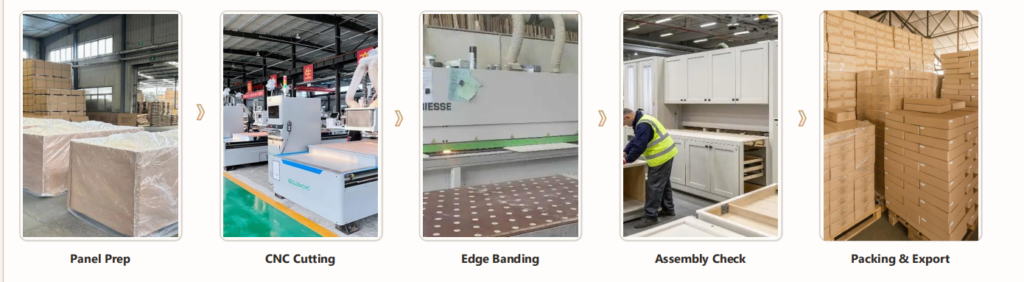
Once the buyer approves the sample, the factory prepares materials, confirms the production schedule, arranges cutting, edge banding, drilling, surface processing, assembly checks, QC, packing, and container loading.
Step 6: Export Packaging and Shipping Documents Are Prepared
The factory prepares cartons, labels, hardware kits, manuals, packing lists, carton marks, and loading plan. For export orders, packaging is not a minor detail. It directly affects damage rate and buyer complaints.
Drawings, Specifications, and Buyer Requirements
Many kitchen cabinet order problems begin with unclear specifications. A buyer may send a photo and ask for a price, but a factory cannot give an accurate OEM quotation without details.
What Buyers Should Provide
For a serious OEM inquiry, buyers should prepare:
- Cabinet type: base cabinet, wall cabinet, pantry cabinet, sink cabinet, drawer cabinet, corner cabinet, island, or full set
- Dimensions: width, depth, height, panel thickness, door size, drawer size
- Material: MDF, plywood, particle board, melamine board, laminate, lacquer, PET, veneer, or other panel material
- Finish: color code, surface texture, gloss level, wood grain direction
- Door style: slab, shaker, framed, frameless, grooved, glass door, or custom profile
- Hardware: hinges, drawer slides, handles, connectors, soft-close options
- Packaging: flat-pack, RTA, assembled, palletized, retail carton, or project carton
- Labels: SKU label, barcode, private label, carton mark, room number label
- Quantity: trial order, sample order, container order, project quantity, or annual forecast
- Destination market: U.S., Canada, Europe, Australia, Middle East, Asia, or other regions
Why Specifications Affect Price
Kitchen cabinet prices are not based only on size. The same cabinet dimension can have different costs depending on board thickness, finish, door type, hardware, edge banding, packing strength, and inspection requirement.
For example, a simple melamine particle board cabinet for apartment projects will not be priced the same as a lacquered MDF cabinet with soft-close hardware and branded retail packaging.
A professional factory should explain these differences instead of giving one unclear price.
Material Confirmation for Export Kitchen Cabinets
Material selection is one of the most important steps in OEM kitchen cabinet sourcing. It affects cost, durability, screw-holding strength, moisture resistance, finish quality, carton weight, and market compliance.
MDF
MDF is commonly used for cabinet doors and smooth surface finishes. It is suitable for lacquer, PET, PVC, veneer, and certain decorative finishes. MDF can provide good surface flatness and is often used for modern kitchen cabinet doors.
However, buyers should confirm board density, thickness, surface treatment, moisture conditions, and emission requirements before placing an order.
Particle Board
Particle board is widely used in flat-pack and RTA kitchen cabinets because it is cost-effective, stable for panel processing, and suitable for melamine or laminate surfaces. For large-volume apartment, rental housing, wholesale, and retail programs, particle board can be a practical choice if structure and edge sealing are properly controlled.
Buyers should pay attention to screw holding, edge banding, drilling accuracy, and surface quality.
Plywood
Plywood is often selected for buyers who need stronger structural performance or better screw-holding ability. It can be used in higher-positioned kitchen cabinet programs, certain project specifications, or markets where buyers prefer plywood cabinet construction.
Plywood usually has a higher material cost than particle board, so it should be selected based on market positioning and project requirements rather than assumption.
Melamine, Laminate, PET, Lacquer, and Veneer
Surface finish affects both appearance and production control. Melamine and laminate are practical for cost-controlled bulk orders. PET and lacquer can support higher-end visual positioning. Veneer can be used for buyers who want a more natural appearance.
Before bulk production, buyers should confirm color samples, gloss level, texture direction, scratch resistance, cleaning requirements, and batch consistency.
For buyers selling composite wood products into the U.S. market, it is useful to review the U.S. EPA guidance on Formaldehyde Emission Standards for Composite Wood Products. For California-related compliance, buyers can also review the California Air Resources Board page on the Composite Wood Products Program.
If responsible sourcing is part of the buyer’s procurement policy, FSC provides information about Chain of Custody certification, which helps verify how forest-based materials are tracked through the supply chain.
Sample Order Before Bulk Production
For OEM kitchen cabinets, a sample order is not optional. It is the buyer’s first real check of the factory’s production understanding.
What a Sample Should Confirm
A kitchen cabinet sample should confirm:
- Overall dimensions
- Panel thickness
- Cabinet structure
- Door alignment
- Hinge position
- Drawer slide performance
- Hole accuracy
- Edge banding quality
- Surface color and finish
- Assembly sequence
- Hardware kit completeness
- Carton protection
- Instruction manual
- Labeling method
- Final packing size
Why Samples Should Be Reviewed Like Production Units
Some buyers only check the visual appearance of the sample. This is not enough. A sample should be assembled, disassembled if necessary, measured, photographed, and checked against the specification sheet.
If the buyer will sell the product as private label kitchen cabinets, the sample should also include packaging, labels, instruction manual, hardware bag, and carton marks. Otherwise, the buyer may approve the cabinet but discover packaging problems later.
Sample Revision Process
If the first sample needs changes, revisions should be recorded clearly. The buyer and factory should confirm which details are changed and whether a second sample is required.
Common sample revisions include:
- Adjusting cabinet size
- Changing panel thickness
- Improving door gap
- Changing hinge type
- Upgrading drawer slides
- Modifying edge banding
- Changing carton structure
- Improving instruction manual
- Adding labels or barcode
A good factory does not treat sample revisions as a problem. It treats them as part of risk control before bulk production.
MOQ, Lead Time, and Production Planning
MOQ
MOQ depends on product structure, material, finish, hardware, packaging, and whether the buyer uses standard models or develops a new OEM program.
For a standard cabinet model, MOQ may be easier to arrange. For custom colors, new door profiles, special hardware, branded cartons, or project-specific cabinet systems, MOQ may be higher because the factory must purchase materials, prepare tooling or settings, and manage production separately.
Importers should discuss MOQ in a practical way:
- MOQ per model
- MOQ per color
- MOQ per finish
- MOQ per hardware set
- MOQ for private label packaging
- Mixed container possibility
- Trial order quantity
- Repeat order forecast
A container-based MOQ is common in export panel furniture because container loading efficiency directly affects landed cost.
Lead Time
Lead time depends on sample approval, material availability, order quantity, finish complexity, hardware sourcing, production capacity, QC schedule, and packing requirements.
A realistic OEM kitchen cabinet order timeline includes:
- Inquiry and specification review
- Factory quotation
- Material and hardware confirmation
- Sample production
- Buyer sample approval
- Deposit and production arrangement
- Material preparation
- Cutting, edge banding, drilling, and processing
- Production inspection
- Export packaging
- Container loading
- Shipping document preparation
Importers should avoid suppliers that promise very short lead times without asking about material, quantity, packaging, and sample approval.
Bulk Production Control in a Panel Furniture Factory
Bulk production is where a supplier’s real capability becomes visible. A good sample does not guarantee good bulk quality unless the factory has repeatable production control.
Cutting and Panel Accuracy
Kitchen cabinet parts must be cut accurately. If the panel size is wrong, the cabinet may not align during assembly. If drilling is inaccurate, hinges, slides, and connectors will not fit properly.
CNC cutting and drilling help improve consistency, but the factory still needs clear production drawings and inspection points.
Edge Banding
Edge banding is critical for kitchen cabinets because cabinet panels may be exposed to cleaning moisture, cooking environment, and frequent use. Poor edge banding can lead to peeling, water entry, rough edges, and customer complaints.
Buyers should check edge banding thickness, glue line, color matching, trimming quality, and corner finishing.
Hardware Matching
Hinges, drawer slides, handles, connectors, hanging brackets, and adjustable feet must match the cabinet design. If the buyer specifies hardware brands or performance levels, these details should be written in the order documents.
For commercial furniture durability thinking, BIFMA provides a useful reference point through its furniture standards and industry resources: BIFMA. Not every kitchen cabinet order needs BIFMA testing, but project buyers can use the durability mindset when reviewing hardware and structural requirements.
Production Inspection
A factory should check:
- Panel dimensions
- Hole positions
- Door alignment
- Drawer slide movement
- Hinge installation
- Surface finish
- Edge banding quality
- Hardware quantity
- Carton contents
- Label accuracy
- Packaging protection
For quality management reference, buyers can review ISO’s information on ISO 9001 Quality Management. In real factory cooperation, the important point is not only whether a supplier mentions quality control, but whether it has practical inspection steps for each order.
Flat-Pack Packaging and Shipping Preparation
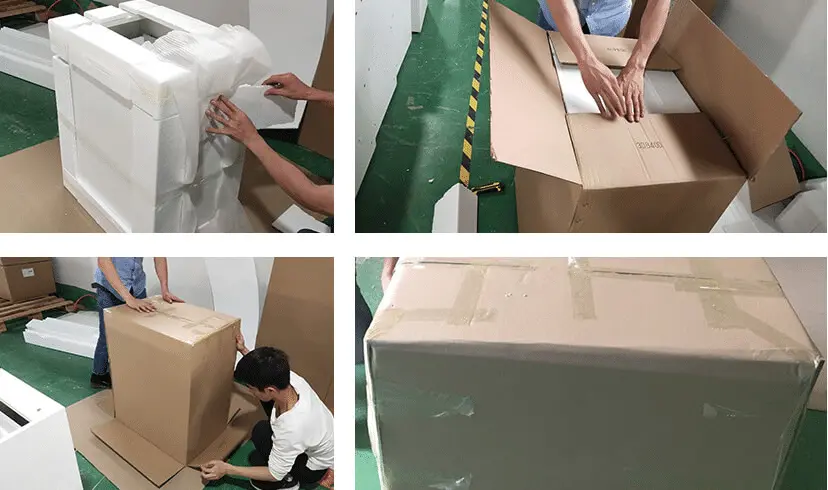
Kitchen cabinet packaging must protect heavy panels, doors, hardware, shelves, and decorative surfaces during long-distance transportation. Export packaging is especially important for flat-pack and RTA kitchen cabinets because the product is assembled after delivery.
What Export Packaging Should Include
A practical flat-pack packaging system usually includes:
- Strong outer carton
- Corner protection
- Edge protection
- Foam, paper, honeycomb, or other protective material
- Hardware bag
- Assembly instruction
- SKU label
- Carton mark
- Barcode label if required
- Spare parts if agreed
- Packing list
- Container loading plan
Why Packaging Should Be Discussed Before Bulk Production
Packaging affects product cost, carton size, container loading quantity, damage rate, and customer satisfaction. If the buyer changes packaging after production, the factory may need to adjust carton size, protection material, label layout, and loading plan.
For packaging performance reference, buyers can review the International Safe Transit Association’s ISTA Test Procedures. If wood packaging material such as pallets or crates is used for international trade, buyers should also review IPPC information on ISPM 15 wood packaging material regulation.
For buyers planning flat-pack export orders, related internal capability can be reviewed through: OEM & ODM Furniture Manufacturing Services.
7 Ordering Checks Before You Confirm a Supplier
1. Is the Supplier a Real Factory or Only a Trading Presentation?
For OEM kitchen cabinets, factory capability matters. A real factory should understand materials, CNC cutting, drilling, edge banding, hardware, packaging, QC, and loading. If a supplier cannot explain the production process, the buyer should be careful.
2. Can the Factory Review Drawings Before Quoting?
A serious OEM kitchen cabinets manufacturer should not quote only from a photo. It should review dimensions, structure, material, finish, hardware, packaging, and order quantity before giving a price.
3. Are Materials and Compliance Requirements Clear?
Buyers should confirm MDF, plywood, particle board, melamine, laminate, lacquer, PET, veneer, or other material requirements. If the target market has emission or sourcing requirements, documents should be discussed before production.
4. Is Sample Approval Included in the Process?
Sample order is essential for OEM kitchen cabinets. Buyers should not move to bulk production without confirming the sample, hardware, finish, assembly, and packaging.
5. Can the Factory Support Private Label Packaging?
If the buyer sells under a private label, the factory must support carton marks, barcode labels, instruction manuals, logo labels, hardware bag labels, and SKU control.
6. Is MOQ Suitable for Your Business Model?
A wholesaler, project contractor, hotel buyer, and e-commerce brand may have different MOQ expectations. Buyers should ask whether trial orders, mixed containers, or repeat-order programs are possible.
7. Does the Factory Understand Export Risk?
Export risk includes damaged panels, missing hardware, wrong labels, unclear instructions, container loading problems, and inconsistent color batches. A reliable factory should discuss these issues before shipment, not after complaints happen.
Common Mistakes Importers Should Avoid
Mistake 1: Asking for Price Without Specifications
A photo alone is not enough for accurate kitchen cabinet pricing. Buyers should provide dimensions, materials, finish, hardware, quantity, packaging, and target market.
Mistake 2: Comparing Prices Without Comparing Materials
Two suppliers may quote very different prices because they use different board thickness, finish quality, hardware, packaging, or inspection standards. The lowest price may not be the lowest landed cost.
Mistake 3: Skipping the Sample Order
Skipping samples can create expensive problems in bulk production. For OEM kitchen cabinets, sample approval protects both the buyer and the factory.
Mistake 4: Ignoring Packaging
Kitchen cabinet panels are heavy and easy to damage if packaging is weak. Packaging should be treated as part of the product, not as an afterthought.
Mistake 5: Changing Specifications Too Late
Changing material, color, hardware, label, or packaging after production starts can delay delivery and increase cost. Buyers should confirm key details before mass production.
Mistake 6: Not Planning Spare Parts
For project orders and retail programs, spare parts can reduce after-sales pressure. Buyers should discuss extra hardware, replacement panels, and part labeling with the factory.
Mistake 7: Treating Kitchen Cabinets Like Simple Furniture
Kitchen cabinets require more technical coordination than many other panel furniture products. Importers should work with a factory that understands cabinet structure, installation, and export requirements.
Inquiry Checklist for a Faster OEM Quote
To receive a faster and more accurate quotation, send the following information to the factory:
- Product type: base cabinet, wall cabinet, pantry cabinet, sink cabinet, drawer cabinet, island, or full kitchen set
- Drawings, reference photos, or target dimensions
- Material preference: MDF, plywood, particle board, melamine board, laminate, lacquer, PET, veneer, or other
- Panel thickness
- Door style and finish
- Hardware requirement
- Quantity per model
- Target market
- Packaging method: flat-pack, RTA, assembled, retail carton, project carton, or palletized
- Private label requirements
- Barcode or SKU label requirements
- Assembly instruction requirements
- Testing or compliance requirements
- Target price range if available
- Destination port or country
- Expected delivery schedule
The clearer the inquiry, the more accurate the quotation.
Why Work With Starwood as Your Kitchen Cabinet Factory
Starwood Industry Co., Ltd. is a China-based flat-pack panel furniture manufacturer serving global furniture brands, importers, wholesalers, retailers, e-commerce sellers, contractors, apartment projects, hotel projects, and commercial buyers.
As an OEM ODM furniture supplier and panel furniture export factory, we support kitchen cabinet programs with custom dimensions, materials, finishes, hardware, packaging, private label options, sample orders, bulk production, QC, and export shipment support.
Our kitchen furniture range includes RTA kitchen cabinets, base cabinets, wall cabinets, pantry cabinets, drawer units, kitchen islands, kitchen storage modules, and custom cabinet systems for retail, wholesale, apartment, hotel, and project markets.
Buyers can review our kitchen furniture capability here: OEM kitchen cabinets manufacturer.
For buyers who need full OEM/ODM development support, please visit: OEM & ODM Furniture Manufacturing Services.
For apartments, hotels, rental housing, and commercial project supply, please visit: Project Furniture Manufacturing.
For factory background and production capability, please visit: About Our Factory.
FAQ
1. Are you an OEM kitchen cabinets manufacturer or a trading company?
We are a panel furniture manufacturer in China, producing OEM kitchen cabinets, RTA kitchen cabinets, modular kitchen storage units, pantry cabinets, kitchen islands, and custom cabinet systems for export buyers.
2. What types of kitchen cabinets can you manufacture?
We manufacture base cabinets, wall cabinets, pantry cabinets, sink cabinets, drawer cabinets, corner cabinets, kitchen islands, storage modules, and flat-pack kitchen cabinet sets.
3. Can you produce private label kitchen cabinets?
Yes. We support private label kitchen cabinets with custom carton marks, barcode labels, logo labels, instruction manuals, hardware bags, SKU labels, and export packaging.
4. Do you accept sample orders before bulk production?
Yes. Sample orders are recommended before bulk production. Samples help buyers confirm cabinet dimensions, materials, finish, hardware, structure, packaging, and assembly instructions.
5. What materials are available for OEM kitchen cabinets?
Common materials include MDF, plywood, particle board, melamine board, laminate panels, PET finish, lacquer finish, veneer, and other panel materials based on buyer requirements and project budget.
6. What is the MOQ for OEM kitchen cabinets?
MOQ depends on cabinet structure, material, finish, hardware, packaging, and customization level. For export orders, MOQ is often discussed by model quantity, mixed container plan, or full container order.
7. Can you customize cabinet size and finish?
Yes. We can customize cabinet dimensions, panel thickness, door style, color, finish, edge banding, hardware, packaging, and private label details.
8. Do you support flat-pack or RTA kitchen cabinet packaging?
Yes. We provide flat-pack and RTA packaging with protected panels, hardware kits, assembly instructions, carton marks, SKU labels, and container loading support.
9. Can you supply kitchen cabinets for apartment and hotel projects?
Yes. We supply kitchen cabinets for apartments, rental housing, hotels, serviced apartments, student housing, contractors, and commercial project buyers.
10. What should I send for an OEM kitchen cabinet quotation?
Please send drawings, reference photos, dimensions, material requirements, finish requirements, hardware specifications, quantity, packaging requirements, target market, and delivery schedule. This allows us to provide a more accurate factory quotation.
Final CTA
Send us your drawings or target specs and we’ll help you build an OEM quote. Our factory team can review your cabinet structure, recommend materials, confirm sample requirements, calculate MOQ, plan bulk production, and prepare export-ready flat-pack packaging for your market.
Start your OEM kitchen cabinet project: Contact Starwood
View kitchen cabinet manufacturing capability: OEM kitchen cabinets manufacturer
Explore OEM/ODM service: OEM & ODM Furniture Manufacturing Services
For apartment and hotel projects: Project Furniture Manufacturing