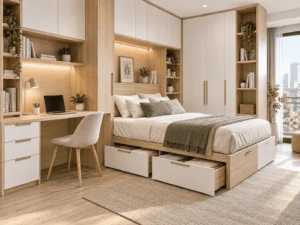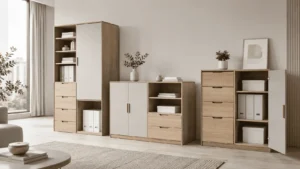
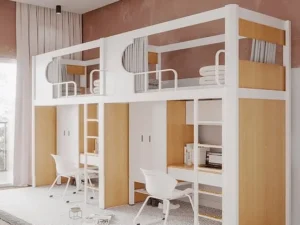
For importers, wholesalers, furniture brands, retailers and project buyers, kids loft beds should be evaluated as manufacturing programs rather than simply attractive bedroom products.
An appealing rendering may help a product sell, but a successful bulk order depends on much more: structural design, guardrail and mattress relationships, panel materials, hardware, storage configuration, flat-pack engineering, packaging efficiency, quality control and destination-market requirements.
From an OEM panel furniture factory perspective, the important question is not only:
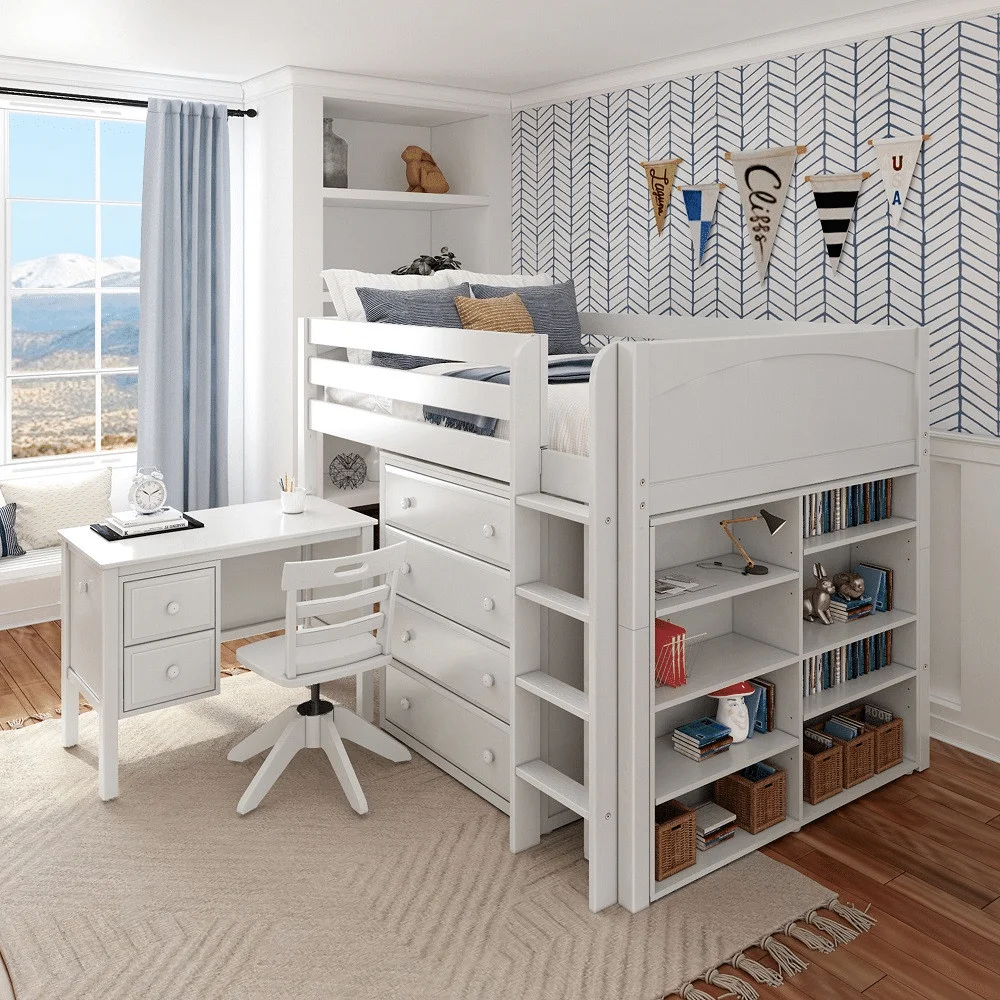
“Does this loft bed look good?”
It is:
“Can this design be manufactured consistently, packed efficiently, assembled clearly and repeated reliably across wholesale or project orders?”
This guide explains nine practical checks B2B buyers should make before approving kids loft beds for retail, e-commerce, apartment, rental or project furniture programs.
Table of Contents
- Define the Buyer, Market and Sales Channel
- Review the Elevated Bed Structure Before Styling
- Match Guardrails and Mattress Specifications
- Select Panel Materials Around the Product Position
- Choose Desk and Storage Functions Commercially
- Evaluate the OEM/ODM Development Process
- Confirm MOQ, Lead Time and Production Planning
- Review QC and Flat-Pack Export Packaging
- Check the Supplier’s Repeat-Order and Project Capability
- Applications for Retail, Apartments and Projects
- What Buyers Should Send for an RFQ
- FAQ
- Request an OEM Loft Bed Quotation
Why Kids Loft Beds Remain Valuable for B2B Furniture Programs
The commercial value of a loft bed comes from using vertical space more efficiently.
Instead of using the entire floor area only for sleeping, the elevated bed creates another usable zone below.
Depending on the design, that area can become:
- a study desk;
- shelving;
- drawers;
- wardrobe storage;
- toy storage;
- a reading area;
- open activity space.
For buyers, this creates a strong product proposition:
sleep + study + storage within one footprint.
This is particularly useful for compact bedrooms and smaller apartments where floor area is limited.
However, the most complicated loft bed ideas are not always the best commercial products.
From our manufacturing experience, buyers usually achieve better results when the functions are selected according to their retail price level, shipping method and intended customer rather than adding every possible feature to one SKU.
A simple loft bed with a desk may be ideal for one market.
Another buyer may need a premium version with staircase storage, drawers and shelving.
A project customer may instead prefer a standardized structure that is easier to install repeatedly across multiple rooms.
Our kids-room manufacturing program currently includes loft beds, bunk beds, beds, desks, wardrobes and storage furniture, with customization intended for importers, retailers, e-commerce buyers and project clients.
View our kids room furniture manufacturing range
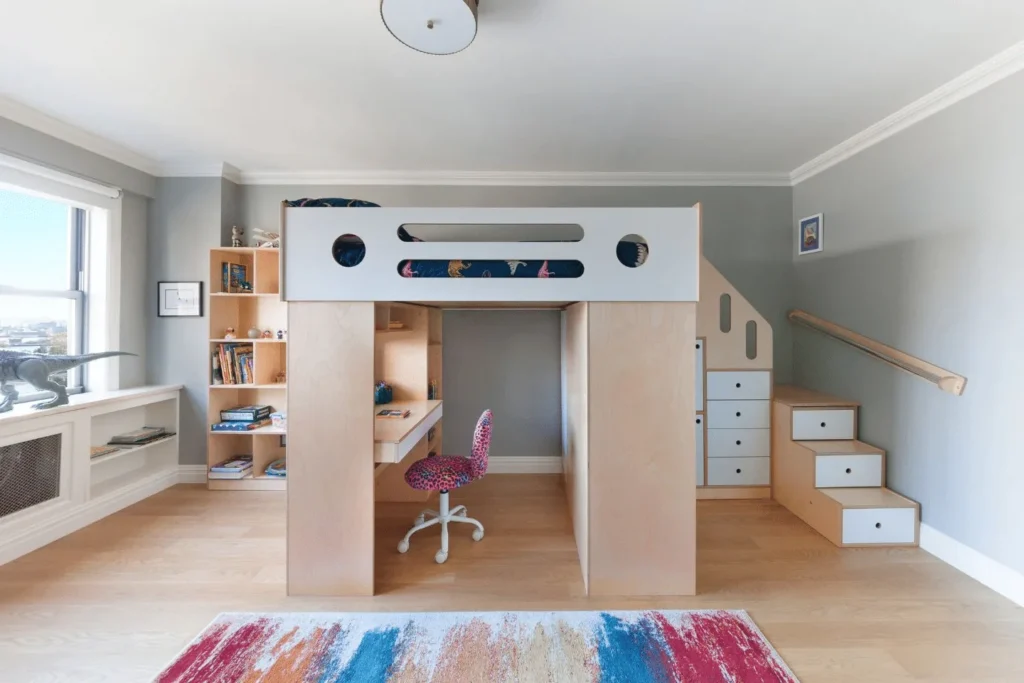
1. Define the Buyer, Market and Sales Channel First
Before discussing colors or decorative styling, tell the factory exactly how the product will be sold.
This affects nearly every production decision.
A loft bed developed for a furniture showroom may need a different configuration from one intended for e-commerce delivery.
Likewise, an apartment project may require different packaging and labeling from a retail SKU.
For Furniture Importers and Wholesalers
Importers normally need a product that can be repeated over multiple orders.
Important considerations include:
- stable specifications;
- competitive FOB cost;
- container efficiency;
- repeatable color and material;
- manageable SKU count;
- replacement hardware availability.
For this customer type, excessively complicated products can create unnecessary production and after-sales risk.
A simple structure with one or two valuable upgrades is often commercially stronger.
For Retail Furniture Chains
Retailers may benefit from a product ladder.
For example:
Basic level: Loft bed + ladder
Mid level: Loft bed + desk
Storage level: Loft bed + desk + shelving
Premium level: Loft bed + storage staircase + cabinets
This allows the buyer to serve different price points without developing completely unrelated products.
For E-Commerce Buyers
For online furniture, product engineering and logistics are closely connected.
Buyers should consider:
- package dimensions;
- parcel handling;
- carton weight;
- long-panel protection;
- assembly instructions;
- hardware organization;
- replacement parts.
A visually impressive loft bed can become an expensive SKU if its panels produce oversized cartons or if assembly is too complicated for end customers.
For Apartment and Project Buyers
Project purchasing normally puts more emphasis on repeatability.
Instead of ten different configurations, the buyer may benefit from one or two standardized layouts that can be installed across multiple units.
Requirements may include:
- room-specific dimensions;
- unit numbering;
- standardized finishes;
- easy-to-replace components;
- organized hardware;
- installation-friendly packaging.
Our project furniture operation supports apartments, hotels, rental properties, offices and commercial projects with custom dimensions, materials, finishes, packaging and container-loading requirements.
See our project furniture manufacturing services
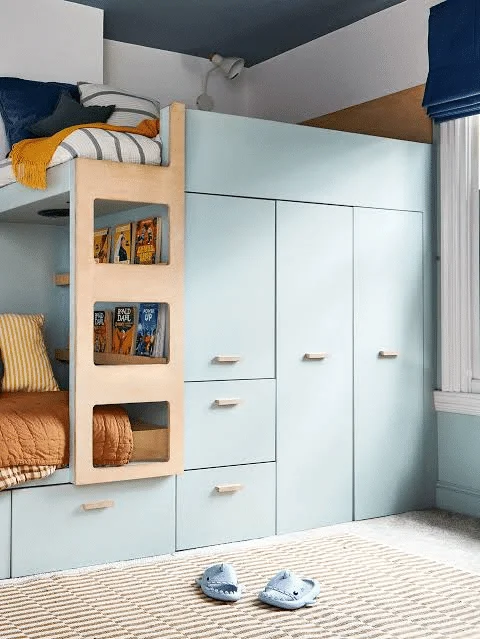
2. Review the Elevated Bed Structure Before Styling
One of the biggest mistakes in OEM development is approving the visual concept before the core construction has been evaluated.
A loft bed is not simply a standard bed placed higher.
Its elevated structure creates additional considerations involving:
- bed rails;
- support panels;
- connections;
- ladder or staircase;
- guardrails;
- mattress foundation;
- movement during use.
The factory therefore needs accurate dimensions before developing the sample.
Structural Questions Buyers Should Answer
Before quotation or sampling, clarify:
What mattress size will be used?
How high is the mattress platform?
Will access be by ladder or staircase?
Will the desk or cabinet contribute to the bed structure?
Is the lower area open or enclosed by storage modules?
Will the product ship as one SKU or several modular cartons?
These decisions affect panel machining, hardware and assembly logic.
Ladder Versus Storage Staircase
A ladder is normally simpler.
It requires fewer panels, less hardware and a smaller shipping volume.
A staircase creates more functionality and can increase the retail value of the product, particularly if drawers or shelving are integrated.
However, it also means:
- more components;
- more hardware;
- larger overall footprint;
- higher carton volume;
- additional assembly stages.
A B2B buyer should therefore compare landed value, not simply ask which version looks more premium.
3. Match Guardrails and Mattress Specifications
For an elevated sleeping surface, guardrail design and mattress specification need to be considered together.
A common sourcing mistake is confirming the bed first and allowing the final mattress thickness to change later.
That can change the effective height between the top of the mattress and the guardrail.
For this reason, buyers should provide the intended:
- mattress width;
- mattress length;
- mattress thickness;
- platform position;
- guardrail configuration;
- ladder opening.
These details should ideally be confirmed before the sample is approved.
U.S. Market Considerations
For buyers selling into the United States, the U.S. Consumer Product Safety Commission defines a bunk bed as a bed where the bottom of the mattress foundation is more than 30 inches above the floor. Its business guidance also addresses guardrails, openings, testing, certification and other requirements for covered products.
Before finalizing an elevated kids-bed structure, U.S. buyers should review the official guidance:
U.S. CPSC Bunk Beds Business Guidance
The purchasing lesson is important:
Do not ask a factory only whether the product is “safe.”
Instead provide:
destination market + applicable requirement + mattress specification + required testing/documentation.
That gives the manufacturer something concrete to work from.
ASTM F1427
ASTM F1427 establishes minimum design and performance requirements for bunk beds and includes requirements related to labeling and instructional material. ASTM describes a covered structure as one with at least one sleeping foundation more than 30 inches above the floor.
ASTM F1427 Bunk Bed Specification
One particularly relevant point for commercial buyers is that ASTM’s published scope states that the specification does not address institutional bunk-bed use.
Therefore, a student-housing, dormitory or other institutional project should be reviewed against its own contract and applicable requirements rather than assuming a normal domestic specification automatically applies.
European High-Bed Programs
For European buyers, EN 747-1 addresses bunk beds and high beds and includes safety, strength and durability requirements.
Again, this is why destination-market information should reach the manufacturer before the product drawing is frozen.
4. Select Panel Materials Around the Product Position
As a panel furniture manufacturer, we do not recommend choosing one material simply because its name sounds more premium.
The appropriate material depends on:
- component function;
- structure;
- finish;
- screw holding;
- machining requirement;
- weight;
- target price;
- packaging.
Our OEM/ODM production scope includes MDF, particleboard, plywood and other engineered panels, with buyer-specified finishes and customized layouts.
Plywood
Plywood may be selected for structural components where the design benefits from its characteristics.
Potential applications can include selected:
- rails;
- support panels;
- stairs;
- connection areas.
However, using plywood for every component can increase cost unnecessarily.
For many commercial programs, mixed-material engineering can provide a more efficient balance.
MDF
MDF is commonly considered when the product needs:
- smooth painted surfaces;
- routed shapes;
- CNC decorative profiles;
- consistent visible finishes.
It can work well for colorful kids-room collections and decorative panels.
Its weight should still be considered when designing KD cartons.
Particleboard
Particleboard is widely used in mass-produced panel furniture and can be suitable for components such as:
- storage cabinets;
- desktops;
- shelves;
- drawer units;
- wardrobes.
The important issue is not simply the name of the board.
The complete construction, thickness, finish and hardware system need to work together.
Composite Wood Requirements for U.S. Buyers
For products entering the United States, EPA’s TSCA Title VI program establishes formaldehyde emission requirements covering composite wood products such as hardwood plywood, MDF and particleboard, including certain finished goods containing them.
Buyers sourcing engineered-wood furniture for this market should review the official EPA information:
EPA Composite Wood Formaldehyde Standards
Therefore, instead of sending:
“Please quote MDF.”
a better purchasing specification would say:
“MDF / particleboard combination, specified thickness and finish, destination market, required documentation and order quantity.”
That produces a more useful factory quotation.
FSC Requirements
Some furniture brands, importers and project buyers may request FSC-certified materials.
FSC explains that Chain of Custody certification is used to verify eligible forest-based material through manufacturing and distribution from source to finished products.
FSC Chain of Custody Certification
If FSC material or claims are required, tell the supplier at RFQ stage because sourcing and documentation requirements can affect the project.
5. Choose Desk and Storage Functions Commercially
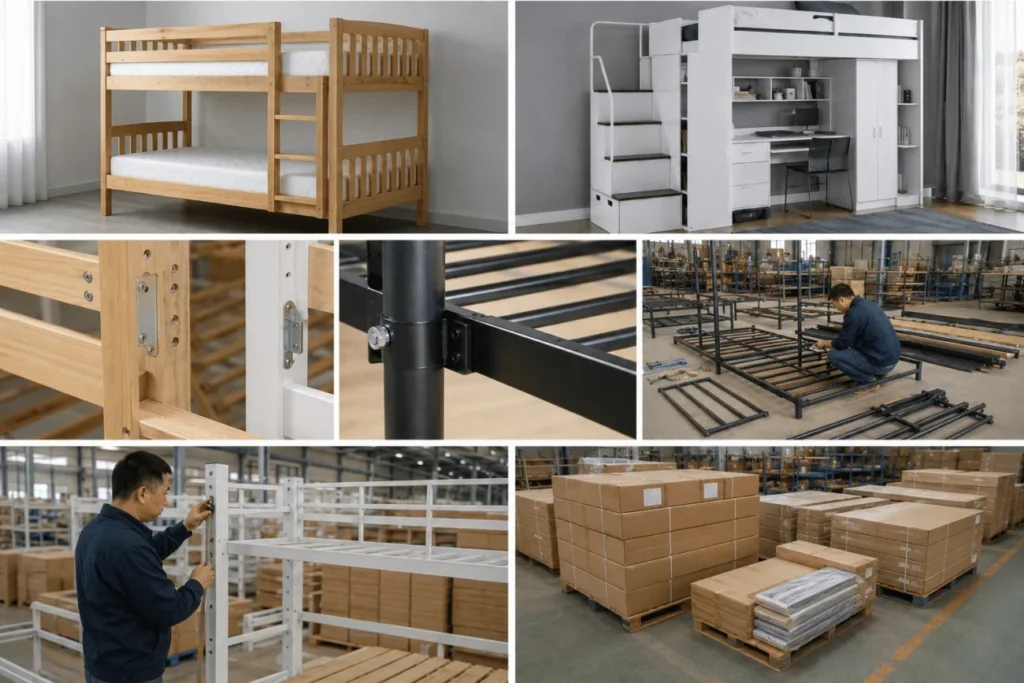
This is where loft bed ideas become actual sellable products.
Adding functions can increase perceived value, but every additional function affects production cost and packaging.
A desk adds panels and machining.
A drawer adds runners and hardware.
A wardrobe adds large panels, shelves and doors.
A storage staircase can add numerous components.
So the purchasing question should be:
Which functions will customers pay for?
—not—
How many functions can we fit into the design?
Loft Bed with Desk
This is one of the most straightforward multifunction designs.
The sleeping area uses the upper level while the space below becomes a study zone.
A buyer should confirm:
- desktop width;
- desktop depth;
- sitting clearance;
- shelves;
- cable access;
- left/right orientation.
For retail programs, this can be a practical mid-tier SKU.
Loft Bed with Storage Stairs
A storage staircase combines access and storage.
Possible configurations include:
- drawers;
- open cubbies;
- cabinet doors;
- bookshelves.
This can create a stronger premium product, but it also increases the number of panels, fasteners and cartons.
Buyers should compare the additional retail value against the additional manufacturing and freight cost.
Loft Bed with Wardrobe
An integrated wardrobe can make a loft bed feel like a complete kids-room system.
Before approving such a layout, confirm:
- wardrobe depth;
- hanging-space height;
- shelf positions;
- drawer clearance;
- door opening;
- staircase interference.
Your website already has a separate article focused specifically on the loft bed + desk + wardrobe / small-room concept, so this new article should not repeat that content in depth.
That article handles the layout idea.
This article handles the supplier and procurement decision.
This distinction is useful for SEO.
6. Evaluate the OEM/ODM Development Process
Once a buyer has identified a suitable concept, the next question is whether the manufacturer can convert it into repeatable production.
A B2B loft-bed supplier should be evaluated on the workflow, not only the sample photo.
Your OEM/ODM page currently describes a process covering buyer brief, quotation, sampling, production, QC, packing and shipment, with customization of dimensions, layout, materials, hardware and private-label packaging.
OEM and ODM panel furniture manufacturing
When the Buyer Has Drawings
For OEM manufacturing, provide:
- CAD/PDF drawings;
- dimensions;
- board specifications;
- hardware;
- finish;
- quantity;
- packaging requirements.
The factory can then review the design for manufacturability before sampling.
When the Buyer Has Only a Reference Image
ODM development requires additional commercial information.
The buyer should provide:
- target market;
- mattress size;
- intended functions;
- retail position;
- expected quantity;
- target cost where possible.
A request such as:
“Please copy this picture and give best price.”
does not give the manufacturer enough information to optimize the structure.
A better request is:
“We need a Twin loft bed with desk and storage for a Canadian retail program. Expected volume is 150 sets per color. Please review the structure for flat-pack production and advise material and packing options.”
That allows the factory to make commercially relevant recommendations.
Sampling Before Mass Production
For a new loft bed, sampling is valuable because it can reveal issues that drawings do not fully demonstrate.
These may include:
- assembly sequence;
- panel alignment;
- hardware access;
- drawer clearance;
- staircase connection;
- desk usability;
- carton arrangement.
Corrections are normally cheaper at sample stage than during bulk production.
7. Confirm MOQ, Lead Time and Production Planning
MOQ should not be viewed as an arbitrary factory number.
For a custom panel furniture order, it can be affected by:
- board color;
- finish;
- hardware;
- packaging;
- number of SKUs;
- production setup;
- custom accessories.
Your current loft-bed product range already includes multiple OEM configurations with desks, storage stairs, cabinets and storage modules.
Therefore, buyers should provide a realistic purchasing scenario.
Instead of:
“What is MOQ?”
send:
“We need two loft-bed models, 80 sets each, in one finish. Destination is Canada. Please advise MOQ, sample timing, bulk lead time and packing arrangement.”
That gives the factory enough information to review the order properly.
Lead Time Should Be Divided into Stages
A new OEM project may include:
technical review → quotation → sample → correction → confirmation → testing if required → packaging approval → bulk production
A repeat order can normally be simpler because the specification has already been approved.
For project buyers, the required shipment date should be shared early.
If furniture must arrive before site installation starts, production needs to be planned backward from the required delivery window.
8. Review QC and Flat-Pack Export Packaging
For export furniture, a low unit price can quickly become expensive if packaging is poor.
Loft beds often contain:
- long bed rails;
- large panels;
- desktops;
- shelving;
- wardrobe panels;
- staircase components;
- hardware.
These parts need a practical KD/RTA packaging plan.
Your factory’s OEM positioning already emphasizes flat-pack packing, carton marking, assembly instructions, QC and container-loading support.
What Should Be Checked During Production?
Depending on the product, QC should review:
- panel dimensions;
- drilling positions;
- edge finishing;
- surface finish;
- hardware;
- critical connections;
- component quantity;
- drawer movement;
- staircase fit;
- packaging accuracy.
The objective is to find problems while the furniture is still inside the factory.
What Buyers Should Confirm About Packaging
Before bulk packing, confirm:
- cartons per set;
- carton dimensions;
- gross weight;
- hardware bag;
- part numbering;
- assembly instructions;
- barcode;
- carton mark;
- private label;
- protection method.
For e-commerce, carton durability and individual package weight may be particularly important.
For wholesale, loading efficiency may have higher priority.
For project furniture, package identification may be more important.
Project Packaging Example
Instead of a generic carton label, a project order could use identification such as:
Building B / Room 205 / Kids Loft Bed / Carton 2 of 4
This type of packaging logic can reduce confusion during site distribution and installation.
Raw-Wood Export Packaging
If solid-wood pallets, crates or dunnage are used, destination-country phytosanitary requirements also need consideration.
The International Plant Protection Convention explains that ISPM 15 applies to raw-wood packaging material used in international trade.
IPPC guidance on ISPM 15 wood packaging
This is not a loft-bed product requirement itself, but it is part of professional export logistics.
9. Check the Supplier’s Repeat-Order and Project Capability
A good sample is important.
But for B2B procurement, repeatability is more important.
Importers and furniture brands need future orders to reproduce the approved:
- dimensions;
- finish;
- hole positions;
- hardware;
- panel specification;
- packaging;
- assembly method.
Project buyers also need the supplier to control multiple furniture units across a delivery program.
What a Serious Panel Furniture Factory Should Support
For repeated OEM business, the manufacturer should be capable of managing the whole chain:
product review → sample → panel processing → edge finishing → drilling → QC → packing → shipment
This is especially useful when buyers want to expand from one kids loft bed into a broader collection.
Your current OEM manufacturing page positions the factory for exactly this type of workflow and serves importers, distributors, project buyers, retailers and e-commerce brands.
Kids Loft Beds for Different B2B Applications
Wholesale Furniture Programs
For wholesalers, we usually recommend prioritizing:
- easy-to-understand functions;
- commercial finishes;
- reasonable carton count;
- repeatable materials;
- a limited number of strong SKUs.
The product needs to remain easy to reorder.
Kids Room Furniture Collections
A loft bed can also become the core product in a larger bedroom collection.
Related items can include:
loft bed + wardrobe + desk + nightstand + bookcase + storage cabinet
Once the finish, hardware and design language are approved, coordinating other panel furniture becomes easier.
Your Kids Room category already supports this collection approach across loft beds, desks, wardrobes, storage products and complete bedroom systems.
Apartment and Rental Projects
For compact apartment bedrooms, the commercial value of a loft bed is efficient use of floor space.
The buyer may choose:
sleeping above + desk below
or
sleeping above + storage below.
Project customers normally benefit from standardized dimensions and fewer configurations.
Hospitality and Accommodation
Selected hospitality, family accommodation or extended-stay concepts may also use space-saving beds.
However, project buyers should clearly state the application.
Do not assume that a normal residential retail specification automatically covers a commercial or institutional project.
Destination requirements, contract specifications and intended users should be confirmed before production.
What Buyers Should Send for an Accurate RFQ
A useful quotation starts with a useful inquiry.
For kids loft beds, send:
Product Information
Drawing or reference photo
Overall dimensions
Mattress dimensions and thickness
Platform height
Ladder or staircase layout
Desk/storage requirements
Material Information
Preferred panel material
Board thickness
Finish
Color reference
Hardware level
Edge specification
Commercial Information
Quantity per SKU
Number of colors
Destination market
Requested shipment date
Target price if available
Compliance Information
Required standard
Testing requirement
Material documentation
Labeling requirement
Packaging Information
Retail / e-commerce / wholesale / project
KD/RTA requirement
Private-label packaging
Carton marks
Barcode requirement
A complete RFQ lets the manufacturer evaluate structure + cost + production + shipping rather than quoting only the visible appearance of the product.
Why Source Kids Loft Beds from an OEM Panel Furniture Factory?
For professional buyers, working directly with a source factory gives better control over the production chain.
The benefit is not merely factory-direct pricing.
It is the ability to coordinate:
design → material → sample → machining → QC → packing → repeat order
through one manufacturing partner.
Starwood’s existing manufacturing pages position the business as an OEM/ODM flat-pack panel furniture factory serving importers, distributors, retailers and project customers, including kids-room and small-space furniture programs.
Learn more about our panel furniture factory
For larger apartment, hospitality or commercial requirements:
Explore our project furniture manufacturing capability
Frequently Asked Questions
Are you a kids loft bed manufacturer?
Yes. We manufacture OEM and ODM panel furniture, including kids loft beds, bunk beds, storage beds, wardrobes, desks and other kids-room furniture for overseas B2B customers. The current kids-room range includes multiple loft-bed configurations with desks, storage and stairs.
Can kids loft beds be customized?
Yes.
Depending on the design, buyers can specify dimensions, desk layout, storage configuration, staircase or ladder, materials, finishes, hardware and export packaging.
The final structure should be reviewed before sampling.
Can you develop a loft bed from our drawings?
Yes.
For OEM projects, send your drawings, dimensions, materials and specifications.
For ODM projects, reference images can also be reviewed together with the target market, quantity and product requirements.
What materials can be used?
Depending on product requirements, engineered-panel options can include MDF, particleboard, plywood and other specified panels. Your current OEM manufacturing program supports these material categories.
The appropriate choice depends on structure, finish, target market and target price.
What is the MOQ for kids loft beds?
MOQ depends on the design, finish, number of colors, hardware and packaging.
Rather than assuming one MOQ for all designs, send the expected quantity per SKU so the production arrangement can be reviewed.
What is the typical production lead time?
Lead time depends on whether the product is an existing model or a new OEM development.
New designs may require additional time for technical review, sampling, corrections, testing where required and packaging confirmation before bulk production.
Include your requested shipment date in the RFQ.
Can kids loft beds be supplied flat packed?
Yes.
KD/RTA construction is well suited to panel furniture exports and can support international shipping, warehousing and distribution.
The packaging specification should be reviewed together with the structure, not only after production.
Can you manufacture for apartment and project orders?
Yes.
Your project manufacturing program supports apartment, hotel, rental and other commercial furniture orders with customized dimensions, materials, finishes and packaging.
For larger projects, buyers should provide quantities, drawings, room information and required delivery dates.
What information do you need for a quotation?
Send:
drawing or reference image + dimensions + mattress specification + desk/storage configuration + material + finish + quantity + destination + packaging requirement + delivery schedule.
The more complete the information, the more useful the technical and commercial review can be.
Request an OEM Kids Loft Bed Quotation
If you are sourcing kids loft beds for a furniture brand, importer, wholesale program, retail chain, e-commerce collection, apartment development or other project, send us your drawings or reference designs.
Our factory team can review:
structure + materials + desk/storage layout + OEM customization + flat-pack packaging + MOQ + production schedule
before quotation.
Send your loft bed drawings, target quantity, destination market and required shipment date to receive an OEM manufacturing review and quotation.
View our OEM & ODM manufacturing services