Finding a reliable kids bunk bed manufacturer with guardrails and storage is not simply a matter of comparing catalog photos and FOB prices.
For importers, wholesalers, furniture brands, retailers and project buyers, a commercially successful bunk bed must balance structure, guardrail design, storage functionality, panel materials, flat-pack engineering, packaging efficiency and market-specific requirements. A design that looks attractive in a rendering can still create problems if the guardrail, mattress relationship, ladder, fittings, drawer system or export packaging has not been properly reviewed before bulk production.
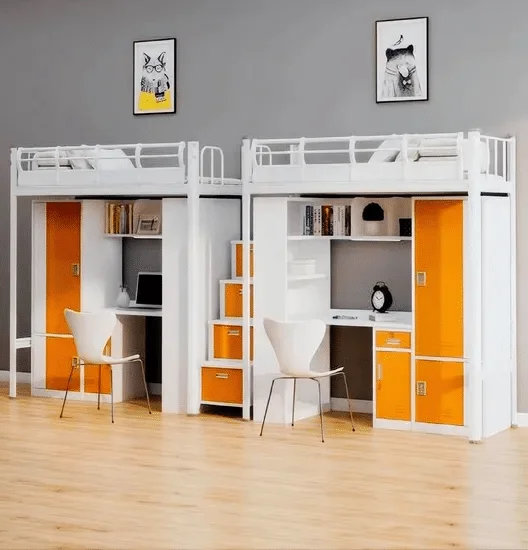
As an OEM/ODM panel furniture factory, we approach kids bunk bed sourcing from a production perspective: Can the design be manufactured consistently, packed efficiently, assembled clearly and repeated reliably across bulk orders?
This guide explains the seven areas professional buyers should check before approving a supplier or placing a production order.
Table of Contents
- Why Bunk Beds with Guardrails and Storage Remain Commercially Attractive
- Buyer Check #1: Guardrail and Structure Engineering
- Buyer Check #2: Materials and Surface Finishes
- Buyer Check #3: Storage Configuration and SKU Planning
- Buyer Check #4: OEM/ODM Development and Sampling
- Buyer Check #5: MOQ, Lead Time and Production Planning
- Buyer Check #6: Quality Control and Export Packaging
- Buyer Check #7: Factory and Project Supply Capability
- Typical Applications for B2B Buyers
- What to Include in Your RFQ
- Frequently Asked Questions
- Request a Quotation
Why Bunk Beds with Guardrails and Storage Remain Attractive to B2B Buyers
For professional furniture buyers, a bunk bed is valuable because one product can solve several commercial requirements at the same time.
The upper and lower sleeping positions improve floor-space efficiency. Guardrails provide an essential structural and safety-focused feature for the upper bunk, while drawers, shelves or staircase storage make better use of otherwise unused space.
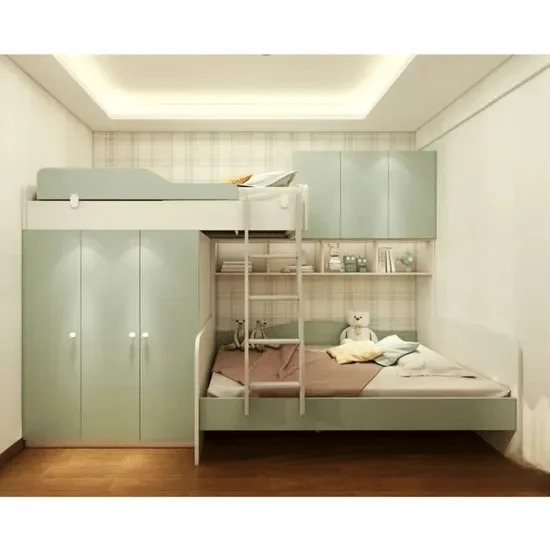
This combination can work particularly well in:
- children’s bedroom furniture collections;
- apartment and rental housing programs;
- compact urban homes;
- family-oriented vacation accommodation;
- e-commerce furniture ranges;
- furniture retail chains;
- kids-room packages;
- selected hospitality and accommodation projects;
- private-label furniture programs.
The commercial value is therefore not just “two beds in one.”
A well-developed SKU can combine sleeping + storage + space saving + flat-pack shipping, which gives importers and distributors more selling points without adding another standalone storage unit.
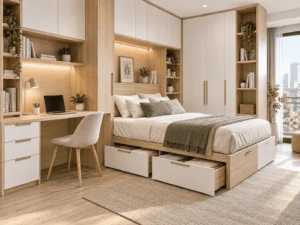
Our current kids-bed manufacturing program includes bunk beds, loft beds, storage beds and coordinated kids-room furniture, with customizable guardrails, dimensions, storage, finishes and packaging.
For buyers planning a larger collection, see our kids bunk bed with guardrails and kids bed manufacturing options.
Buyer Check #1: Guardrails Are an Engineering Requirement, Not a Styling Detail
A common sourcing mistake is to treat the upper guardrail as a decorative rail that can simply be made higher or lower according to appearance.
In reality, guardrail design needs to be coordinated with the mattress foundation, recommended mattress thickness, openings, bed-end structures, ladder access and destination-market requirements.
This should happen before the sample is approved, not after mass production starts.
Confirm the Mattress Specification First
The relationship between the mattress and guardrail matters.
If the buyer changes mattress thickness after the bunk bed structure has already been finalized, the effective guardrail height can change as well.
For this reason, an RFQ should clearly indicate:
- mattress width and length;
- maximum intended mattress thickness;
- mattress support position;
- upper-bunk clearance requirements;
- market-specific labeling or warning requirements.
For U.S.-market children’s bunk beds, the U.S. Consumer Product Safety Commission states that bunk beds are subject to federal bunk-bed requirements and describes requirements covering guardrails, openings, entrapment, testing, certification and labeling.
Professional buyers supplying the U.S. should review the official CPSC Bunk Beds Business Guidance before freezing a design.
ASTM also publishes ASTM F1427, Standard Consumer Safety Specification for Bunk Beds, covering design and performance requirements as well as labeling and instructional material.
For European programs, buyers may encounter EN 747 requirements for bunk beds and high beds; European Union documentation lists EN 747-1 for safety, strength and durability.
The key sourcing principle is simple:
Do not ask a factory to “make the guardrail look safe.” Give the factory the destination market, mattress specification and required standard first.
Also note that standards can have different scopes. For example, ASTM F1427 states that it does not address bunk beds for institutional use. That is particularly relevant if you are sourcing for dormitories, hotels or other commercial applications.
What Our Factory Reviews Before Sampling
From a manufacturing perspective, we normally want to review:
- guardrail location;
- bed-end construction;
- ladder or staircase access;
- panel thickness;
- critical connection points;
- fittings and fasteners;
- mattress support;
- storage interference;
- assembly sequence;
- packaging dimensions.
For buyers searching for a safe bunk bed supplier for kids, this engineering discussion is much more meaningful than relying on a supplier simply using the word “safe” in its catalog.
Compliance must be defined by the destination market and confirmed through the required testing and documentation.
Buyer Check #2: Select Panel Materials for Structure, Finish and Target Price
For an OEM panel furniture factory, material selection affects much more than the visual appearance of a bunk bed.
It affects machining, screw holding, edge finishing, surface finish, weight, packaging, target cost and repeated production.
Common options can include plywood, MDF, particleboard and other engineered panels depending on the structure and buyer specification.
Plywood
Plywood can be selected where the buyer needs good structural performance and screw-holding characteristics.
Depending on the design, it may be used for structural components, rails, panels or other parts where the engineering specification calls for it.
It is typically more expensive than lower-cost panel alternatives, so it should be selected based on the product position rather than simply because it sounds “premium.”
MDF
MDF is useful for smooth painted or lacquered surfaces and allows consistent CNC machining.
It works particularly well when the collection depends on:
- painted finishes;
- shaped panel profiles;
- routed details;
- smooth visible surfaces.
However, material thickness, panel weight and connection design still need to be considered.
Particleboard
Particleboard is widely used in panel furniture where buyers require cost-efficient mass production and melamine or laminate finishes.
It can be suitable for storage cabinets, drawers and selected bunk-bed components when the structure is properly engineered.
The decision should be based on the complete specification rather than using one board type throughout the entire product by default.
Composite Wood Requirements Matter for Export Programs
For products entering regulated markets, buyers should also confirm the required composite-wood documentation.
The U.S. Environmental Protection Agency maintains guidance for the TSCA Title VI Formaldehyde Emission Standards for Composite Wood Products.
EPA guidance on formaldehyde standards for composite wood products
California’s Air Resources Board also explains that its composite wood requirements apply to materials including hardwood plywood, particleboard and MDF used in finished goods such as furniture and cabinets.
CARB composite wood products guidance
This is why a professional RFQ should specify the destination market before the material quotation is finalized.
“Use MDF” is not enough.
A stronger RFQ is:
18 mm MDF, specified surface finish, destination market, required emission documentation and target price.
FSC Options for Buyer Sustainability Programs
Some retailers, brands and project customers may also request responsibly sourced wood or FSC-certified supply-chain options.
FSC explains that Chain of Custody certification is used to verify how FSC-certified forest-based materials move through the supply chain into finished products.
FSC Chain of Custody information
If FSC claims are required, buyers should state that requirement at quotation stage so material sourcing, documentation and labeling expectations can be reviewed before production.
Buyer Check #3: Storage Should Improve the SKU, Not Complicate It
Storage is one of the strongest commercial advantages of a kids bunk bed, but it can also become one of the easiest areas to over-engineer.
From a factory perspective, every additional drawer, cabinet door, shelf or staircase compartment adds:
- more panels;
- additional hardware;
- more machining;
- more assembly steps;
- more cartons or heavier cartons;
- more quality-control checkpoints.
So the question is not simply, “Can we add more storage?”
The better B2B question is:
Which storage configuration gives the buyer the best balance of retail value, production cost and shipping efficiency?
Option 1: Under-Bed Drawers
Pull-out drawers are one of the most straightforward upgrades.
They can be used for:
- toys;
- bedding;
- clothes;
- seasonal storage.
Buyers can specify standard slides, upgraded slides or soft-close hardware depending on price position.
This option usually keeps the main bunk-bed silhouette easy to understand for retail customers.
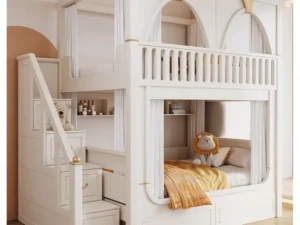
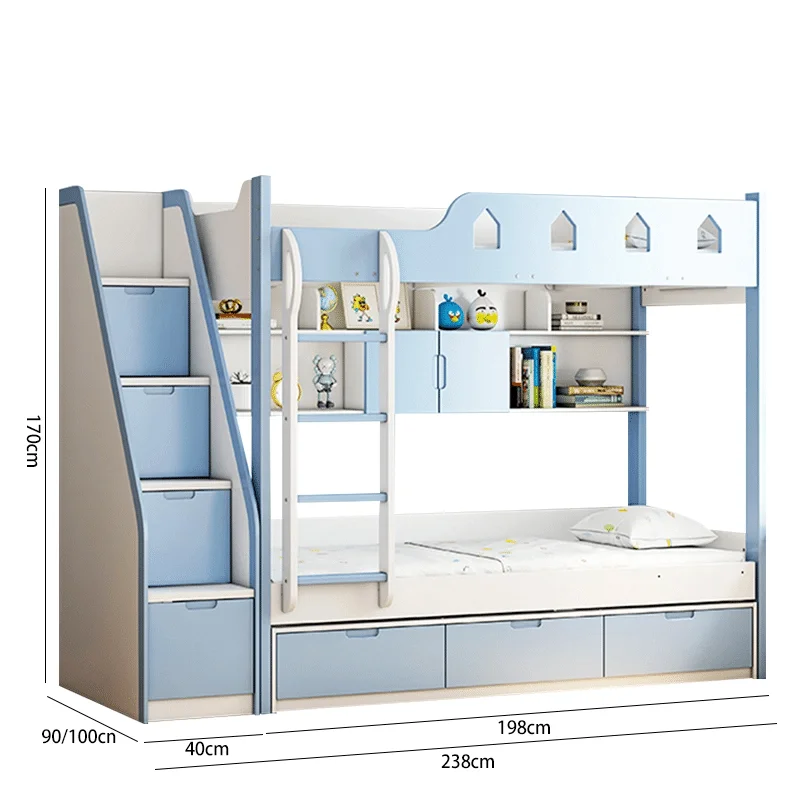
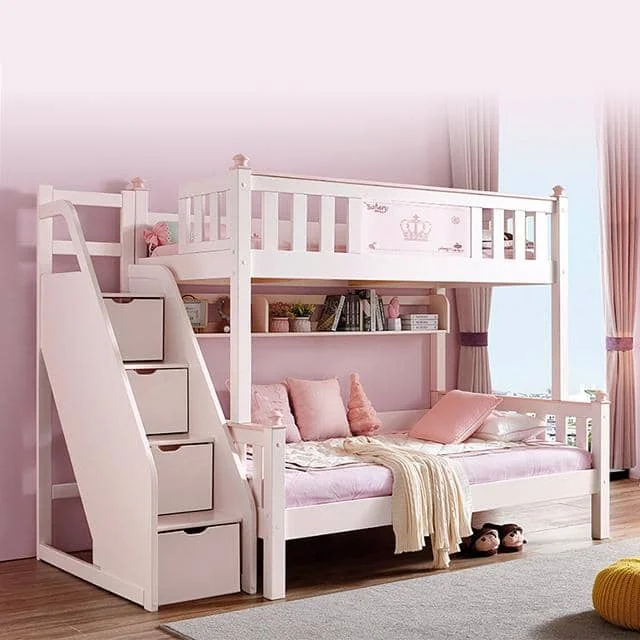
Option 2: Storage Staircase
A storage staircase can increase perceived product value because the access structure also provides drawers, doors or open compartments.
However, it requires more detailed engineering.
The factory needs to review:
- stair dimensions;
- connection to the bed;
- hardware;
- drawer or cabinet clearance;
- assembly order;
- carton size;
- total product footprint.
It is normally more suitable for a higher-value bunk or loft-bed program than for a highly price-sensitive entry-level SKU.
Option 3: Shelving and Side Storage
Open shelves or a side storage unit can create a coordinated kids-bedroom look while keeping individual modules relatively simple.
This is useful when importers want to turn one bunk bed into a broader furniture series.
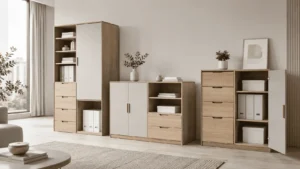
A matching program may include:
bunk bed + wardrobe + desk + bookcase + bedside storage.
That strategy can be more valuable for wholesalers and retailers than developing one overly complex bed.
Our OEM/ODM manufacturing page specifically supports customization of dimensions, layouts, materials, hardware, storage details, packaging and sampling.
For broader product development, see our OEM and ODM panel furniture manufacturing services.
Buyer Check #4: Evaluate the OEM/ODM Process Before Comparing Unit Price
A serious buyer should evaluate how the factory handles the project before focusing only on the final unit price.
Two quotations that look similar can involve very different levels of manufacturing support.
For OEM kids bunk beds, the workflow typically starts with one of three inputs:
Existing Buyer Drawing
You already have dimensions, materials, hardware and construction details.
The factory reviews the design for production and quotation.
Existing Sample
The buyer provides a reference sample or specification, and the factory develops a production version based on agreed requirements.
Reference Images or Market Concept
For ODM projects, the buyer provides product direction, target dimensions, functions, price position and destination market.
The factory then helps develop a manufacturable version.
Our Recommended Development Flow
For a kids bunk bed with guardrails and storage, a practical development sequence is:
RFQ → technical review → quotation → drawing confirmation → sample → sample inspection/test → packaging confirmation → bulk production → QC → packing → shipment
The sample stage is particularly important for bunk beds because a drawing cannot fully demonstrate:
- assembly sequence;
- wobble or connection behavior;
- drawer fit;
- ladder access;
- mattress relationship;
- hardware usability;
- carton protection;
- final appearance.
This is where an actual panel furniture factory adds value.
A trading-style supplier may simply forward specifications between different parties. A source factory can connect the drawing, CNC machining, edge processing, hardware, pre-assembly checks and packaging directly.
Our factory profile describes support for OEM/ODM panel furniture from drawings or concepts through sampling, production, QC and export packing.
See our flat-pack furniture factory capabilities
Buyer Check #5: Ask About MOQ and Lead Time Before Finalizing the Collection
MOQ is not only about how many beds the factory wants to sell.
It is affected by:
- board purchasing;
- custom colors;
- hardware minimums;
- packaging printing;
- production setup;
- machining efficiency;
- number of SKUs in the order.
For selected existing bunk-bed programs on our website, the published starting MOQ can be 10 pieces, with a listed production lead time of approximately 35–40 days after deposit.
View the kids bunk bed with full-length guardrails and ladder
However, buyers should not assume that every custom design has the same MOQ or lead time.
A special color, custom hardware package, testing requirement or project quantity can change the production plan.
A Better Way to Ask About MOQ
Instead of:
“What is your MOQ?”
Send:
“We need 3 bunk-bed SKUs, 50 pcs per SKU, two colors, custom carton marks, destination Canada. Please advise production MOQ and the most efficient order combination.”
That gives the factory enough information to recommend a commercial production structure.
Lead Time Should Be Split into Stages
For a new OEM product, buyers should distinguish between:
sample lead time
and
bulk production lead time.
The first production order also requires more confirmation than a repeat order because drawings, hardware, finish, packaging and instructions may still be under development.
For project supply, the requested delivery date should be communicated early.
Apartment and hospitality orders often need furniture to arrive according to a construction or installation schedule, so production planning must be coordinated backward from the required shipment date.
Buyer Check #6: Flat-Pack Engineering and Packaging Affect Your Landed Cost
For export furniture, packaging should not be treated as the final step.
It should influence product engineering from the beginning.
A bunk bed is a relatively large furniture product. If the structure cannot be packed efficiently, a low factory price can be offset by:
- poor container utilization;
- oversized cartons;
- high courier surcharges;
- warehouse difficulty;
- transport damage;
- missing hardware;
- complicated final assembly.
This is why we generally approach export kids furniture as KD / RTA / flat-pack furniture where appropriate.
What Buyers Should Confirm in the Packing Specification
Typical requirements include:
- carton dimensions;
- number of cartons per set;
- panel protection;
- hardware bags;
- spare hardware;
- assembly instructions;
- carton marks;
- barcode labels;
- private-label information;
- pallet requirements;
- loading plan.
Hardware should be organized logically so the end customer or installation team does not need to search through unrelated fittings.
Assembly instructions should also match the final approved production version.
Packaging Is Different for Retail and Project Orders
An e-commerce buyer may prioritize stronger individual cartons and parcel handling.
A wholesale buyer may prioritize pallet efficiency and container loading.
A hotel or apartment project buyer may instead want:
- room identification;
- unit numbering;
- package labels;
- installation-zone information;
- organized delivery sequence.
The same bunk bed can therefore require different export preparation depending on the customer’s channel.
If Solid-Wood Pallets or Crates Are Used
Where regulated raw-wood packaging materials such as pallets, crates or dunnage are used in international trade, buyers and exporters should consider destination-country phytosanitary requirements.
The International Plant Protection Convention explains that ISPM 15 provides measures for wood packaging materials used in international trade.
IPPC guidance on ISPM 15 wood packaging material
This is separate from the furniture product itself but is an important export detail for B2B shipments.
Buyer Check #7: Choose a Factory That Can Support Repeat Orders and Projects
The lowest-priced sample is not necessarily the best supplier for a repeat furniture program.
Professional importers should ask whether the manufacturer can reproduce the same:
- dimensions;
- hole positions;
- board specification;
- finish;
- hardware;
- carton configuration;
- labeling;
- assembly logic
across repeat orders.
For a furniture brand or distributor, this consistency becomes more important as the product line grows.
What a Panel Furniture Export Factory Should Control
A practical manufacturing system should cover:
Material Confirmation
Board thickness, finish, color and hardware are checked against the approved specification.
CNC Processing
Cutting, drilling and machining should follow controlled production data.
Edge Finishing
Visible panel edges need consistent banding or other specified finishing.
Hardware Positioning
Incorrect hole positions can create assembly problems even when the individual panel itself looks acceptable.
Trial Assembly or Sample Assembly
Critical connections should be checked where required.
In-Process Inspection
Problems should be found during production rather than only after the order is packed.
Packing Verification
The final packing method needs to match the approved specification and assembly sequence.
Our OEM/ODM operation currently positions the factory as supporting inquiry, sampling, mass production, quality control, KD packing and shipment for importers, distributors, project buyers and retail channels.
Typical B2B Applications for Kids Bunk Beds with Storage
Different buyers require different versions of the same basic product.
Furniture Importers and Wholesalers
The priority is usually a repeatable SKU with a competitive landed cost.
Useful options include:
- neutral commercial colors;
- simple KD construction;
- storage drawer upgrades;
- private-label packaging;
- coordinated kids-room products.
Retail Furniture Chains
Retailers often want several price levels.
For example:
Entry: bunk bed + ladder
Mid: bunk bed + under-bed drawers
Upper: bunk bed + storage staircase + coordinated storage
This creates a collection architecture without developing completely unrelated products.
E-Commerce Brands
E-commerce buyers should pay particular attention to:
- carton dimensions;
- package weight;
- hardware organization;
- assembly instructions;
- product photography;
- spare parts;
- damage reduction.
A design that is excellent for a showroom may not be efficient for parcel-based distribution.
Apartment and Rental Projects
For family-oriented apartments and rental properties, bunk beds can help use compact bedrooms more efficiently.
Project buyers may care more about:
- repeat dimensions;
- simple assembly;
- replacement parts;
- practical finishes;
- storage capacity;
- batch identification.
Our project-furniture manufacturing program already supports apartment and rental housing clients as part of broader flat-pack project supply.
Project furniture manufacturer for apartments and accommodation projects
Hospitality and Accommodation Projects
Bunk beds may also appear in selected family accommodation, vacation rentals or other hospitality concepts.
However, project and institutional requirements can differ from normal domestic retail requirements.
The buyer should therefore provide:
- property type;
- intended users;
- destination;
- required standard;
- contract specification;
- mattress details;
- installation method
before production approval.
Do not assume that a retail bunk-bed specification automatically meets every hotel, dormitory or institutional project requirement.
That distinction is important for responsible B2B sourcing.
What Should Buyers Send for an Accurate RFQ?
A buyer who sends complete information usually receives a more meaningful quotation than one who sends only a reference image.
For faster project review, send:
Product Information
- product drawing or reference photo;
- overall dimensions;
- mattress dimensions;
- mattress thickness;
- guardrail configuration;
- ladder or staircase design;
- storage requirements.
Material Information
- plywood, MDF, particleboard or specified material;
- board thickness;
- finish;
- color reference;
- edge requirements;
- hardware level.
Commercial Information
- quantity per SKU;
- number of colors;
- target market;
- target price if available;
- requested delivery date.
Compliance Information
- destination country;
- applicable test standard;
- labeling requirements;
- required documentation;
- material emission requirements.
Packaging Information
- KD/RTA requirement;
- private-label carton;
- barcode;
- retail or project packaging;
- pallet requirements.
This information lets the factory evaluate the whole program, rather than quoting only the visible shape of the product.
From One Bunk Bed to a Full Kids-Room Furniture Program
One reason we recommend thinking beyond a single bunk-bed SKU is that repeat buyers often gain more value from a coordinated collection.
Once the board finish, hardware style and color system have been confirmed, related products can be developed around the same visual language.
A kids-room program can include:
bunk bed → loft bed → single bed → wardrobe → desk → bookcase → bedside table → toy storage
For buyers, this can create:
- larger average orders;
- coordinated retail displays;
- simpler supplier management;
- consistent finishes;
- shared materials;
- more efficient container planning.
This is also where working with an OEM/ODM furniture supplier rather than a single-product trader becomes more useful.
Our kids-room category already includes beds, bunk beds, loft beds, desks, wardrobes, storage and multifunctional children’s furniture for export customers.
Why Buyers Work Directly with a Panel Furniture Manufacturer
For an importer, direct factory cooperation should provide more than a factory price.
The real value is better control over:
product development → sample → production → QC → packing → repeat order
A panel furniture manufacturer can review whether a concept is suitable for CNC processing, flat-pack assembly and efficient packaging before large amounts of time are spent on a design that is difficult to mass-produce.
This is especially valuable for:
- furniture brands;
- importers;
- wholesalers;
- retailers;
- e-commerce sellers;
- apartment projects;
- accommodation projects;
- contractors.
You can learn more about our OEM and ODM panel furniture manufacturing process or view our panel furniture factory and manufacturing capabilities.
For commercial and project purchasing, see our project furniture manufacturing services.
Kids Bunk Bed Manufacturer: Buyer RFQ Checklist
Before contacting a factory, confirm these points internally:
Design: Twin-over-twin, twin-over-full, loft/bunk configuration or custom size?
Guardrail: Required configuration, mattress relationship and target-market standard?
Access: Ladder or staircase?
Storage: Drawers, shelves, staircase cabinets or no storage?
Material: Plywood, MDF, particleboard or mixed construction?
Finish: Melamine, laminate, lacquer, paint or buyer-specified finish?
Quantity: Pieces per SKU and number of colors?
Packaging: Retail, e-commerce, wholesale or project?
Market: Which country will receive the product?
Compliance: What tests, labels and documents are required?
Schedule: Sample date and required shipment date?
These details will normally give you a much more useful factory response than sending:
“Please quote your best price for this bunk bed.”
Frequently Asked Questions
1. Are you a kids bunk bed manufacturer or a trading company?
We are an OEM/ODM panel furniture manufacturer in China producing flat-pack kids beds, bunk beds, loft beds, storage beds and related kids-room furniture for B2B export buyers.
Our factory supports product development, sampling, mass production, quality control and export packing.
2. Can you manufacture kids bunk beds with custom guardrails and storage?
Yes.
Guardrail layout, overall dimensions, ladder or staircase configuration, under-bed drawers, shelving and other storage details can be reviewed according to the buyer’s drawings and target market.
Safety-related details must be confirmed according to the destination market and required standard before production.
3. What materials can be used for OEM kids bunk beds?
Depending on the product structure and finish, common options can include plywood, MDF, particleboard and other engineered panels.
Surface options can include melamine, laminate, painted or lacquered finishes according to the design and price target.
Material selection should also consider applicable emission and market requirements.
4. What is your MOQ for kids bunk beds?
MOQ depends on the structure, material, color, hardware and packaging.
For one of our existing export bunk-bed programs, the published starting MOQ is 10 pieces. Custom OEM projects should be evaluated separately.
Send your quantity per SKU so we can recommend an efficient production plan.
5. What is the production lead time?
For an existing bunk-bed program on our website, the listed bulk production lead time is approximately 35–40 days after deposit.
Custom colors, new samples, testing, special hardware or large project orders may require a different schedule.
We recommend confirming the required shipment date at RFQ stage.
6. Can you make KD or RTA flat-pack bunk beds?
Yes.
Flat-pack construction is particularly useful for export because it can improve warehousing and container efficiency.
We can review panel breakdown, hardware packs, assembly instructions, carton marks and private-label packaging according to buyer requirements.
7. Can you manufacture bunk beds for apartment or hospitality projects?
We support project furniture programs, including apartment, rental and accommodation projects.
However, the buyer should provide the exact application, destination and required specification because commercial or institutional requirements may differ from residential retail furniture standards.
8. Can you help with U.S. bunk-bed compliance?
We can manufacture according to confirmed buyer specifications and support production based on required project documents.
For U.S. children’s bunk beds, buyers should establish applicable requirements using CPSC rules and required third-party testing/certification procedures. The CPSC notes that children’s bunk beds subject to its rules require testing through a CPSC-accepted third-party laboratory and certification in a Children’s Product Certificate where applicable.
For a more detailed compliance overview, see our related guide on U.S. kids furniture safety standards for OEM buyers.
Request a Kids Bunk Bed Quotation
If you are sourcing from a kids bunk bed manufacturer with guardrails and storage, send us your drawings, reference images or current product specifications.
For a faster factory review, include:
dimensions + mattress size + guardrail requirements + storage layout + material + finish + quantity + destination market + packaging requirements + delivery schedule.
We can review the structure for OEM production, recommend suitable panel materials and flat-pack solutions, and discuss sampling before bulk manufacturing.
Recommended CTA
Request bunk bed specifications, MOQ, sampling options and OEM customization details for your next wholesale or project order.
Stronger RFQ CTA
Send us your kids bunk bed drawings or reference design, required quantity and destination market. Our factory team can review the guardrail structure, storage layout, materials, flat-pack packaging and production requirements before quotation.