Table of Contents
- Why B2B Buyers Search for a Hospitality Furniture Manufacturer
- What Makes Hospitality Furniture Different from Retail Furniture
- Common Application Scenarios for Panel Furniture Projects
- Why Panel Furniture Works for Hotels and Apartments
- 9 Factory Checks Before Placing an OEM/ODM Order
- Materials, Finishes and Hardware Buyers Should Confirm
- MOQ, Lead Time and Production Planning
- Packaging, Loading and Export Delivery
- OEM/ODM Custom Process for Project Buyers
- Why Work with a Panel Furniture Export Factory
- Send Your Hospitality Furniture Project Inquiry
- FAQ
Why B2B Buyers Search for a Hospitality Furniture Manufacturer
When a hotel group, apartment developer, contractor, importer or furniture brand searches for a hospitality furniture manufacturer, the goal is usually not to read general furniture ideas. Buyers need a factory that can quote clearly, produce consistently, control cost, meet project timelines, handle OEM/ODM customization and pack goods safely for export. For B2B sourcing, the most important questions are practical: Can the factory make my drawings? What is the MOQ? How long is sampling and mass production? Can the supplier support hotel rooms, apartments, rental housing and commercial projects with stable panel furniture production?
This guide is written from a factory-side procurement perspective. It is for buyers who want to compare a hospitality furniture factory, commercial furniture manufacturer, OEM ODM furniture supplier or panel furniture export factory before sending drawings, BOQ, reference photos or project specifications.
At Starwood Industry Co., Ltd. focuses on flat-pack panel furniture manufacturing for global buyers. Our factory supports OEM/ODM furniture manufacturing, project furniture manufacturing, export packing and customized panel furniture solutions for hotels, apartments, retail brands, distributors and commercial buyers. To learn more about the factory background, visit About Our Factory. For customized production capability, visit OEM & ODM Furniture Manufacturing Services. For project-based supply, visit Project Furniture Manufacturing.
What Makes Hospitality Furniture Different from Retail Furniture
Hospitality furniture is not only about appearance. For hotel rooms, serviced apartments, student housing, rental apartments and commercial accommodation projects, furniture must meet project quantity, repeatable dimensions, easy installation, predictable replacement and export delivery requirements.
A retail furniture buyer may focus on one product style. A hospitality project buyer usually considers the whole supply chain:
- Room type standardization
- Bulk production consistency
- Material cost control
- Moisture resistance and surface durability
- Flat-pack structure and installation efficiency
- Hardware replacement convenience
- Export carton strength
- Container loading efficiency
- Project timeline coordination
- After-sales part replacement
That is why buyers often search long-tail terms such as “hospitality furniture manufacturer factory,” “hotel furniture OEM manufacturer,” “commercial furniture manufacturer China,” “OEM ODM furniture supplier,” and “panel furniture export factory.” These keywords show clear procurement intent. The buyer is not only collecting design inspiration; the buyer is looking for a source factory that can produce and deliver.
A reliable hospitality furniture manufacturer should understand how procurement teams think. Price matters, but buyers also need stable drawings, clear material options, sample confirmation, production updates, QC photos, packing details and shipment support.
Common Application Scenarios for Panel Furniture Projects
Panel furniture is widely used in hospitality and accommodation projects because it can be standardized, customized and shipped efficiently. For B2B buyers, the most common project scenarios include:
Hotel Guest Rooms
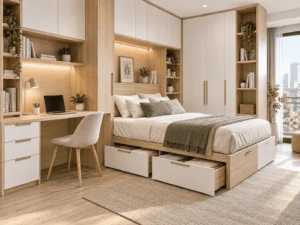
Hotel guest room furniture usually includes wardrobes, luggage benches, desks, TV cabinets, bedside tables, wall-mounted panels, minibar cabinets and storage units. The key requirement is consistency. When a hotel has 80, 200 or 500 rooms, small differences in color, drilling position or edge banding can create installation problems on site.
A factory should review room drawings, furniture dimensions, installation conditions, wall clearance, electrical outlet positions and hardware requirements before quotation.
Serviced Apartments
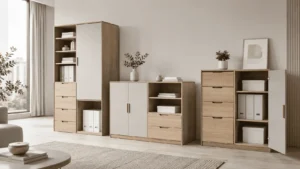
Serviced apartment furniture requires a balance between cost, durability and long-term maintenance. Buyers often request wardrobes, kitchen cabinets, desks, shoe cabinets, storage beds, bathroom cabinets and compact living room storage. Space-saving design is important because many apartment projects need maximum storage in limited space.
Student Housing and Rental Properties
For student housing and rental apartments, buyers usually focus on strong structure, simple assembly, replaceable parts and cost-efficient materials. The furniture may not need luxury finishing, but it must withstand frequent use and tenant turnover.
Senior Living and Staff Accommodation
These projects often need easy-to-clean surfaces, safe edge treatment, stable cabinet structures and simple hardware. A practical hospitality furniture factory can help optimize product details for daily use, not only showroom photos.
Resort, Hostel and Long-Stay Projects
Resorts, hostels and long-stay accommodation may require custom finishes, compact wardrobes, storage beds, modular cabinets and flat-pack furniture that can be transported to different job sites. For export projects, packing and labeling become especially important.
Why Panel Furniture Works for Hotels and Apartments
Panel furniture is a practical solution for many hospitality and commercial furniture projects. Compared with fully solid wood furniture, panel furniture can provide better cost control, stable dimensions, scalable production and flexible surface finishes.
A panel furniture export factory can usually support MDF, particle board, plywood and engineered panels depending on the target market, budget, structure and finish requirement. For hotel and apartment buyers, the advantages are clear:
1. Better Cost Control
Project buyers often work with strict budgets. Panel furniture allows buyers to choose different board thicknesses, surface finishes, edge banding types and hardware levels. This makes it easier to match the price target without redesigning the whole product.
2. Stable Bulk Production
Hospitality projects require repeat orders and consistent dimensions. CNC cutting, drilling and edge banding help control accuracy across large quantities. When drawings and samples are approved correctly, mass production becomes more predictable.
3. Efficient Flat-Pack Export
Flat-pack furniture helps reduce shipping volume and improves container loading efficiency. For importers, wholesalers and project contractors, this can improve landed cost and warehouse handling.
4. Flexible Surface Options
Melamine, veneer-look paper, laminate, UV finish and other surface options can be selected based on project style. Buyers can match hotel room design, apartment interior style or brand visual identity.
5. Easier Replacement
For hospitality operations, maintenance matters. If a cabinet door, panel, shelf or hardware item is damaged, it is easier to replace parts when the furniture is designed with standardized panel dimensions and hardware positions.
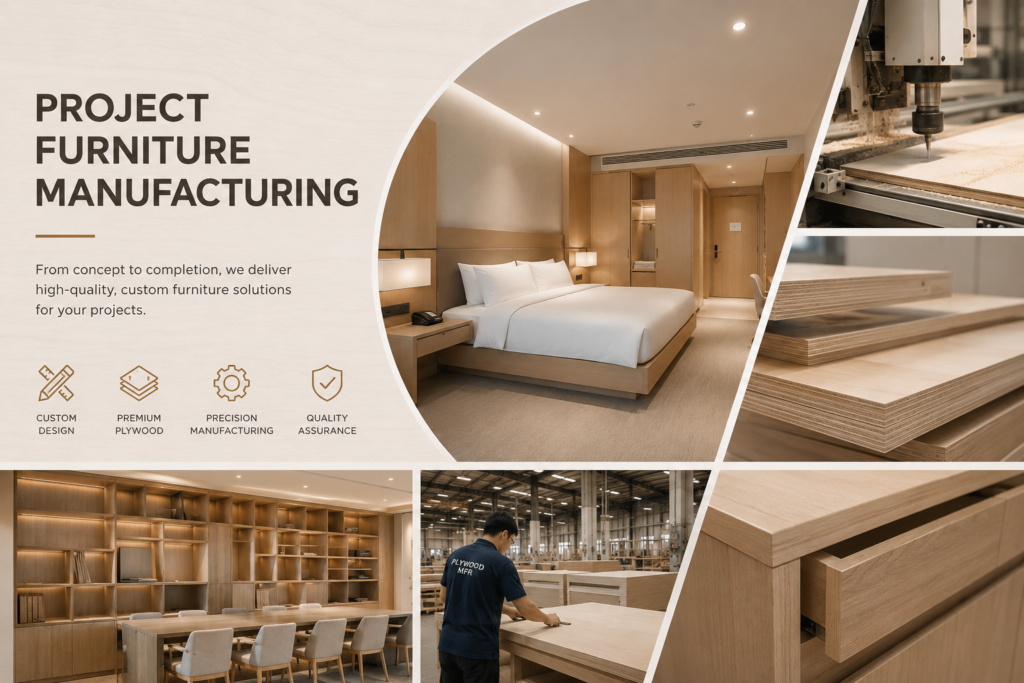
9 Factory Checks Before Placing an OEM/ODM Order
Choosing a hospitality furniture manufacturer should not depend only on a low quotation. For real projects, buyers should check whether the supplier can manage drawings, materials, sampling, bulk production, packing and export delivery. Below are 9 practical checks used by experienced B2B buyers.
Check 1: Is It a Real Factory or Only a Trading Presentation?
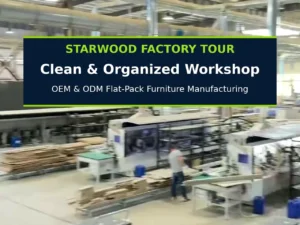
For project buyers, factory capability directly affects lead time, quality control and communication speed. A real hospitality furniture factory should be able to discuss production details, material options, hardware selection, packing method and container loading.
Before placing an order, ask for:
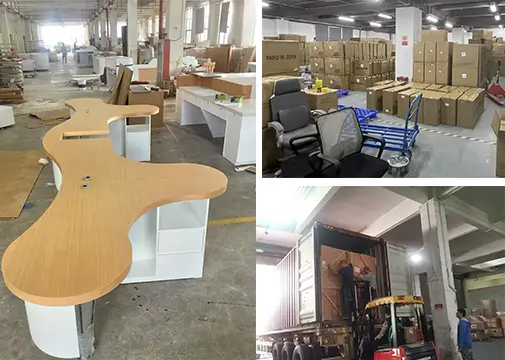
- Factory photos or videos
- Production process information
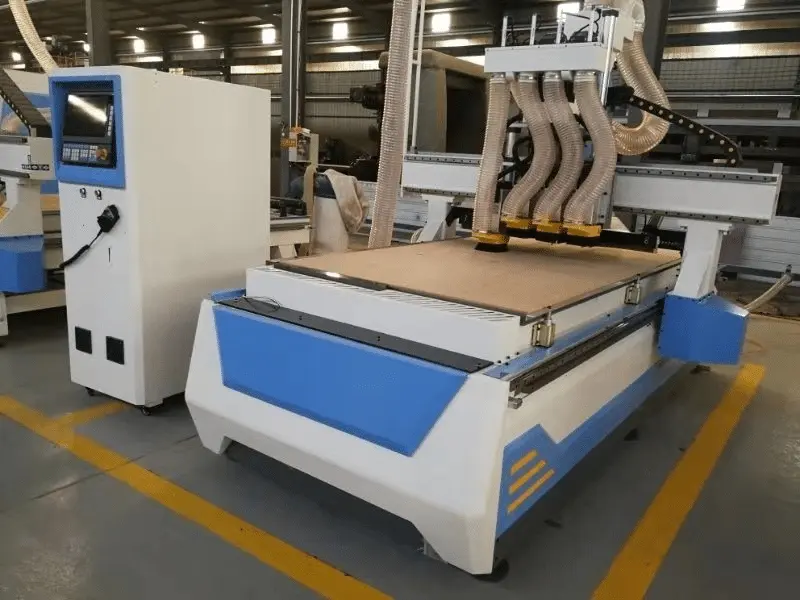
- CNC cutting, edge banding and drilling capability
- Sample room or project reference photos
- Packing method examples
- QC process explanation
- Export order experience
- Contact person responsible for production follow-up
A trading company may still be useful in some cases, but for OEM/ODM project furniture, a source factory usually gives buyers better control over product details and production planning.
Starwood is positioned as a panel furniture source factory in China, supporting global brands, importers, wholesalers and project buyers with OEM/ODM manufacturing. Buyers can review the factory background on The Company.
Check 2: Can the Factory Understand Drawings and BOQ?
Hospitality furniture projects usually start from drawings, BOQ, room layouts, reference photos or design concepts. The factory must be able to convert these documents into production-ready details.
A good OEM ODM furniture supplier should confirm:
- Product dimensions
- Board thickness
- Surface finish
- Edge banding color and thickness
- Hardware type
- Cabinet structure
- Door opening direction
- Installation method
- Packing method
- Quantity per room type
- Spare parts requirement
If the supplier quotes too fast without asking technical questions, buyers should be careful. A low price based on incomplete details often creates problems later.
For example, a wardrobe quotation may change depending on sliding door hardware, back panel thickness, drawer quantity, hanging rail strength, door panel finish and packaging method. A desk quotation may change because of cable holes, metal frame, modesty panel, drawer unit or wall fixing parts.
Factory quotation should be based on clear specifications, not assumptions.
Check 3: Does the Factory Support OEM and ODM Customization?
A hospitality furniture OEM manufacturer produces according to the buyer’s drawings, brand standards or project specifications. An ODM supplier can also help develop or optimize designs based on target price, function and production feasibility.
For B2B buyers, OEM/ODM capability is important because hotel and apartment projects often require customized:
- Dimensions
- Materials
- Finishes
- Hardware
- Packaging
- Labels
- Installation instructions
- Carton marks
- Spare parts kits
- Brand requirements
At OEM & ODM Furniture Manufacturing Services, Starwood supports customized panel furniture production from product development and sampling to mass production and export packing.
For new product development, buyers should send CAD drawings, 3D drawings, sample photos, target market, quantity estimate and packaging requirement. For existing products, buyers can send reference photos and expected price range so the factory can suggest practical material combinations.
Check 4: Are Materials Suitable for the Target Market?
Material selection is one of the most important decisions in hospitality furniture sourcing. A professional panel furniture export factory should not recommend the same board for every buyer. The best solution depends on market regulation, budget, finish requirement, humidity, structure and usage intensity.
Common materials include:
MDF
MDF is often used for painted surfaces, shaped panels and smooth finishing. It is suitable for certain cabinet doors, decorative panels and furniture parts requiring a clean surface.
Particle Board
Particle board is widely used for cost-effective panel furniture, especially with melamine surfaces. It is suitable for wardrobes, desks, cabinets and storage furniture when the structure is properly designed.
Plywood
Plywood can provide better screw-holding strength and structural performance in some applications. It may be selected for parts requiring stronger support or better durability.
Engineered Panels
Engineered panels allow buyers to balance cost, appearance and production stability. For large hospitality projects, the factory should recommend material based on real use, not only catalog description.
For buyers shipping composite wood furniture to the United States, it is useful to review the U.S. EPA’s guidance on Formaldehyde Emission Standards for Composite Wood Products. For California-related projects, buyers can also refer to the California Air Resources Board page on Composite Wood Products. These references help buyers understand why panel compliance documents should be discussed early before sample confirmation.
If a buyer requires FSC-related sourcing, it is better to confirm availability, document requirements and cost impact before quotation. The Forest Stewardship Council provides background information for furniture buyers on its FSC Furniture page.
Check 5: Is the Quotation Clear Enough for Procurement Approval?
A quotation for hospitality furniture should be easy for procurement, project managers and finance teams to review. A vague quotation creates confusion and delays approval.
A good B2B factory quotation should include:
- Product name and model
- Dimensions
- Main material
- Surface finish
- Hardware specification
- Packing method
- MOQ
- Unit price
- Sample cost if applicable
- Lead time
- Trade term
- Validity period
- Payment terms
- Loading quantity estimate
- Remarks for optional upgrades
For export orders, Incoterms should be clearly discussed because they define responsibilities between buyer and seller. The International Chamber of Commerce explains Incoterms rules and how they allocate obligations, costs and risks between parties on its official Incoterms Rules page.
For many furniture buyers, common terms may include EXW, FOB, CIF or other agreed trade terms. The right choice depends on the buyer’s freight forwarder, destination, import experience and shipment control.
Check 6: Can the Factory Make Samples Before Mass Production?
Sampling is a critical step in OEM/ODM hospitality furniture manufacturing. A sample is not only for appearance. It confirms structure, dimensions, drilling, assembly, hardware, finish, packing and installation.
Before approving a sample, buyers should check:
- Overall dimensions
- Color and finish
- Edge banding
- Door alignment
- Drawer movement
- Hardware strength
- Assembly difficulty
- Screw positions
- Panel labeling
- Carton size
- Instruction sheet clarity
- Surface protection
For hotel and apartment projects, one approved sample can prevent many problems during bulk production. If the project includes several room types, buyers may need samples for key products such as wardrobe, desk, bedside table, luggage bench, kitchen cabinet or bathroom vanity.
A factory should keep sample records and use them as the reference for mass production. Buyers should also confirm whether the sample cost can be refunded after bulk order, depending on project size and negotiation.
Check 7: Is Quality Control Built into Production?
Quality control should not happen only at the final inspection. In panel furniture manufacturing, many problems must be controlled during production.
Important QC points include:
Incoming Material Check
The factory should check board quality, finish surface, color consistency, thickness and visible defects before cutting.
Cutting Accuracy
CNC cutting should follow confirmed drawings. Wrong cutting dimensions can cause assembly problems and increase replacement cost.
Edge Banding
Edge banding affects appearance, durability and moisture resistance. Buyers should check color matching, glue line, trimming and corner quality.
Drilling Accuracy
Flat-pack furniture depends heavily on drilling accuracy. Misaligned holes create installation problems on site.
Hardware Check
Hinges, slides, connectors, handles and rails should match approved specifications. Hardware substitution without approval can affect long-term use.
Trial Assembly
For new items, trial assembly helps confirm structure before mass packing.
Final Inspection
Final inspection should check appearance, quantity, labels, carton marks, packing strength and loading plan.
For quality management thinking, buyers can use ISO 9001 as a useful reference when asking how a supplier manages repeatable processes and customer requirements. ISO describes ISO 9001 as a globally recognized quality management standard that helps organizations improve performance and meet customer expectations. Buyers do not need every supplier to make broad claims, but they should ask for a clear and repeatable QC process.
Check 8: Does the Factory Understand Export Packaging?
Packaging is one of the most practical differences between a domestic furniture supplier and a panel furniture export factory. Hospitality furniture may travel by truck, container, port handling, warehouse handling and local delivery before installation. Weak cartons, poor corner protection or unclear labels can create high damage rates.
Export packing should consider:
- Carton strength
- Corner protection
- Foam or honeycomb protection
- Surface protection film
- Hardware bag separation
- Clear assembly instructions
- Carton marks
- SKU labels
- Room type labels
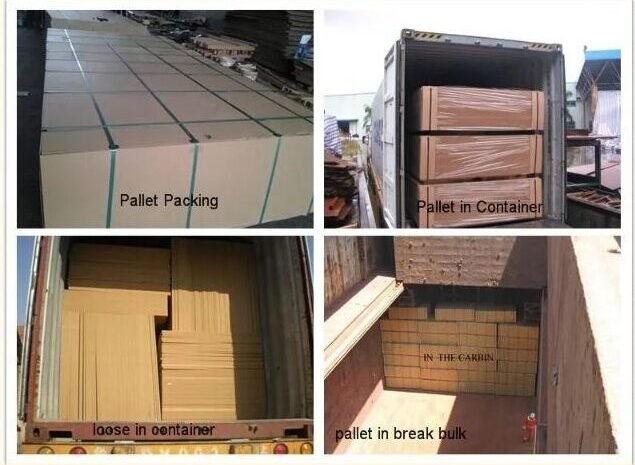
- Pallet option if required
- Container loading sequence
- Spare parts package
Flat-pack furniture packaging should be designed for both protection and loading efficiency. Buyers should ask for packing photos before shipment and confirm whether the carton mark format matches their warehouse or project site needs.
For buyers who want to understand distribution damage control, the International Safe Transit Association explains that effective package design can help minimize product damage throughout distribution. Buyers can refer to ISTA when discussing packaging performance expectations with suppliers.
At Starwood, packaging is treated as part of the export manufacturing process, not an afterthought. Buyers can also review the site’s Packaging page when preparing project requirements.
Check 9: Can the Factory Support Project Communication?
Hospitality project furniture requires communication discipline. A professional hospitality furniture manufacturer should support buyers from inquiry to shipment with clear steps.
Good project communication usually includes:
- Inquiry review
- Drawing clarification
- Material recommendation
- Quotation
- Sample arrangement
- Sample feedback
- Order confirmation
- Production schedule
- QC updates
- Packing confirmation
- Shipment coordination
- After-sales support
For project contractors and importers, communication speed is often as important as product price. Delayed replies can delay drawing approval, sample approval, deposit payment, material booking and shipment planning.
A factory with export experience should understand that buyers may need documents, photos, packing lists, carton measurements, loading details and product information for their own customers or project teams.
Materials, Finishes and Hardware Buyers Should Confirm
Before placing an order with a hospitality furniture manufacturer factory, buyers should confirm the technical details below. These points make quotation more accurate and reduce changes during production.
Board Type and Thickness
Specify MDF, particle board, plywood or other engineered panels. Also confirm thickness for side panels, shelves, doors, back panels and structural parts.
Surface Finish
Confirm melamine, laminate, veneer-look finish, painted finish or other surface treatment. If color matching is important, use physical samples instead of only screen images.
Edge Banding
Confirm edge banding thickness, color, glue quality and visible edges. For hotel rooms and apartments, exposed edges should be carefully controlled.
Hardware
Confirm hinge brand or grade, drawer slide type, handles, connectors, hanging rails, feet, wall fixing accessories and soft-close requirements.
Moisture Consideration
For bathroom cabinets, kitchen cabinets or humid areas, material and edge sealing should be discussed carefully. Buyers should not use the same specification for all rooms without checking the use environment.
Fire, Emission or Sustainability Requirements
If the target market or project owner has special requirements, confirm them before sample order. Requirements may affect material availability, cost, document preparation and lead time.
For European projects involving wood products, buyers may also need to follow policy developments related to deforestation-free products. The European Commission provides information on the Regulation on Deforestation-free Products. For project buyers, this means wood sourcing documents should be discussed early when required by the market.
MOQ, Lead Time and Production Planning
MOQ and lead time are key questions for every B2B buyer. A panel furniture export factory usually calculates MOQ based on product type, material, finish, hardware, packaging and container loading.
For hospitality furniture projects, MOQ may depend on:
- Number of SKUs
- Quantity per item
- Board color and finish
- Hardware type
- Custom mold or special accessory
- Packaging requirement
- Container loading plan
- Sample requirement
- Project timeline
For export panel furniture, container-level ordering is often more practical because it improves material purchasing, production scheduling and shipping cost efficiency. For many project buyers, the MOQ can be discussed after the factory reviews drawings, quantity and target delivery date.
Typical Lead Time Planning
Actual lead time depends on order details, material availability and factory schedule, but B2B buyers can plan around these stages:
- Drawing review and quotation
- Material and finish confirmation
- Sample production
- Sample testing and approval
- Deposit and bulk order confirmation
- Material purchasing
- Cutting, edge banding and drilling
- Trial assembly and QC
- Packing
- Container loading and shipment
For urgent hotel opening or apartment handover projects, buyers should share the required delivery date early. The factory can then check whether phased delivery, priority sampling or simplified specifications are possible.
OEM/ODM Custom Process for Project Buyers
A structured OEM/ODM process makes cooperation smoother. Below is a practical workflow for buyers sourcing from a hospitality furniture manufacturer.
Step 1: Send Project Information
Send drawings, BOQ, reference photos, room type quantity, target market, expected material level and delivery schedule. If you do not have full drawings, send dimensions and design references first.
Step 2: Factory Technical Review
The factory reviews structure, material, production feasibility, packing method and possible cost optimization. This step is important because a design that looks good in rendering may need adjustment for mass production.
Step 3: Quotation
The quotation should clearly list product details, material, finish, hardware, packing, MOQ, lead time and trade term. For project comparison, buyers should avoid comparing only unit price without checking specification differences.
Step 4: Sample Production
Sample production confirms appearance, structure, assembly and packaging. Buyers should provide written feedback after receiving the sample.
Step 5: Pre-Production Confirmation
Before mass production, confirm final drawings, material, finish samples, hardware, labels, carton marks, packing method and inspection standard.
Step 6: Mass Production
The factory arranges material purchasing, cutting, edge banding, drilling, assembly test, cleaning and packing according to the approved standard.
Step 7: QC and Packing Photos
Buyers can request production photos, QC photos and packing photos before shipment. For project orders, this helps the buyer report progress to the hotel owner, developer or contractor.
Step 8: Container Loading and Export
The factory coordinates packing list, carton details, loading plan and shipment support based on the agreed trade term.
Step 9: After-Sales Support
For hospitality projects, spare parts and replacement panels should be discussed before shipment. This can reduce maintenance pressure after installation.
Why Work with a Panel Furniture Export Factory
A panel furniture export factory is different from a general furniture showroom. The value is not only in product photos; it is in production control, customization, packing, communication and project delivery.
For importers, wholesalers, hotel buyers, apartment developers and project contractors, a suitable factory partner can help:
- Convert drawings into producible furniture
- Optimize structure for cost and assembly
- Recommend practical materials
- Control finish consistency
- Support OEM/ODM customization
- Produce flat-pack furniture for export
- Improve container loading efficiency
- Provide packing and labeling support
- Communicate during production
- Support long-term repeat orders
Starwood Industry Co., Ltd. works as a panel furniture export factory for global buyers who need reliable OEM/ODM production. Our product categories include bedroom furniture, kitchen cabinets, living room furniture, dining room furniture, bathroom cabinets, storage cabinets and space-saving solutions for apartments, hotels and residential projects.
Buyers can explore our manufacturing capability on these pages:
- Home – Flat-Pack Furniture Manufacturer in China
- About Our Factory
- OEM & ODM Furniture Manufacturing Services
- Project Furniture Manufacturing
- Products
- Contact Us
Practical Buyer Checklist Before Sending an Inquiry
To get a faster and more accurate quotation from a hospitality furniture manufacturer, prepare the following information:
- Product drawings or reference photos
- Dimensions
- Quantity per item
- Room type quantity
- Material preference
- Surface finish requirement
- Hardware requirement
- Target market
- Packaging requirement
- Delivery schedule
- Trade term
- Budget range if available
- Compliance documents if required
- Branding or labeling requirements
The more complete the information, the faster the factory can provide a useful quotation. If some details are not confirmed, buyers can still send the project concept. A professional factory can suggest practical options based on experience.
Send Your Hospitality Furniture Project Inquiry
If you are looking for a hospitality furniture manufacturer, hospitality furniture factory, commercial furniture manufacturer or OEM ODM furniture supplier for hotel, apartment, rental housing or project furniture, Starwood is ready to support your sourcing work.
Send us your drawings, BOQ, reference photos or project requirements. Our team can review your specifications, recommend materials, quote factory-direct pricing and support OEM/ODM panel furnit
ure production from sample development to bulk manufacturing and export packing.
Start your project here: Contact Starwood
For faster quotation, please include:
- Product list
- Dimensions
- Quantity
- Target market
- Required material or finish
- Expected delivery time
- Packing requirement
- Destination port or country
A reliable hospitality furniture project starts with clear technical communication. We are ready to help you turn your furniture drawings and project requirements into stable, export-ready panel furniture production.
FAQ
FAQ 1: What is a hospitality furniture manufacturer?
A hospitality furniture manufacturer is a factory or supplier that produces furniture for hotels, serviced apartments, rental housing, resorts, hostels and commercial accommodation projects. For B2B buyers, the manufacturer should support project drawings, OEM/ODM customization, material selection, sampling, bulk production, quality control, packing and export delivery.
FAQ 2: What is the difference between a hospitality furniture factory and a trading company?
A hospitality furniture factory directly manages production, materials, quality control, packing and production schedule. A trading company may coordinate suppliers but may not control the production line directly. For OEM/ODM project furniture, many buyers prefer working with a source factory because communication is more direct and technical changes can be handled faster.
FAQ 3: Can you manufacture OEM hotel and apartment furniture?
Yes. OEM furniture manufacturing means producing according to the buyer’s drawings, dimensions, materials, finishes, hardware and branding requirements. Buyers can send CAD drawings, BOQ, reference photos or samples for quotation and technical review.
FAQ 4: Do you support ODM furniture development?
Yes. ODM support means the factory can help develop or optimize furniture based on the buyer’s market, target price, function and project requirement. This is useful for furniture brands, importers, apartment projects and hotel buyers who need new product lines or customized panel furniture solutions.
FAQ 5: What materials are commonly used for hospitality panel furniture?
Common materials include MDF, particle board, plywood and engineered panels. The final material depends on budget, structure, surface finish, target market, moisture condition and compliance requirements. Buyers should confirm board type, thickness, finish and edge banding before sample production.
FAQ 6: What is the MOQ for hospitality furniture projects?
MOQ depends on product type, quantity, material, finish, hardware and packaging requirement. For export panel furniture, container-level orders are often more practical because they improve production planning and shipping efficiency. Buyers can send drawings and estimated quantity for MOQ review.
FAQ 7: How long does hospitality furniture production take?
Lead time depends on design complexity, sample approval, material availability, order quantity and factory schedule. A typical project includes drawing review, quotation, sample production, sample approval, mass production, QC, packing and shipment. Buyers with urgent hotel opening or apartment handover schedules should share the deadline early.
FAQ 8: How should buyers control quality before shipment?
Buyers should confirm drawings, materials, finishes, hardware and packing before production. During production, they can request QC photos, packing photos, trial assembly photos and final inspection details. For large projects, buyers may also arrange third-party inspection before shipment.
FAQ 9: Can flat-pack furniture be used for hotel and apartment projects?
Yes. Flat-pack panel furniture is widely used for hotels, serviced apartments, rental housing and commercial projects because it supports standardized production, efficient shipping, easier storage and convenient installation. Proper design, hardware selection and packaging are important for project success.
FAQ 10: How can I get a quotation from Starwood?
Send your product list, drawings, dimensions, quantity, material requirements, finish requirements, target market, delivery schedule and packing requirements through the contact page. The factory team will review your project details and provide quotation support.