
For importers, contractors, wholesalers, kitchen brands, hotel groups, and apartment developers, export packaging for kitchen furniture is not a minor production detail. It directly affects landed cost, container utilization, installation speed, replacement orders, project delays, and customer claims. A cabinet may leave the factory in perfect condition yet arrive with crushed corners, scratched doors, broken glass, mixed hardware, swollen panels, or collapsed cartons. The right packaging system must therefore be designed together with the cabinet structure, material, shipping route, unloading method, and project schedule—not added as an afterthought.
Table of Contents
- Why Export Packaging Is a Procurement Issue
- Common Shipping Damage in Kitchen Furniture Orders
- Flat-Pack vs. Assembled Cabinet Export Packaging
- Seven Proven Packaging Methods
- Packaging for Hotels, Apartments, Wholesale, and OEM/ODM Projects
- How Cabinet Materials Affect Packaging Design
- MOQ, Lead Time, and Packaging Cost Planning
- OEM/ODM Packaging Customization Process
- Buyer Checklist Before Approving Packaging
- How Better Packaging Reduces Claims and Total Landed Cost
- Why Work With a Panel Furniture Export Factory
- FAQ
- Start Your Kitchen Furniture Project
Why Export Packaging Is a Procurement Issue
Professional buyers do not purchase kitchen cabinets only by unit price. They purchase a complete supply result: approved materials, accurate dimensions, stable color, functional hardware, export-ready packing, efficient loading, traceable cartons, and predictable installation.
This is why export packaging for kitchen furniture should be reviewed during quotation and sampling. If packaging is discussed only after mass production, the factory may discover that the cabinet panels do not fit the planned carton size, decorative doors require additional surface protection, glass shelves need separate boxes, or the final CBM is too high for the expected container quantity.
A reliable packaging plan should answer five procurement questions:
- What damage risks are expected during factory handling, truck transport, container loading, ocean freight, customs inspection, unloading, and site delivery?
- Which components need impact, abrasion, moisture, or compression protection?
- Will the cabinets ship flat-packed, semi-assembled, or fully assembled?
- How will cartons be identified by model, room, unit, floor, or installation sequence?
- How will the supplier verify packaging performance before bulk shipment?
At Starwood, our role as a flat-pack furniture manufacturer in China is to connect product engineering with packaging and shipment planning. Since 2013, we have supported importers, brands, wholesalers, e-commerce sellers, and commercial projects with OEM/ODM panel furniture production. Buyers can review our factory background on the panel furniture export factory page.
Common Shipping Damage in Kitchen Furniture Orders
Kitchen furniture contains many parts with different risk profiles. Cabinet carcass panels are heavy and vulnerable at drilled edges. Doors may have high-gloss, painted, PET, PVC, veneer, melamine, laminate, glass, or metal surfaces. Hinges and drawer slides can scratch panels when packed loosely. Long trim pieces can bend. Quartz or stone items require a different packing strategy from wood-based cabinets.
The most common damage we see buyers trying to prevent includes:
Crushed Corners and Chipped Edges
Carton corners receive concentrated impact during handling. If a heavy side panel moves inside the carton, the force can transfer directly to the board corner. Particle board and MDF are especially vulnerable around exposed corners, grooves, and drilled areas.
Surface Scratches and Pressure Marks
Decorative doors can rub against one another during vibration. Dust, loose screws, staples, or hardware bags may create visible scratches. High-gloss panels can also develop pressure marks if protective film, foam, or interleaving sheets are insufficient.
Broken Glass, Mirrors, and Lighting Parts
Glass shelves, glass doors, mirrors, LED profiles, and lighting accessories require isolated packing. Placing them inside a general hardware carton without fixed separation increases the risk of breakage and concealed damage.
Missing or Mixed Hardware
For flat pack kitchen cabinets, a missing hinge plate or incorrect drawer slide can stop installation. On a 200-unit apartment project, one mixed hardware bag can create repeated site delays if carton identification and packing control are weak.
Moisture Damage and Panel Swelling
Ocean freight exposes goods to changing temperature and humidity. Condensation can form inside containers, especially when loading conditions, transit routes, or ventilation are unfavorable. Moisture can weaken cartons, stain metal hardware, affect unsealed panel edges, or contribute to swelling if water reaches the board.
Carton Collapse During Stacking
Kitchen cabinet cartons are often heavy. If corrugated board strength, carton dimensions, stacking pattern, or internal support is poorly planned, lower cartons may deform under load. Once a stack shifts, neighboring cartons can also be damaged.
Damage Caused by Container Movement
Even strong cartons can fail when large voids remain in the container or when cargo is not packed and secured as a stable load. The IMO/ILO/UNECE CTU Code provides internationally recognized guidance for packing cargo transport units and is a useful reference when planning container loading and cargo securing.
Flat-Pack vs. Assembled Cabinet Export Packaging
The first packaging decision is whether the order will ship as flat pack kitchen cabinets, semi-assembled units, or assembled cabinets export cargo.
Flat-Pack Kitchen Cabinets
Flat-pack or knock-down cabinets are disassembled into panels, hardware kits, and accessories. This method normally provides better container utilization because empty cabinet space is removed. It is suitable for wholesalers, retailers, e-commerce programs, apartment projects, student housing, and markets with local installation teams.
The advantages include:
- Lower CBM per cabinet set
- Better container loading quantity
- Easier handling of standard cartons
- Replaceable individual panels
- Flexible room-by-room delivery
The risks include panel movement, edge impact, hardware mixing, incorrect assembly, and surface abrasion. Flat-pack packaging therefore requires accurate panel sequencing, protective layers, clearly identified hardware, and readable instructions.
Semi-Assembled Cabinets
Semi-assembled packing may keep drawer boxes, cabinet frames, or selected modules pre-built while other parts remain knock-down. This can reduce site labor without using as much volume as fully assembled cabinets.
The packaging must protect structural joints and prevent distortion. Buyers should also confirm whether the semi-assembled unit can pass through doors, elevators, corridors, and loading bays at the destination.
Assembled Cabinets Export
Fully assembled cabinets reduce installation work but use more container space and may create large, irregular packages. Doors, drawers, legs, and projecting parts must be secured against movement. Internal voids should be supported where necessary, and cabinet faces need strong abrasion protection.
Assembled export is often selected when labor cost is high, installation time is limited, or the product structure is difficult to assemble locally. The correct choice depends on total landed cost rather than packaging cost alone.
Seven Proven Export Packaging Methods for Kitchen Furniture
1. Engineer the Carton Around the Product, Not the Other Way Around
Good export packaging for kitchen furniture begins with a packing drawing or packing list that defines which components go into each carton, their sequence, their orientation, and the protective material between them.
Heavy panels should not float inside oversized cartons. Decorative surfaces should not face exposed hardware. Long panels should have sufficient support to avoid bending. The center of gravity should remain manageable for lifting, especially when cartons will be handled manually.
For repeated OEM kitchen cabinet programs, the packaging design should be standardized by SKU. Standardization improves purchasing accuracy, carton printing, operator training, inspection, spare-part management, and repeat orders.
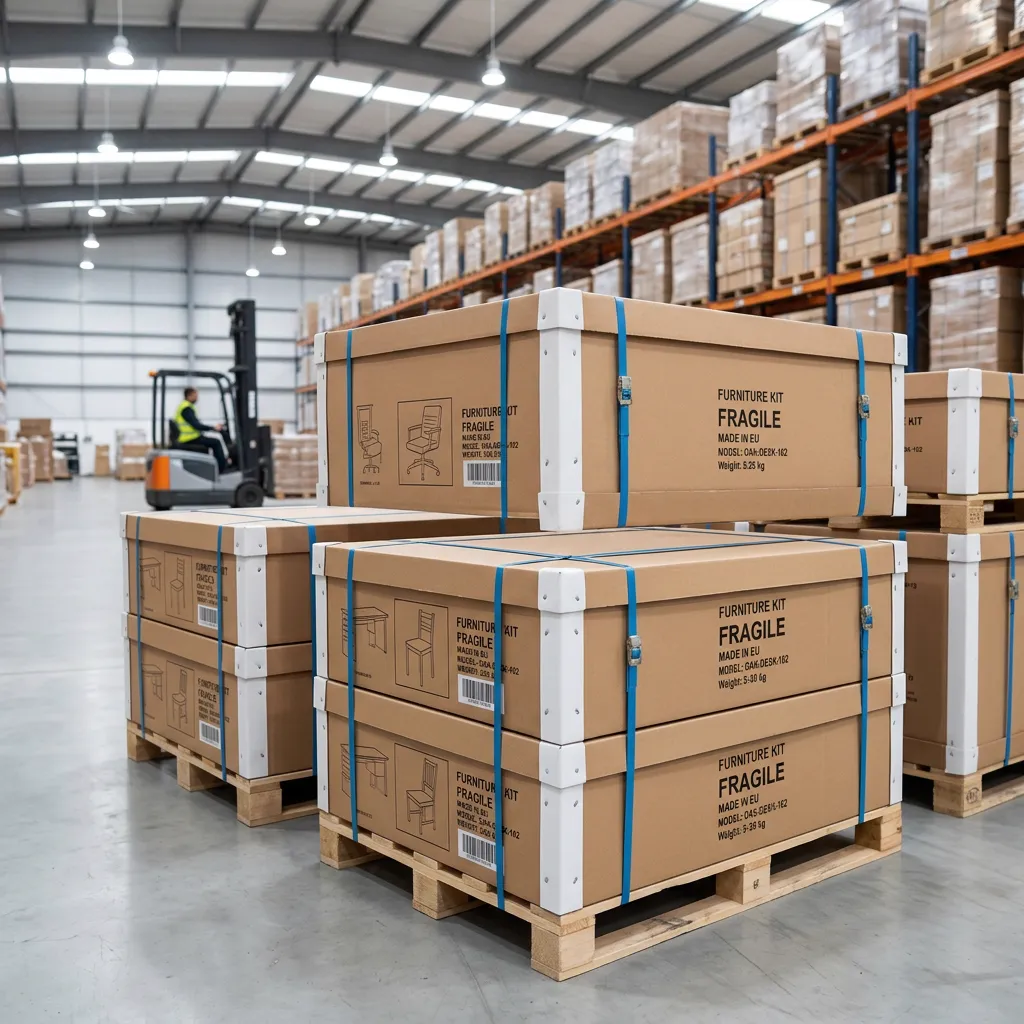
Carton construction should be selected according to gross weight, dimensions, stacking requirement, shipping route, and handling method. A stronger carton is not automatically a better carton if the internal product can still move. The external carton, internal cushioning, component arrangement, and closure method must work as one system.
For buyers who require laboratory or protocol-based verification, the International Safe Transit Association test procedure library includes furniture-related package testing. ISTA Procedure 2C is specifically described for individual packaged furniture products, and its official overview can help procurement and quality teams discuss appropriate test conditions with a packaging laboratory.
2. Protect Corners, Edges, and Drilled Areas
Corners and edges are high-risk points because impact force is concentrated there. Depending on the product and buyer requirement, protection may include:
- Molded foam corner blocks
- EPE foam sheets or profiles
- Honeycomb board corner protectors
- Corrugated edge guards
- Protective cardboard pads
- Reinforced end caps
- Additional panel spacers around drilled zones
The material should be dense enough to absorb impact but not so hard that it marks a painted or high-gloss surface. Corner blocks must also remain in position after vibration. Loose pieces that shift away from the protected area give a false sense of security.
For heavy base cabinet panels, sink cabinet components, pantry sides, and tall unit doors, we normally recommend focusing protection on the load path: where the panel touches the carton, where other panels press against it, and where impact is most likely during lifting.
A packaging sample should be opened after trial handling to check whether the edge banding, drilled holes, grooves, and decorative faces remain intact.
3. Isolate Glass, Hardware, and Fragile Accessories
Glass, mirrors, handles, hinges, drawer slides, lighting components, aluminum profiles, and stone samples should not be treated as ordinary filler items.
Hardware bags should be sealed, labeled, counted, and fixed in a controlled position. For multi-carton cabinet sets, the hardware carton number should be clearly stated. A practical label may include model number, cabinet type, hardware kit number, quantity, and installation reference.
Glass and mirrors should be separated from hard components, protected on all faces and edges, and packed so they cannot move inside the carton. When glass is packed with a cabinet, the carton should clearly show the fragile component location. For some projects, a dedicated glass carton is safer and easier to inspect.
Handling symbols can be standardized with reference to ISO 780:2015, which covers graphical symbols for handling and storage of distribution packages. Symbols do not replace good packaging, but they improve communication across warehouses, ports, carriers, and project sites.
4. Control Surface Contact, Moisture, and Metal Corrosion
Decorative surfaces require clean, non-abrasive contact layers. Common options include protective film, PE bags, EPE foam, nonwoven sheets, tissue, corrugated pads, or custom sleeves. The correct choice depends on the finish.
For example, a matte melamine panel may need basic scratch protection, while a high-gloss lacquer or PET door may require a protective film plus soft interleaving. Painted doors should be fully cured before packing. Veneer surfaces should not be exposed to dirty or rough materials.
Moisture control should include more than adding a desiccant bag. The factory should check that:
- Panels are dry and clean before packing
- Cartons are stored away from wet floors and walls
- Container floors and walls are inspected before loading
- Wet or damaged containers are rejected
- Desiccant quantity is planned for the route and container condition
- Metal parts are protected against moisture where necessary
- Packaging is completed close enough to shipment to avoid long storage in humid conditions
When solid-wood pallets, wooden crates, or raw-wood dunnage are used, buyers should confirm destination requirements under ISPM 15. The standard applies to specified raw wood packaging material used in international trade; processed wood products such as plywood are generally excluded from its scope. This distinction is important when deciding between solid-wood and engineered-wood packing components.
5. Use Buyer-Friendly Labels and Room-by-Room Packing
For project orders, packaging must support installation—not only shipping.
A hotel, apartment, dormitory, or contractor order may include dozens of cabinet types across multiple room layouts. If cartons arrive with only a generic model name, site teams may spend hours opening cartons to identify the correct unit.
Buyer-friendly labeling can include:
- Buyer PO number
- Project name
- Building, block, floor, and room number
- Cabinet type and model
- Carton number, such as 1 of 3
- Product dimensions and color
- Gross and net weight
- Quantity
- Handling symbols
- Country of origin and shipping mark
- QR code or reference to assembly instructions, where requested
Room-by-room packing is especially valuable for apartments, hotels, serviced apartments, student housing, and modular construction. It reduces sorting time and lowers the risk of sending the correct product to the wrong room.
Private-label cartons, buyer logos, multilingual assembly instructions, barcode labels, carton marks, and spare-parts kits can be included through our OEM and ODM furniture manufacturing services.
6. Optimize Container Loading and Load Stability
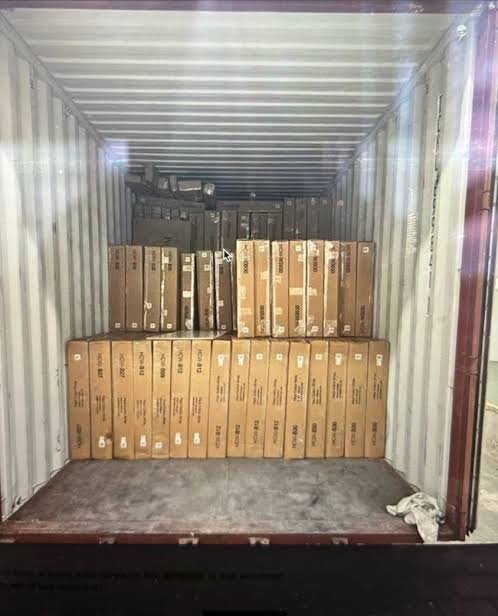
Container loading is part of export packaging for kitchen furniture because carton design determines loading efficiency and load stability.
Before shipment, the supplier should calculate carton dimensions, CBM, gross weight, loading quantity, stacking direction, and mixed-SKU sequence. A loading plan should consider which cartons are heavy, fragile, long, or needed first at the destination.
Key factory controls include:
- Inspecting the container for holes, water, odor, contamination, and damaged flooring
- Keeping heavy cartons at stable lower positions
- Avoiding excessive point loads on weak cartons
- Filling avoidable voids without crushing products
- Using suitable dunnage or securing methods where required
- Protecting cargo near container doors
- Recording loading photos and seal number
- Matching the physical load with the packing list
The goal is not simply to fit the maximum number of cartons. Over-compression can damage surfaces and cartons, while poor loading density can allow cargo movement. The correct loading plan balances container utilization with protection and unloading efficiency.
7. Approve Packaging Through Testing, Inspection, and Documentation
A packaging specification should be approved before mass production. The buyer and factory should agree on carton material, internal protection, panel sequence, hardware location, labels, instructions, pallet requirements, and acceptance criteria.
Testing can be scaled to the project. A basic factory review may include carton measurement, gross-weight confirmation, manual handling, stacking observation, and trial opening. Higher-risk programs may require drop, vibration, compression, or full distribution testing through a qualified laboratory.
ASTM D4169 provides a recognized practice for evaluating shipping units through a sequence of distribution-related tests. ASTM D5276 addresses free-fall drop testing of loaded containers. These references help buyers define a more objective testing discussion, although the exact procedure, assurance level, sample quantity, and acceptance criteria should be selected according to the product and distribution channel.
For mass production, inspection records can include:
- Approved packaging sample photos
- Carton specification and dimensions
- Gross and net weight
- Packing checklist by SKU
- Hardware count record
- Label approval
- Random carton opening report
- Drop or handling test record, when required
- Container loading photos
- Final packing list and seal record
Documentation makes root-cause analysis easier if a claim occurs. Without records, it is difficult to determine whether damage came from product design, packaging, loading, carrier handling, warehouse storage, or site unloading.
Packaging for Hotels, Apartments, Wholesale, and OEM/ODM Projects
Different buyers need different packaging priorities.
Hotel and Serviced Apartment Projects
Hotel projects often require consistent finishes, room-specific labels, controlled hardware, and phased delivery. Packaging should support installation schedules and protect visible surfaces such as wardrobe doors, minibar cabinets, bathroom vanities, and kitchenettes.
Apartment and Residential Development Projects
Apartment projects usually involve repeated layouts and high quantities. Flat-pack packaging can improve container utilization, while room-by-room labels and standardized hardware kits reduce site labor. Replacement panels should be identified by model and room type.
Wholesalers and Distributors
Wholesalers may need retail-ready cartons, neutral cartons, private-label cartons, barcodes, multilingual manuals, and stronger outer packaging for repeated warehouse handling. Carton dimensions should also match local storage and delivery practices.
Furniture Brands and OEM/ODM Programs
Brands require consistent packaging across repeat orders. They may specify carton graphics, logo position, label format, spare-parts policy, assembly instructions, and packaging performance requirements.
A packaging change-control process is important. When the panel thickness, hardware, finish, product structure, or carton supplier changes, the approved packaging should be reviewed again.
Contractors and Commercial Projects
Contractors need accurate packing lists, coordinated delivery, room allocation, and fast identification of missing parts. For these buyers, packaging is a project-management tool.
Our project furniture manufacturer service supports apartments, hotels, offices, rental properties, student housing, and other commercial furniture programs.
How Cabinet Materials Affect Packaging Design
Kitchen cabinet materials influence weight, edge durability, moisture sensitivity, and surface protection.
Plywood
Plywood is often selected for stronger screw holding and structural performance. Packaging should still protect exposed veneers, laminated faces, edges, and corners. Thin panels or long parts need support against bending.
MDF
MDF provides a smooth surface for painted, PVC-wrapped, PET, or decorative doors. However, exposed corners and machined edges can be vulnerable to impact and moisture. Painted MDF doors require careful face protection and full curing before packing.
Particle Board
Particle board is widely used in cost-controlled flat-pack furniture. It can perform well when edges are sealed and the carton prevents movement, but corners and drilled areas need good impact protection.
Melamine, Laminate, Veneer, Lacquer, and PET Finishes
Each finish has a different abrasion and pressure-mark risk. Protective film should be compatible with the surface and removable after transit without leaving residue. Buyers should approve protection materials on the actual finish, not on a generic sample.
Glass, Metal, and Stone Components
Glass and mirrors need isolated protection. Metal doors and profiles need scratch and corrosion control. Stone and quartz components usually require separate engineering, rigid support, and specialized handling; they should not be assumed to follow the same packaging method as panel cabinets.
MOQ, Lead Time, and Packaging Cost Planning
MOQ for kitchen furniture depends on product type, material, finish, hardware, packaging customization, and whether the order uses standard or project-specific dimensions.
A printed private-label carton may have a different MOQ from a neutral carton with labels. Custom foam, molded corner protectors, or special inserts may also require tooling or minimum purchasing quantities.
For a new OEM/ODM program, buyers should ask the factory to separate:
- Product MOQ
- Color or finish MOQ
- Hardware MOQ
- Printed carton MOQ
- Custom protective-material MOQ
- Sample packaging cost
- Bulk packaging cost
Lead time should include drawing review, material confirmation, sample production, packaging development, buyer approval, mass production, inspection, and loading.
As a practical planning reference, a new sample or mock-up may take around 7–15 days after details are confirmed, while mass production may commonly require around 25–45 days after deposit and sample approval. Actual timing depends on order quantity, material availability, customization, production schedule, packaging development, and shipping requirements.
The lowest packaging price is not always the lowest procurement cost. Saving a small amount on corner protection or carton strength may create much larger costs through replacement panels, airfreight, labor, reinstallation, delayed handover, or retailer penalties.
OEM/ODM Packaging Customization Process
A clear customization process helps the factory develop the product and packaging together.
Step 1: Buyer Brief
Send drawings, cabinet list, room layout, reference photos, quantities, destination market, preferred structure, finish, hardware, target price, and shipping method.
Step 2: Technical and Packaging Review
The factory reviews panel sizes, weights, fragile components, assembly method, carton grouping, expected CBM, and loading quantity. Potential risks are identified before quotation.
Step 3: Quotation and MOQ Confirmation
The quotation should state product scope, material, finish, hardware, packaging method, MOQ, estimated lead time, and trade terms. Special packaging should be clearly listed.
Step 4: Sample and Packing Prototype
The product sample should be packed in the proposed export carton. Buyers can review appearance, assembly, hardware completeness, carton size, lifting weight, labels, instructions, and protective materials.
Step 5: Approval and Mass Production
After product and packaging approval, the factory prepares production documents and QC checkpoints. Packaging materials should match the approved sample.
Step 6: Packing Inspection
Random cartons are opened to verify panel sequence, finish protection, hardware count, labels, and instructions. Gross weight and carton dimensions are checked.
Step 7: Container Loading and Shipment Records
The factory follows the loading plan, records the process, checks carton count, confirms the seal, and prepares shipping documents.
Buyer Checklist Before Approving Export Packaging
Before confirming an order, ask your supplier for the following information:
- Flat-pack, semi-assembled, or fully assembled structure
- Number of cartons per cabinet or set
- Carton dimensions, gross weight, and CBM
- Corrugated board and reinforcement specification
- Corner and edge protection method
- Surface protection for each finish
- Packing method for glass, mirrors, hardware, and lighting
- Moisture-control plan
- Label and shipping-mark format
- Assembly instructions and spare-parts policy
- Pallet, crate, or dunnage material
- ISPM 15 compliance where raw wood packaging is used
- Container loading quantity and loading plan
- Packaging sample approval method
- Drop, vibration, compression, or handling test requirements
- Claim documentation and replacement-part process
This checklist turns packaging from a vague promise into a measurable purchasing specification.
How Better Packaging Reduces Claims and Total Landed Cost
The commercial purpose of packaging is not to make the carton look strong. It is to deliver usable furniture to the destination with minimum waste, delay, and rework.
Effective export packaging for kitchen furniture can improve total landed cost by:
- Reducing visible and concealed damage
- Increasing container loading efficiency
- Lowering replacement and airfreight expenses
- Shortening warehouse sorting time
- Supporting faster room-by-room installation
- Reducing missing-hardware complaints
- Improving retailer and contractor satisfaction
- Creating better evidence for claim analysis
- Supporting repeat orders with standardized packaging
Buyers should therefore compare suppliers on damage-control capability, not carton price alone.
A professional commercial furniture manufacturer should be able to explain why each packaging material is used, how the carton is loaded, how components are identified, and how the system will be checked before shipment.
Why Work With a Panel Furniture Export Factory
Starwood Industry Co., Ltd. is an OEM/ODM panel furniture export factory in Jiangmen, Guangdong, China. We manufacture kitchen cabinets and other flat-pack panel furniture for importers, wholesalers, brands, contractors, hotels, apartments, rental properties, and commercial projects.
Our kitchen furniture support can include:
- Custom cabinet dimensions and layouts
- Plywood, MDF, particle board, and engineered panel options
- Melamine, laminate, veneer, painted, PVC, PET, and other finishes
- Custom hinges, drawer slides, handles, and accessories
- Flat-pack, semi-assembled, or project-specific structures
- Private-label cartons and shipping marks
- Room-by-room labels and installation references
- Export packaging review
- Container loading support
- OEM/ODM sampling and bulk production
Explore our export kitchen furniture supplier page for cabinet materials, finishes, hardware, structures, packaging, and private-label options.
FAQ About Export Packaging for Kitchen Furniture
1. What is the best export packaging for kitchen furniture?
The best packaging depends on cabinet structure, material, finish, gross weight, shipping route, handling method, and destination installation plan. For many B2B orders, a well-engineered flat-pack carton with corner protection, surface interleaving, fixed hardware bags, clear labels, and an approved loading plan provides a strong balance between protection and container efficiency.
2. Are flat pack kitchen cabinets safer to export than assembled cabinets?
Flat-pack cabinets can be safer and more space-efficient when panels are tightly arranged and properly protected. However, poor panel sequencing or loose hardware can cause damage. Assembled cabinets reduce site assembly but require more volume and stronger protection for doors, drawers, joints, and projecting parts.
3. How should glass cabinet doors and mirrors be packed?
Glass and mirrors should be isolated from hard parts, protected on their faces and edges, fixed against movement, and clearly identified. High-risk or large glass components may be safer in dedicated cartons or crates, depending on their size and shipping route.
4. How can buyers reduce corner damage?
Use correctly positioned corner blocks or edge protectors, prevent panel movement, select carton strength based on weight and stacking, and verify the complete package through trial handling or testing. Protecting only the outside carton is not enough if heavy panels can move internally.
5. Do wooden pallets and crates need ISPM 15 treatment?
Raw solid-wood pallets, crates, and dunnage used in international trade may fall under ISPM 15 and should meet destination requirements. Processed wood materials such as plywood are generally excluded from the standard. Buyers should confirm the exact packaging material and importing-country requirements before shipment.
6. What information should a buyer provide for a packaging quotation?
Provide cabinet drawings, panel sizes, materials, finishes, hardware, quantity, packing structure, destination port, shipping method, labeling requirements, testing requirements, and target container quantity. Project buyers should also provide room lists or unit schedules.
7. Can packaging be customized with our brand and labels?
Yes. OEM/ODM packaging may include printed cartons, buyer logos, shipping marks, barcodes, multilingual instructions, room labels, model labels, hardware kit labels, and private-label spare-parts packs. MOQ and cost depend on the printing and material specification.
8. What tests can be used for furniture packaging?
Depending on the distribution channel, buyers may consider handling, drop, vibration, compression, or broader distribution testing. ISTA furniture procedures and ASTM shipping-container methods are useful references. The exact protocol and acceptance criteria should be agreed with a qualified laboratory and the supplier.
9. What is the normal MOQ for OEM kitchen cabinet export orders?
MOQ depends on cabinet type, material, color, finish, hardware, and packaging customization. Container-efficient quantities are usually more economical for export, but trial orders may be possible depending on the product program. Send your cabinet list for a practical MOQ recommendation.
10. How long does customized kitchen cabinet production take?
New projects require time for drawing review, sampling, packaging approval, material preparation, production, inspection, and loading. A sample may take approximately 7–15 days after confirmation, and mass production may take approximately 25–45 days after deposit and sample approval, subject to final specifications and production scheduling.
Start Your Kitchen Furniture Project
Packaging should protect your cabinets, support your installation team, and control your total landed cost.
Send us your kitchen cabinet drawings, product list, target quantity, materials, finishes, hardware requirements, destination port, and preferred packing method. We can review flat-pack versus assembled options, carton grouping, protection materials, room labels, MOQ, estimated lead time, and container loading quantity.
Ask us about export packaging options for your next kitchen furniture shipment.