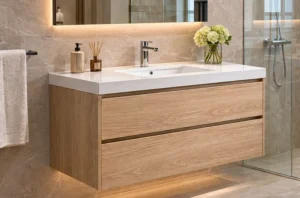
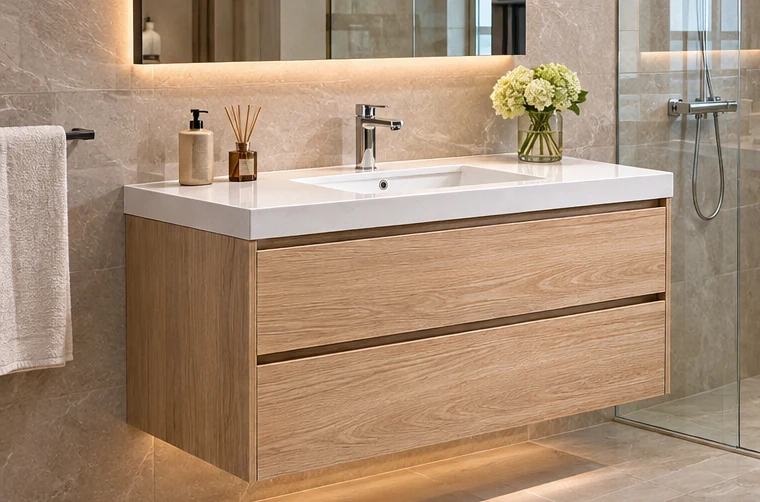
Bathroom vanity construction is an important sourcing consideration for furniture importers, wholesalers, hotel developers, and apartment project contractors. A bathroom cabinet may look attractive in a showroom, but its long-term performance depends on the cabinet box structure, panel materials, edge sealing, hardware installation, and manufacturing consistency. For B2B buyers, understanding these construction details helps reduce moisture-related damage, installation problems, warranty claims, and unexpected replacement costs.
At Starwood Industry Co., Ltd., we specialize in OEM and ODM panel furniture manufacturing for international trade and commercial projects. This guide explains how buyers can evaluate bathroom vanity cabinet construction and develop practical specifications for repeatable factory production.
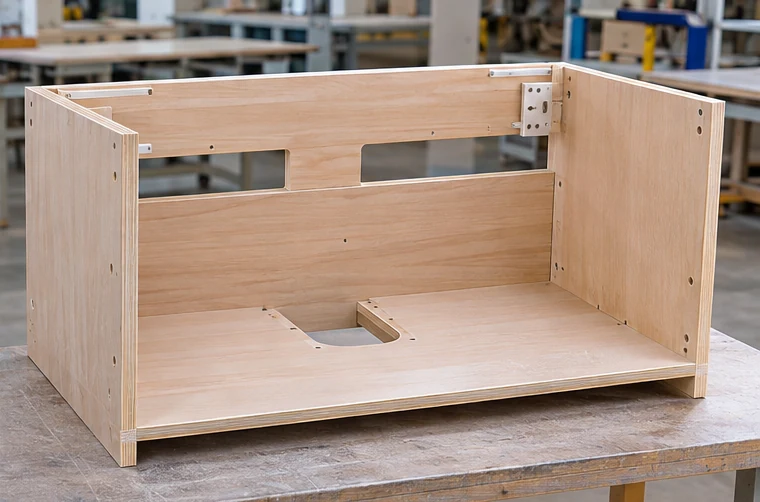
Table of Contents
- Why Bathroom Vanity Construction Matters for B2B Buyers
- Understanding Bathroom Vanity Cabinet Box Structure
- Choosing the Right Materials for Vanity Cabinets
- Cabinet Joinery and Structural Connections
- Moisture Protection and Edge Banding
- Doors, Drawers, Hinges, and Hardware
- Bathroom Vanity Construction for Hotels and Apartments
- OEM and ODM Customization Options
- How a Factory Manufactures Bathroom Vanity Cabinets
- Quality Control and Product Testing
- MOQ, Production Lead Time, and Export Packaging
- How to Evaluate a Bathroom Vanity Manufacturer
- Frequently Asked Questions
- Request an OEM Bathroom Vanity Quotation
Why Bathroom Vanity Construction Matters for B2B Buyers
For professional furniture buyers, choosing bathroom cabinets involves much more than comparing product photographs and unit prices.
A well-designed vanity cabinet needs to support the countertop and basin, accommodate plumbing connections, operate smoothly under repeated use, and maintain its appearance in a humid bathroom environment.
For wholesale and project orders, even a relatively small manufacturing defect can become expensive when repeated across hundreds of units.
Typical purchasing concerns include:
- Cabinet panels swelling near sink connections.
- Drawer mechanisms failing after frequent use.
- Cabinet boxes becoming misaligned during installation.
- Poorly sealed panel edges absorbing moisture.
- Inconsistent dimensions between production batches.
- Shipping damage caused by insufficient protective packaging.
- Replacement parts being unavailable for repeat project orders.
These issues usually originate in material selection, engineering details, production control, or packaging design.
For buyers sourcing bathroom vanities from China, discussing construction specifications with the manufacturer before placing an order can prevent avoidable problems later.
A practical sourcing approach considers three factors together: product durability, manufacturing cost, and installation efficiency.
The lowest quotation does not necessarily represent the lowest total project cost.
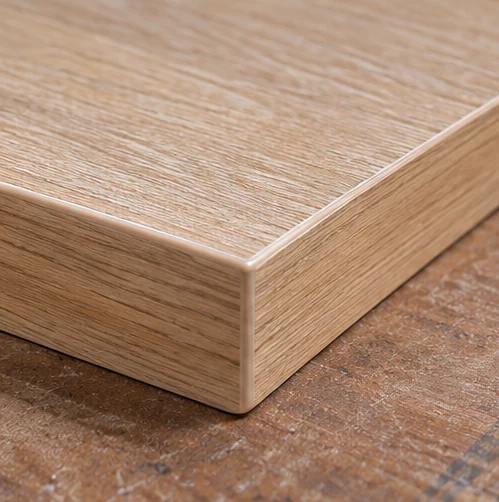
Understanding Bathroom Vanity Cabinet Box Structure
The cabinet box, also called the carcass, forms the structural foundation of a bathroom vanity.
Its main components usually include side panels, bottom panels, rear supports or back panels, internal partitions, and the connection points for doors, drawers, and mounting hardware.
Side Panels and Bottom Panels
Side panels determine the cabinet’s height, depth, and general structural alignment. They also provide mounting surfaces for hinges, drawer runners, shelves, and connection fittings.
Bottom panels support stored bathroom products and help maintain cabinet rigidity.
For many panel-furniture programs, 16 mm or 18 mm engineered panels are common starting specifications. However, the appropriate thickness depends on cabinet dimensions, material properties, countertop weight, fixing method, and the required performance level.
A manufacturer should not recommend panel thickness based on price alone.
For example, a compact freestanding cabinet and a wide wall-mounted vanity may require different reinforcement strategies.
Back Panels and Plumbing Clearance
Bathroom vanity cabinets must accommodate water supply pipes, waste outlets, and sometimes electrical accessories.
Depending on the product design, the cabinet may use:
- A full back panel with plumbing openings.
- A partial back panel.
- Rear support rails.
- An open-back construction.
- A removable service-access section.
A full back panel can contribute to cabinet rigidity, but plumbing access and installation requirements must be considered.
For hotel and apartment projects, standardized plumbing cutouts can make installation more efficient when the building layout is consistent.
However, the actual cutout positions should be confirmed against approved plumbing drawings rather than assumed during production.
Wall-Mounted and Freestanding Structures
Wall-mounted bathroom vanities create a modern appearance and allow easier floor cleaning.
However, a floating cabinet requires suitable structural reinforcement and a verified wall-fixing system.
The installer must account for the cabinet’s own weight, basin and countertop loads, stored contents, wall construction, and applicable local requirements.
Freestanding cabinets transfer much of their vertical load through legs, side panels, or a supporting base.
They may offer more installation flexibility, particularly where the wall structure does not support a floating cabinet.
For large projects, buyers should confirm the intended installation method before approving final cabinet construction.
Choosing the Right Materials for Vanity Cabinets
Material selection is one of the most important parts of bathroom vanity construction.
For B2B purchasing, the objective is not simply to choose the most expensive material. It is to select a board specification appropriate for the expected moisture exposure, selling price, cabinet design, and intended market.
Moisture-Resistant MDF
Moisture-resistant MDF offers a smooth, uniform surface suitable for painted cabinet doors and certain decorative finishes.
Its advantages may include consistent machining, relatively smooth painted surfaces, and flexibility for CNC processing.
However, moisture-resistant MDF is not waterproof.
The performance of the finished cabinet still depends on surface finishing, edge protection, cutout sealing, installation conditions, and maintenance.
Buyers should request the actual board grade and relevant test information rather than relying on the description “moisture-resistant” alone.
Plywood Cabinet Construction
Plywood consists of multiple bonded wood veneer layers. Depending on its grade and construction, it can provide useful strength and fastening properties for cabinet applications.
For premium bathroom vanity programs, buyers may consider plywood for structural cabinet components.
Important details include plywood grade, adhesive classification, core consistency, thickness tolerance, surface quality, and edge protection.
Not all plywood performs equally in damp environments.
Buyers should specify the required performance characteristics rather than assuming every plywood cabinet is water-resistant.
Particleboard and Cost-Optimized Construction
Particleboard is widely used in panel furniture manufacturing because it provides a practical balance between price, processing efficiency, and finish options.
For bathrooms, however, standard particleboard may be unsuitable in areas exposed to repeated moisture.
Moisture-resistant particleboard combined with appropriate surface protection can be considered for certain vanity designs, subject to performance verification.
For cost-sensitive wholesale programs, the most effective approach may be to optimize the complete cabinet structure rather than simply reducing material thickness.
Material Comparison for Procurement
| Material | Typical Application | Procurement Consideration |
|---|---|---|
| Moisture-resistant MDF | Painted fronts, selected cabinet components | Confirm moisture performance and sealed edges |
| Plywood | Structural panels, premium cabinet programs | Confirm grade, bonding and finish quality |
| Moisture-resistant particleboard | Cost-controlled cabinet programs | Verify suitability for the exposure conditions |
| Laminated engineered panels | Decorative cabinet boxes | Check surface durability and edge integrity |
| Solid wood | Premium fronts and decorative components | Consider movement, coating and humidity effects |
For cabinets supplied to the United States, buyers should also review applicable composite wood emission requirements.
The U.S. Environmental Protection Agency’s TSCA Title VI guidance explains requirements affecting regulated hardwood plywood, MDF, particleboard, and finished goods containing those materials.
Compliance documentation should be confirmed for the actual boards used in the order.
US EPA
Cabinet Joinery and Structural Connections
Cabinet joinery influences structural stability, assembly time, repairability, and manufacturing cost.
Different production programs may use different joining systems.
Cam Locks and Dowel Connections
Cam lock fittings and dowels are commonly used for knock-down furniture construction.
They are especially relevant for flat-pack bathroom cabinets that need to be shipped efficiently and assembled at the destination.
When properly engineered, these connections can offer repeatable assembly and clear installation procedures.
However, the design must consider panel density, drilling accuracy, fitting specifications, and required cabinet strength.
Confirmat Screws and Mechanical Fasteners
Confirmat screws and other mechanical fastening systems may be used in engineered panel construction.
They can provide a practical connection method for suitable materials and configurations.
For export furniture, the manufacturer must consider whether exposed fastener heads are acceptable and whether the connection allows convenient installation.
Dowels, Adhesives, and Factory-Assembled Cabinets
Factory-assembled vanity cabinets may use dowels, adhesives, mechanical fasteners, or combinations of these methods.
Assembly conditions such as drilling tolerance, adhesive compatibility, clamping, and alignment control influence final consistency.
For commercial projects, buyers should request a construction drawing or approved sample showing how the cabinet panels connect.
This is more reliable than selecting a cabinet based only on external appearance.
Structural Standards as a Reference
For project-based cabinetry, the Architectural Woodwork Institute’s casework standards provide useful references for construction requirements and performance considerations.
They help buyers distinguish between visually acceptable products and documented cabinet performance specifications.
The applicable standard and acceptance criteria should be agreed upon before manufacturing, particularly for large commercial orders.
AWI QCP
Moisture Protection and Edge Banding
Moisture management is a critical issue in bathroom vanity manufacturing.
Unlike many bedroom or living room cabinets, bathroom furniture may experience frequent humidity changes, water splashes, and occasional leaks.
Edge Banding Quality
Exposed or poorly sealed panel edges are potential moisture-entry points.
Depending on the design, manufacturers may use PVC, ABS, or other suitable edge-banding materials.
Buyers should review:
- Edge-banding material and thickness.
- Adhesive and application process.
- Bonding consistency.
- Corner finishing.
- Edge trimming quality.
- Protection around drilled holes and cutouts.
The objective is to produce clean, consistent, appropriately protected edges across the entire production order.
A decorative surface alone does not ensure moisture protection if vulnerable edges or cutouts remain exposed.
Sink Cutouts and Plumbing Openings
Water can enter cabinet components through unfinished sink openings, pipe penetrations, or poorly protected joints.
For this reason, plumbing openings should be reviewed during the engineering and sampling stages.
Project specifications may call for suitable sealants, protective coatings, moisture-resistant components, or other measures appropriate to the installation.
Plumbing connections must also be installed correctly, since no ordinary wood-based cabinet should be expected to withstand continuous water leakage.
Surface Finishes
Bathroom cabinets may use melamine surfaces, laminate, painted finishes, decorative foil, or other approved coating systems.
The selection depends on the desired appearance, manufacturing cost, durability requirements, and target market.
For example, a modern retail vanity collection may prioritize color consistency and surface appearance, while a hotel project may place greater emphasis on repairability and repeat supply.
In either case, buyers should verify actual sample performance rather than relying on marketing descriptions.
Doors, Drawers, Hinges, and Hardware
Hardware selection plays an important role in bathroom vanity construction, particularly for commercial projects where cabinets may be opened and closed frequently.
A cabinet can have durable panels and attractive finishes, but poorly specified drawer slides or hinges may result in early maintenance complaints.
Soft-Close Hinges
Soft-close hinges are often selected for modern bathroom cabinets because they control door-closing movement and help reduce impact.
When evaluating hinges, buyers should consider opening angle, adjustment range, corrosion resistance, door weight, and supplier consistency.
For hotel and apartment projects, adjustable hinges can make installation and maintenance easier.
Hardware selection should also reflect the humidity conditions in which the cabinet will operate.
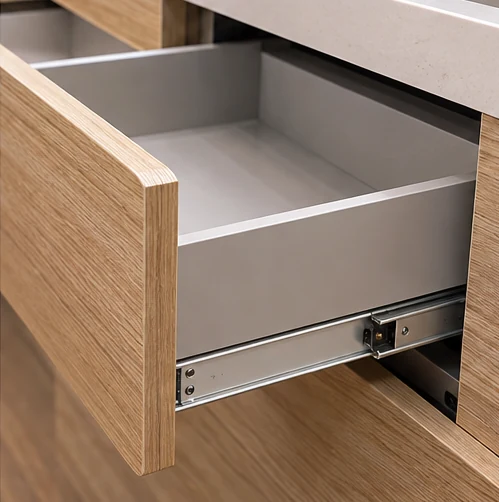
Drawer Slides and Storage Design
Drawer slides may include conventional side-mounted runners, concealed undermount slides, and soft-close systems.
Different solutions have different cost and performance characteristics.
A factory should confirm the drawer’s expected load, width, travel distance, and installation requirements before recommending a slide specification.
For bathroom vanity cabinets, drawer design must also consider plumbing clearance.
An upper drawer may require a U-shaped arrangement or a modified drawer box to accommodate sink drainage.
These details should be checked during product development rather than corrected during installation.
Hardware Standardization for Project Orders
For a project involving hundreds of bathroom cabinets, standardized hardware can simplify procurement, replacement, and ongoing maintenance.
Buyers should discuss whether the manufacturer can supply consistent hardware models across repeat orders.
Where branded hardware is required, the approved model and genuine component sourcing should be specified.
For larger orders, a spare-parts plan may also help reduce future maintenance delays.
Bathroom Vanity Construction for Hotels and Apartments
Bathroom vanity requirements can vary significantly between residential retail products and commercial property projects.
A successful project cabinet must fit the installation environment, construction schedule, maintenance plan, and overall purchasing budget.
Hotel Bathroom Vanity Cabinets
Hotel bathroom furniture experiences frequent use, regular cleaning, and repeated exposure to humidity.
Purchasing teams should pay close attention to:
- Stable and repeatable cabinet dimensions.
- Moisture-resistant material specifications.
- Durable door and drawer hardware.
- Service access for plumbing maintenance.
- Consistent finishes across guest rooms.
- Suitable installation and fixing details.
- Availability of replacement components.
For hotel developments, product consistency across multiple rooms is often more important than offering numerous decorative variations.
A standardized cabinet structure with approved finish and hardware options may help simplify purchasing and installation.
Apartment and Residential Development Projects
Apartment projects frequently require a balance between price, appearance, and efficient installation.
Developers may need different vanity widths for studio apartments, family units, and larger residential layouts.
Instead of creating completely different constructions for every size, a manufacturer can evaluate whether common panel specifications, hardware systems, and finishing materials can be used across the collection.
This approach may improve production consistency and simplify spare-parts management.
For projects requiring coordinated bedroom, kitchen, bathroom, and storage furniture, buyers can also explore our project furniture manufacturing services.
Student Housing and Rental Properties
Student housing and rental developments often prioritize practical storage, straightforward cleaning, and cost-controlled replacement.
Simple cabinet layouts with standardized components may provide advantages for property management.
For these applications, product engineering should focus on durable everyday performance rather than unnecessary decorative complexity.
OEM and ODM Bathroom Vanity Customization
International buyers often require bathroom vanity products that match a particular market, brand identity, or construction project.
OEM and ODM manufacturing allows buyers to develop cabinets around defined dimensions, materials, finishes, and performance expectations.
OEM Bathroom Vanity Manufacturing
OEM manufacturing is suitable for buyers who already have product drawings, reference samples, or detailed technical specifications.
Typical customization requirements include:
- Cabinet width, height, and depth.
- Panel thickness and substrate.
- Decorative surfaces and color.
- Door and drawer configuration.
- Hardware models and opening systems.
- Sink and countertop interface.
- Wall-mounted or freestanding construction.
- Plumbing access and service clearances.
- Flat-pack or assembled delivery.
- Private-label packaging and instructions.
Before quotation, the manufacturer should review whether the proposed structure is practical for serial production.
At Starwood, our OEM and ODM furniture manufacturing services support product development, material selection, sampling, bulk manufacturing, quality control, and export preparation.
ODM Bathroom Vanity Development
ODM development is relevant for importers, furniture brands, and distributors introducing a new cabinet collection.
The buyer may provide market references, target dimensions, price positioning, and desired appearance.
The manufacturing team can then evaluate structural feasibility, panel processing, hardware integration, and packaging requirements.
For example, a buyer developing a contemporary apartment vanity collection may request wood-grain finishes, concealed handles, soft-close drawers, and several cabinet widths.
A practical ODM process reviews whether those design features can be manufactured consistently within the target cost range.
Custom Bathroom Vanity Programs for Wholesalers
Wholesalers may require multiple sizes and finishes under one coordinated product range.
Standardizing cabinet construction can simplify repeat purchasing while still allowing visual customization.
For example, one core cabinet structure may support several approved decorative finishes, provided the dimensional and hardware requirements remain compatible.
This can help buyers manage product variations without unnecessarily increasing manufacturing complexity.
For importers and distributors, a reliable custom bathroom vanity program should begin with a clearly defined specification and approved production sample.
Product category link should be confirmed in the website backend before publishing, especially if its current permalink differs.
How a Factory Manufactures Bathroom Vanity Cabinets
Understanding the manufacturing workflow helps buyers evaluate whether a supplier can maintain quality across repeat orders.
At Starwood, our published OEM/ODM service scope includes engineering review, sampling, panel furniture production, quality inspection, export packing, and shipment preparation.
The following workflow represents a practical approach for evaluating a bathroom vanity manufacturing program.
Engineering Review and Material Selection
The process begins with reviewing the buyer’s dimensions, technical drawings, reference images, target materials, and intended application.
Important questions include whether the cabinet will be wall-mounted, whether the sink is supplied separately, and which plumbing clearances are required.
The factory should also review material suitability, component thicknesses, expected loading, hardware positions, and packaging method.
Any proposed design changes should be approved before final production.
CNC Cutting and Drilling
Panel furniture manufacturing commonly uses CNC cutting and drilling equipment to produce repeatable components.
Accurate machining supports consistent cabinet dimensions and fitting locations.
For knock-down bathroom cabinets, drilling accuracy is particularly important because connection hardware must align during assembly.
Factories should check whether critical dimensions and hole positions remain consistent during production.
Edge Banding and Surface Finishing
After machining, applicable panel edges are finished using the approved edge-banding or coating process.
Quality checks should cover bonding, trimming, surface damage, color consistency, and vulnerable edge locations.
For moisture-sensitive bathroom furniture, particular attention should be given to the approved protection of cut edges and plumbing openings.
Trial Assembly and Sample Approval
Before bulk production, an assembled sample can help identify practical construction problems.
The buyer and factory should review door gaps, drawer operation, stability, plumbing access, countertop compatibility, and packaging components.
Sample approval should include both visual details and functional construction requirements.
A useful practice is to retain an approved reference sample or documented inspection specification for comparison during mass production.
Bulk Production and Final Inspection
After sample approval, the production team can organize material preparation, machining, finishing, component identification, and assembly or packaging operations.
During manufacturing, quality control should focus on critical dimensions, surface quality, edge integrity, drilling positions, hardware installation, and completeness.
Final inspection should verify that the products match the approved specification.
For export orders, packaging and component identification are also part of the finished product’s quality.
Quality Control and Product Testing
Quality control is not only a final inspection activity.
For a bathroom vanity order, quality should be managed from material sourcing through shipment preparation.
Incoming Material Inspection
The factory should verify that incoming boards and hardware match the approved order requirements.
Relevant checks may include panel thickness, surface quality, material identification, and required supplier documentation.
For market-specific environmental or certification requirements, buyers should confirm the supporting evidence before shipment.
For wood sourcing claims, the Forest Stewardship Council’s Chain of Custody guidance explains how certified forest-based materials are tracked through the supply chain.
FSC claims should only be made where the relevant chain-of-custody requirements are satisfied.
Forest Stewardship Council
Cabinet Stability and Functional Performance
Cabinet performance depends on construction design, material properties, connection methods, and hardware.
Buyers may request appropriate strength, durability, and stability testing according to the product type and contractual requirements.
The ISO 7170:2021 furniture testing standard specifies test methods for assessing the strength, durability, and stability of storage units.
The standard provides test methods rather than a universal pass/fail requirement, so acceptance criteria must be defined separately.
ISO
Kitchen and Vanity Cabinet Performance
For buyers sourcing cabinets for the North American market, the Kitchen Cabinet Manufacturers Association provides information about the ANSI/KCMA A161.1 performance and construction standard for kitchen and vanity cabinets.
This standard can be considered when developing appropriate procurement requirements.
However, buyers should distinguish between choosing a standard as a technical reference and purchasing products that are actually certified under a particular program.
KCMA
Moisture-Related Inspection Points
Bathroom cabinets require particular attention to moisture-sensitive areas.
A practical inspection plan may include examination of panel edges, plumbing openings, sink interfaces, bottom panels, and areas around fasteners.
Where moisture exposure testing is specified, the test method, duration, acceptance criteria, and applicable material standard should be agreed upon in advance.
A supplier should not describe engineered wood furniture as completely waterproof without appropriate evidence.
For procurement decisions, documented performance is more useful than unsupported product claims.
MOQ, Production Lead Time, and Export Packaging
For international B2B buyers, manufacturing capability must be evaluated together with order flexibility and shipping requirements.
A suitable bathroom vanity supplier should be able to explain how product complexity, material availability, order quantity, and packaging affect the quotation and production schedule.
Minimum Order Quantity
The minimum order quantity for an OEM bathroom vanity project depends on several factors.
These include material availability, finish customization, cabinet size variations, hardware sourcing, production setup, and packaging requirements.
A standard product using existing materials may have different minimum order conditions from a fully customized cabinet collection.
Buyers should confirm MOQ by SKU, finish, and total order rather than assuming that one minimum applies to every design.
Starwood offers flexible customization and low-MOQ support within its published furniture manufacturing services, but the actual minimum for each bathroom vanity specification must be confirmed during quotation.
Production Lead Time
Production lead time depends on sample approval, raw material availability, order complexity, hardware procurement, and factory scheduling.
For accurate project planning, buyers should separate the schedule into sample development, sample approval, bulk production, inspection, and shipment preparation.
A new OEM design may require additional engineering and sampling compared with a repeat order using approved drawings.
Any quoted delivery date should clearly identify the agreed starting point, such as receipt of the deposit and approval of final specifications.
Buyers should also allow for international shipping and destination-side customs clearance.
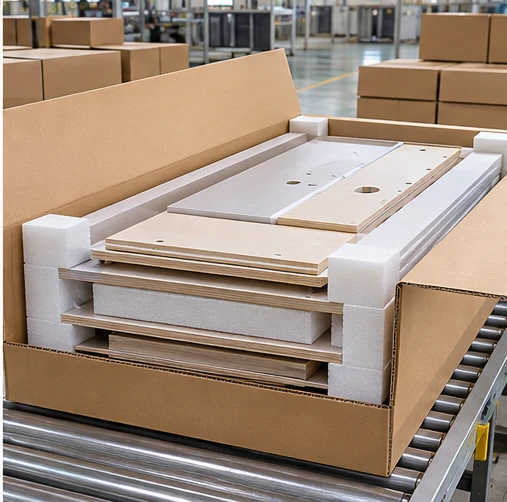
Flat-Pack Bathroom Vanity Packaging
Flat-pack packaging is particularly relevant for panel furniture exporters serving wholesalers, distributors, and retail channels.
A well-engineered knock-down structure may improve container utilization and reduce the storage volume required before assembly.
However, flat-pack packaging is not automatically the best choice for every bathroom vanity.
Products with integrated stone countertops, fragile basins, unusual hardware, or complex installation requirements may need different packaging arrangements.
Packaging should be selected according to the actual product and delivery channel.
Packaging Protection and Transit Testing
Important packaging elements may include protective corner materials, suitable cushioning, separated hardware bags, panel identification, clear assembly instructions, and reinforced outer cartons.
For international orders, the goal is to protect exposed corners, decorative surfaces, hardware, and fragile components during handling and transportation.
Buyers can refer to the International Safe Transit Association’s packaging test procedures when considering appropriate distribution testing.
For example, ISTA 3A is designed for eligible parcel-delivery packages, while other procedures apply to different transportation environments. The relevant test should match the product’s shipping method.
International Safe Transit Association
For large bathroom vanity orders, packaging design should be reviewed before shipment rather than treated as a final production detail.
How to Evaluate a Bathroom Vanity Manufacturer
A reliable manufacturer should be able to explain not only what the cabinet looks like, but also how it is built, inspected, packed, and reproduced.
For international importers, wholesalers, and project buyers, a practical supplier evaluation covers technical capability, communication, sample development, quality management, and export experience.
Factory Manufacturing Capability
Buyers should first confirm whether the supplier can support the required cabinet construction and production processes.
For panel furniture, this may include CNC machining, drilling, edge banding, assembly checks, and export packaging.
It is also important to confirm which components are manufactured in-house and which are sourced from external suppliers.
At Starwood, we focus on panel furniture manufacturing and OEM/ODM support for international buyers. Our factory profile introduces our production background, customization services, and export-oriented operations.
Technical Communication
An experienced manufacturing partner should ask detailed questions before finalizing a quotation.
These may include:
- What is the required bathroom vanity size?
- Which cabinet material is specified?
- Is the cabinet wall-mounted or freestanding?
- What are the sink and plumbing requirements?
- Which drawer slides and hinges are required?
- Is the product intended for wholesale or a commercial project?
- Are there specific testing or regulatory requirements?
- Is flat-pack or assembled packaging preferred?
Clear answers help reduce engineering changes during production.
Sample and Specification Control
For an OEM order, the approved sample should become the reference for bulk manufacturing.
Important information should be documented in drawings, material specifications, hardware lists, finish approvals, and packaging requirements.
When a supplier proposes cost-saving changes, the buyer should review how they affect durability, appearance, installation, and product consistency.
Export Experience
For buyers importing from China, export experience can influence the overall purchasing process.
Useful capabilities include carton marking, component labeling, container-loading preparation, shipment documentation, and coordination of inspection requirements.
A supplier that understands manufacturing and export packaging can help buyers manage more of the procurement process through one point of contact.
Bathroom Vanity Construction: Frequently Asked Questions
What is the best material for bathroom vanity cabinet construction?
There is no single best material for every project. Moisture-resistant MDF, appropriately specified plywood, and moisture-resistant engineered panels can all be considered for different designs and budgets. Selection should be based on performance requirements, moisture exposure, structural design, finishing, and cost.
Is plywood better than MDF for bathroom vanities?
Plywood may offer useful structural and fastening characteristics, while MDF provides a smooth surface suited to certain painted finishes. The better choice depends on the panel grade, cabinet design, coating, edge protection, and intended application. Neither material should automatically be considered waterproof.
What panel thickness is commonly used for bathroom vanity cabinets?
Panel furniture commonly uses 16 mm and 18 mm boards for certain cabinet components, although other thicknesses may be specified. The final choice depends on cabinet dimensions, material performance, countertop load, wall mounting, and engineering requirements.
What is the difference between flat-pack and assembled bathroom vanities?
Flat-pack bathroom vanities are shipped as components for assembly at the destination. They can reduce shipping volume for suitable designs. Assembled vanities may simplify on-site installation but can require more shipping and storage space. The correct option depends on product structure, logistics, and installation costs.
Can bathroom vanity manufacturers support OEM and ODM orders?
Yes. Suitable panel furniture manufacturers may support OEM production from approved drawings and ODM development based on market requirements. Buyers should confirm material options, technical capabilities, sample development, MOQ, packaging, and production conditions with the supplier.
Are moisture-resistant bathroom cabinets waterproof?
Not necessarily. Moisture-resistant boards are designed to provide improved performance under specified conditions, but they do not make a complete bathroom cabinet waterproof. Effective moisture management requires suitable materials, edge sealing, surface protection, installation, and plumbing maintenance.
What should hotel project buyers check before placing a bulk order?
Hotel buyers should confirm approved dimensions, cabinet construction, moisture-resistant materials, hardware, plumbing access, wall-fixing requirements, quality acceptance criteria, packaging, and spare-part availability. An approved production sample is particularly important for projects involving multiple rooms.
What information is needed for an OEM bathroom vanity quotation?
A useful inquiry includes product drawings or photographs, cabinet dimensions, required materials, finishes, hardware, order quantity, destination market, packaging method, and target delivery schedule. Project buyers should also provide relevant plumbing and installation requirements.
Request an OEM Bathroom Vanity Quotation
Bathroom vanity construction directly affects long-term durability, production consistency, installation efficiency, and purchasing cost.
For importers, wholesalers, furniture brands, and commercial property developers, working with a manufacturer that understands cabinet engineering and export production can reduce sourcing risk.
At Starwood Industry Co., Ltd., we support OEM and ODM panel furniture programs, including structure review, material selection, sample development, bulk manufacturing, quality control, and export-ready packaging.
Whether you are developing a custom bathroom vanity collection or sourcing cabinet furniture for an apartment or hotel project, our team can review your requirements and discuss suitable manufacturing options.
Looking for a bathroom vanity manufacturing partner in China?
Send us your cabinet drawings, dimensions, material requirements, estimated order quantity, and destination market.
We can help evaluate cabinet construction options, customization feasibility, packaging requirements, and the next steps toward a factory quotation.
Contact Starwood Industry Co., Ltd.
- Email: info@plywoodmfr.com
- Phone / WhatsApp: +86 136 9199 4727
- Factory Location: Jiangmen, Guangdong, China
Explore our OEM & ODM manufacturing services or learn more about our factory to discuss your next bathroom vanity project.