For kitchen cabinet importers, distributors, and project contractors, kitchen cabinet hardware durability is a purchasing decision—not a small accessory detail. A drawer slide that binds after installation or a hinge that loosens in an apartment kitchen can create costly service calls across hundreds of units. Buyers evaluating OEM kitchen cabinets should inspect the complete system: hinge specification, drawer-runner capacity, mounting strength, soft-close consistency, documented testing, and factory assembly controls. This practical guide explains how to translate those checks into a reliable RFQ, approved sample, and repeatable bulk-production specification.
Table of Contents
- Why hardware durability matters for commercial purchasing
- Start with the application and a written hardware schedule
- Check concealed hinges and door mounting
- Evaluate drawer slides and load capacity
- Understand cycle testing and independent standards
- Test soft-close function under realistic conditions
- Match hardware to panel materials and drilling accuracy
- Review factory QC, OEM/ODM options, MOQ and lead time
- Protect hardware during flat-pack export and installation
- Use a buyer’s inspection checklist before ordering
- Frequently asked questions
- Request a kitchen cabinet hardware quotation
Why Kitchen Cabinet Hardware Durability Matters for B2B Buyers
Cabinet doors and drawers may look identical in a showroom even when their component specifications vary significantly. Hardware problems often become visible only after repetitive use, loading, humidity changes, transportation, or field assembly. In multi-unit developments, a small defect rate can affect many apartments simultaneously and multiply the cost of replacement parts, labor, tenant coordination, and warranty claims.
For importers and wholesalers, the risk is also commercial. A supplier may quote a standard concealed hinge for one shipment and substitute a lower-cost version in the next unless the purchase order identifies the approved model. A drawer runner may advertise a load rating without defining the test length, extension type, or whether the load includes the drawer itself. The procurement goal is therefore to make performance verifiable and substitutions controlled.
In our OEM and ODM panel furniture manufacturing services, Starwood supports buyers with hardware selection, panel structures, sampling, production quality checks, and export packing for flat-pack furniture programs. The right combination depends on your target market, use frequency, budget, and installation method—not the highest specification on paper alone.
Start with the Application and a Written Hardware Schedule
Before comparing price lists, divide the project by intended use. A private residence has different traffic and replacement costs from a serviced apartment, a student residence, or a hospitality pantry. In a development with hundreds of kitchens, consistency across units may matter more than a cosmetic upgrade.
Define the operating conditions
Ask these questions before selecting hardware:
- How often will each door or drawer be opened, and who will use it?
- Will drawers hold light utensils, dishes, cookware, or heavier pantry goods?
- What are the door height, width, thickness, weight, and opening angle?
- Is the environment a dry interior, a humid kitchen, or a coastal location?
- Is the furniture assembled at the factory or delivered ready-to-assemble (RTA)?
- Are replacement runners and hinges expected to remain available for future maintenance?
Classify your hardware into economy residential, upgraded residential, and more demanding multi-unit/project specifications. These are purchasing categories, not official grades. For each cabinet SKU, record the required hinge quantity, hinge opening angle, slide type, nominal slide length, full or partial extension, rated capacity, finish, and damping system. Include manufacturer and model numbers when agreed.
Quote the same specification across suppliers
A meaningful landed-cost comparison needs the same hardware schedule. Otherwise, a lower cabinet quote may simply reflect a different runner design, fewer hinges, thinner mounting plates, or a non-damped closing system. Ask suppliers to separate standard hardware from optional upgrades in their quotations so the additional cost is visible.
Check Concealed Hinges and Door Mounting
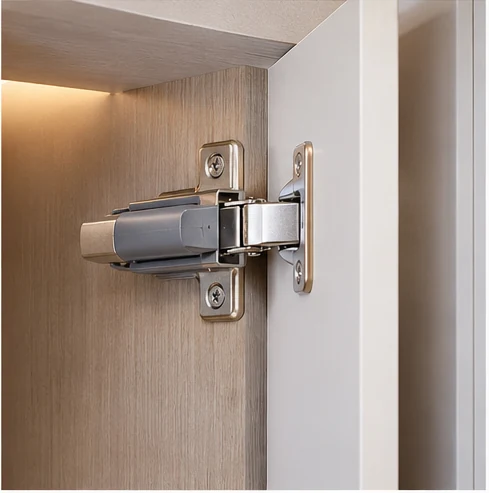
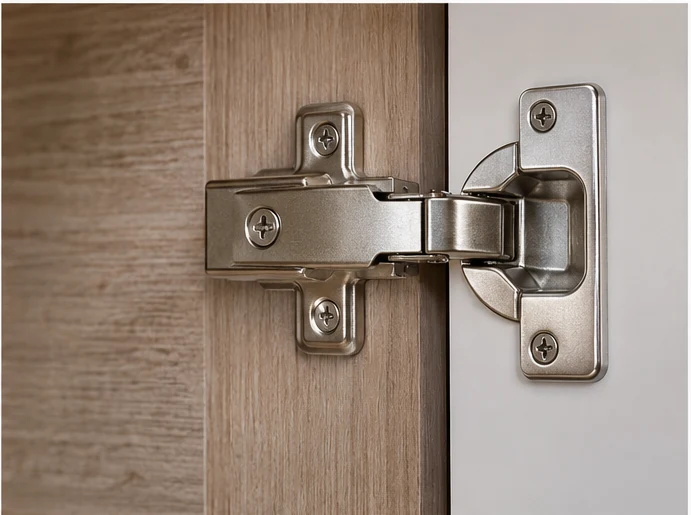
Concealed cup hinges are common in modern panel kitchen cabinets because they provide adjustable door positioning and a clean exterior. However, not all concealed hinges have the same movement range, corrosion resistance, spring force, or soft-close performance.
Specify hinge type and adjustment
Check whether the design needs a full-overlay, half-overlay, or inset hinge. Confirm the opening angle, mounting plate height, cup depth and drilling pattern. Three-way adjustment—typically vertical, lateral, and depth adjustment—helps installers achieve consistent door gaps, but the available adjustment range depends on the selected model.
For taller or heavier doors, the required number and placement of hinges must be determined from the actual door dimensions, weight, panel construction, and the hardware maker’s installation guidance. Do not assume that two hinges are sufficient for every door. During sample approval, inspect the top and bottom gaps, alignment after repeated operation, and the security of the mounting plate.
Ask for model-specific endurance evidence
Quality hinge suppliers may publish cycle-test results. As a useful benchmark—not a universal minimum—Blum states that its hinges undergo 200,000 opening and closing cycles. This is evidence about Blum’s own testing program, not a claim that every hinge or finished cabinet achieves the same result. For an unbranded or alternative hinge, request the exact model’s test report and identify the test load, fixture, conditions, and pass criteria.
Inspect the attachment, not only the metal part
A sturdy hinge can still fail if screws pull out of an inadequately specified board, a cup hole is mis-drilled, or an edge is too close to the fixing points. Test hinges mounted in the actual production panel rather than relying solely on a free-standing hardware sample. Check screw engagement, repeatability of CNC hole positions, and any damage to decorative surfaces during adjustment.
Evaluate Drawer Slides and Real Load Capacity
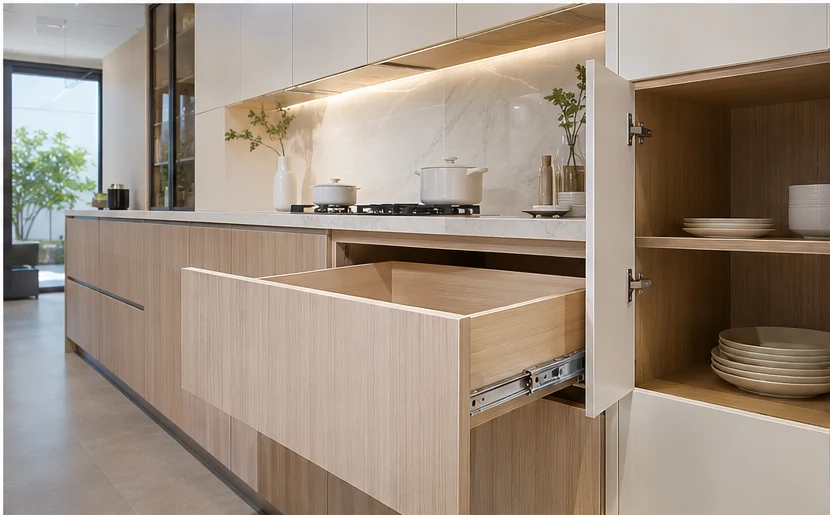
Drawer slides are among the most important components in kitchen cabinet hardware durability. A smooth empty drawer may behave very differently when filled with plates, pots, or pantry items. A buyer needs to know the usable load, extension, travel stability, mounting method, and long-term closing behavior.
Choose the slide mechanism for the use case
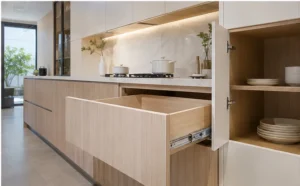
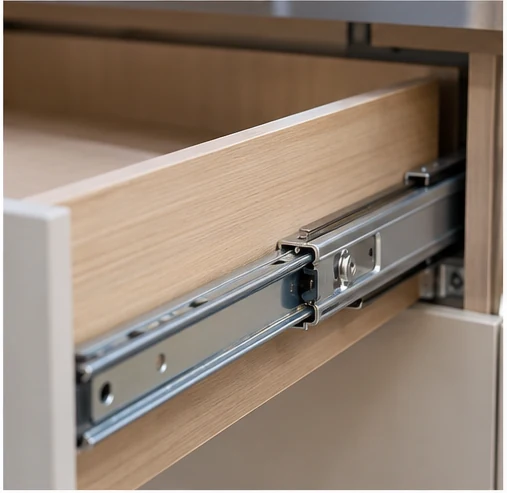
Roller slides can suit cost-sensitive, light-duty applications, but may provide less refinement or extension than higher-specification systems. Ball-bearing telescopic slides are widely used where longer travel and predictable motion are needed. Undermount concealed runners hide beneath the drawer and may offer integrated soft close and a premium interior appearance. Each system must be assessed by its manufacturer-specific performance, not by type alone.
For storage-heavy kitchens, full-extension slides improve access to the rear of the drawer. Partial-extension options may reduce cost when full access is not necessary. Verify the drawer width, runner length, side clearances, installation tolerances, and compatibility with the drawer-box design.
Make load ratings comparable
A label such as “30 kg drawer slide” is incomplete. Does it refer to the total moving mass, including the drawer box, or only contents? At what runner length and extension is the rating validated? Is it based on static support or repeated loaded movement?
A concrete example is Hettich’s published test report for selected InnoTech Atira/Quadro runners, which specifies a 30 kg total weight rating (drawer included) under stated reference-length conditions and reports an 80,000-cycle durability result for the indicated product. These values are specific to that product and test setup. They should not be assigned to a different slide without supporting evidence.
Test for rack, sag, and uneven motion
Install a fully assembled sample drawer and distribute the specified test load as it would be used in practice. Open and close it repeatedly, then inspect for binding, sideways movement, sag at extension, front-panel alignment, screw movement, noise, and damper engagement. Wide drawers deserve special attention because off-center loading can reveal instability that a narrow test drawer hides.
Understand Cycle Testing, Standards, and Test Reports
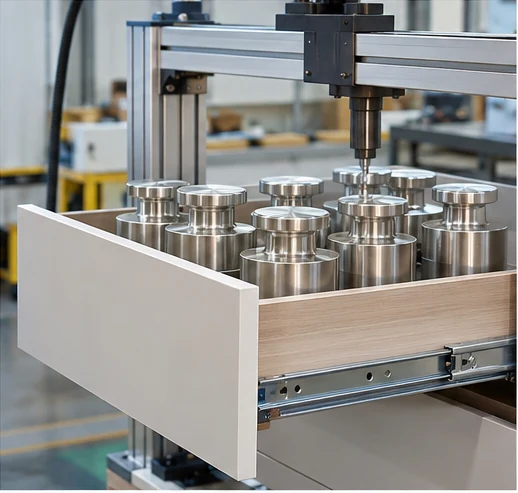
Cycle testing is a valuable screening tool, but test counts have meaning only when the procedure is defined. Always ask what constituted a cycle, how the sample was mounted, what load was used, which acceptance criteria applied, and whether testing was performed on the exact product proposed for supply.
The current ANSI/BHMA A156.9-2026 cabinet hardware standard addresses cabinet hardware including hinges and drawer slides and contains operational, cyclical, and strength performance tests. When a supplier claims compliance, request the relevant grade, test method, report, and model identification. Do not present ANSI/BHMA compliance as automatic for every kitchen cabinet or every component supplied by a factory.
For European-oriented purchasing, buyers may also encounter product-specific declarations referencing EN 15338 for furniture extension elements. The requirement must be tied to the intended runner and current applicable specification, not copied from another manufacturer’s catalogue.
A practical durability evidence package
For project approval, request (1) hardware datasheets with part numbers, (2) relevant cycle and load test reports, (3) corrosion or finish test evidence if the environment warrants it, (4) sample-assembly photographs, and (5) an agreed visual and functional inspection checklist. If the supplier only offers a verbal assurance such as “high-quality, 100,000 times,” treat that figure as unverified until a document supports it.
Where a buyer wants added assurance, arrange independent inspection or testing to an agreed protocol. Distinguish component-test results from whole-cabinet performance, because a passed hinge test does not independently validate the cabinet substrate, drilling, screws, or installation.
Test Soft-Close Cabinets Under Realistic Conditions
Soft-close cabinets are attractive for apartment developments and retail kitchen programs because they can reduce impact noise and improve perceived quality. But “soft close” describes a function rather than a fixed durability grade. A premium damping device can still underperform when paired with the wrong door weight or installed outside its adjustment range.
Evaluate closing behavior at different speeds
During sample approval, close each door gently, at a normal speed, and from a wider opening angle. Check whether the damper engages consistently, whether the door reaches the closed position completely, and whether it rebounds or stops short. Repeat with heavier doors and with the cabinet slightly out of level to reveal installation sensitivity.
For drawers, test the damping function both empty and at the specified operating load. A drawer that closes smoothly without contents may feel too slow, noisy, or uneven when loaded. Confirm that runners on both sides are aligned and that the drawer does not collide with the carcass or adjacent fronts.
Test the whole mechanism after cycling
Do not stop at a demonstration on a new sample. Recheck closing force, gaps, noise, and damper action after repeated use. Ask whether the mechanism is integrated into the hinge or runner or supplied as a separate accessory. Integrated and add-on systems have different service and replacement considerations; neither is automatically better without testing the chosen model.
Match Hardware to Cabinet Boards, Edges, and Drilling Accuracy
Hardware durability depends on the assembly around it. For panel furniture export orders, common materials include plywood, MDF, and particleboard with melamine, laminate, PET, veneer, or painted finishes. Each can be suitable in the right construction; selection should reflect moisture exposure, screw-holding requirements, surface performance, cost, and market expectations.
Confirm the mounting substrate
Hinge cups and mounting screws need sufficient panel thickness and accurate machining. For the drawer body, the base, side panels, joints, and runner attachment must support the intended loaded movement. Check that the chosen fasteners suit the board core and that repeated adjustment does not strip or loosen fixing holes.
In sample inspections, look for tear-out around hinge cups, chipped edges, delamination near fasteners, incorrect edge-banding termination, and screw tips penetrating visible surfaces. These are manufacturing and design issues that a branded hinge alone cannot prevent.
Consider moisture and market compliance separately
Kitchen cabinets can experience splashes and humidity, especially around sinks and dishwashers. Specify edge-sealing details, the appropriate board grade, and any desired corrosion resistance for metal hardware. For U.S.-bound programs, evaluate applicable composite-wood emissions requirements: the U.S. EPA’s TSCA Title VI guidance covers regulated hardwood plywood, MDF, particleboard, and relevant finished goods. This is a panel-material compliance issue, not a certificate of hinge or slide durability.
Where certified forest-based materials are requested, the Forest Stewardship Council’s chain-of-custody guidance helps buyers understand traceable FSC claims. Request relevant supplier and material documentation rather than assuming every furniture order carries FSC certification.
Review Factory QC and OEM/ODM Manufacturing Support
A dependable cabinet program starts with design review and ends with consistent production. Importers should ask how the manufacturer translates drawings into panel cutting, CNC drilling, edge banding, sample assembly, hardware kitting, inspections, and export packaging.
What a factory should check before production
Before bulk cutting, confirm the approved board thickness and finish, cutting list, hole coordinates, hinge-overlay logic, runner clearances, screw type, and carton-level accessory list. A pre-production sample should reflect production materials and hardware, not an expensive one-off substitute that will not be used for the order.
Starwood Industry Co., Ltd. describes its factory-direct capabilities across kitchen cabinet materials and RTA furniture, including customized cabinet structures, soft-close hardware options, CNC processing, and export-oriented packing. Buyers can discuss a standard cost-controlled build or specify alternative hardware brands and functions through its OEM/ODM manufacturing workflow.
Set hold points and a substitution rule
For commercial orders, agree which details require buyer approval: hardware brand/model, substrate grade, finish color, carton design, and critical dimensions. Request photos and records at incoming hardware inspection, first-article assembly, in-process checks, and pre-shipment inspection. If a component becomes unavailable, require a documented alternative with equivalent specifications and a new sample approval before substitution.
The ISO 9001:2026 quality-management standard provides a useful general framework for process control and continual improvement. However, ISO 9001 certification of a supplier, if verified, does not substitute for product-specific testing or incoming inspection. Ask the factory which inspections are actually performed for your order.
Discuss MOQ, samples, and production lead time early
MOQ depends on construction, finishes, size variations, hardware purchasing requirements, and carton customization. A standard cabinet with common hardware may be easier to consolidate than a private-label range containing many finishes and special runner lengths. Rather than rely on a generic published MOQ, send your intended SKU list and quantity per model for confirmation.
Lead time similarly depends on approved samples, material and hardware availability, capacity, packaging development, and project size. Request separate dates for technical review, sample completion, sample sign-off, bulk production, QC, and shipment readiness. A factory should provide project-specific estimates at quotation stage instead of an unconditional promise for all orders.
Protect Hardware in Flat-Pack Export and On-Site Assembly
A durable hardware specification can be undermined in transit. In RTA kitchen cabinet shipments, loose metal fittings can scratch finishes, damage edges, or be lost if accessories are not packed and labeled correctly. The cabinet may arrive structurally intact but be impossible to install on schedule because a few runners or mounting plates are missing.
Define the hardware kit and packing method
Agree whether hinges, plates, runners, screws, dowels, connectors, and any replacement accessories ship preinstalled or in labeled kits. Protect delicate runner mechanisms from impact and contamination. Verify carton markings, SKU identification, finish/size variants, multilingual assembly instructions where necessary, and the sequence of panels and fittings inside each package.
For container orders, consider vibration, handling, stacking loads, and delivery through multiple distribution points. A packaging trial or transit test can be valuable when introducing a new cabinet design or a new e-commerce distribution route.
Make installation repeatable
Include the correct drilling diagram, fastener identification, drawer adjustment instructions, and installation sequence. Where the project requires fast site assembly, trial-build a cabinet using only the supplied carton contents and manual. If an experienced installer needs unlisted parts or special tools, the end customer may encounter delays or damage.
Explore Starwood’s project furniture manufacturing support for apartment, hotel, and multi-unit programs where coordinated specifications, packaging, and shipment preparation matter across multiple furniture categories.
Kitchen Cabinet Hardware Inspection Checklist for Buyers
Use the following checklist in an RFQ, sample review, or factory audit:
| Inspection item | What to specify or verify | Evidence to request |
|---|---|---|
| Hinge selection | Overlay, opening angle, adjustment, door size and weight | Model datasheet and mounted sample |
| Hinge fixing | Cup drilling, screws, panel thickness, plate security | Assembly check and fixing inspection |
| Drawer slide type | Roller, ball-bearing, or undermount; extension length | Model datasheet and sample |
| Load capacity | Rated total mass, relevant length, load distribution | Manufacturer’s test conditions |
| Cycling | Defined test method, sample, load and pass criteria | Model-specific test report |
| Soft close | Smooth, complete, consistent movement under load | Empty/loaded functional checks |
| Corrosion | Finish and exposure suitability for project environment | Relevant coating/test evidence |
| Cabinet substrate | Board grade, fastening strength and edge sealing | Material specification and actual-panel sample |
| Bulk QC | Approved parts, drilling tolerance, inspection hold points | QC checklist and production records |
| Export packing | Protected fittings, complete kits, clear carton markings | Packing sample and kit checklist |
Common purchasing mistakes to avoid
Do not compare only the unit price of the hinge. Do not accept an unspecified “heavy-duty” runner as proof of capacity. Do not confuse a manufacturer’s laboratory cycle result with a warranty period. Do not approve a sample with premium hardware unless the same part numbers are locked into the bulk order. And do not forget that a runner’s performance depends on accurate cabinet construction and installation.
How to Structure a Kitchen Cabinet Hardware RFQ
A clear request for quotation reduces negotiation time and helps the factory propose realistic options. Include your target market, project type, estimated annual or project quantity, door and drawer dimensions, material preference, finish, desired hardware function, packaging format, destination port, and target delivery schedule.
For a hotel or apartment project, also supply a room or unit schedule and identify high-use cabinets. For a wholesale or e-commerce range, specify the number of SKUs, carton-size limits, barcode requirements, and whether you need replacement parts. When possible, attach a marked-up cabinet drawing with a hardware schedule for each SKU.
Request two comparable options if cost matters: one value-engineered configuration that meets the agreed baseline and one upgraded configuration with documented higher-performance components. Compare the total package—hardware, panel structure, assembly labor, packing, freight efficiency, replacement-part plan, and quality documentation—rather than a small per-unit fitting difference alone.
Frequently Asked Questions About Kitchen Cabinet Hardware Durability
What is the best hardware for long-lasting kitchen cabinets?
There is no single best option for every project. Select hinges and slides with suitable capacity, documented cycle performance, corrosion resistance where needed, reliable spare-part availability, and mounting compatibility with the chosen cabinet material. Verify the exact models in a completed cabinet sample.
How many cycles should a kitchen cabinet hinge last?
Cycle requirements should follow the project’s applicable standard and usage needs. Some premium hinge makers publish 200,000-cycle testing, but that result does not automatically apply to other products or the complete assembled cabinet. Ask for the actual product’s documented test method and pass result.
Are soft-close hinges more durable than standard hinges?
Not necessarily. Soft close reduces closing impact when correctly specified, but the damper adds a functional component that also requires validation. Compare model-specific testing and examine performance after repeated use rather than assuming the presence of soft close guarantees longer life.
What drawer slide load rating should buyers choose?
Choose a rating above the intended total moving load, including the drawer itself, in accordance with the slide manufacturer’s limits and required safety margin. Validate the rating for the actual runner length, width, installation configuration, and expected use rather than applying one rating to every drawer.
Can OEM kitchen cabinet buyers specify hinge and slide brands?
Yes. In an OEM/ODM program, buyers can request preferred brands or approved equivalents, subject to availability, compatibility, price, and order requirements. Record the approved manufacturer and part number in the purchase order and production specification.
How can buyers confirm hardware quality before a bulk order?
Request datasheets, relevant test reports, and production-material samples; approve a fully assembled cabinet; and define incoming inspection, first-article checks, and pre-shipment acceptance requirements. Where risk justifies it, use independent laboratory or third-party inspection services.
Does a furniture factory’s ISO certification prove cabinet hardware durability?
No. ISO 9001 concerns the supplier’s quality-management system. Hardware durability requires appropriate model-specific evidence and inspection of the completed cabinet assembly. Verify any claimed certification directly and evaluate its scope.
What is the MOQ and lead time for custom kitchen cabinets?
Both depend on the requested sizes, materials, hardware, finishes, packaging, and order mix. Send the manufacturer a SKU-level specification and anticipated quantities to receive a project-specific MOQ, sample plan, and production schedule.
Request a Kitchen Cabinet Hardware and OEM Manufacturing Quote
For importers, distributors, developers, and contractors, kitchen cabinet hardware durability should be part of the approved manufacturing specification from the first quotation—not a final inspection surprise. Starwood Industry Co., Ltd. supports OEM/ODM panel furniture and kitchen cabinet manufacturing for export, with options for cabinet materials, fittings, sample development, QC, and flat-pack packaging.
Send us your cabinet drawings, quantities, target market, preferred hinge and drawer-slide specifications, project schedule, and packaging requirements. We can discuss suitable hardware options, sample evaluation, and a factory-direct quotation tailored to your kitchen cabinet or multi-unit furniture project.
Contact: info@plywoodmfr.com | OEM/ODM manufacturing services | Project furniture manufacturing