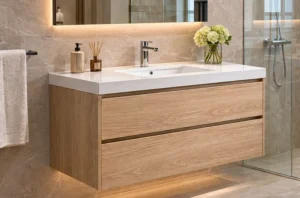
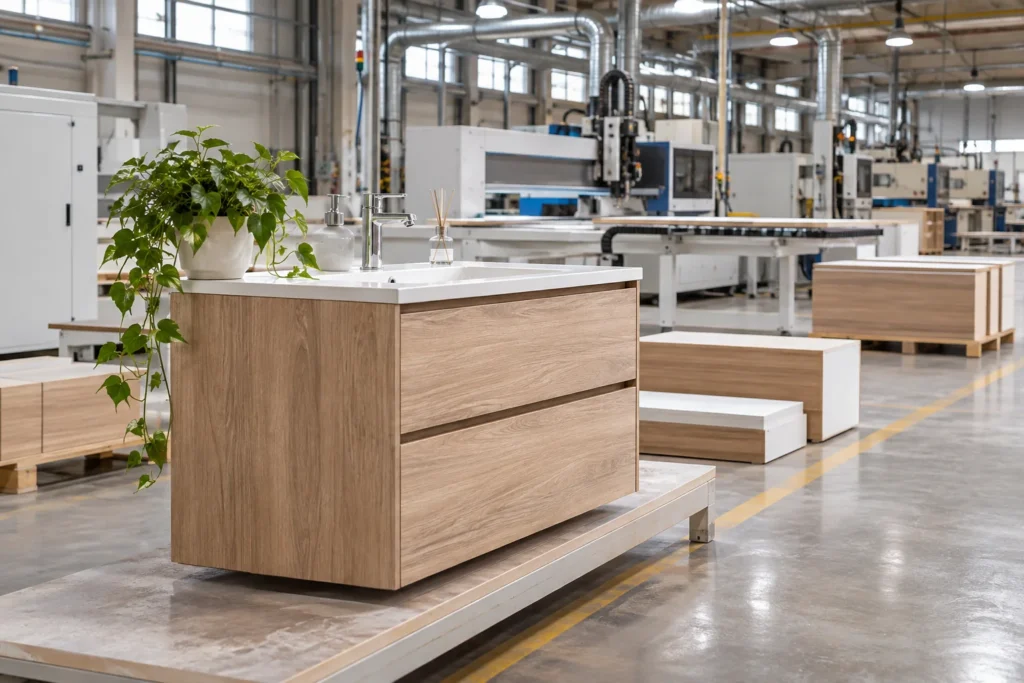
Understanding how bathroom cabinets are made is important for furniture importers, wholesale distributors, private-label brands, and hotel or apartment project buyers. Manufacturing quality directly affects product durability, installation efficiency, shipping costs, and customer satisfaction.
For international buyers, the bathroom cabinet manufacturing process involves much more than cutting wood panels and assembling drawers. It requires suitable materials, accurate machining, moisture-conscious construction, reliable hardware, controlled production, and export-ready packaging.
This guide explains the complete vanity manufacturing process from a B2B factory perspective, including practical sourcing decisions that can help buyers develop consistent, cost-effective bathroom cabinet programs.
Table of Contents
- What Is the Bathroom Cabinet Manufacturing Process?
- Step 1: Design Review and Technical Planning
- Step 2: Selecting Bathroom Cabinet Materials
- Step 3: Precision Panel Cutting and CNC Machining
- Step 4: Edge Banding and Surface Finishing
- Step 5: Cabinet Assembly and Hardware Installation
- Step 6: Quality Control and Product Inspection
- Step 7: Export Packaging and Shipping Preparation
- Step 8: Final Production Review and Shipment
- Bathroom Cabinet Types for Wholesale and Projects
- OEM and ODM Bathroom Cabinet Customization
- MOQ, Lead Times, and Pricing Considerations
- How to Choose a Bathroom Cabinet Manufacturer
- Frequently Asked Questions
- Request an OEM Bathroom Cabinet Quotation
What Is the Bathroom Cabinet Manufacturing Process?
Bathroom cabinet manufacturing is the controlled process of converting engineered wood panels, decorative surfaces, hardware, and accessories into finished bathroom storage cabinets and vanity units.
For panel furniture manufacturers, the process generally includes technical drawing preparation, material selection, CNC panel cutting, edge sealing, machining, assembly, inspection, and packaging.
The exact workflow depends on the cabinet design, material specifications, order quantity, required finish, and export destination.
Why Manufacturing Details Matter to B2B Buyers
Bathroom cabinets operate in environments where humidity, cleaning chemicals, occasional splashes, and daily opening and closing are common.
Poor manufacturing decisions can create commercial problems such as swollen panel edges, damaged finishes, misaligned drawers, inconsistent dimensions, or excessive shipping damage.
For a hotel developer ordering hundreds of identical vanity units, even a small production inconsistency can delay installation across multiple rooms.
For a wholesale distributor, inconsistent quality may lead to warranty costs, customer complaints, and reduced reorder confidence.
A professional sourcing program therefore evaluates the manufacturing process rather than focusing exclusively on the unit price.
At Starwood Industry Co., Ltd., our panel furniture manufacturing services are organized around OEM and ODM development, production coordination, quality control, and export-oriented supply for international buyers.
Step 1: Design Review and Technical Planning
The first stage of bathroom cabinet manufacturing begins before a panel reaches the cutting machine.
A buyer typically provides reference photographs, technical drawings, desired dimensions, materials, finish preferences, and expected order quantity.
The manufacturing team reviews whether the design can be produced consistently and economically.
Confirming Cabinet Dimensions and Installation Requirements
Common bathroom cabinet configurations include floor-standing vanities, wall-mounted units, compact storage cabinets, drawer-based vanities, and cabinets with open shelving.
Technical planning should establish the cabinet width, height, depth, sink position, plumbing clearance, mounting method, and door or drawer arrangement.
For a wall-mounted vanity, the wall fixing system and intended load must be considered during design development. Installation suitability also depends on the site structure and the specified anchoring system.
For an apartment development, the designer may require a common cabinet structure with several widths to suit different bathroom layouts.
Standardizing components across those variations can simplify manufacturing and future spare-part support.
Preparing Production Drawings and a Bill of Materials
Once the design is reviewed, the next task is to prepare or confirm production documents.
These normally include:
- Component dimensions and drilling details
- Panel thickness and surface finish
- Edge-banding specifications
- Hardware models and quantities
- Assembly and installation instructions
- Packaging configuration
- Approved product samples or reference standards
A bill of materials, commonly called a BOM, helps connect each component to the correct production requirement.
It is especially important for private-label furniture programs where consistent repeat orders are expected.
Buyer tip: Before approving production, confirm whether the quoted product includes the basin, countertop, faucet, handles, mounting accessories, and other components. Cabinet-only quotations and complete vanity-set quotations are not directly comparable.
Step 2: Selecting Bathroom Cabinet Materials
Material selection is one of the most important parts of understanding how bathroom cabinets are made.
Bathroom environments require careful consideration of moisture exposure, board stability, surface durability, cleaning resistance, and project budget.
No conventional wood-based cabinet should automatically be treated as waterproof. Moisture resistance depends on the complete construction and its intended conditions of use.
Moisture-Resistant MDF
Moisture-resistant MDF can be considered for certain bathroom cabinetry designs, particularly where smooth decorative or painted surfaces are required.
Its uniform structure supports machining and decorative finishes.
However, moisture-resistant MDF is not the same as waterproof material.
Exposed edges, unsealed holes, and prolonged water contact may still cause damage.
Buyers should define the board grade, coating system, and sealing requirements rather than relying only on the words “moisture resistant.”
Plywood for Bathroom Vanity Construction
Plywood is another material option for bathroom cabinets.
Depending on its construction and grade, plywood can provide useful mechanical properties for cabinet bodies, drawers, and supporting components.
The veneer structure, adhesive system, surface grade, and edge protection should be chosen according to the project requirements.
Plywood specifications may also affect cost and the appearance of exposed edges.
For a premium vanity program, a buyer might select a plywood structure with decorative laminate or another suitable finished surface.
Particleboard and Cost-Effective Panel Cabinets
Particleboard is widely used in engineered panel furniture.
It can offer an economical solution for projects where cost control, decorative surface consistency, and efficient flat-pack manufacturing are priorities.
For bathroom use, particular attention should be given to the specified board grade, surface protection, edge sealing, and exposure conditions.
A low-cost board should not be selected without considering the expected product life and maintenance environment.
Comparing Common Bathroom Cabinet Materials
| Material | Main advantage | Key purchasing consideration |
|---|---|---|
| Moisture-resistant MDF | Smooth surface and machining flexibility | Edge sealing and finish quality |
| Plywood | Structural versatility | Grade, bonding, and cost |
| Particleboard | Cost-efficient panel production | Moisture exposure and edge protection |
| PVC board | Water-resistant material characteristics | Rigidity, fixing performance, and finish options |
| Solid wood | Natural appearance | Movement, finishing, and maintenance |
The best option is not always the most expensive material. It is the material system that meets the performance requirements of the intended application at an acceptable total cost.
Formaldehyde Emissions and Material Documentation
For cabinets entering the United States, buyers should review applicable composite wood product requirements.
The U.S. Environmental Protection Agency explains the TSCA Title VI formaldehyde emission standards, which cover regulated composite wood products and certain finished goods containing them.
Importers should request appropriate supplier documentation, product labeling information, and supporting records according to the applicable requirements.
Environmental claims also require verification.
For buyers requesting FSC-certified material, the Forest Stewardship Council explains chain-of-custody certification, including how certified materials are identified and tracked through the supply chain.
Buyers should verify certificate validity and whether the specific products are covered. A supplier’s general statement about sustainable sourcing does not by itself establish an FSC-certified product claim.
Step 3: Precision Panel Cutting and CNC Machining
After the drawings and material specifications are approved, the factory begins preparing the cabinet components.
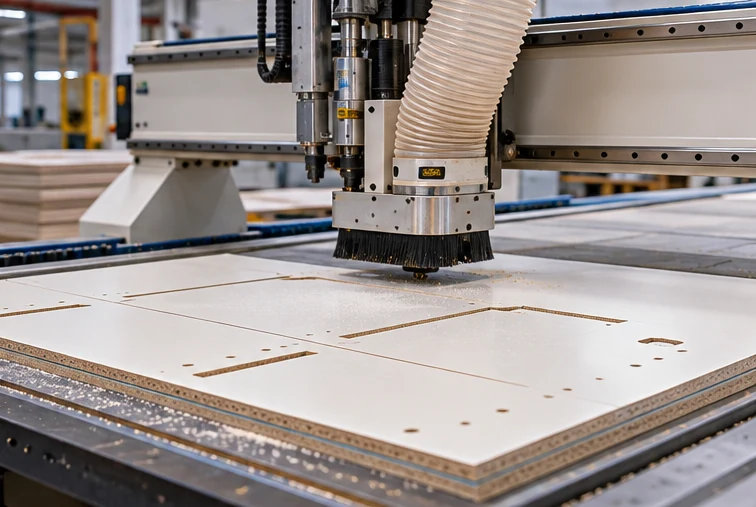
Panel cutting converts large sheets into the required sides, shelves, backs, fronts, and other structural pieces.
Optimizing Panel Cutting for Production Efficiency
A panel cutting plan helps determine how parts are arranged on each sheet.
Efficient nesting can reduce material waste and improve production consistency.
Manufacturers also need to consider grain direction, decorative pattern alignment, part identification, and machining allowances.
For large hotel and apartment orders, these details become particularly important because the same components may be reproduced across many units.
Cutting accuracy affects the next production stages. Incorrect dimensions can create assembly gaps, uneven fronts, or hardware installation problems.
CNC Drilling, Routing, and Component Identification
CNC equipment can perform operations such as drilling, routing, and shaping specified cabinet components.
Depending on the design and production setup, these operations may include hinge holes, drawer-slide fixing positions, connector holes, and rear-panel grooves.
Consistent machining improves the repeatability of knock-down or ready-to-assemble furniture.
For a wholesale bathroom vanity manufacturer, repeatability matters because cabinets need to fit together correctly without extensive site adjustments.
Part identification is equally important.
Proper labels or codes help operators match machined panels with the correct cabinet model, finish, and order.
This reduces the risk of mixing components during assembly or packaging.
Buyer tip: Ask whether the manufacturer can review installation clearances and provide assembly drawings before confirming a multi-model order.
Step 4: Edge Banding and Surface Finishing
Edge treatment is critical in panel bathroom cabinet manufacturing.
Even when a board has a decorative laminated surface, its exposed edges need suitable protection.
How Edge Banding Protects Cabinet Components
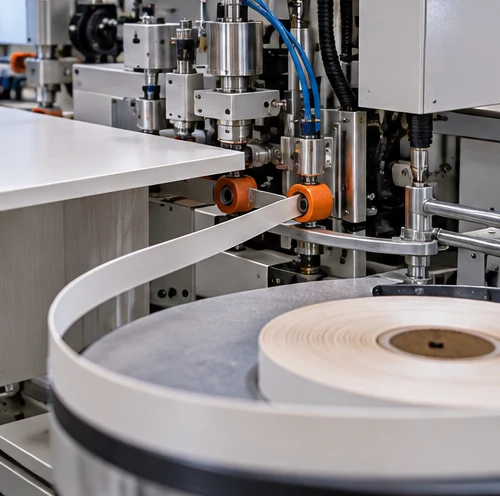
Edge banding covers exposed panel edges using a specified strip material and bonding process.
It helps create a finished appearance and reduces direct exposure of the board core.
Common options include PVC, ABS, and other compatible edge materials.
The appropriate specification depends on the desired appearance, substrate, edge thickness, adhesive system, and expected exposure.
Operators should check adhesion, joint quality, trimming accuracy, and visible glue residue.
Special attention is often needed around sink-adjacent surfaces, lower cabinet areas, and other locations where splashing or cleaning water may occur.
Edge banding reduces exposure but does not make a cabinet completely waterproof.
Decorative Surface Options
Bathroom cabinets may use melamine-faced panels, decorative laminates, painted surfaces, or other suitable finish systems.
For OEM projects, finish selection affects both commercial positioning and manufacturing complexity.
Wood-grain melamine, for example, may support a consistent decorative look at a competitive cost.
Painted finishes can offer a different visual result but may require additional preparation and finishing controls.
The buyer should approve actual finish samples before mass production.
Photographs alone may not accurately represent color, texture, or gloss.
Finish Quality and Bathroom Conditions
Good surface quality should be evaluated for more than appearance.
Relevant considerations include cleaning resistance, scratch resistance, adhesion, and suitability for normal bathroom humidity.
Buyers should specify any required tests and acceptance criteria in the purchase documents.
The Kitchen Cabinet Manufacturers Association discusses cabinet durability and performance testing, including structural, operational, and finish-related performance.
Its materials provide useful context for buyers evaluating cabinet durability. They do not mean that every bathroom cabinet, or any particular supplier, is automatically certified under the referenced program.
Step 5: Cabinet Assembly and Hardware Installation
Following machining and finishing, cabinet components are prepared for trial assembly or final assembly, depending on the production method.
A manufacturer may supply fully assembled cabinets, semi-assembled cabinets, or flat-pack components.
The appropriate format depends on the buyer’s distribution model, shipping requirements, and installation plan.
Constructing the Cabinet Carcass
The cabinet carcass is the main supporting structure of a bathroom vanity.
Typical components include side panels, a bottom panel, structural rails, shelves, and back-panel elements.
The connection system must match the cabinet design and expected loads.
Manufacturers may use cam-lock fittings, dowels, screws, brackets, or other specified connectors.
For flat-pack products, the connection method should also support practical assembly at the destination.
A cabinet that appears economical at the factory can become expensive if the installation process requires excessive labor or rework.
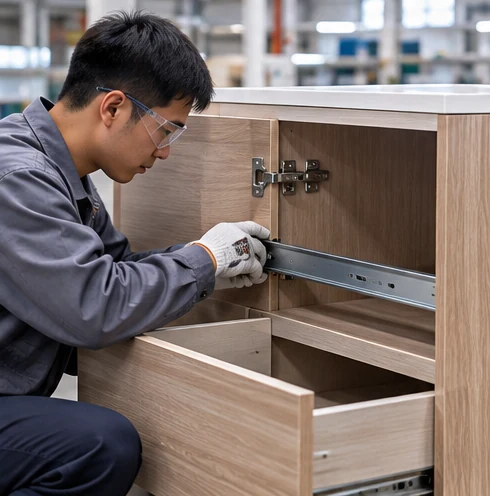
Installing Hinges and Drawer Slides
Bathroom cabinets commonly feature concealed hinges, soft-close mechanisms, or drawer slides.
The choice of hardware affects daily use, customer perception, and warranty risk.
Hardware specifications should include suitable loading capacity, corrosion protection where needed, operational performance, and approved product references.
For hotel projects, hardware should be chosen with the expected usage frequency and maintenance strategy in mind.
For retail programs, a consistent hardware platform can simplify replacement parts and after-sales service.
Sink and Plumbing Integration
A bathroom vanity often requires coordination with a sink, countertop, or plumbing layout.
Cutouts, internal clearance, drawer depth, and back-panel arrangements should be checked against the actual fixture specifications.
This is especially important for drawer-based vanities where drainage pipes may interfere with the storage mechanism.
Buyers should verify whether plumbing accessories and sink components are included in the manufacturer’s scope.
When third-party basins or countertops are supplied separately, compatible dimensions and installation tolerances should be established before production.
Step 6: Quality Control and Product Inspection
Bathroom cabinet manufacturing quality should be checked during production, not only after the last cabinet has been packed.
A structured inspection approach helps identify problems early and reduce the cost of corrective work.
Incoming Material Inspection
Before production, a manufacturer should check whether incoming materials match the approved order specifications.
Relevant checks may include board thickness, visible surface condition, finish identification, edge-banding materials, and hardware quantities.
For regulated materials, buyers should also confirm that the necessary compliance documentation is available.
In-Process Quality Checks
During machining and assembly, typical inspection points include:
- Component dimensions
- Drilling and routing positions
- Edge-banding adhesion and appearance
- Surface scratches and finish defects
- Door alignment and drawer operation
- Hardware installation
- Assembly stability and correct parts
Inspections should use an agreed acceptance standard rather than subjective descriptions such as “good quality.”
Final Product Inspection
Before shipment, selected cabinets or production samples can be assembled and reviewed.
A final inspection may cover overall appearance, dimensions, operating components, completeness, and packaging accuracy.
For project buyers, inspection documentation can also assist with handover and installation planning.
Where an independent pre-shipment inspection is required, the sampling approach and acceptance criteria should be agreed upon in advance.
Buyer tip: Ask the supplier for an approved sample reference, a product inspection checklist, and photographs of the packaging configuration before releasing the balance payment.
Step 7: Export Packaging and Shipping Preparation
Packaging is a major part of the overall manufacturing cost for export furniture.
Bathroom cabinets contain finished panels, corners, hardware, and sometimes fragile additional components.
Packaging must therefore protect the product throughout normal handling and transport.
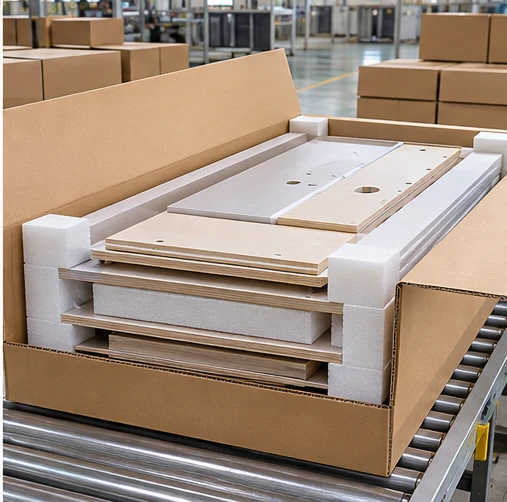
Flat-Pack Bathroom Cabinet Packaging
Flat-pack packaging can reduce shipping volume when the product design is suitable for knock-down assembly.
For container-based furniture programs, this may improve loading efficiency and reduce the amount of empty space transported.
However, flat-pack packaging requires accurate component identification, complete hardware sets, and clear assembly instructions.
A typical export package may contain protective sheets or foam, corner protection, hardware bags, instructions, and labeled panels.
The exact configuration should be validated for the cabinet design and shipping channel.
Assembled Bathroom Vanity Packaging
Fully assembled vanity cabinets generally require more shipping space, but they may reduce installation labor after delivery.
They can be appropriate for project situations where installation speed is more important than maximum container utilization.
Because assembled cabinets are larger and may have vulnerable corners or projections, protective packaging needs particular attention.
Buyers should compare total landed and installed costs rather than freight costs alone.
Packaging Tests and Shipment Risk
Transportation risks include drops, vibration, compression, and repeated handling.
The International Safe Transit Association provides packaging test procedures for different distribution systems.
For example, suitable procedures depend on whether the product travels through parcel networks, less-than-truckload operations, or palletized distribution.
A specific ISTA procedure should not be claimed without appropriate testing and documentation.
For international bathroom cabinet orders, packaging drawings and trial packing reviews are useful tools for reducing damage risk.
Step 8: Final Production Review and Shipment
The last stage of the bathroom cabinet production process is shipment preparation.
At this point, the manufacturer should review whether the completed order matches the agreed specifications, quantities, finishes, and packaging requirements.
Checking Quantities and Carton Markings
The production team should reconcile packed quantities against the approved purchase order.
Carton markings may identify product models, colors, component sets, destination details, and handling requirements.
For projects involving multiple room types, identifying the correct cabinet model is essential.
Poor carton identification can delay installation even when the physical cabinets are manufactured correctly.
Container Loading and Documentation
Before loading, the supplier should review carton dimensions, shipment quantities, loading arrangements, and any agreed protective measures.
Depending on the transaction, export documentation may include a commercial invoice, packing list, shipping documents, and other records required by the destination market.
The buyer and supplier should also agree on Incoterms, responsibility for customs procedures, and the required inspection or shipping milestones.
For repeat orders, recording confirmed product and packaging specifications supports future production consistency.
Bathroom Cabinet Types for Wholesale and Commercial Projects
Different end users need different vanity structures, and this affects the manufacturing specification.
Wall-Mounted Bathroom Vanities
Wall-mounted bathroom vanities are popular in contemporary bathrooms because they provide a floating appearance and leave floor space visible.
For B2B procurement, the mounting arrangement and structural requirements need careful review.
Wall type, fixing hardware, basin weight, and expected use conditions all influence the installation design.
These products may suit modern apartments, serviced residences, and hotel bathrooms where a coordinated appearance is important.
Floor-Standing Bathroom Cabinets
Floor-standing designs can offer practical storage layouts and a familiar installation format.
They may include drawers, hinged doors, adjustable shelves, and integrated utility spaces.
For bulk residential developments, simpler and standardized structures can reduce variation and improve replacement-part consistency.
Compact Bathroom Storage Cabinets
Compact designs are useful where bathroom floor area is limited.
Manufacturers may need to accommodate shallow depths, small sinks, or restricted plumbing spaces.
Early technical review helps prevent conflicts between storage compartments and installation requirements.
Hotel and Apartment Bathroom Cabinets
For commercial projects, visual consistency and long-term maintenance often matter more than individual decorative features.
Buyers should consider durable finishes, accessible hardware, spare parts, installation instructions, and the ability to repeat the same specification across multiple phases.
Explore our project furniture manufacturing solutions for hotels, apartments, and commercial developments to understand how bathroom cabinets can be coordinated with wider furniture procurement requirements.
OEM and ODM Bathroom Cabinet Customization
OEM and ODM manufacturing gives importers, brands, and project developers greater control over cabinet specifications.
However, successful customization requires clear technical communication and a realistic sampling process.
OEM Bathroom Cabinet Manufacturing
Under an OEM arrangement, the buyer usually provides the design or defined product specifications.
The factory reviews production feasibility, materials, machining requirements, packaging, and cost.
This arrangement is useful for established furniture brands or importers who already have technical drawings and product standards.
ODM Bathroom Vanity Development
ODM development may involve further factory participation in structural design, material alternatives, component optimization, or production-ready documentation.
This can be useful when a buyer has a product concept but needs manufacturing input.
Design ownership, tooling responsibility, sample approvals, and confidentiality should be agreed before development begins.
Customization Options for B2B Orders
Bathroom cabinet customization may include cabinet width and depth, decorative finishes, drawer layouts, handles, hinges, slides, shelves, installation systems, and packaging formats.
Not every design option is practical at every order quantity.
A manufacturing review should identify which customizations require new components, different tooling, additional tests, or separate production runs.
At Starwood, our OEM and ODM furniture manufacturing services cover the workflow from buyer requirements and technical review to sampling, production, inspection, and export preparation.
For importers developing private-label vanity collections, this manufacturing approach can help create a repeatable product program instead of managing each order as an unrelated project.
MOQ, Lead Times, and Bathroom Cabinet Pricing
Price and delivery are often the first questions asked when buyers contact a bathroom cabinet factory.
However, meaningful quotations depend on the product specification and the commercial scope.
What Is the MOQ for OEM Bathroom Cabinets?
Minimum order quantity depends on material procurement, model complexity, finish requirements, hardware selections, and production planning.
Starwood’s published general furniture sourcing policy identifies one container as its MOQ.
The feasibility of particular bathroom cabinet models, color combinations, and mixed-SKU orders should be confirmed during quotation.
For wholesale buyers, consolidating compatible products may help improve container utilization, subject to factory approval.
How Long Does Bathroom Cabinet Manufacturing Take?
Lead times should be separated into development and production stages.
These can include technical confirmation, material sourcing, sampling, sample revision, bulk manufacturing, inspection, packing, and shipment arrangements.
A standard repeat order may require less development work than a new private-label vanity collection.
Actual schedules depend on order volume, material availability, production capacity, customization, and sample approval.
Buyers should request a written production schedule rather than assuming that an indicative lead time is guaranteed.
What Affects Bathroom Cabinet Manufacturing Cost?
Important cost factors include panel material, thickness, finishes, edge-banding specifications, cabinet construction, hardware, packaging, and order quantity.
A low initial quotation may exclude items that are important to the final selling product.
For example, upgraded drawer slides, specialized decorative surfaces, or separate packing requirements can change the cost structure.
Export buyers should compare quotations using equivalent specifications and the same agreed Incoterms.
The lowest factory unit price is not necessarily the lowest landed or installed cost.
How to Choose a Bathroom Cabinet Manufacturer in China
Choosing a reliable bathroom cabinet manufacturing partner requires more than comparing product photographs.
A serious supplier evaluation should address the manufacturer’s production capabilities, technical communication, quality systems, export experience, and willingness to document agreed requirements.
Review Real Manufacturing Capabilities
Ask whether the supplier operates the relevant machining and assembly processes or uses subcontractors for particular stages.
Outsourcing is not automatically a problem, but responsibility for quality and delivery should be clear.
Factory photographs, process videos, sample records, and production documentation can help buyers assess the supplier’s capabilities.
Evaluate Sampling and Quality Control
A capable OEM manufacturer should be able to explain the process for approving samples, controlling production changes, and handling nonconforming components.
Buyers should also consider how the supplier records material specifications and supports repeat orders.
Check Market-Specific Documentation
Product requirements vary by destination market.
For European markets, buyers should review relevant regulations and product scope carefully.
The European Commission’s EU Deforestation Regulation guidance is a useful starting point for understanding timber-related due diligence requirements and implementation dates.
Applicability depends on the actual product classification, commercial role, and current rules; suppliers should not assume every furniture product is covered in the same way.
Compare Factory Support Beyond the Unit Price
A useful manufacturing partner can support technical review, design-for-manufacture recommendations, packing optimization, inspection coordination, and shipping preparation.
For long-term sourcing, communication quality and repeatability are just as important as price.
Starwood is a China-based panel furniture export manufacturer serving brands, wholesalers, importers, and commercial project buyers.
You can learn more about our manufacturing background and operations on our factory and company profile.
Frequently Asked Questions About Bathroom Cabinet Manufacturing
How are bathroom cabinets made in a factory?
Bathroom cabinets are typically manufactured through technical design review, material selection, panel cutting, CNC machining, edge banding, assembly, hardware fitting, quality inspection, and packaging. The exact workflow depends on product construction and whether the cabinet is supplied assembled or flat-packed.
What materials are commonly used for bathroom cabinets?
Common options include moisture-resistant MDF, plywood, particleboard, PVC-based boards, and solid wood. Material selection should reflect humidity exposure, mechanical requirements, surface finish, budget, and destination-market requirements.
Are MDF bathroom cabinets waterproof?
No. Moisture-resistant MDF and waterproof materials are not interchangeable. Even suitable bathroom cabinet panels require appropriate surface finishes, protected edges, and correct installation and maintenance.
Can bathroom cabinets be customized for hotels and apartments?
Yes. OEM and ODM programs can support custom dimensions, finishes, storage layouts, hardware, and packaging configurations, depending on manufacturing feasibility and the approved order specifications.
What is the MOQ for wholesale bathroom cabinets?
MOQ varies by manufacturer and product. Starwood publishes a general MOQ of one container for its furniture programs. Buyers should confirm specific bathroom cabinet requirements, mixed-model possibilities, and finish quantities with the sales team.
Can bathroom cabinets be shipped flat-packed?
Yes, when the product is engineered for knock-down construction. Flat-pack packaging can reduce shipping volume, but the hardware system, panel identification, instructions, and protective packaging must be suitable for the intended distribution channel.
How can importers check bathroom cabinet quality?
Buyers can request approved samples, material specifications, dimension checks, hardware testing requirements, inspection records, and packaging photographs. Independent inspections can also be arranged according to agreed acceptance criteria.
How do I request a bathroom vanity manufacturing quotation?
Prepare product drawings or references, dimensions, board and finish requirements, hardware preferences, target quantity, packaging expectations, and destination market. The manufacturer can then review feasibility and prepare a more accurate quotation.
Request an OEM Bathroom Cabinet Manufacturing Quotation
Understanding how bathroom cabinets are made helps importers, furniture brands, wholesalers, and commercial project buyers make better sourcing decisions.
From material specification and CNC machining to moisture-conscious edge treatment, hardware selection, inspection, and export packaging, every production stage influences the final product.
For successful sourcing, the goal is not simply to find a low-cost bathroom cabinet. It is to develop a product that can be manufactured consistently, transported safely, installed efficiently, and reordered with confidence.
Looking for an OEM bathroom vanity manufacturer in China?
Starwood Industry Co., Ltd. supports international buyers with panel furniture manufacturing, OEM/ODM development, factory production coordination, quality control, and export packaging.
Whether you are developing a private-label vanity collection or sourcing bathroom cabinets for an apartment or hotel project, our team can review your specifications and discuss suitable manufacturing options.
Send us your drawings, target dimensions, preferred materials, order quantity, and destination market.
Contact Starwood for a bathroom cabinet manufacturing quotation.
Email: info@plywoodmfr.com
WhatsApp: +86 136 9199 4727
Work with an OEM bathroom vanity manufacturing partner focused on consistent panel furniture production and international B2B supply.