Finding a reliable custom hotel bedroom furniture supplier is a critical purchasing decision for hotel developers, FF&E procurement managers, furniture importers and commercial fit-out contractors. The right manufacturer must do more than offer competitive prices. It must translate approved designs into consistent production, coordinate multiple furniture items, control material specifications and prepare goods for international delivery.
At Starwood Industry Co., Ltd., we specialize in OEM and ODM panel furniture manufacturing for international B2B buyers. Our factory supports custom wardrobes, bed frames, nightstands, writing desks, TV cabinets, storage furniture and flat-pack furniture for hotels, serviced apartments and commercial accommodation projects.
This sourcing guide explains how to evaluate manufacturing capabilities, structure a supplier quotation, compare materials, manage minimum order quantities and organize bulk hotel bedroom furniture purchasing.
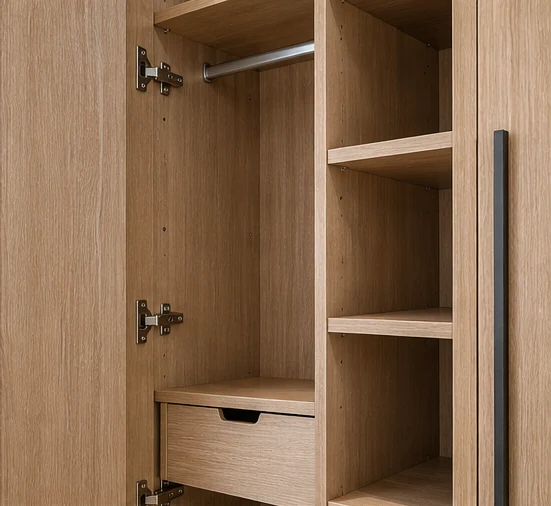
Table of Contents
- What B2B Buyers Should Expect From a Custom Supplier
- Hotel Bedroom Furniture Products for Commercial Projects
- Choosing the Right Panel Materials and Finishes
- OEM and ODM Hotel Bedroom Furniture Manufacturing
- MOQ, Bulk Pricing and Total Project Costs
- Production Lead Times and Project Scheduling
- Flat-Pack Packaging and International Logistics
- Factory Quality Control and Compliance
- Hotel and Apartment Furniture Applications
- How to Evaluate a Furniture Factory
- How to Prepare a Professional Furniture RFQ
- Why Work With Starwood
- Frequently Asked Questions
- Request a Custom Hotel Furniture Quotation
What B2B Buyers Should Expect From a Custom Hotel Bedroom Furniture Supplier
A professional supplier should be able to manufacture furniture according to the actual requirements of a hotel project, rather than simply offer products from a fixed catalog.
For a purchasing manager, successful sourcing means obtaining furniture that meets the approved design, target budget, installation requirements and project delivery schedule.
Manufacturing Capability Matters More Than Catalog Size
A factory may display hundreds of furniture designs online, but a large catalog does not automatically demonstrate its ability to handle custom project orders.
For hotel bedroom furniture procurement, buyers should evaluate whether the manufacturer can support:
- Custom product dimensions and room-specific layouts.
- Consistent materials and surface finishes across different products.
- Coordinated wardrobes, beds, bedside cabinets and desks.
- OEM production from technical drawings.
- ODM development from reference designs and functional requirements.
- Sample production and technical modifications.
- Bulk manufacturing with repeatable product quality.
- Export packaging and container loading preparation.
- Replacement components and repeat orders.
The most important question is not simply, “Can you manufacture this wardrobe?”
A better question is, “Can you produce the same approved wardrobe specification across multiple hotel rooms and shipment batches?”
That distinction separates a project-focused manufacturer from a furniture trading catalog.
One Coordinated Furniture Package Reduces Procurement Complexity
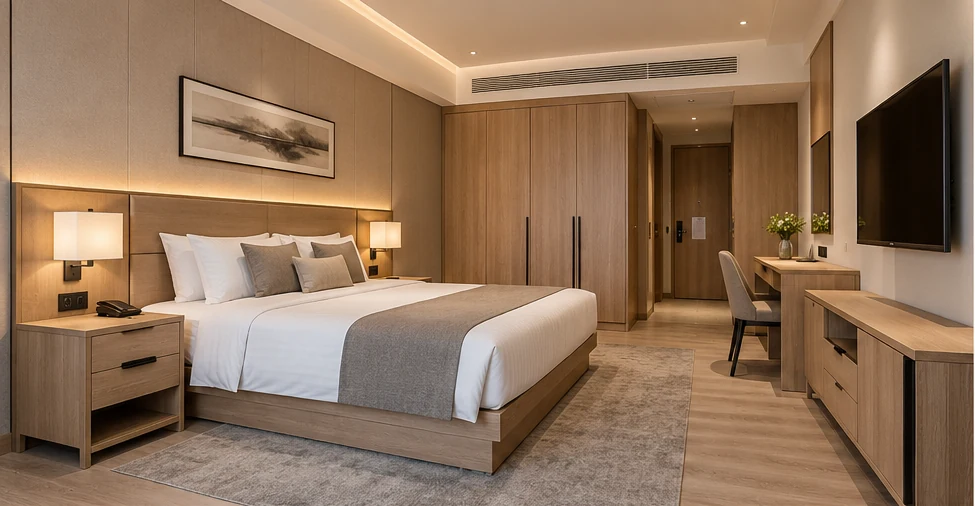
Hotel guest rooms usually require several furniture items that must function as one coordinated package.
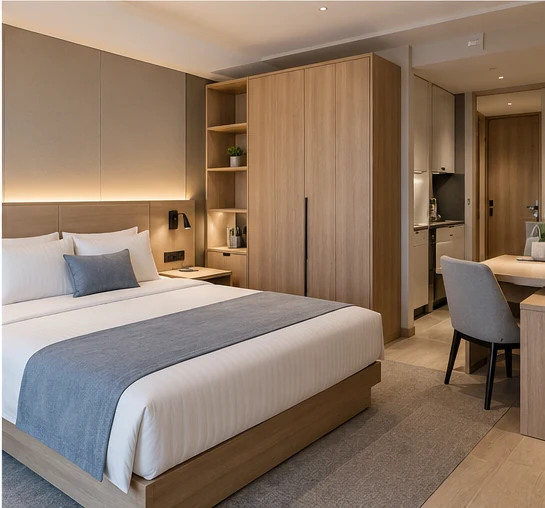
For example, a hotel bedroom order may include a bed frame, decorative headboard, two bedside tables, wardrobe, luggage storage unit, writing desk and TV cabinet.
If these products are purchased from unrelated suppliers, buyers may face differences in wood-grain colors, edge finishes, hardware quality and delivery schedules.
Working with one suitable manufacturing partner for the panel furniture package can simplify technical coordination and reduce the number of supplier interfaces.
Our project furniture manufacturing services are designed around this type of coordinated B2B purchasing requirement.
Hotel Bedroom Furniture Products for Commercial Projects
The furniture specification should reflect the hotel positioning, guest room dimensions, storage requirements and expected maintenance conditions.
Custom Hotel Beds and Headboard Systems
Beds and headboards establish the visual character of a hotel room.
For panel furniture projects, common manufacturing options include platform bed frames, engineered-wood bed bases, storage beds and decorative headboard panels.
A well-designed structure should consider mattress dimensions, support requirements, floor clearance, assembly access and transportation.
Headboard design also requires coordination with electrical outlets, lighting positions, switches and wall conditions.
Buyers should specify whether electrical components or upholstered elements are included in the furniture supplier’s scope or supplied by separate contractors.
Hotel Wardrobes and Storage Cabinets
Custom wardrobes are particularly important in hotel and serviced apartment projects because different room categories may require different storage arrangements.
Common options include full-height wardrobes, compact wardrobes, open hanging systems and combined shelving units.
Customization may cover hanging rails, drawer quantities, luggage compartments, internal shelves, mirrors, door configurations and lockable storage areas.
Before production, the factory should review wardrobe depth, door opening clearance, wall alignment and access for installation.
Bedside Tables, Writing Desks and TV Cabinets
Bedside cabinets and writing desks receive frequent daily use.
Buyers should consider scratch-resistant surfaces, suitable edge protection, reliable drawer slides and practical cable management.
TV cabinets and minibar enclosures may also require ventilation openings, removable access panels and coordination with electrical or appliance suppliers.
A supplier experienced in panel furniture can review these functional details before preparing mass-production drawings.
Furniture Schedule for a Typical Hotel Room
| Furniture item | Typical customization | Main purchasing consideration |
|---|---|---|
| Bed frame | Size, structure, finish | Stability and installation |
| Headboard panel | Width, finish, cable openings | Wall and electrical coordination |
| Nightstand | Drawers, height, hardware | Durability and accessibility |
| Wardrobe | Internal layout, doors, shelves | Storage and door clearance |
| Writing desk | Dimensions, surface, cable access | Wear resistance |
| TV cabinet | Storage, ventilation, finish | Equipment coordination |
| Luggage unit | Dimensions, edge protection | High-contact durability |
| Minibar cabinet | Cabinet layout, ventilation | Appliance compatibility |
A complete furniture schedule helps suppliers calculate material consumption, hardware requirements, packaging quantities and production costs more accurately.
Choosing the Right Materials for Custom Hotel Bedroom Furniture
Material selection is one of the most important factors affecting furniture performance, appearance and manufacturing cost.
There is no single board material that is ideal for every component.
A professional custom hotel bedroom furniture supplier should help buyers select materials according to the application, expected service conditions and target market.
Plywood for Structural and Selected Cabinet Applications
Plywood is produced from bonded layers of wood veneer and can be suitable for furniture components requiring appropriate structural performance and fastening characteristics.
It may be considered for selected cabinet structures, reinforced furniture components or other applications where its grade and construction match the design requirements.
However, plywood should not automatically be specified for every furniture component.
The correct grade, thickness, finish and construction must be selected according to the intended application.
MDF for Smooth Decorative Surfaces
Medium-density fiberboard, commonly called MDF, is often selected for painted surfaces and decorative furniture components.
Its relatively uniform surface is useful when buyers require smooth finishing, routed profiles or a consistent painted appearance.
MDF may be suitable for cabinet doors, decorative panels and certain furniture components.
For exposed edges or areas subject to moisture, the finishing and protection details should be reviewed carefully.
Particleboard and Melamine-Faced Panels
Particleboard and melamine-faced panels are widely used in cost-controlled furniture manufacturing.
For hotel bedrooms and rental accommodation, properly specified melamine-faced panels may provide practical surfaces for wardrobes, shelving, desks and cabinet structures.
Performance depends on board grade, thickness, surface quality, edge banding and connection design.
Hotel buyers should evaluate panel specifications rather than selecting a product based only on the lowest unit price.
Surface Finish and Edge Protection
Available finishing approaches may include melamine, laminate, veneer and painted finishes.
High-pressure laminate may be considered for demanding desk surfaces or luggage-contact areas, depending on project requirements.
Edge banding is equally important because exposed or poorly finished edges can affect durability and visual consistency.
A project specification should identify finish references, acceptable color variation, edge treatment, panel thickness and approved samples.
For US-bound furniture using covered composite wood materials, buyers should review applicable formaldehyde-emission requirements under the US Environmental Protection Agency’s TSCA Title VI program. The EPA’s regulations address covered composite wood products and relevant supply-chain participants, including furniture manufacturers and importers.
US EPA
+1
Compliance should be verified through appropriate supplier documentation rather than assumed from a board description.
OEM and ODM Hotel Bedroom Furniture Manufacturing
OEM and ODM services allow professional buyers to develop furniture according to their market requirements instead of relying on standard retail collections.
OEM Manufacturing: Production From Approved Drawings
OEM manufacturing is suitable when the buyer already has technical drawings, product specifications or an approved design.
Typical buyer information includes dimensions, material specifications, finishes, hardware details, construction requirements and target quantities.
The manufacturer’s role is to review feasibility, clarify technical details, prepare samples where required and reproduce approved specifications consistently.
For example, a hotel contractor may provide a wardrobe drawing with exact dimensions, internal shelf positions and specified door hardware.
The factory can then review the construction and prepare the product for repeatable panel processing.
ODM Manufacturing: Development From a Project Brief
ODM manufacturing is useful when the buyer has a design concept but does not yet have complete production drawings.
A developer may provide reference images, room plans, style preferences and a target budget.
The manufacturer can propose suitable structures, panel materials, dimensions and hardware configurations.
The objective is to turn a project concept into a manufacturable furniture specification that the buyer can review and approve.
From Prototype to Mass Production
An effective OEM/ODM workflow normally includes the following stages:
- Initial project inquiry and requirement review.
- Product structure and material evaluation.
- Preliminary costing and quotation.
- Technical drawing confirmation.
- Sample or prototype development where required.
- Sample inspection and design approval.
- Final specification and purchase order confirmation.
- Bulk production and quality inspection.
- Export packaging and shipment preparation.
Clear approval records are important because a small change to a wardrobe dimension, finish or hardware item may affect production costs and installation.
Learn more about our OEM and ODM furniture manufacturing services for overseas project buyers.
MOQ, Bulk Pricing and Total Project Costs
Minimum order quantity is a common concern for hotel developers, furniture wholesalers and procurement companies.
However, custom furniture MOQ should be evaluated in relation to the complete project rather than a single product.
What Determines the MOQ?
A furniture factory generally considers material purchasing, hardware requirements, production setup, finish selection and order volume.
A project containing several furniture models with shared materials and finishes may be easier to organize than an order containing many unrelated product specifications.
For example, one hotel project might require wardrobes, bedside cabinets and desks using the same approved surface finish.
Coordinated material purchasing and production planning may help reduce unnecessary variation.
At Starwood, the published factory purchasing model uses a container-based MOQ as its general reference. Project-specific minimums, mixed models and sampling arrangements should be confirmed during quotation.
Why a Lower Unit Price Is Not Always a Lower Project Cost
Professional buyers should compare the complete purchasing cost.
A supplier’s quoted furniture price may exclude elements that affect the final landed and installed cost.
These can include:
- Sample and development charges.
- Special hardware or finish requirements.
- Export cartons and protective materials.
- Freight and local handling.
- Import duties and destination charges.
- On-site installation labor.
- Replacement parts and potential damage.
- Storage costs caused by early or delayed delivery.
A flat-pack wardrobe may offer lower transportation volume than a fully assembled alternative, but the buyer must also account for assembly labor and installation complexity.
The correct purchasing comparison should therefore consider furniture cost, logistics cost, installation cost and operational risk.
How to Obtain a More Accurate Bulk Quotation
To receive comparable quotations from different manufacturers, buyers should provide the same technical information to each supplier.
Important details include project location, room quantity, furniture schedule, expected material grade, finishes, hardware, packaging requirements and requested Incoterms.
For a hotel with several room categories, quantities should be separated by room type and furniture SKU.
This allows the factory to assess production volume and material requirements instead of relying on a general room-count estimate.
Production Lead Times and Project Scheduling
Hotel furniture deliveries are often linked to fixed renovation, installation or opening schedules.
A manufacturing delay can affect several downstream activities, including room installation, inspection and final handover.
What Influences Hotel Furniture Lead Time?
Production time depends on design complexity, material availability, sample requirements, order volume and the final manufacturing specification.
Custom finishes, unusual hardware and repeated drawing revisions may extend the project schedule.
A realistic production plan should identify separate milestones for technical approval, sampling, procurement, manufacturing, inspection and loading.
Rather than relying on an unsupported universal delivery promise, buyers should request a written project schedule based on the actual order.
Approve Samples Before Releasing Bulk Production
A physical sample or approved mock-up can help identify problems that may not be visible in product drawings.
These include inconsistent finishes, unsuitable hardware, difficult assembly, incorrect dimensions and inadequate edge treatment.
For a multi-room hotel project, a mock-up room can also help verify the relationship between furniture components and the actual interior space.
The approved sample should serve as a reference for subsequent inspections.
Plan for Installation and Delivery Sequence
Factory completion and site readiness are not always aligned.
Buyers should confirm whether furniture will be shipped in one batch or divided into multiple deliveries.
Where necessary, cartons can be organized according to room type, product code or installation sequence.
This can help contractors identify components without opening unrelated packages.
Flat-Pack Hotel Bedroom Furniture and Export Packaging
Flat-pack furniture, also called knock-down or KD furniture, is especially relevant to international furniture projects.
By separating suitable furniture structures into transportable components, factories can support more efficient storage and shipment planning.
Advantages of Flat-Pack Construction
For wardrobes, cabinets, desks and selected bed structures, flat-pack construction can offer practical logistical benefits.
These may include reduced packing volume, easier movement through narrow access areas and improved handling of individual furniture components.
However, the design must still provide sufficient structural performance and a manageable assembly process.
A well-engineered knock-down connection should balance transportation efficiency with installation reliability.
Export Packaging Requirements
International furniture packaging should be selected according to the product, shipping route and handling conditions.
A practical packaging specification may include protective corner materials, edge protection, suitable outer cartons, separated hardware bags and clear identification labels.
For fragile surfaces, additional protection may be necessary.
The International Safe Transit Association’s packaging test procedures provide useful references for discussing distribution hazards. ISTA Procedure 2C, for example, addresses individual packaged furniture products, while other procedures apply to different shipping systems.
International Safe Transit Association
Buyers should specify any required testing or validation rather than assuming that standard export packaging has passed a particular protocol.
Carton Labels and Installation Documentation
Packaging design should also support warehouse handling and on-site assembly.
A typical hotel furniture carton label may contain the product code, room category, carton sequence, quantity, gross weight and handling instructions.
Hardware should be packed and identified clearly.
Assembly instructions should correspond to the approved product design.
For large projects, room-coded packaging can reduce confusion during distribution and installation.
Factory Quality Control and Compliance Requirements
Quality control is particularly important when furniture will be installed repeatedly across many guest rooms.
A single unresolved production issue may affect hundreds of components.
Incoming Material Inspection
Quality control should begin before machining.
The factory should verify relevant board specifications, surface appearance, thickness, edge materials and hardware against approved requirements.
Where project documentation requires specific emission classifications or material certifications, supporting documents should be checked before production.
In-Process Manufacturing Inspection
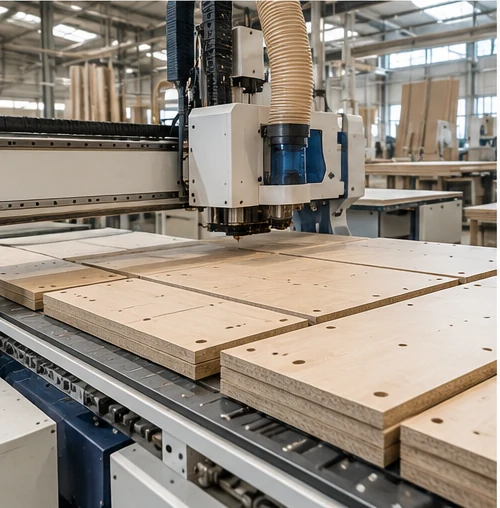
Panel furniture production involves multiple processes, such as cutting, drilling, edge banding and component preparation.
Critical inspections may include dimensional accuracy, drilling positions, edge adhesion, surface defects and hardware compatibility.
Repeatability is especially important for modular furniture structures.
A misplaced connector hole may create assembly problems even when the external appearance appears acceptable.
Final Assembly and Pre-Shipment Inspection
Before shipment, selected products should be checked against the approved drawings and sample.
Depending on the inspection plan, checks may cover appearance, dimensions, functional operation, hardware completeness, assembly and packaging.
Buyers may also request documented inspection results or independent inspection services.
Quality Standards and Responsible Material Sourcing
The ISO 9001 quality management framework provides an internationally recognized approach to managing organizational quality processes. Its current 2026 edition covers requirements for quality management systems, but the existence of a standard does not establish that a particular factory is certified.
Quality management systems — Requirements
For buyers with responsible sourcing requirements, the Forest Stewardship Council’s chain-of-custody certification guidance explains how certified material claims are traced through participating supply chains.
Forest Stewardship Council
Certificates, product claims and supporting documentation should be requested and verified for the specific order.
Buyers should also communicate applicable fire safety, accessibility and other destination-market requirements before quotation, as these may vary according to furniture type, hotel location and project specifications.
Hotel and Apartment Furniture Applications
Custom panel furniture manufacturing is relevant to several accommodation sectors.
Each application has different priorities for durability, storage capacity, appearance and cost control.
Business Hotels and Limited-Service Hotels
Business hotels often require efficient furniture layouts, consistent finishes and practical storage.
Common furniture packages include compact wardrobes, desks, bedside cabinets, bed frames and luggage units.
Simple and repeatable structures can be useful for projects with many similar rooms.
Serviced Apartments and Extended-Stay Accommodation
Serviced apartments often require more storage and multi-functional furniture than standard short-stay rooms.
Furniture buyers may prioritize larger wardrobes, desks, storage beds, shelving and additional cabinets.
For properties combining bedroom and dining functions, buyers may also explore coordinated products in our Dining Room Furniture category.
This approach can support a consistent finish across bedrooms, living areas and dining spaces while keeping the project within a coordinated panel furniture specification.
Student Housing and Rental Apartments
Student accommodation and rental properties usually prioritize durability, manageable replacement costs and efficient use of space.
Common products include wardrobes, beds, study desks, bookcases, drawer units and other storage furniture.
Modular structures can also be helpful when properties require repeat orders or individual replacement components.
Hotel Renovation and Refurbishment Projects
Renovation projects introduce additional challenges.
Existing room dimensions may vary, furniture access routes can be restricted and installation may need to take place in phases.
For these projects, the supplier should review actual measurements, packaging sizes and installation constraints before finalizing production.
How to Evaluate a Custom Hotel Bedroom Furniture Factory
Choosing a suitable manufacturer requires more than comparing quotations.
Buyers should evaluate whether the factory’s capabilities match the actual project.
Review the Factory’s Core Product Specialization
A manufacturer specializing in engineered wood panel furniture may be well suited for wardrobes, desks, storage cabinets and knock-down furniture.
However, buyers should confirm whether other furniture categories, such as upholstered seating, loose lounge furniture or specialized metalwork, are included in the quotation.
Defining the manufacturing scope early helps avoid misunderstandings.
Evaluate Technical Communication
Reliable suppliers should ask practical questions about materials, dimensions, installation conditions and required quantities.
A quotation based only on a product photograph may not contain enough information for a controlled project order.
Technical clarification is an important part of professional supplier evaluation.
Request Relevant Manufacturing Evidence
Buyers may request production photographs, machinery information, approved sample records, packaging examples and relevant project references.
Evidence should be evaluated according to the supplier’s actual production responsibilities.
Marketing images alone do not establish technical capacity.
Confirm Commercial Terms and After-Sales Arrangements
Before confirming the order, buyers should clarify payment terms, inspection requirements, shipment terms, spare-part arrangements and the procedure for handling nonconforming goods.
A clear agreement reduces the risk of disputes after the furniture has arrived at the destination.
How to Prepare a Professional Hotel Bedroom Furniture RFQ
A clear request for quotation is one of the most effective ways to improve supplier communication.
Instead of asking only for a price per bedroom set, buyers should prepare a structured RFQ covering technical, commercial and logistical requirements.
Essential RFQ Information
| RFQ field | Information to provide |
|---|---|
| Project type | Hotel, serviced apartment, rental housing |
| Destination | Country and delivery destination |
| Room quantity | Total rooms and quantities by room type |
| Furniture schedule | Product names and SKU quantities |
| Dimensions | Product drawings or required measurements |
| Materials | Plywood, MDF, particleboard or other specifications |
| Finishes | Color codes, laminate or veneer references |
| Hardware | Hinges, drawer slides, handles and connectors |
| Packaging | KD, flat-pack, semi-assembled or other |
| Compliance | Required standards and documentation |
| Schedule | Sample date, production deadline, shipment window |
| Commercial terms | Preferred currency and Incoterms |
Example: A 120-Room Hotel Furniture Inquiry
Consider a hypothetical hotel project with 120 guest rooms.
Each room may require one wardrobe, one bed frame, two bedside cabinets, one writing desk and one TV cabinet.
The initial schedule would therefore include 120 wardrobes, 120 bed frames, 240 bedside cabinets, 120 desks and 120 TV cabinets.
If the property contains several room types, the quantities should be further divided by approved furniture design.
This allows the supplier to assess shared materials and manufacturing operations while identifying any items requiring special production.
The example is illustrative rather than a claim about an existing Starwood project.
Questions Buyers Should Ask Before Placing an Order
Ask the supplier whether it can manufacture from your drawings, what material grades are available, how the MOQ is calculated and whether mixed furniture models can be included in one project.
Also confirm sample arrangements, quality inspection methods, flat-pack packaging options, production scheduling and export documentation.
Where possible, request clear written answers before approving the purchase order.
Why Work With Starwood for Custom Hotel Bedroom Furniture?
Starwood Industry Co., Ltd. is a China-based panel furniture manufacturer serving international B2B buyers.
Our manufacturing focus includes engineered wood furniture, OEM and ODM product development, flat-pack construction and export-oriented production.
We work with furniture importers, wholesalers, project procurement companies, commercial buyers and accommodation projects requiring customized panel furniture.
Specialized Panel Furniture Manufacturing
Our product capabilities include wardrobes, bed frames, bedside cabinets, writing desks, TV cabinets, storage furniture and related cabinet products.
We work with plywood, MDF, particleboard, melamine-faced panels and other suitable engineered wood materials according to project specifications.
Factory-Direct OEM and ODM Support
Buyers can provide completed drawings or preliminary ideas.
Our team can review product structure, materials, hardware and packaging to support the transition from design requirements to repeatable manufacturing.
We also support sample development, quality control and export shipment preparation.
Flexible Customization for Project Buyers
Depending on product feasibility and commercial requirements, customization may include dimensions, surface finishes, hardware, cabinet layouts, packaging and private-label details.
Our focus is on manufacturable solutions suitable for repeat orders and international distribution.
Export-Oriented Flat-Pack Furniture
Our manufacturing model includes flat-pack and knock-down furniture options for suitable products.
Packaging, assembly instructions, carton identification and shipment preparation can be considered during product development.
This allows logistics requirements to be addressed before bulk production rather than treated as an afterthought.
Frequently Asked Questions About Custom Hotel Bedroom Furniture Suppliers
Can you manufacture hotel bedroom furniture according to our drawings?
Yes. Starwood provides OEM panel furniture manufacturing support based on buyer drawings, samples and technical requirements. Product feasibility, materials, hardware, structure and packaging are reviewed before confirming the manufacturing specification.
Do you provide ODM hotel furniture development?
Yes. ODM development can begin from project concepts, reference images, room layouts and functional requirements. The proposed product specification is developed and reviewed before bulk production.
What is the MOQ for custom hotel bedroom furniture?
MOQ depends on product specifications, material requirements, the number of models and the overall order volume. Starwood’s general published ordering reference is one container. Mixed-SKU and project-specific arrangements should be discussed during quotation.
Can you supply furniture for hotels and serviced apartments?
Yes. Our project furniture range includes panel furniture suitable for hotel rooms, serviced apartments, rental housing and other commercial accommodation projects.
What materials are available for hotel bedroom furniture?
Depending on the design, available options can include plywood, MDF, particleboard, melamine-faced panels and other engineered wood products. The exact grade, thickness and finish are confirmed according to project requirements.
Do you offer flat-pack hotel furniture packaging?
Yes. Flat-pack or KD structures can be developed for suitable furniture products. Export cartons, protective materials, hardware packaging, carton labels and assembly instructions can be specified according to project requirements.
How long does custom hotel bedroom furniture production take?
Lead time depends on product complexity, material availability, sample approval, order quantity and production scheduling. A project-specific timeline should be confirmed after the technical and commercial requirements are reviewed.
Can you provide samples before bulk production?
Sample development can be arranged according to the project requirements. Buyers can review structure, appearance, finishes, hardware, assembly and packaging before approving production.
Can different hotel furniture products be shipped together?
Mixed-product container planning may be possible when quantities, product specifications, packaging dimensions and production schedules are compatible. Final loading arrangements are confirmed against the order.
What information is needed to request a factory quotation?
Please provide drawings or reference images, product dimensions, furniture quantities, preferred materials, finishes, destination market, packaging requirements and target delivery schedule. A detailed RFQ supports a more accurate quotation.
Request a Custom Hotel Bedroom Furniture Quotation
If you are sourcing a custom hotel bedroom furniture supplier for a hotel development, serviced apartment project, renovation or bulk furniture import program, Starwood can review your purchasing requirements.
Our team supports OEM and ODM panel furniture manufacturing, coordinated bedroom furniture packages, custom dimensions, material selection, sample development, flat-pack packaging and export shipment preparation.
Send us your room quantities, furniture schedule, drawings or reference images, material preferences, target market and requested delivery window.
We can review the technical requirements and discuss a suitable manufacturing and quotation approach.
Request a quote now for bulk and custom hotel bedroom furniture orders.
Contact Starwood Industry Co., Ltd.
Email: info@plywoodmfr.com
Website: www.plywoodmfr.com
OEM/ODM Services: Explore Our Furniture Manufacturing Capabilities
Project Furniture: Discuss Your Hotel or Apartment Furniture Project
Factory Location: Jiangmen, Guangdong, China