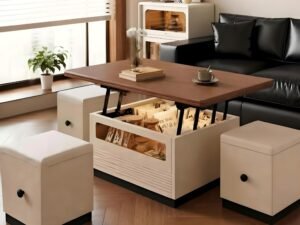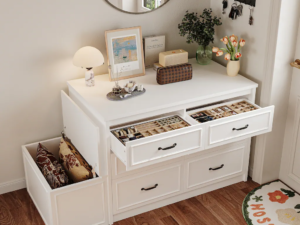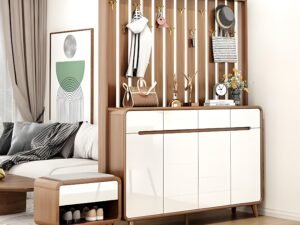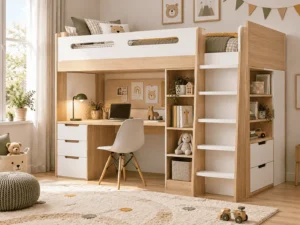
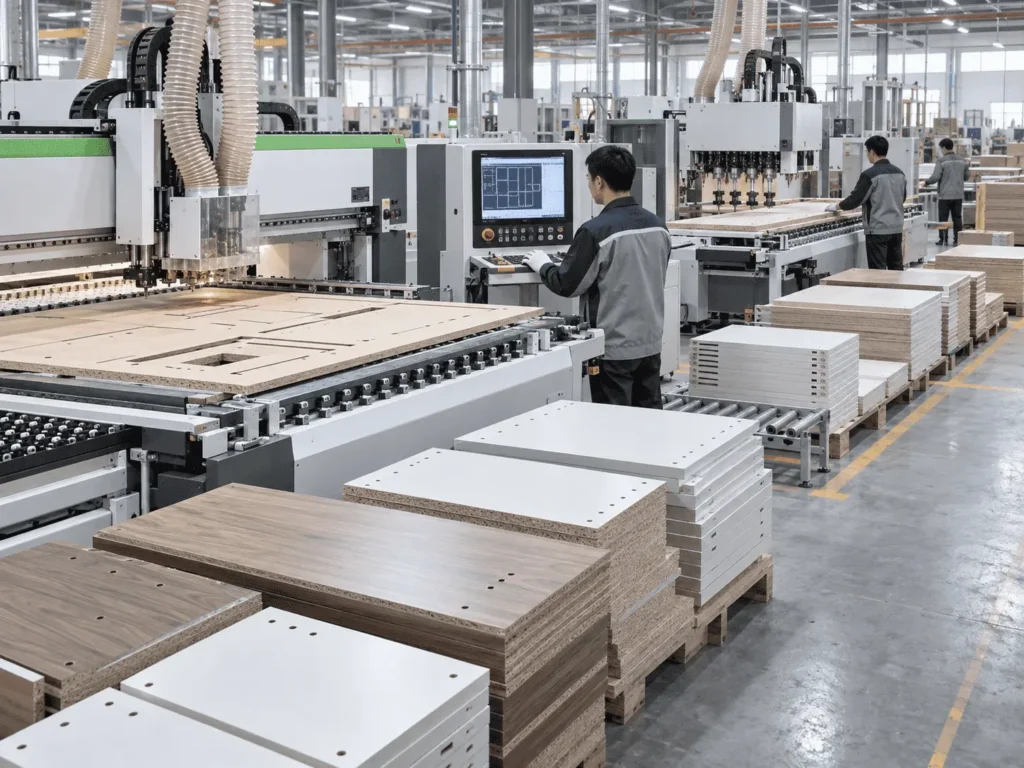
For importers, furniture brands, wholesalers, hospitality contractors, and real estate developers, choosing a panel furniture manufacturer is not simply about comparing factory prices. The supplier must be able to convert drawings, target costs, materials, finishes, hardware, quantities, packaging requirements, and destination-market rules into repeatable production.
The real purchasing question is not “Who can make this cabinet?”
It is: Which manufacturer can control the complete process from product brief and sample approval to mass production, quality inspection, export packing, and repeat orders?
This guide is written from a factory-side B2B perspective for buyers sourcing wardrobes, beds, cabinets, desks, TV stands, storage furniture, kitchen units, bathroom cabinets, hotel furniture, apartment furniture, and other flat-pack panel products.
Table of Contents
- Confirm That You Are Working With the Right Manufacturing Model
- Match Factory Capability to Your Product Program
- Check OEM and ODM Engineering Support
- Verify Panel Materials, Finishes, and Hardware
- Understand MOQ at Program Level
- Evaluate Sampling and Pre-Production Control
- Check Production and Quality-Control Systems
- Review Capacity and Lead-Time Planning
- Evaluate Flat-Pack Packaging and Logistics
- Confirm Destination-Market Compliance
- Test the Factory’s Project and Repeat-Order Capability
- Applications for Wholesale, Hotel, and Apartment Buyers
- What to Include in Your RFQ
- Frequently Asked Questions
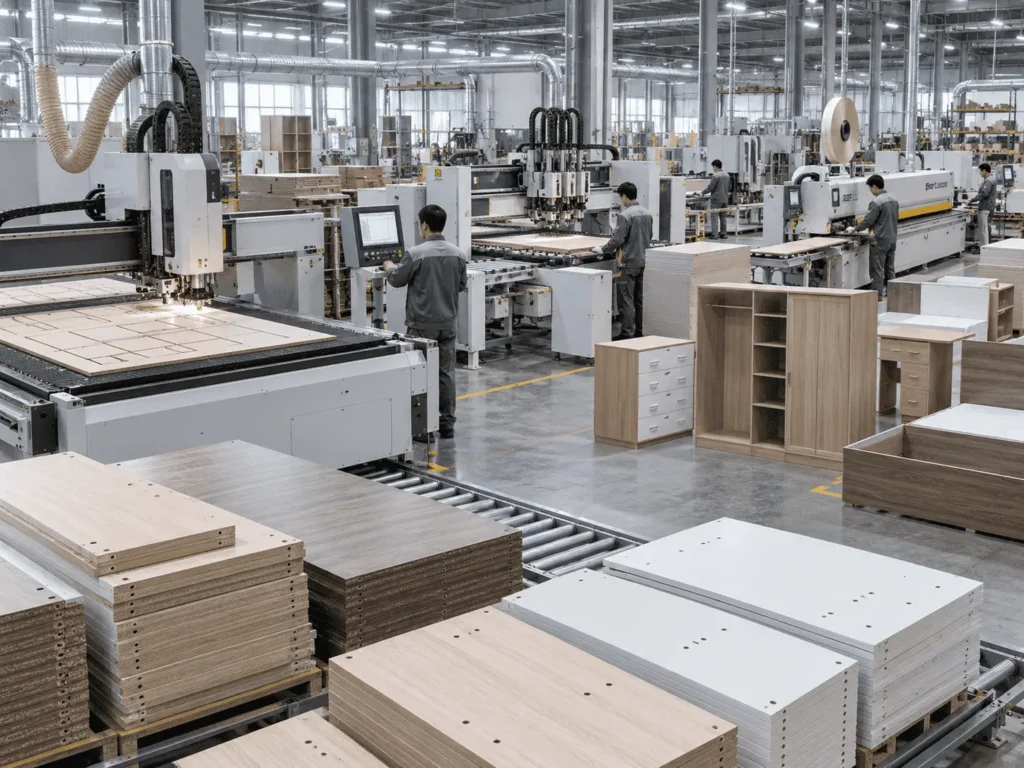
What Global Buyers Should Expect From a Panel Furniture Manufacturer
A professional panel furniture factory should be able to do more than cut panels and assemble cabinets.
For international B2B purchasing, the manufacturer usually needs to coordinate:
- product engineering;
- board materials;
- surface finishes;
- edge banding;
- hardware;
- drilling specifications;
- samples;
- mass production;
- inspection;
- flat-pack packaging;
- labels and instructions;
- container preparation.
This is especially important when the buyer intends to place repeat orders.
A beautiful prototype has limited value if the manufacturer cannot reproduce the same dimensions, drilling pattern, color, hardware, and packaging across the next production run.
Starwood focuses on flat-pack panel furniture manufacturing for importers, brands, wholesalers, and project buyers, with production organized around engineered panels, CNC machining, repeatable hardware systems, quality control, and export-ready packaging.
Buyers who want to understand the factory background first can review our furniture factory and production capability.
1. Confirm That You Are Working With the Right Manufacturing Model
The word “supplier” can describe many different businesses.
A buyer may be dealing with:
- a manufacturing factory;
- a trading company;
- a sourcing company;
- a wholesaler;
- a retailer;
- a mixed manufacturing and trading business.
None of these business models is automatically good or bad.
The important question is whether the supplier model fits your procurement requirement.
When a Direct Panel Furniture Manufacturer Makes Sense
Factory-direct cooperation is especially useful when you need:
- OEM specifications;
- custom dimensions;
- private-label packaging;
- special hardware;
- repeated production;
- material optimization;
- project-based manufacturing;
- coordinated QC;
- container-level orders.
A manufacturer can usually communicate directly with production, engineering, sampling, purchasing, packing, and QC teams.
That becomes important when technical decisions need to be made quickly.
Do Not Verify a Factory Only From a Sales Presentation
Ask to see evidence of actual production.
Useful verification may include:
- real workshop videos;
- CNC machinery;
- drilling equipment;
- edge-banding production;
- assembly areas;
- packing areas;
- raw panel storage;
- ongoing orders;
- trial assembly;
- container loading.
Professional buyers should try to understand how the factory actually produces their category rather than judging the supplier from a showroom alone.
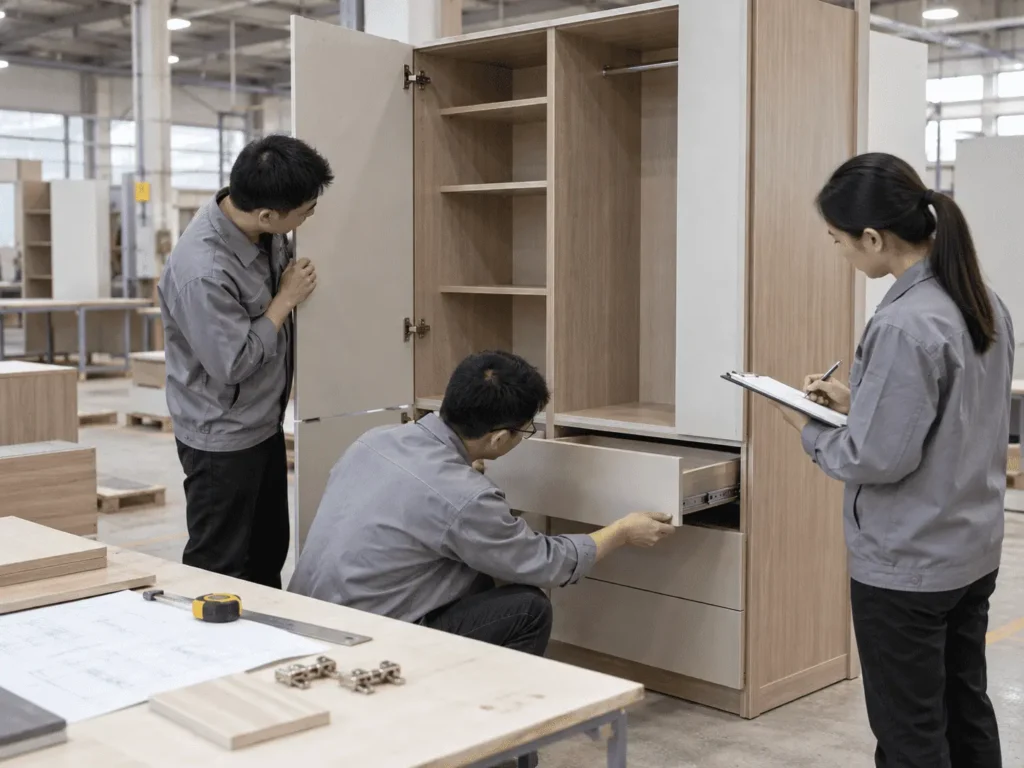
2. Match Factory Capability to Your Product Program
A panel furniture manufacturer may be highly experienced in one category but not necessarily suitable for every furniture type.
A factory focused on panel casegoods may be appropriate for:
- wardrobes;
- storage cabinets;
- TV stands;
- sideboards;
- desks;
- nightstands;
- bookcases;
- shoe cabinets;
- beds;
- kitchen storage;
- bathroom cabinets;
- modular furniture.
That does not automatically mean it is equally strong in solid-wood chairs, upholstered sofas, metal furniture, or complex outdoor products.
Product Specialization Matters
Before requesting prices, check whether the manufacturer’s regular production matches your sourcing program.
For example, a buyer developing an apartment furniture package may need:
- wardrobes;
- beds;
- bedside tables;
- desks;
- TV cabinets;
- shoe cabinets;
- bathroom cabinets.
Using one compatible manufacturing system can simplify materials, finishes, hardware, and packing.
Starwood’s current product range is organized around panel furniture categories for bedroom, bathroom, dining, entryway, home office, kids’ room, kitchen, living room, and space-saving applications.
Buyers can review our panel furniture products for OEM and export before sending a product list.
3. Check OEM and ODM Engineering Support
For many B2B buyers, customization is part of normal purchasing.
The question is not simply whether a factory says “OEM available.”
The more important question is how the factory converts buyer requirements into manufacturing information.
OEM Manufacturing
OEM is appropriate when the buyer already has defined specifications.
You may provide:
- CAD drawings;
- dimensions;
- BOM information;
- materials;
- panel thickness;
- hardware;
- finish codes;
- labels;
- packaging requirements.
The manufacturer’s responsibility is to review feasibility and execute the approved specification consistently.
ODM Development
ODM is more useful when the buyer has a commercial requirement but not a complete technical package.
For example:
“We need a compact bedroom furniture collection for rental apartments using oak-look panels, flat-pack construction, strong storage capacity, and a competitive target cost.”
A competent ODM supplier should help translate that brief into a manufacturable solution.
That can involve:
- structure development;
- dimension adjustment;
- board selection;
- hardware selection;
- cost engineering;
- flat-pack optimization;
- sample development.
Our OEM & ODM panel furniture manufacturing service covers the workflow from inquiry and sampling through production, QC, packing, and shipment preparation.
Look for Engineering Feedback, Not Automatic Agreement
One of the most useful signs of an experienced manufacturer is the willingness to question a drawing.
If a panel dimension creates packaging problems, the supplier should mention it.
If a hardware choice creates machining conflicts, the supplier should raise the issue.
If a construction detail adds cost without adding meaningful customer value, the factory should explain the alternative.
A supplier that agrees to every request without technical review may simply move the risk into production.
4. Verify Panel Materials, Finishes, and Hardware
Material descriptions should be specific enough for purchasing.
Terms such as “high-quality board” or “premium hardware” are not specifications.
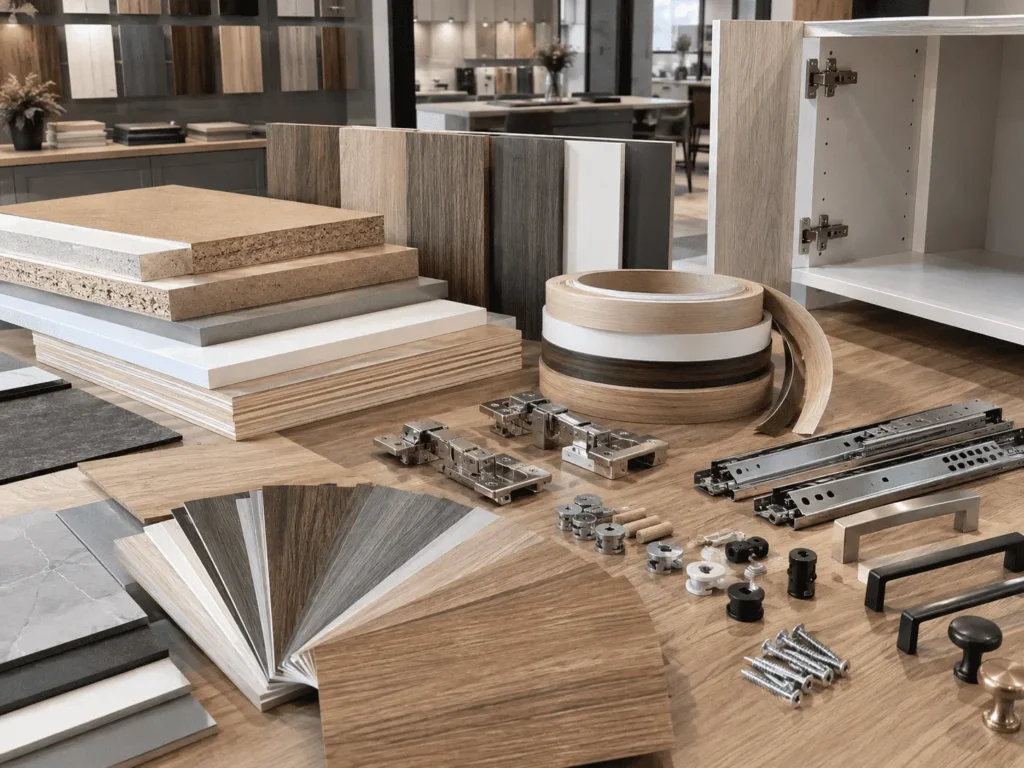
Common Panel Materials
A panel furniture manufacturer may work with:
Particle Board
Particle board is commonly used in flat-pack wardrobes, desks, cabinets, TV stands, and storage furniture where efficient machining and commercial pricing are important.
MDF
MDF provides a uniform surface and is useful for painted finishes, routed profiles, and certain decorative applications.
Plywood
Plywood may be selected where a buyer requires different structural characteristics, screw-holding performance, or project positioning.
Melamine-Faced Panels
Melamine-faced boards are widely used because decorative surfaces can be combined with efficient panel processing and consistent repeat production.
Material Selection Must Match the Market
The same cabinet may require different materials depending on whether it is sold through:
- value retail;
- furniture stores;
- e-commerce;
- hotel projects;
- rental apartments;
- student housing;
- commercial offices.
Therefore, the correct question is not:
“Which board is best?”
It is:
“Which material specification is appropriate for this application, price level, destination market, and expected use?”
Hardware Must Also Be Controlled
Hardware affects both product function and machining.
Confirm:
- hinges;
- drawer slides;
- connectors;
- handles;
- hanging rails;
- adjustable feet;
- brackets;
- anti-tip components where applicable.
Changing the hardware after sampling can change drilling patterns, drawer dimensions, packaging contents, and production cost.
5. Understand MOQ at Program Level
MOQ is one of the most searched commercial questions in furniture sourcing.
However, buyers should avoid treating MOQ as one universal number.
A factory’s practical MOQ can depend on:
- material availability;
- number of SKUs;
- finish;
- special colors;
- custom hardware;
- carton printing;
- production setup;
- container planning.
Starwood’s current homepage lists a general export MOQ starting point of one container.
For a global buyer, the more useful question is often:
How can different compatible SKUs be planned within the production and container program?
Example: Bedroom Collection
Suppose you are sourcing:
- one wardrobe;
- one bed;
- two bedside tables;
- one dresser;
- one desk.
If the products share board colors, edge bands, and hardware families, production planning may be easier than five completely unrelated designs.
This is why experienced buyers plan MOQ at collection or program level, not only product by product.
MOQ Should Be Discussed Before Final Engineering
A common mistake is to fully customize every detail and only then ask about MOQ.
Instead, discuss:
- annual expected volume;
- first-order volume;
- number of SKUs;
- container plan;
- target price;
- market-testing quantity.
The factory may be able to suggest a more practical configuration.
6. Evaluate Sampling and Pre-Production Control
The sample stage is where buyer expectations and factory manufacturing reality meet.
A sample should not only answer:
“Does the furniture look good?”
It should also answer:
“Can this specification be reproduced reliably?”
What Should Be Checked on the Sample?
Review:
- dimensions;
- material thickness;
- finish;
- edge quality;
- color consistency;
- hole positions;
- door gaps;
- drawer movement;
- hardware;
- structural stability;
- assembly process;
- packing configuration.
Trial Assembly Is Particularly Important for Flat-Pack Furniture
Flat components may appear correct when inspected individually.
Problems sometimes become visible only after assembly.
Examples include:
- holes that do not align;
- drawers that bind;
- doors that cannot be adjusted correctly;
- missing fittings;
- unclear instructions;
- panel interference.
Trial assembly helps identify these problems before production volume increases.
Freeze the Specification
After approval, define the approved manufacturing version.
This may include:
- final drawing;
- approved sample;
- BOM;
- finish;
- hardware list;
- packing method.
Uncontrolled changes during production create unnecessary risk.
7. Check Production and Quality-Control Systems
A manufacturer should not depend only on final inspection.
Quality needs to be controlled during production.
Incoming Material Checks
The factory should verify the correct:
- board material;
- thickness;
- finish;
- edge band;
- hardware.
CNC and Drilling Checks
Panel furniture depends heavily on machining accuracy.
Important points include:
- length and width;
- hole diameter;
- hole spacing;
- drilling depth;
- connector locations.
Errors at this stage can create assembly problems later.
Edge-Banding Control
Buyers should pay attention to:
- adhesion;
- visible joints;
- corner quality;
- edge color;
- glue residue;
- damaged surfaces.
Assembly and Functional Checks
Appropriate products may require checking:
- door opening;
- drawer slides;
- hinges;
- shelves;
- alignment;
- stability.
Final Inspection
Final QC should connect back to the approved specification.
Professional buyers may also provide their own:
- inspection checklist;
- AQL requirement;
- approved sample;
- buyer manual;
- third-party inspection protocol.
This makes quality expectations clearer before production.
8. Review Capacity and Lead-Time Planning
A supplier can produce a good sample and still fail a commercial program if production cannot be completed on time.
Lead-time evaluation should therefore include more than a single number.
Pre-Production Activities
The project may require:
- drawing review;
- costing;
- samples;
- revisions;
- finish approval;
- hardware approval;
- packaging confirmation;
- material ordering.
Production Activities
Mass production can include:
- material preparation;
- CNC cutting;
- drilling;
- edge banding;
- assembly inspection;
- hardware preparation;
- final QC;
- packing.
Post-Production Activities
After production, buyers may still need:
- third-party inspection;
- container booking;
- loading;
- export documentation;
- ocean freight;
- customs;
- local delivery.
For hotel and apartment projects, the factory should understand not only the shipment date but also the project handover schedule.
Work Backward From the Required Arrival Date
Tell the supplier:
- required factory completion date;
- preferred ETD;
- required arrival date;
- installation period;
- project opening or handover date.
Then identify the approval deadlines that cannot slip.
This is much more reliable than asking only, “How many days is production?”
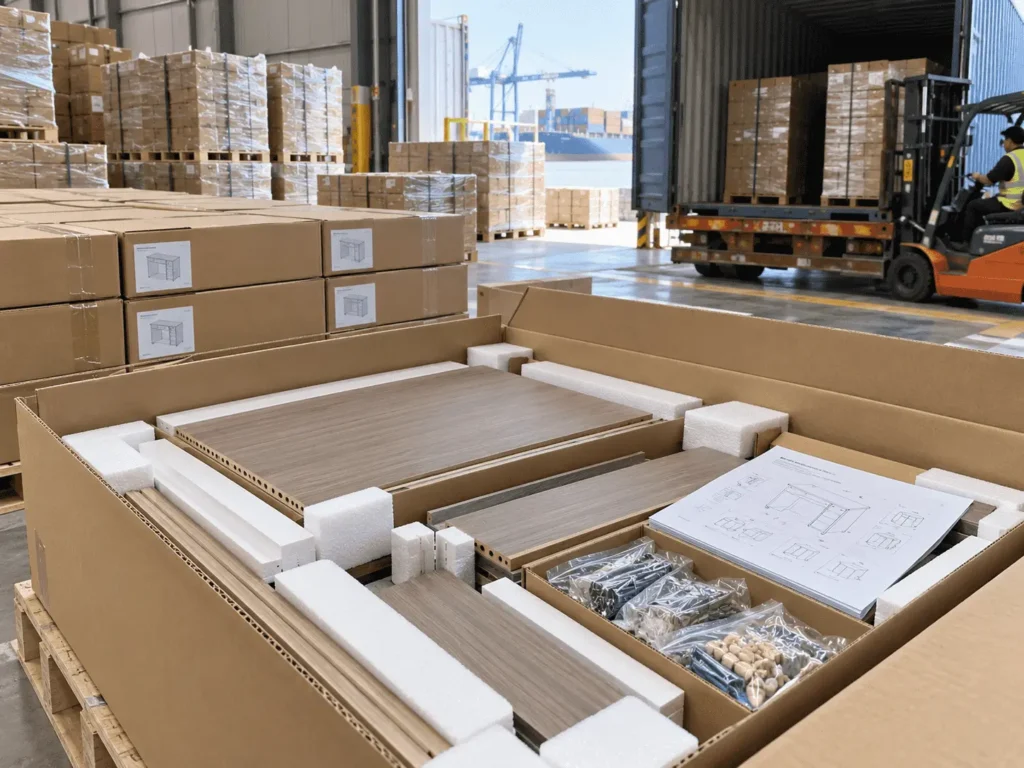
9. Evaluate Flat-Pack Packaging and Logistics
For export panel furniture, packaging is part of product engineering.
A furniture product does not create value for the buyer if it arrives damaged or cannot be assembled easily.
Flat-Pack Packaging Should Control
- carton dimensions;
- board protection;
- corner protection;
- surface protection;
- hardware organization;
- instructions;
- carton labels;
- SKU identification;
- container utilization.
Packaging Affects Landed Cost
Two suppliers may quote similar FOB prices but use different carton sizes.
The larger carton can reduce container loading quantity and increase freight cost per unit.
That means purchasing teams should compare:
product price + packaging volume + loading quantity + damage risk
rather than FOB price alone.
Packaging Testing
Where formal transport validation is required, the International Safe Transit Association publishes packaging test procedures. ISTA Procedure 2C covers individual packaged furniture products transported in a container and is designed as a partial simulation test for furniture packages.
Buyers with specific packaging requirements can review:
ISTA — Packaging Test Procedures and Furniture Package Testing
The correct test should always be chosen according to the actual product and distribution route.
10. Confirm Destination-Market Compliance Before Sampling
Compliance discussions should happen before quotation and sampling—not after bulk production.
Different furniture categories and markets may have different requirements.
United States: Composite Wood
For furniture using regulated composite wood materials in the United States, EPA TSCA Title VI covers hardwood plywood, MDF, particleboard, and finished goods containing regulated panels. The rule includes certification, labeling, recordkeeping, and import requirements.
U.S. buyers can review:
U.S. EPA — Formaldehyde Emission Standards for Composite Wood Products
EPA also maintains information on recognized third-party certifiers.
U.S. EPA — Recognized TSCA Title VI Third-Party Certifiers
California: Composite Wood Products
California’s Composite Wood Products regulation covers hardwood plywood, particleboard, MDF, and finished goods such as furniture and cabinets containing regulated materials.
California-market buyers can review:
California Air Resources Board — Composite Wood Products Program
European Union: Formaldehyde Requirements
For the EU market, Commission Regulation (EU) 2023/1464 amended REACH Annex XVII for formaldehyde and formaldehyde-releasing substances. The furniture and wood-based article restriction applies after 6 August 2026, subject to the regulation’s limits, test conditions, scope, and exemptions.
EU buyers should review the official regulation directly:
EUR-Lex — Commission Regulation (EU) 2023/1464
Because this requirement is now applicable in 2026, European purchasing teams should discuss material and testing requirements before finalizing panel specifications.
United States: Clothing Storage Units
Some free-standing dressers, drawer chests, armoires, and similar clothing storage units fall within the U.S. CPSC mandatory requirements in 16 CFR Part 1261. The rule applies to qualifying clothing storage units manufactured after September 1, 2023.
Relevant buyers can review:
U.S. CPSC — Clothing Storage Units Business Guidance
Commercial Furniture Standards
Commercial and institutional buyers may also specify voluntary performance standards according to the product.
BIFMA develops furniture standards covering areas such as safety, durability, storage, casegoods, seating, ergonomics, and sustainability.
Commercial furniture buyers can review:
BIFMA — Furniture Standards Overview
Responsible Material Sourcing
Where an RFQ requires FSC claims, buyers should confirm the appropriate Chain of Custody certification and documentation.
FSC Chain of Custody requirements are designed to identify and track certified materials through sourcing, processing, labeling, and sale.
Procurement teams can review:
Forest Stewardship Council — Chain of Custody Certification
The important purchasing principle is simple:
Tell your panel furniture manufacturer the destination market and required standards before the material specification is approved.
11. Test the Factory’s Project and Repeat-Order Capability
A factory may perform well on one container but struggle with a long project or repeated collection.
This is where B2B buyers should look beyond the first purchase order.
Ask How Repeat Orders Are Controlled
Questions include:
- Is the approved drawing archived?
- Is the finish reference retained?
- Is the hardware specification recorded?
- Are packaging revisions documented?
- Can replacement components be identified?
- How are specification changes version-controlled?
Repeatability is particularly important for furniture brands.
If an importer sells the same wardrobe for several years, the next order should not suddenly use a different hinge, drilling pattern, or edge color without approval.
Project Buyers Need Additional Coordination
Hotel and apartment projects may involve:
- multiple room types;
- different SKUs;
- phased delivery;
- room labels;
- building labels;
- installation sequences;
- replacement pieces.
That makes project furniture manufacturing different from a simple wholesale product order.
Our project furniture manufacturing service for hotels, apartments, rental properties, offices, and commercial projects supports custom sizes, materials, finishes, hardware, export packaging, and project-oriented production planning.
Where Panel Furniture Manufacturing Works Best
Panel furniture is particularly suitable where buyers need repeatable dimensions and coordinated production.
Furniture Brands and Importers
Private-label buyers can develop product ranges around defined:
- finishes;
- hardware;
- price points;
- packaging;
- assembly systems.
Wholesalers and Distributors
Flat-pack furniture helps with warehousing and container utilization across categories such as:
- wardrobes;
- cabinets;
- desks;
- TV stands;
- beds;
- storage furniture.
Hotels and Serviced Apartments
Repeated rooms can use standardized:
- wardrobes;
- nightstands;
- desks;
- headboards;
- storage units;
- TV cabinets.
Apartment Developments
Panel furniture can be adapted to room dimensions and project budgets for:
- bedroom storage;
- wardrobes;
- kitchen cabinets;
- bathroom cabinets;
- shoe cabinets;
- work desks.
Rental and Student Housing
Compact spaces often benefit from modular and multi-functional panel furniture combining:
- sleeping;
- storage;
- study;
- wardrobe functions.
Commercial Furniture Programs
Offices and other commercial spaces may require:
- work desks;
- bookcases;
- filing storage;
- lockers;
- display cabinets;
- meeting-room storage.
These applications are one reason Google should understand a specialist factory site not merely as a “furniture blog,” but as a commercial furniture manufacturer, OEM/ODM furniture supplier, and panel furniture export factory.
How to Compare Panel Furniture Manufacturer Quotations
Never compare two factory quotations only by the final unit price.
First confirm that both suppliers are quoting the same specification.
Compare:
- board type;
- board thickness;
- density or grade where relevant;
- finish;
- edge banding;
- back panel;
- hardware;
- connectors;
- packaging;
- labels;
- testing;
- commercial terms.
Example
Supplier A quotes a wardrobe at USD X.
Supplier B quotes the same-looking wardrobe at USD Y.
But Supplier B may include:
- thicker panels;
- a different back panel;
- better drawer slides;
- stronger carton protection;
- custom labels;
- additional hardware.
These are not identical quotations.
Professional procurement compares a normalized specification before deciding which price is more competitive.
What Information Should Global Buyers Send in an RFQ?
A good inquiry helps a panel furniture manufacturer respond quickly and accurately.
Instead of writing:
“Please send your catalog and best price.”
Send something closer to:
“We are an importer / furniture brand / hotel contractor / apartment developer sourcing panel furniture for the ___ market. Please review the attached product list and advise on material options, MOQ, sampling, production lead time, packaging, and quotation.”
Then provide:
- product name;
- drawings;
- reference images;
- dimensions;
- quantity per SKU;
- target material;
- panel thickness;
- finish;
- hardware;
- target market;
- compliance requirements;
- packaging requirement;
- target shipment date.
For project orders, also provide:
- BOQ;
- room layouts;
- room types;
- installation schedule;
- project handover date.
If you already have a target price, sharing it can help the manufacturer understand the intended market position and suggest commercially realistic material or structural options.
A Practical Manufacturer Qualification Checklist
Before placing a bulk order, confirm that the supplier can answer the following questions clearly:
Factory Capability:
Can you show actual panel furniture production?
Product Fit:
Do you regularly manufacture our product category?
Engineering:
Can you review drawings and identify manufacturing risks?
OEM/ODM:
Can you work from either full specifications or early-stage concepts?
Materials:
Can you document the required boards, finishes, and hardware?
MOQ:
Can you explain MOQ by SKU, material, and container plan?
Sampling:
What exactly is checked and approved before production?
Production:
How are machining and specifications controlled?
QC:
How are incoming materials, processing, assembly, and packing inspected?
Lead Time:
Can the factory provide a realistic approval-to-shipment schedule?
Packaging:
Can cartons and flat-pack engineering be optimized for export?
Compliance:
Can the required destination-market documentation or testing be coordinated?
Repeat Orders:
How are approved specifications controlled for future orders?
Project Delivery:
Can the factory manage multiple SKUs and project schedules?
If a supplier cannot answer these questions before receiving the order, the problems will usually be harder to solve after production begins.
Why Buyers Work With Starwood
Starwood Industry Co., Ltd. is a China-based flat-pack panel furniture manufacturer supporting furniture brands, importers, wholesalers, e-commerce sellers, hospitality buyers, real estate projects, and commercial programs. The factory describes its manufacturing focus as OEM/ODM panel furniture supported by CNC production, sampling, mass production, quality control, flat-pack packaging, and export preparation.
Our typical workflow is:
Product Brief → Technical Review → Quotation → Sampling → Approval → Mass Production → QC → Packing → Shipment
For buyers that already have drawings, our OEM furniture manufacturing service can support production execution.
For buyers that need product development support, ODM cooperation can help convert concepts, reference images, target costs, and market requirements into a manufacturing plan.
For hotels, apartments, rental housing, offices, and larger developments, our project furniture manufacturing capability supports multi-SKU and customized programs.
Frequently Asked Questions
What does a panel furniture manufacturer produce?
A panel furniture manufacturer typically produces furniture primarily from engineered wood panels such as particle board, MDF, plywood, and melamine-faced boards. Typical products include wardrobes, cabinets, desks, TV stands, sideboards, beds, storage furniture, bookcases, kitchen units, and bathroom cabinets.
What should global buyers check before choosing a panel furniture manufacturer?
Buyers should evaluate actual factory capability, relevant product experience, OEM/ODM engineering, materials, hardware, MOQ, sampling, quality control, production capacity, lead time, export packaging, compliance support, and repeat-order management.
What is the MOQ for panel furniture manufacturing?
MOQ varies according to the product, material, finish, custom hardware, number of SKUs, and packaging requirements. Starwood currently lists one container as its general export MOQ starting point, while product allocation should be discussed according to the actual order program.
Can a panel furniture manufacturer produce from my drawings?
Yes. OEM panel furniture manufacturers can work from drawings, dimensions, specifications, material requirements, hardware lists, samples, and packaging standards. The manufacturer should conduct a feasibility review before sampling and mass production.
Can the factory help if I do not have complete drawings?
Yes. With ODM cooperation, buyers can provide reference images, dimensions, room layouts, functional requirements, target market, quantities, and target price. The factory can then help develop a manufacturable solution.
Which materials are commonly used in panel furniture?
Common materials include particle board, MDF, plywood, and melamine-faced engineered panels. The correct material depends on product structure, target price, finish, destination-market requirements, usage environment, and buyer specifications.
How is panel furniture quality controlled?
Quality control can include incoming material checks, CNC dimension and drilling checks, edge-banding inspection, hardware verification, trial assembly, appearance inspection, functional checks, packaging inspection, and final shipment inspection.
Is panel furniture suitable for hotel and apartment projects?
Yes. Panel furniture is well suited to repeated room types and customized project dimensions. Common applications include wardrobes, beds, nightstands, desks, TV units, kitchen storage, bathroom cabinets, shoe storage, and multi-functional apartment furniture.
How should flat-pack furniture be packaged for export?
Packaging should protect panels and finishes while organizing hardware, instructions, corner protection, carton labels, and SKU identification. Carton dimensions should also be reviewed for warehouse handling and container utilization.
What compliance information should buyers provide?
Buyers should tell the factory the destination market and relevant product requirements before sampling. Depending on the product and market, requirements may involve composite wood emissions, stability, mechanical performance, labeling, certification, responsible sourcing, or packaging tests.
What information should I send for a quotation?
Send drawings or reference photos, dimensions, quantity by SKU, materials, finish, hardware, destination market, packing requirements, compliance requirements, and required shipment date. Project buyers should also provide BOQs, room layouts, and delivery schedules where available.
Start Your Panel Furniture Sourcing Project
If you are looking for a panel furniture manufacturer for wholesale, private-label retail, e-commerce, hotel, apartment, rental property, student housing, or commercial projects, send your requirements for factory review.
Please include:
- product drawings or reference images;
- dimensions;
- quantities by SKU;
- target materials;
- finish requirements;
- hardware requirements;
- destination market;
- compliance requirements;
- packaging requirements;
- target shipment date.
We can review the structure, material options, customization, MOQ, sampling, production planning, quality-control requirements, and export packaging before bulk production.
Review Starwood’s OEM & ODM Panel Furniture Manufacturing Services
View Project Furniture Manufacturing for Hotels, Apartments and Commercial Projects
Explore Panel Furniture Products for OEM and Export
Planning a new furniture program? Send your product list, drawings, quantity, target market, and required shipment schedule. Request factory pricing, MOQ, sample planning, material recommendations, and export-packaging advice for your next panel furniture order.