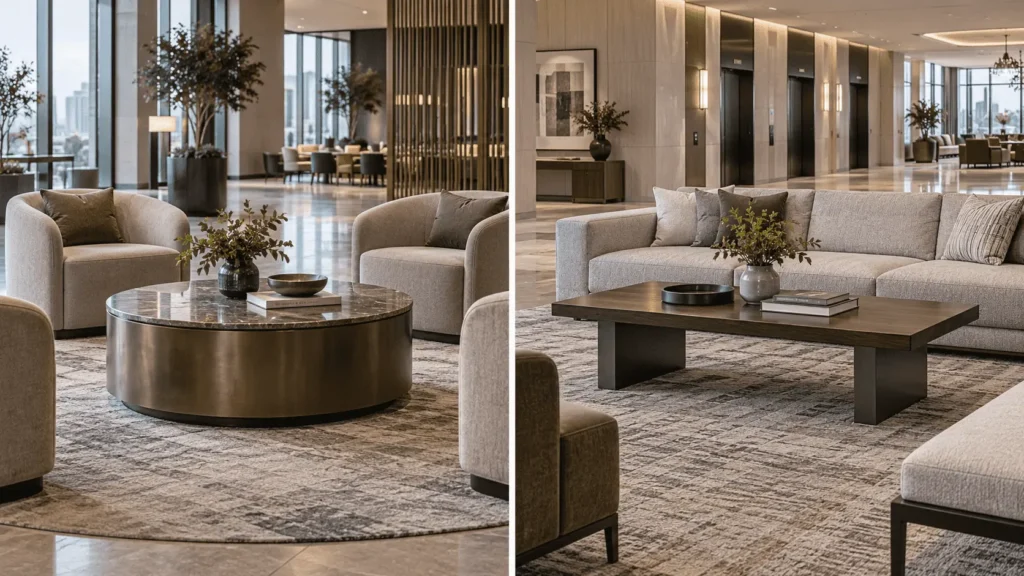
For importers, furniture brands, hotel contractors, apartment developers and wholesale buyers, the round vs rectangular coffee table decision is not simply about appearance. Shape affects usable floor space, seating layouts, panel utilization, production cost, packaging dimensions, container efficiency and the number of SKUs a supplier can produce consistently. A coffee table that looks attractive in a showroom can still become a weak commercial program if it is expensive to manufacture, difficult to pack or unsuitable for the room types in your project.
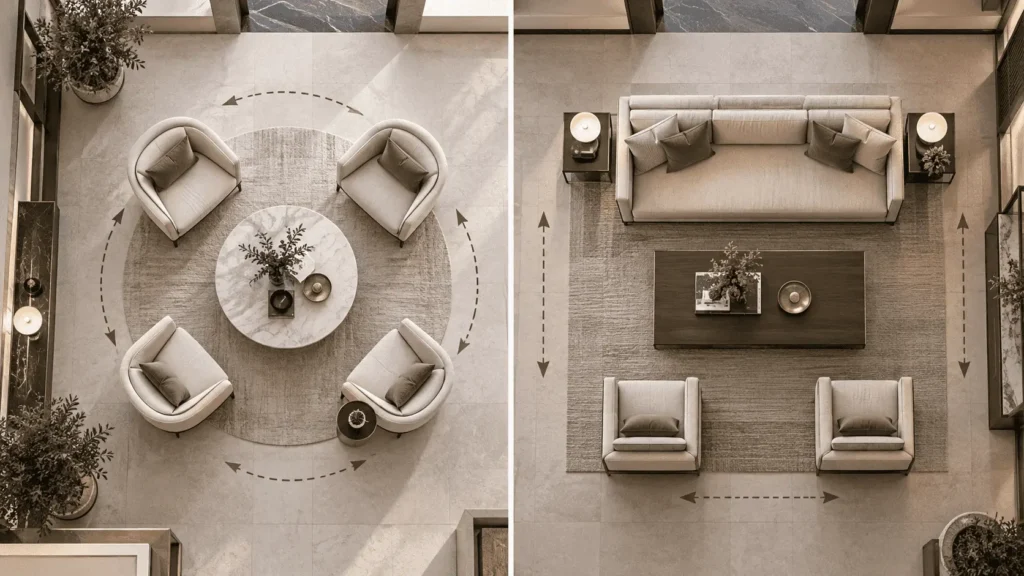
As a panel furniture export manufacturer, we evaluate coffee-table shape from a production and procurement perspective: where the table will be used, which materials are required, how the structure will be manufactured, what MOQ is practical, how it will be packed, and whether the design can be repeated accurately across bulk orders.
If you are sourcing coffee tables for an OEM range, hotel project, furnished apartment program or international furniture distribution business, this guide will help you decide which shape makes more commercial sense before sampling begins.
Table of Contents
- Round vs Rectangular Coffee Table: Quick B2B Comparison
- Decision 1: Match the Shape to the Project Layout
- Decision 2: Compare Manufacturing and Material Efficiency
- Decision 3: Specify Materials for Your Target Market
- Decision 4: Calculate MOQ, Lead Time and Packaging
- Decision 5: Build the Right OEM/ODM Specification
- Round vs Rectangular Coffee Table for Different Buyer Types
- What Buyers Should Include in an RFQ
- How Our Coffee Table Manufacturing Process Works
- FAQ for B2B Coffee Table Buyers
- Request an OEM/ODM Coffee Table Quotation
Round vs Rectangular Coffee Table: Quick B2B Comparison
The most important difference for a commercial buyer is that a round and rectangular coffee table create different consequences throughout the supply chain.
| Procurement Factor | Round Coffee Table | Rectangular Coffee Table |
|---|---|---|
| Best layout | Compact seating groups, lounge areas, flexible circulation | Long sofas, linear hotel rooms, apartments |
| Visual effect | Softer, more decorative | Structured, practical, commercial |
| Panel cutting | Requires CNC contour cutting | Straight cutting is usually simpler |
| Edge treatment | Curved edge processing required | Straight edge banding is efficient |
| Flat-pack engineering | Possible but requires careful base design | Highly suitable for KD/RTA structures |
| Storage functions | Less efficient for drawers | Excellent for drawers, shelves and lift tops |
| Carton shape | May create unused carton space | Easy to optimize into rectangular cartons |
| Container loading | Depends strongly on knock-down structure | Generally straightforward |
| Project standardization | Good for feature areas | Excellent for repeated room types |
| OEM customization | Diameter, base, finish, edge profile | Length, width, storage, drawers, lift top |
| Hospitality use | Lobby, lounge, suite seating | Guest rooms, suites, serviced apartments |
| Retail positioning | Design-led / accent model | Broad-market / functional model |
From our factory perspective, neither shape is automatically better. The better choice is the one that matches the buyer’s room plan, target price, quantity, packaging method and sales channel.
For buyers developing complete living-room collections, our OEM coffee table manufacturing page covers lift-top tables, storage tables, nesting tables, foldable models and other flat-pack coffee-table structures.
Decision 1: Match Coffee Table Shape to the Project Layout
When Round Coffee Tables Make More Sense
A round coffee table is useful when a project requires softer circulation around the furniture.
Typical applications include hotel lobby seating clusters, serviced-apartment lounges, boutique hotel suites, reception areas, compact conversation zones and residential furniture ranges where the buyer wants a softer visual identity.
Because a round table has no projecting corners, designers can often position it between several seats without visually creating one dominant direction.
This can be valuable in lobby and lounge projects where sofas and lounge chairs may be arranged around the center table from several directions.
However, buyers should not assume that “round” automatically means “space saving.” The diameter determines both the maximum width and maximum depth of the table. A large Ø1000 mm round table can occupy considerably more central floor space than a 1000 × 500 mm rectangular table.
For an OEM project, always compare actual footprints rather than comparing shapes by appearance.
When Rectangular Coffee Tables Make More Sense
Rectangular tables remain one of the most practical choices for commercial furniture programs.
They pair naturally with:
- three-seat sofas;
- long hotel sofas;
- apartment living-room packages;
- student housing;
- furnished rental projects;
- modular seating;
- retail living-room collections.
A rectangular structure also gives the manufacturer more freedom to incorporate drawers, open shelves, lift-top mechanisms and concealed storage.
For buyers developing furniture for apartments or furnished rentals, those functions can create more commercial value than shape alone.
If you are sourcing furniture for multiple room types, review our project furniture manufacturing capability for hotels, apartments and commercial projects. A coffee-table specification can then be coordinated with TV units, sideboards, desks, wardrobes and other panel furniture using related finishes and hardware.
Do Not Ignore Accessible Circulation
Commercial projects should also consider circulation requirements rather than simply copying residential furniture layouts.
For U.S. projects, for example, the U.S. Access Board explains that accessible routes generally require a continuous clear width of at least 36 inches, with additional clearance required in certain turning conditions. That does not mean every coffee table needs a fixed 36-inch gap around it; it means designers and project buyers need to check whether furniture interferes with the required accessible route for the specific space.
Before finalizing a hospitality layout, buyers can review the official U.S. Access Board guidance on accessible routes and clearances and confirm applicable requirements with the project’s architect or accessibility consultant.
Factory recommendation: send the supplier the room plan or furniture layout instead of only sending a coffee-table reference photo. Ten minutes of dimensional review before sampling can prevent a model that looks good but does not fit the actual project.
Decision 2: Compare Manufacturing and Material Efficiency
This is where a factory sees differences that are rarely discussed in consumer coffee table guides.
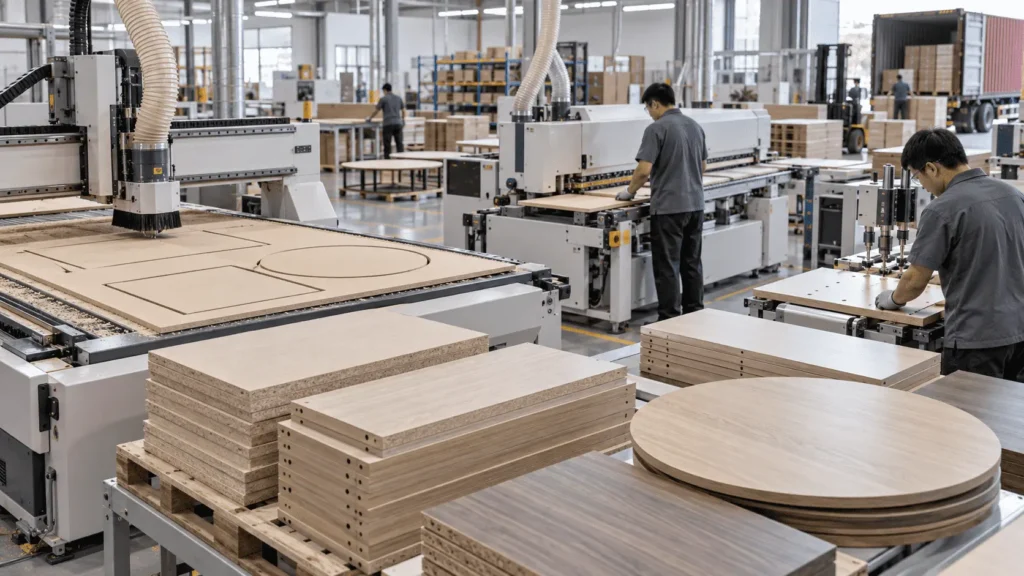
Round Coffee Table Production
For panel-based round tabletops, the basic production route may include:
CNC routing → edge preparation → curved edge finishing or edge banding → drilling → base installation → inspection → packing.
Circular components normally require more contour machining than a basic rectangular panel. Material utilization may also be different because circular parts do not always nest as efficiently on a rectangular sheet.
The final effect on price depends on diameter, panel thickness, edge profile, surface material and quantity.
For high-volume OEM orders, buyers should therefore ask:
Can the diameter or component arrangement be optimized for the factory’s standard board size?
A small change in diameter may sometimes improve board utilization without materially changing the visual design.
Rectangular Coffee Table Production
Rectangular panel furniture typically works well with automated panel-processing systems.
Straight cutting, drilling and edge banding make it easier to standardize components. Rectangular panels are also convenient when several furniture categories share the same board thickness and finish.
This makes rectangular coffee tables particularly suitable for complete apartment furniture programs where a buyer may want one finish across:
TV units, sideboards, bedside tables, desks, storage cabinets and coffee tables.
Production efficiency does not mean every rectangle will be cheaper. Complex drawer systems, lift mechanisms, rock-plate tops, special metal frames and premium finishes can still increase cost substantially.
The important point is that buyers should compare complete construction, not shape alone.
Decision 3: Specify Materials for Your Target Market
For a B2B buyer, “wood coffee table” is not an adequate production specification.
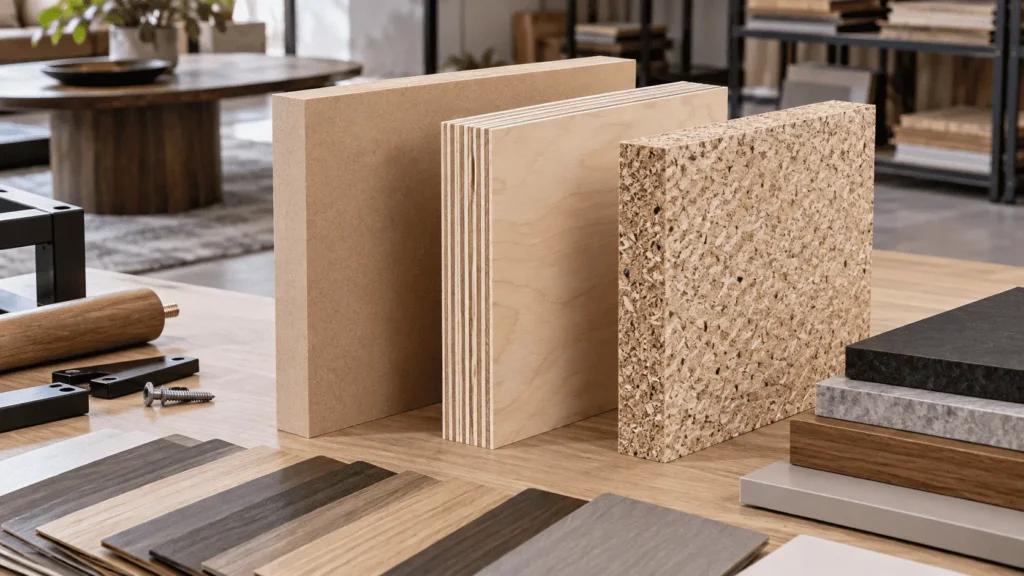
The RFQ should define the substrate, surface material, thickness, edge treatment, hardware, structural load expectations and destination market.
MDF
MDF is useful where buyers need:
- smooth painted or lacquered surfaces;
- routed profiles;
- consistent machining;
- decorative shapes;
- controlled surface appearance.
It can work particularly well for rounded profiles because CNC machining can create clean contours.
Particle Board
Particle board is commonly used in cost-controlled flat-pack furniture.
It can be suitable for rectangular coffee tables, storage tables and retail programs when board density, connector selection, edge banding and carton protection are properly specified.
Plywood
Plywood can be selected where the project requires a different balance of structural performance, weight, screw-holding behavior or premium material positioning.
The exact plywood construction matters, so buyers should specify grade and finish rather than simply requesting “plywood.”
Melamine, Laminate and Veneer
Melamine surfaces are frequently selected for cost-effective commercial and apartment furniture because they allow consistent decorative finishes.
Laminate may be appropriate where the project requires additional surface-performance characteristics.
Wood veneer can move the collection toward a more natural or premium positioning while still using engineered panel construction underneath.
The right choice depends on target price, expected use, required documentation and project positioning.
Our OEM & ODM furniture manufacturing service supports material, size, finish, hardware, structure and packaging customization from sampling through bulk production.
Material Compliance Should Be Confirmed Before Quotation
When panel furniture is exported, material compliance cannot be treated as an afterthought.
For furniture entering the United States, buyers using MDF, particleboard or hardwood plywood should review the U.S. EPA requirements under TSCA Title VI. The EPA’s formaldehyde rules cover regulated composite wood products and finished goods containing those materials.
For the official requirements, buyers can review the U.S. EPA Formaldehyde Emission Standards for Composite Wood Products before confirming board specifications.
California buyers should also understand the state’s Composite Wood Products Airborne Toxic Control Measure. The California Air Resources Board states that its program addresses formaldehyde emissions from hardwood plywood, particleboard and MDF as well as finished goods containing regulated panels.
For California-bound programs, see the California Air Resources Board Composite Wood Products Program.
If FSC-certified sourcing is required by the customer, tender or brand policy, communicate that requirement before material purchasing. FSC explains that Chain of Custody certification tracks eligible forest-based material through the supply chain.
Buyers can review the Forest Stewardship Council Chain of Custody certification requirements when establishing responsible-sourcing documentation.
Factory-side rule: put regulatory, certification and testing requirements into the RFQ before price confirmation. Changing panel specifications after the sample is approved can affect material cost, lead time and documentation.
Decision 4: Calculate MOQ, Lead Time and Packaging Before Choosing the Shape
Shape affects more than product appearance. It can also affect the commercial structure of the order.
How to Think About MOQ
There is no useful universal MOQ for every custom coffee table.
MOQ can depend on:
- board finish;
- custom color;
- hardware;
- metal frame;
- glass or stone components;
- carton printing;
- tabletop size;
- whether the item shares materials with other SKUs;
- whether production is for retail, e-commerce or a complete project.
A buyer ordering one new custom finish on one SKU will normally create different factory conditions from a buyer ordering several coordinated furniture models in the same finish.
For hotel and apartment projects, it may therefore be more efficient to discuss a project MOQ or mixed-SKU loading plan, not simply ask, “What is your minimum quantity?”
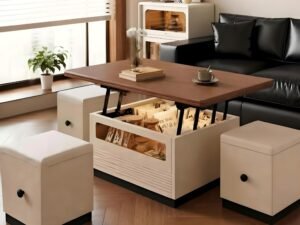
As one concrete product reference, our current Lift-Top Coffee Table Set with Storage Stools is listed with an MOQ of 10 sets and a standard lead time of 35–40 days after deposit. Custom round or rectangular models should still be quoted separately because material, finish, structure, tooling and packaging requirements can change the production plan.
Typical Lead-Time Factors
A custom coffee-table program usually moves through:
drawing review → quotation → sample development → sample approval → material preparation → mass production → QC → packing → loading.
Lead time becomes longer when the product requires:
custom decorative board, painted finishes, special metalwork, non-standard hardware, new molds, printed packaging or repeated sample modifications.
This is why professional buyers should request a production timeline at the quotation stage instead of asking for delivery dates only after the PO is issued.
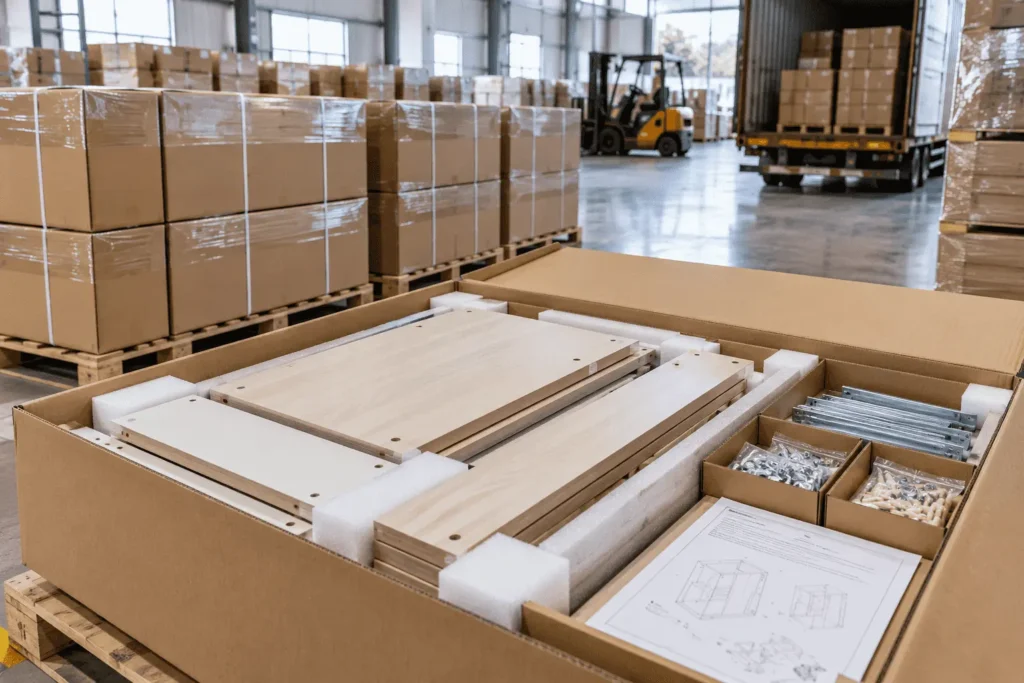
Packaging: Rectangular Cartons Usually Have an Advantage
For an export factory, packaging is part of product engineering.
Rectangular coffee tables naturally suit rectangular cartons. When the legs, frame or base can be disassembled, components can be nested around the tabletop to reduce unused space.
Round coffee tables can also be engineered as flat-pack products, but buyers should examine how the circular top, base and hardware use carton volume.
A visually attractive pedestal design can become expensive to export if the base cannot be knocked down.
Before approving a design, ask the manufacturer for:
packed dimensions, gross weight, pieces per carton, carton CBM and estimated loading quantity.
Those numbers make the difference between evaluating FOB unit cost and evaluating actual landed cost.
Packaging for Retail vs E-Commerce vs Project Delivery
One packaging specification should not automatically be used for every sales channel.
For palletized project shipments, cartons may experience a different handling environment from individual e-commerce parcels.
For parcel-distribution programs, buyers should discuss whether transit testing is required. The International Safe Transit Association explains that its 3-Series procedures simulate transport hazards such as vibration, drops and environmental conditioning. ISTA Procedure 3A specifically addresses parcel-delivery packaged products up to 70 kg / 150 lb.
For packaging-development reference, review the International Safe Transit Association test procedures.
A furniture factory should not merely make a strong table. It should help the table arrive without chipped panels, crushed corners, scratched surfaces or loose hardware.
Decision 5: Build the Right OEM/ODM Coffee Table Specification
Once the buyer has chosen between a round vs rectangular coffee table, the next step is translating the idea into a specification that can be manufactured repeatedly.
For a Round Coffee Table RFQ
Define:
diameter, overall height, tabletop thickness, substrate, finish, edge profile, base diameter or leg spacing, knock-down requirement, weight target, carton size limit and intended project application.
If the base uses metal, also define finish color, coating requirements and whether the base should ship assembled or knock-down.
If two nesting round tables form one set, provide both dimensions and clarify whether they ship in one carton.
For a Rectangular Coffee Table RFQ
Define:
overall length, depth, height, panel thickness, corner design, shelf location, drawer configuration, lift-top mechanism, leg or plinth structure, hardware, edge banding, assembly method and packaging requirement.
If the product is part of a larger furniture collection, send the factory the complete finish schedule so the coffee table can be matched with TV cabinets, sideboards and storage furniture.
Structural Testing
Buyers with formal testing requirements should specify the applicable standard in the RFQ instead of using vague wording such as “commercial quality.”
ISO 19682:2023 specifies test methods for determining the stability, strength and durability of the structure of tables and desks across different materials and constructions.
Project buyers can use the official ISO 19682:2023 furniture table test-method reference as a starting point when discussing whether formal structural testing is required for their market or contract.
The exact standard required can vary by country, use case and tender specification, so testing requirements should always be confirmed for the target project.
Round vs Rectangular Coffee Table for Hotel Projects
Hotel procurement adds requirements that are less important in a purely residential purchase.
A hotel table must coordinate with the sofa, guest circulation, housekeeping requirements, room type, finish schedule and replacement strategy.
Round Tables in Hotels
Round models work especially well in:
lobby seating groups, executive lounges, boutique suites, lounge-chair arrangements and reception waiting areas.
Their softer geometry can help create a less rigid seating cluster.
For large projects, consider whether the base provides enough stability and whether surface edges can withstand repeated cleaning.
Rectangular Tables in Hotels
Rectangular tables are often easier to standardize for guest-room and serviced-apartment programs.
They coordinate naturally with linear sofas and can offer additional storage or shelving.
When several hundred rooms share the same specification, component repeatability becomes particularly important. A simple structure that can be assembled consistently may have more project value than a complicated design that adds unnecessary installation time.
Round vs Rectangular Coffee Table for Apartment Projects
Apartment developers normally focus on three things:
space, budget and repeatability.
A compact rectangular model can deliver more functional surface area along a sofa while controlling table depth.
A small round model can work well where the furniture arrangement is more flexible or where curved geometry helps reduce visual congestion.
For furnished rental properties, we also consider replaceability.
Can a damaged tabletop be replaced without replacing the entire table?
Can the factory maintain the same finish for repeat orders?
Can hardware be standardized with other furniture in the apartment package?
Can spare parts be supplied?
These questions are more valuable to a project operator than a purely decorative comparison.
Round vs Rectangular Coffee Table for Furniture Brands and Importers
Retail and wholesale buyers often need both shapes.
Instead of choosing one winner, a stronger product-line strategy may be to create one coordinated platform:
Round accent model: design-led, compact, visually distinctive.
Rectangular functional model: larger surface area, optional shelf or storage, broader commercial appeal.
Both can use the same board finish, metal color or design language.
That creates a more complete collection without building every product from completely different components.
For brands interested in multifunctional living-room products, our coffee table category for OEM and export buyers includes lift-top, storage, foldable and other RTA/KD concepts that can be customized for different channels.
What Should B2B Buyers Include in a Coffee Table RFQ?
A useful RFQ gives the factory enough information to calculate the actual product instead of guessing.
Send the following information:
Product reference: drawing, rendering, CAD file or reference image.
Shape and dimensions: diameter for round models; length × depth for rectangular models.
Quantity: quantity per SKU and total project quantity.
Target market: United States, Canada, EU, UK, Middle East, Australia or another destination.
Application: retail, wholesale, e-commerce, hotel, serviced apartment, rental housing or another commercial project.
Material: MDF, particle board, plywood or specified substrate.
Finish: melamine, laminate, veneer, lacquer, painted finish, rock plate or custom decorative surface.
Hardware: connectors, drawer slides, lift mechanism, metal base or specified hardware brands.
Packaging: flat-pack/KD, project carton, retail packaging or e-commerce packaging.
Compliance: material-emission, certification and testing requirements.
Target price: FOB target if available.
Delivery schedule: desired shipment window and destination port.
A detailed RFQ allows the supplier to give useful technical feedback before sampling.
Our quotation page follows the same logic by asking buyers for product references, dimensions/specifications, quantity and packaging, destination market and timeline. Send your project requirements for quotation
How Our OEM/ODM Coffee Table Process Works
As a panel furniture export factory, our job is not simply to reproduce a photograph.
The goal is to convert a buyer’s reference into a product that can be manufactured, packed, assembled and reordered consistently.
Step 1: Product Brief and Feasibility Review
You send the drawing, dimensions, quantity, target market and reference finish.
We review whether the structure suits panel production, whether dimensions can be optimized and whether the proposed construction is practical for export packaging.
Step 2: Material and Cost Engineering
We compare panel options, surface finishes, hardware, edge treatments and structural alternatives against the target positioning.
For cost-sensitive programs, this stage is particularly important because the cheapest panel is not always the lowest-cost finished solution.
Production efficiency, assembly time, packaging volume and defect risk also affect the commercial result.
Step 3: Sample Development
The sample allows the buyer to check:
proportion, color, surface finish, stability, hardware function, assembly method and packaging concept.
For round models, this is also the time to verify the edge quality and base geometry.
For rectangular storage tables, drawer alignment or lift-top operation should be tested before bulk production.
Step 4: Sample Approval and Bulk Production
Approved drawings, finishes and hardware become production references.
CNC processing, cutting, drilling, edge finishing and component preparation should follow the confirmed specification.
Step 5: QC and Assembly Check
Coffee-table QC should include more than visual appearance.
Typical checks include:
dimensions, finish consistency, edge quality, drilling alignment, hardware installation, tabletop stability, wobble, functional components and carton contents.
Step 6: Flat-Pack Packaging and Export Preparation
The final packaging plan should protect exposed surfaces and vulnerable corners while keeping carton volume commercially reasonable.
Hardware bags, assembly instructions, carton marks and private-label requirements should be confirmed before shipment.
For more information about this factory workflow, see our OEM & ODM panel furniture manufacturing services and factory manufacturing capability.
Which Shape Is Usually More Cost-Effective?
For simple panel furniture, a standard rectangular coffee table often has an efficiency advantage because straight cutting, straight edge banding and rectangular packing are easy to standardize.
But that is not a universal pricing rule.
A simple round tabletop on a basic knock-down base may cost less than a rectangular table containing two drawers, a lift mechanism, multiple partitions and premium hardware.
Therefore, compare the complete bill of materials and construction.
For serious sourcing, ask the supplier to quote at least two alternatives:
Option A: design as requested.
Option B: factory-optimized structure maintaining the same appearance and function.
This gives purchasing teams a more useful basis for cost engineering than requesting discounts after the design has already been frozen.
Round vs Rectangular Coffee Table: Factory Recommendation
From a project-manufacturing perspective, choose a round coffee table when the design needs softer circulation, multiple-direction seating or a more decorative lounge character.
Choose a rectangular coffee table when you need efficient panel production, linear sofa compatibility, storage functionality, straightforward flat-pack packaging and easy standardization across multiple rooms.
For many brands and importers, the strongest answer is not round or rectangular.
It is to develop both around the same material platform.
A round feature table can attract design-focused buyers while a rectangular storage or lift-top table addresses broader functional demand. Shared finishes, hardware and packaging systems can then make the collection easier to source and repeat.
That is the difference between treating coffee-table shape as a styling question and treating it as a commercial furniture program.
FAQ: Round vs Rectangular Coffee Table for B2B Buyers
Is a round or rectangular coffee table better for hotel projects?
It depends on the layout. Round coffee tables work well in hotel lobbies, lounges and seating clusters where guests approach from several directions. Rectangular coffee tables are often easier to standardize in guest rooms and serviced apartments, particularly when positioned in front of a long sofa.
Which coffee table shape is cheaper to manufacture?
A simple rectangular panel coffee table can often be efficient to manufacture because it uses straight cutting and edge processing. However, storage systems, drawers, lift mechanisms, hardware and premium finishes may make a rectangular model more expensive than a simple round table. Buyers should compare complete specifications rather than shape alone.
Can round coffee tables be manufactured as flat-pack furniture?
Yes. Round tables can be designed as KD or flat-pack furniture when the base, legs and tabletop connections are engineered for disassembly. The factory should review stability, assembly hardware and carton utilization during product development.
What materials are suitable for OEM coffee tables?
Depending on the design and target market, options can include MDF, plywood, particle board, melamine-faced panels, laminate, veneer, lacquered surfaces, rock plate and metal components. Material requirements should be confirmed according to appearance, cost, structural requirements and destination-market compliance.
What is the MOQ for custom OEM coffee tables?
MOQ depends on the model, board finish, hardware, packaging and customization level. Standard products may support lower quantities, while custom finishes and new structures may require larger production quantities. Buyers should provide expected volume when requesting a quotation so the factory can recommend a practical production plan.
How long does custom coffee table production take?
Lead time depends on material availability, sample approval, quantity, finish, hardware and packaging. Sampling should be completed and approved before mass production. As a current product example, one of our lift-top coffee table sets is listed with a 35–40 day standard lead time after deposit, while fully customized projects should be scheduled individually.
Can you manufacture both round and rectangular coffee tables for one furniture collection?
Yes. OEM/ODM programs can use coordinated finishes, materials, metal colors and design details across both shapes. Developing both from one material platform can help brands create a broader collection while maintaining visual consistency.
What information should I send for a coffee table quotation?
Send the reference image or drawing, dimensions, required quantity, material, finish, hardware, packaging method, target market, destination, compliance requirements and target price if available. For project furniture, room layouts and BOQ information are also useful.
Final B2B CTA
Source Custom Coffee Tables Directly from a Panel Furniture Export Factory
If you are comparing a round vs rectangular coffee table for a new furniture line, hotel project, serviced apartment, rental property or wholesale program, send us your drawing, reference photo or project furniture schedule.
We can review:
- table shape and dimensions;
- MDF, plywood and particle-board options;
- finish and edge details;
- storage or lift-top structures;
- flat-pack / KD engineering;
- MOQ and production planning;
- private-label packaging;
- export-carton requirements;
- sample development;
- bulk production and QC.
Starwood supports OEM/ODM panel furniture development for importers, brands, wholesalers and commercial project buyers.
Request an OEM/ODM Coffee Table Quotation