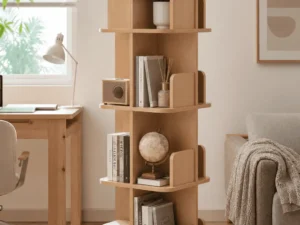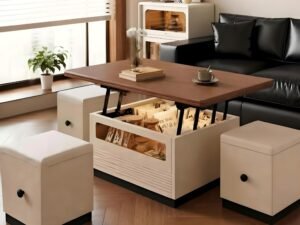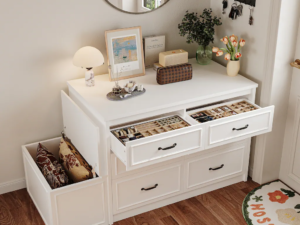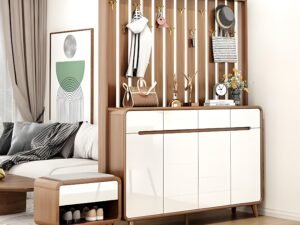
For an importer, furniture brand, contractor, hotel operator, apartment developer, or distributor, choosing between a custom storage cabinet and a ready-made cabinet is not simply a design decision. It affects landed cost, installation, project coordination, MOQ, lead time, packaging efficiency, replacement parts, regulatory documentation, and repeat-order consistency.
A ready-made cabinet may win when speed and low development cost are the priority. A custom program usually becomes more valuable when dimensions, materials, finish matching, branding, room layouts, container efficiency, or long-term supply must be controlled.
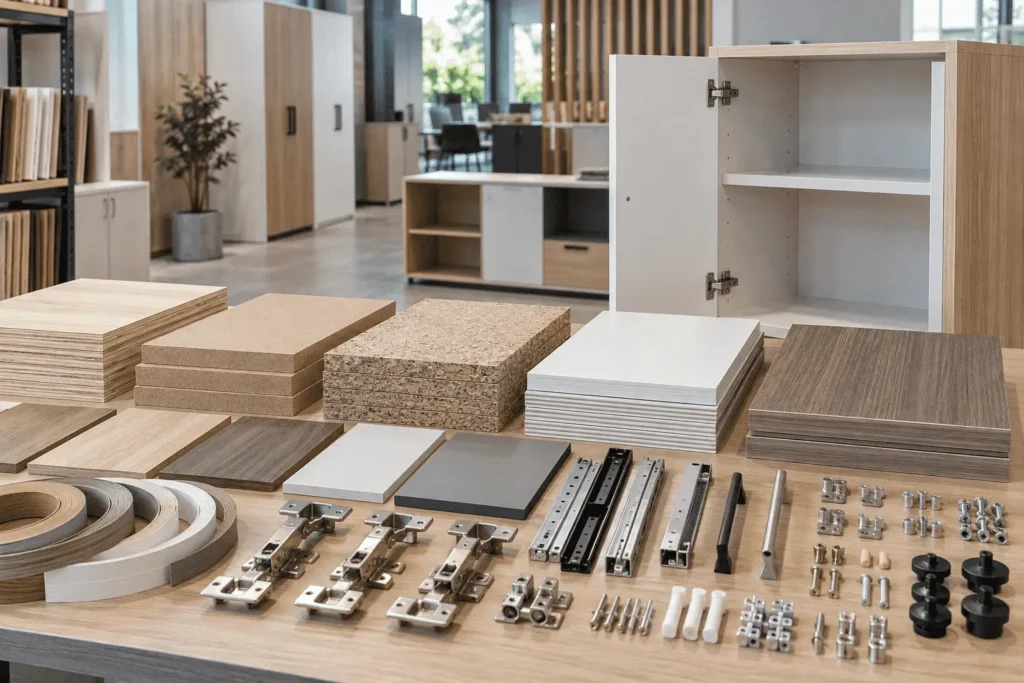
From a panel furniture factory perspective, the better question is therefore not “Which cabinet is cheaper?” It is:
Which sourcing model creates the lowest procurement risk and best total commercial result for this project?
That is what this buyer guide evaluates.
Table of Contents
- Custom Storage Cabinet vs Ready-Made: The Buyer Difference
- Project Fit and Application Requirements
- Purchase Price vs Total Landed Cost
- Materials, Emissions and Compliance
- Structure, Hardware and Service Requirements
- MOQ and Order Economics
- Lead Time and Project Scheduling
- Flat-Pack Packaging and Logistics
- Branding and Market Differentiation
- Repeat Orders and Supply-Chain Control
- Applications for Hotels, Apartments and Commercial Projects
- Material Selection for Custom Storage Cabinets
- Our OEM/ODM Customization Process
- MOQ, Lead Time and Packaging Planning
- How to Prepare an Effective Cabinet RFQ
- Custom or Ready-Made: Which Should You Buy?
- FAQ
- Request a Custom Storage Cabinet Quotation
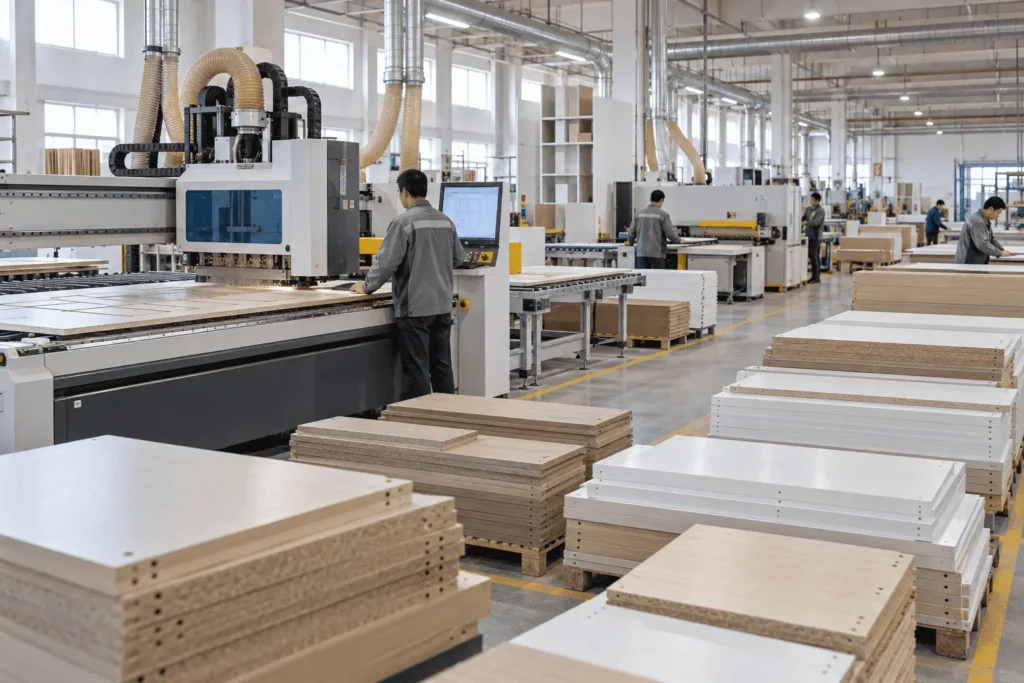
Custom Storage Cabinet vs Ready-Made: What Changes for a B2B Buyer?
A ready-made cabinet is normally based on an existing size, structure, finish, hardware package, and packing method. The buyer selects from available specifications with relatively limited engineering changes.
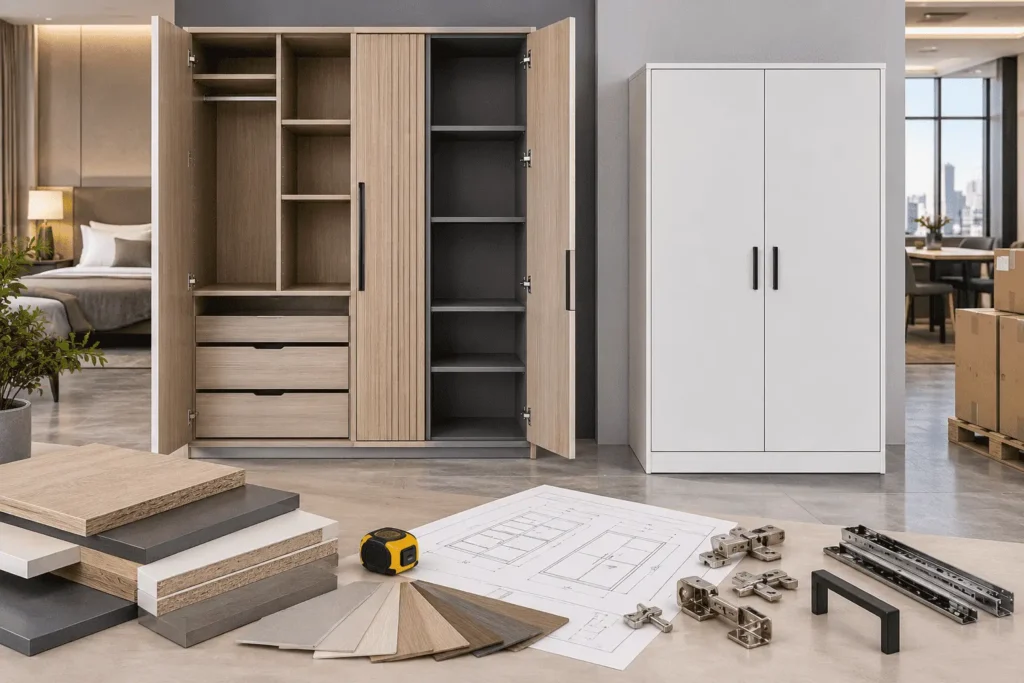
A custom storage cabinet is developed or modified around the buyer’s commercial requirements. Customization can include dimensions, internal layout, panel material, finish, edge banding, door construction, drawers, shelves, hinges, slides, handles, legs, locks, wall-fixing systems, packaging, branding, labels, assembly instructions, and carton dimensions.
This is the practical difference between OEM vs standard furniture.
Standard furniture asks:
“Does the existing product fit our requirement?”
OEM sourcing asks:
“How should the product be manufactured to fit our requirement?”
Neither approach is automatically better. The decision depends on volume, target market, application, logistics, price positioning, and how much control the buyer requires.
For buyers who need more than an existing catalogue item, our OEM & ODM furniture manufacturing services cover design review, sampling, production, quality control, export packing, and bulk shipment support.
1. Project Fit: Start With Where the Cabinet Will Be Used
The first purchasing question should be application, not price.
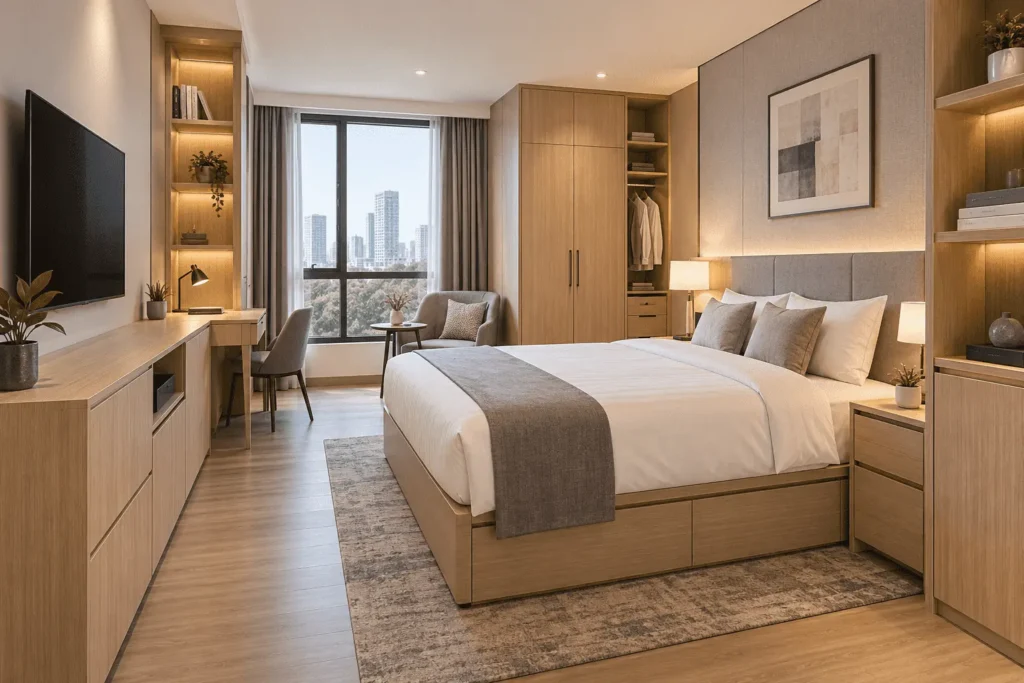
A storage cabinet for a residential retail collection is different from a unit designed for a hotel room, serviced apartment, office, student residence, rental property, or commercial fit-out.
Apartment and Rental Housing
Apartment projects often require cabinets that make efficient use of limited floor area.
Buyers may prioritize:
- compact depth;
- adjustable shelving;
- easy-clean surfaces;
- replaceable hardware;
- neutral finishes;
- wall anchoring;
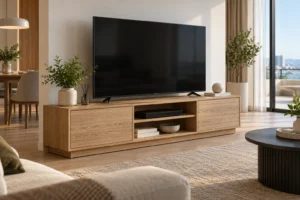
- coordinated wardrobes, desks, TV units, and sideboards;
- simple assembly for installers.
When hundreds of similar apartments are involved, even a 20–30 mm dimensional problem can create installation issues across many rooms. Custom manufacturing allows the cabinet footprint to be coordinated with actual room plans.
Hotels and Serviced Apartments
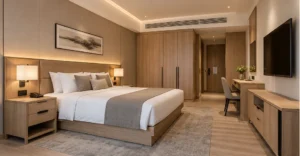
Hospitality storage may need to coordinate with wardrobes, minibar cabinets, desks, luggage units, bedside furniture, TV panels, and bathroom cabinetry.
Finish consistency becomes more important because several furniture items appear in the same room.
Project buyers may also require room-number carton labels, spare hardware kits, replacement panels, phased deliveries, or different cabinet configurations for different room types.
For these requirements, see our project furniture manufacturing solutions for hotel, apartment, rental, office, and commercial programs.
Office and Commercial Interiors
Office storage can require file dimensions, locks, adjustable shelves, cable openings, stronger drawer slides, modular configurations, or compatibility with desks and workstations.
Commercial buyers should specify the intended load and applicable performance requirements instead of assuming that a residential cabinet is suitable.
Organizations supplying business and institutional furniture can also review BIFMA furniture standards and guidance when determining which durability or performance requirements may apply to a particular commercial program.
Retail and E-Commerce
Retail buyers often care more about SKU economics, carton dimensions, consumer assembly, return rates, barcode labels, visual differentiation, and private-label packaging.
In this case, customization must be balanced against volume.
A small design change that increases carton volume or adds another package can erase the commercial benefit of the feature.
That is why factory engineering should consider the product and the package together.
2. Compare Total Landed Cost, Not Only Cabinet Price
One of the most common sourcing mistakes is comparing only FOB unit price.
For B2B cabinet procurement, the better comparison is:
Product cost + packaging + freight + warehousing + installation + damage + replacement parts + project delay risk.
A ready-made cabinet often has the advantage at the beginning. There is no major engineering process, existing materials may already be available, and sampling can be faster.
But the lowest unit price does not always create the lowest project cost.
For example, a standard cabinet may be cheaper at factory level but more expensive commercially if:
- its dimensions waste valuable room space;
- it requires site modification;
- packaging uses excessive container volume;
- several cabinet types must be purchased from different suppliers;
- the finish does not coordinate with other furniture;
- replacement parts are difficult to manage;
- installation takes longer;
- the standard hardware does not meet the project’s expected use.
A custom storage cabinet can therefore justify a higher initial development cost when it reduces downstream expense.
For importers, the correct question is not:
“How much is one cabinet?”
It is:
“What will one installed, saleable cabinet cost after freight, handling, assembly, defects, and replacement support?”
That change in purchasing logic is especially important for multi-unit projects.
3. Materials, Emissions and Compliance Must Match the Destination Market
Material selection should begin with the target market and application.
Typical panel furniture options include:
- plywood;
- MDF;
- particle board;
- melamine-faced board;
- laminated engineered panels;
- veneer-faced panels;
- lacquered MDF;
- combinations of engineered wood, glass, and metal components.
The right material is not necessarily the most expensive option.
A hotel minibar cabinet, office file cabinet, entryway cabinet, residential sideboard, and apartment utility cabinet can require different combinations of surface durability, moisture resistance, screw holding, weight, appearance, and cost.
U.S. Market: Composite Wood Documentation
For products containing hardwood plywood, MDF, or particleboard sold into the United States, procurement teams should review the U.S. Environmental Protection Agency’s requirements for composite wood products.
The EPA confirms that regulated composite wood products and finished goods containing them are subject to TSCA Title VI formaldehyde emission requirements. Buyers importing into the U.S. should therefore define required documentation before approving materials.
Before approving your cabinet specification, review the U.S. EPA Formaldehyde Emission Standards for Composite Wood Products.
Responsible Wood Sourcing
Where a project or retail program requires certified forest-based materials, the procurement specification should identify the required certification and claim from the beginning.
The Forest Stewardship Council explains that Chain of Custody certification tracks certified forest-based material through manufacturing and distribution to finished goods.
Buyers with sustainability requirements can review the FSC Chain of Custody certification framework before finalizing material documentation.
EU-Bound Furniture
Wood and furniture buyers supplying the European market should also monitor the EU Deforestation Regulation and determine whether their products and supply-chain responsibilities fall within its scope.
The European Commission specifically identifies wood and some derived products, including furniture, within the EUDR framework and provides the current implementation timetable and guidance.
For current requirements, buyers can consult the European Commission’s EUDR information page.
Factory-side purchasing lesson: regulatory requirements should be written into the RFQ before quotation, not discussed after production begins.
Changing board suppliers or documentation requirements after approval can affect price, lead time, and material availability.
4. Structure and Hardware Can Matter More Than Appearance
Two cabinets can look nearly identical in a rendering but perform very differently in actual use.
For a project or OEM program, buyers should evaluate details such as:
- panel thickness;
- back-panel construction;
- shelf span;
- shelf load requirement;
- connector type;
- hinge quantity;
- hinge opening angle;
- drawer slide specification;
- anti-tip provision;
- leg construction;
- wall mounting;
- adjustable feet;
- lock system;
- replacement hardware availability.
The structure should match the cabinet’s application.
A low storage cabinet for a living room does not face the same demands as a tall office cupboard with loaded shelves.
Similarly, a cabinet used in a hotel may experience more frequent use than one sold for a lightly used residential room.
Custom production allows the factory to adjust structure according to these conditions rather than forcing every application into the same standard specification.
However, customization should remain commercially sensible.
Adding heavier panels, premium hardware, unnecessary metal reinforcement, or complicated fittings to every component can increase cost and carton weight without producing a meaningful buyer benefit.
The objective is specification optimization, not specification inflation.
5. MOQ: Customization Must Make Production Sense
MOQ is one of the clearest differences between custom and ready-made sourcing.
Ready-made products generally allow easier entry because the supplier can produce the same specification for multiple customers or use established materials and components.
Custom cabinets require more preparation.
Depending on the program, this may include:
- CAD or drawing review;
- new cutting files;
- special board colors;
- custom hardware;
- packaging artwork;
- labels;
- instruction manuals;
- samples;
- production setup.
For this reason, buyers should discuss MOQ at two levels:
MOQ Per SKU
How many units of one cabinet configuration are required?
MOQ Per Material or Finish
A project may include several cabinet sizes using one common board color and hardware family. Combining material specifications can sometimes improve purchasing and production efficiency even when individual SKU quantities vary.
For our export furniture programs, bulk production is normally planned with commercial production efficiency and container loading in mind. Sample quantities or development orders can be discussed separately from normal repeat-order economics.
The best RFQ therefore includes expected quantity per SKU plus expected total project or annual volume.
That information allows the factory to propose a more realistic manufacturing plan.
6. Lead Time: Ready-Made Wins on Speed, Custom Wins on Control
If a buyer needs an available standard cabinet quickly, ready-made furniture normally has the advantage.
Custom development includes more approval stages.
A typical timeline may involve:
RFQ → technical review → quotation → drawing confirmation → material confirmation → sample → sample approval → bulk production → QC → packing → loading
The exact production lead time depends on:
- quantity;
- number of SKUs;
- board availability;
- finish requirements;
- hardware;
- packaging;
- sample changes;
- project phasing;
- production schedule.
This is why professional project buyers should separate sample lead time from mass-production lead time.
They should also allow time for approval.
A factory cannot responsibly treat an unapproved sample as approved merely because the project schedule has become tight.
For hotel and apartment projects, procurement teams should work backward from the required installation date, including ocean freight, customs clearance, inland delivery, site storage, and installation.
A well-planned custom program usually gives the buyer more control.
A poorly planned custom program simply creates unnecessary urgency.
7. Packaging Can Change the Economics of the Entire Order
For export furniture, a cabinet is not finished when production ends.
It is finished when it can survive handling and reach the customer in usable condition.
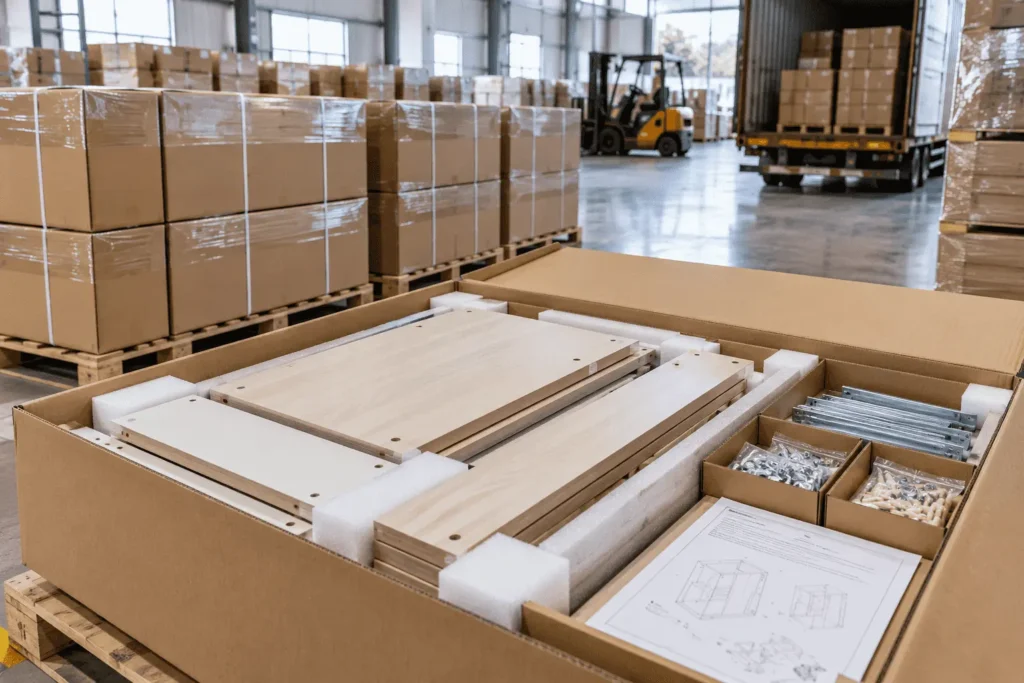
Flat-pack or KD construction can reduce shipping volume and improve container utilization, but only when the structure and packaging are designed together.
Factory packaging review can include:
- carton dimensions;
- gross weight;
- panel protection;
- corner protection;
- hardware separation;
- foam or protective materials where required;
- numbered components;
- assembly instructions;
- spare hardware;
- carton marks;
- barcode labels;
- private-label artwork;
- pallet requirements;
- container loading sequence.
For buyers wanting a recognized reference for distribution testing, the International Safe Transit Association publishes packaging test procedures, including a procedure specifically addressing packaged furniture products transported as case goods.
See the ISTA packaged-product testing procedures when determining whether transit testing should form part of your program.
If raw-wood pallets, crates, or dunnage are used, international buyers should also confirm applicable phytosanitary requirements. The International Plant Protection Convention’s ISPM 15 addresses raw-wood packaging used in international trade; processed materials such as plywood are treated differently under the standard.
Procurement teams can review the IPPC ISPM 15 guidance for wood packaging material.
A cheaper cabinet that requires inefficient or fragile packaging can become a more expensive import.
Packaging is therefore a procurement specification—not an afterthought.
8. Custom Cabinets Give Brands More Market Differentiation
For wholesalers and furniture brands, custom sourcing is not only about fitting a room.
It can prevent a product range from becoming identical to competitors’ catalogues.
Customization can create commercial differentiation through:
- exclusive dimensions;
- door profiles;
- drawer combinations;
- color programs;
- handles;
- legs;
- glass details;
- open and closed storage combinations;
- modular configurations;
- branded packaging;
- private-label instructions;
- market-specific sizes.
The strongest OEM programs do not customize every component unnecessarily.
They focus on the features customers notice and value while standardizing hidden components where possible.
For example, several cabinet SKUs can share the same hinge family, drawer slides, shelf pins, connectors, panel thicknesses, and finish system.
This gives the buyer visible product differentiation while helping the factory maintain production efficiency.
That is generally more scalable than creating a completely unique technical system for every SKU.
Our custom furniture manufacturing capability supports buyers that already have CAD drawings as well as buyers who require ODM development from concepts, reference images, or project requirements.
9. Repeatability Is Often More Important Than the First Order
A successful B2B cabinet program is not measured only by whether the first shipment looks good.
The real test comes with the second, third, and later orders.
Can the factory reproduce:
- the board color;
- dimensions;
- drilling positions;
- hardware;
- edge treatment;
- assembly method;
- carton configuration;
- labels;
- instructions;
- replacement parts?
This is where custom manufacturing requires stronger documentation.
Approved drawings, material specifications, hardware references, packing requirements, labeling, and quality standards should become part of the production record.
Repeatability matters particularly for:
- hotel expansion programs;
- apartment developments delivered in phases;
- replacement furniture;
- distributor stock programs;
- retail collections;
- e-commerce replenishment;
- private-label products.
A slightly lower initial price is not valuable if the next order arrives with a noticeably different finish or incompatible hardware.
For long-term buyers, supplier consistency usually creates more value than a one-time quotation difference.
Where Custom Storage Cabinets Work Best
Hotel Furniture Projects
Custom storage is appropriate when cabinets must coordinate with bedroom furniture, wardrobes, desks, TV units, minibars, vanities, or luggage furniture.
The buyer gains control over dimensions, finish, hardware, room-type variation, and phased delivery.
Apartment and Multi-Family Projects
Apartment developers often need compact products adapted to floor plans.
A custom storage cabinet can combine functions, reduce wasted space, and coordinate visually with wardrobes, kitchens, desks, TV cabinets, and entryway furniture.
Student Housing
Student accommodation commonly prioritizes compact size, simple maintenance, replaceable hardware, stable construction, wall fixing, and cost control.
Standardizing common components across several room products can make the program easier to manage.
Office and Commercial Projects
Commercial storage often requires specific shelf spacing, filing dimensions, locking functions, modular configurations, or stronger hardware.
Performance requirements should be confirmed before quotation.
Importers, Wholesalers and Furniture Brands
Custom production helps buyers create market-specific product ranges instead of buying exactly the same catalogue item as other distributors.
For direct product development, buyers can review our OEM cabinet manufacturing options for modular, flat-pack, filing, side, entryway, and multi-functional storage cabinets.
Material Selection for a Custom Storage Cabinet
Material choice should follow the target specification rather than a simple “plywood is better” or “MDF is cheaper” rule.
Plywood
Plywood can be selected when structural strength, screw holding, or specific market positioning makes it commercially appropriate.
The grade, veneer structure, thickness, surface finish, and certification requirement should be defined clearly.
MDF
MDF offers a smooth and consistent surface and can work well for painted, laminated, or decorative applications.
Buyers should specify density, thickness, finish, intended environment, and relevant emission requirements.
Particle Board
Particle board is widely used for cost-controlled flat-pack furniture and melamine cabinet programs.
Good engineering, edge finishing, connector selection, and packaging remain important.
A lower-cost board does not automatically mean a poor cabinet; incorrect specification is usually a bigger problem than material name alone.
Melamine-Faced Panels
Melamine surfaces are practical for many apartment, office, retail, rental, and hospitality applications because they can offer a repeatable decorative surface and straightforward maintenance.
Finish availability and batch consistency should be considered for repeat projects.
Hardware
Cabinet hardware can include standard or buyer-specified hinges, drawer slides, handles, connectors, locks, shelf supports, leveling feet, wall-fixing kits, and other fittings.
Where branded hardware is required, it should be identified in the RFQ so quotation is based on the correct specification.
Our OEM/ODM Custom Storage Cabinet Process
As a China-based panel furniture manufacturer, Starwood Industry Co., Ltd. supports OEM and ODM furniture programs for importers, wholesalers, furniture brands, e-commerce sellers, and commercial projects. The company has focused on panel furniture manufacturing since 2013.
You can review our factory and company profile before starting a sourcing program.
A practical custom cabinet workflow is:
Step 1 — Send the Project Brief
Provide available information such as:
- drawings or CAD files;
- reference photos;
- dimensions;
- quantities;
- target market;
- target price;
- material requirements;
- finishes;
- hardware;
- packaging;
- compliance requirements.
Step 2 — Factory Feasibility Review
We review whether the proposed design is suitable for panel processing, flat-pack construction, assembly, packing, and bulk production.
Where necessary, practical adjustments can be suggested.
Step 3 — Material and Hardware Confirmation
The board, thickness, finish, edge banding, hinges, slides, handles, legs, locks, and accessories are aligned before final quotation.
Step 4 — Quotation
Pricing is calculated against the confirmed specification instead of relying only on a reference photograph.
This produces a more useful commercial comparison.
Step 5 — Drawing and Sample Development
For new OEM/ODM programs, production drawings and samples can be prepared for approval.
Step 6 — Buyer Approval
Dimensions, appearance, construction, hardware, packing, and other relevant details should be approved before bulk production.
Step 7 — Mass Production and Quality Control
Production follows the approved specification, with quality checks incorporated into the manufacturing process.
Step 8 — Flat-Pack Packing and Shipment Preparation
Carton marks, parts, hardware, instructions, protective packaging, and loading requirements are checked according to the order.
This complete process is part of our OEM and ODM panel furniture manufacturing service.
MOQ, Lead Time and Packaging: What Buyers Should Confirm Before Ordering
MOQ
Do not request only “your MOQ.”
Send:
SKU + quantity per SKU + total project quantity + expected repeat volume.
This gives the factory enough information to evaluate material purchasing, production setup, and container loading.
Bulk export orders are normally planned around efficient production and shipment quantities, while sampling and development requirements are evaluated separately.
Lead Time
Ask the supplier to separate:
- drawing confirmation;
- material preparation;
- sample time;
- sample approval;
- bulk manufacturing;
- packaging;
- shipment readiness.
The final schedule depends on specification and quantity.
Do not base a project program on a generic catalogue lead time if the cabinet is customized.
Packaging
Specify whether you require:
- KD / RTA flat-pack;
- retail packaging;
- project packaging;
- private label;
- barcode labels;
- carton marks;
- room or unit identification;
- assembly instructions;
- spare fittings;
- palletized loading.
A serious export quotation should consider how the product will travel, not just how it will leave the production line.
How to Send a Better Custom Storage Cabinet RFQ
A useful RFQ does not have to be complicated.
The following information gives a factory enough direction to start a professional review:
Product: Storage cabinet
Application: Hotel / Apartment / Office / Retail / Student Housing / Other
Dimensions: Width × Depth × Height
Quantity: Units per SKU
Material: Plywood / MDF / Particle Board / Other
Finish: Melamine / Laminate / Veneer / Paint / Other
Hardware: Standard or specified brand/model
Internal Layout: Shelves / Drawers / Hanging / Locks / Other
Structure: Assembled or RTA / flat-pack
Target Market: Country or region
Compliance: Required standards or documentation
Packaging: Export / Retail / Private Label / Project
Branding: Logo, carton mark, barcode, manual
Target Delivery: Required shipment or installation schedule
Reference: CAD, drawing, photo, BOQ, room layout, or existing sample
Providing these details normally creates a much more meaningful quotation than sending a photograph with the message:
“Please quote your best price.”
Custom Storage Cabinet or Ready-Made: Which Is Better?
Choose ready-made storage cabinets when:
- speed is the main priority;
- quantities are small;
- existing dimensions already fit;
- no exclusive finish is needed;
- standard packaging is acceptable;
- development cost needs to remain minimal.
Choose a custom storage cabinet when:
- dimensions must match room layouts;
- the program includes multiple coordinated furniture items;
- material or compliance requirements are specified;
- a private-label collection is being developed;
- finish consistency is important;
- hardware needs to be controlled;
- packaging must be optimized;
- containers or project phases must be planned;
- repeat-order consistency matters.
For many professional B2B buyers, the best solution is actually a hybrid.
Use standardized manufacturing platforms, hardware, and panel specifications wherever possible, but customize the visible dimensions, layouts, functions, finishes, and branding that create commercial value.
This approach combines OEM flexibility with production efficiency.
Why Work With a Panel Furniture Export Factory?
For international buyers, cabinet sourcing involves much more than cabinet construction.
A capable panel furniture export factory should understand:
- engineering;
- panel processing;
- repeat production;
- OEM/ODM development;
- commercial furniture requirements;
- flat-pack construction;
- quality control;
- export packaging;
- private labeling;
- project schedules;
- container loading.
Working with one manufacturing partner can also help coordinate storage cabinets with wardrobes, desks, sideboards, TV stands, kitchen cabinets, bathroom cabinets, and other panel furniture.
Starwood positions its manufacturing around OEM and ODM panel furniture for brands, importers, wholesalers, and project buyers, with production and export support from sampling through bulk shipment.
For a broader view of the factory’s manufacturing focus, visit our flat-pack furniture manufacturer homepage.
Request a Custom Storage Cabinet Quotation
If you are comparing a standard cabinet with an OEM alternative, send us your drawings, dimensions, product photos, BOQ, material requirements, target quantity, target market, and packaging requirements.
We can review the project from a manufacturing perspective and help you evaluate:
structure, materials, cost, MOQ, production feasibility, flat-pack packaging, container efficiency, and repeat-order production.
For hotel, apartment, rental, office, wholesale, retail, or private-label programs, start with our OEM & ODM furniture manufacturing service or project furniture manufacturing capability.
Send your cabinet drawings or project requirements and request a factory-direct OEM quotation.
FAQ
What is a custom storage cabinet?
A custom storage cabinet is manufactured according to buyer-defined dimensions, internal layout, materials, finishes, hardware, branding, packaging, or project requirements rather than being limited to one standard catalogue specification.
Are custom storage cabinets more expensive than ready-made cabinets?
Not always when total project cost is considered. Customization can add development or material cost, but it may reduce installation work, improve room fit, increase container efficiency, consolidate suppliers, or reduce replacement and coordination problems. Buyers should compare total landed and installed cost rather than FOB unit price alone.
What is the MOQ for OEM storage cabinets?
MOQ depends on cabinet design, material, finish, hardware, SKU quantity, and total order volume. For export programs, production is normally evaluated around commercially efficient bulk manufacturing and shipment quantities. Buyers should provide quantity per SKU and total project volume for an accurate assessment.
How long does custom cabinet production take?
Lead time depends on engineering work, material availability, sampling, number of SKUs, order volume, hardware, finish, packaging, and production scheduling. Buyers should confirm separate sample and bulk-production timelines after specifications have been reviewed.
Can storage cabinets be customized for hotel and apartment projects?
Yes. Typical project customization includes cabinet dimensions, internal layout, panel material, finish, hardware, locks, adjustable shelving, wall fixing, room labels, flat-pack construction, packaging, and coordination with other furniture in the room.
What materials can be used for custom storage cabinets?
Common materials include plywood, MDF, particle board, melamine-faced panels, laminated boards, veneer-faced panels, and combinations with glass or metal components. The right choice depends on target cost, market requirements, finish, intended use, and required documentation.
Can you manufacture flat-pack or RTA storage cabinets?
Yes. Flat-pack construction is suitable for many export, retail, apartment, office, and e-commerce programs. Cabinet structure and packaging should be developed together to balance assembly, carton dimensions, protection, and container efficiency.
Can buyers provide their own cabinet drawings?
Yes. OEM buyers can submit CAD files, drawings, samples, specifications, or existing designs. ODM buyers can also provide reference images, room plans, target prices, and functional requirements for further development.
What should I send to get an accurate storage cabinet quotation?
Send dimensions, quantities, application, target market, preferred material, finish, hardware requirements, packaging requirements, compliance needs, drawings or reference photos, and the expected delivery schedule. The more complete the specification, the more meaningful the quotation.
Recommended Internal Links
Homepage anchor: Flat-Pack Furniture Manufacturer
Target: PlywoodMFR homepage
Factory / Company anchor: Panel Furniture Factory in China
Target: Factory & Company Profile
Custom manufacturing anchor: Custom Furniture Manufacturing
Target: Custom Furniture Manufacturing Services
Service anchor: OEM & ODM Furniture Manufacturing Services
Target: OEM & ODM Furniture Manufacturing Services
Project anchor: Project Furniture Manufacturer
Target: Project Furniture Manufacturing
Product-page anchor: OEM cabinet
Target: Multi-Functional Storage Cabinet Manufacturer
Recommended CTA
Primary CTA:
Send us your cabinet drawings, dimensions, quantity, material requirements, target market, and packaging specifications to receive a factory-direct OEM quotation.
Secondary CTA:
Planning a hotel, apartment, office, retail, or private-label furniture program? Contact our OEM/ODM team to evaluate custom storage cabinet specifications, MOQ, lead time, packaging, and bulk production.
Product CTA Anchor:
OEM cabinet
CTA Destination:
OEM cabinet manufacturing page