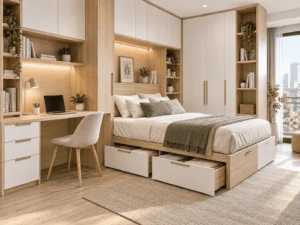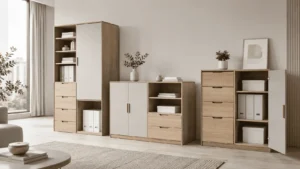
For furniture importers, wholesalers, private-label brands and project contractors, Storage Cabinets are not simply products for keeping a room organized. They are a procurement category that must balance usable storage, panel cost, cabinet strength, flat-pack efficiency, installation, packaging volume, target-market requirements and repeat-order consistency. A cabinet that looks attractive in a catalog can still create serious commercial problems if the door alignment is unstable, shelves are underspecified, the carton is too large, assembly takes too long or the finish cannot be reproduced consistently. As a panel furniture export manufacturer, we approach multi-purpose storage cabinets from the buyer’s side: application, specifications, manufacturing feasibility, MOQ, lead time, quality control and landed-cost efficiency.
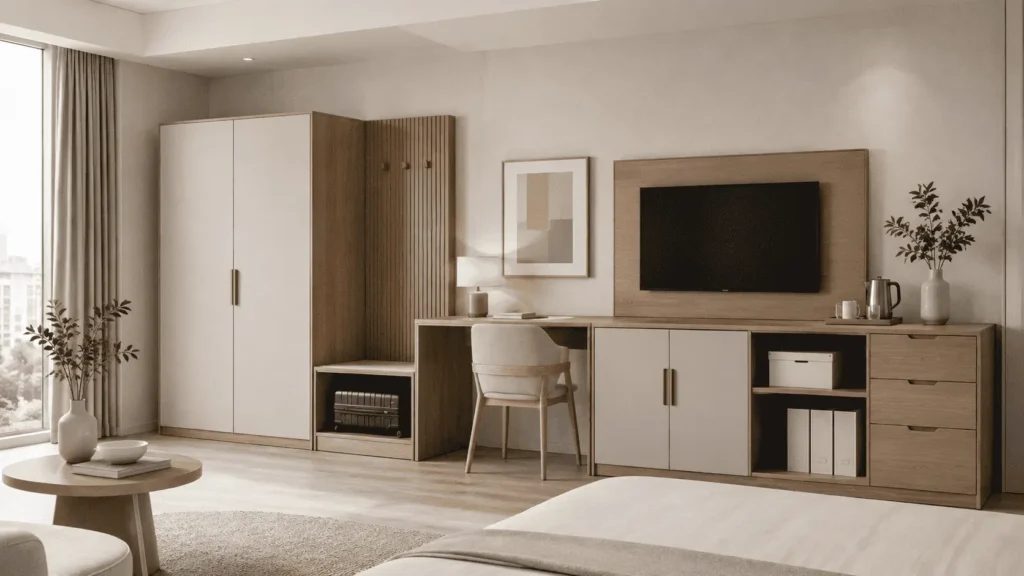
Table of Contents
- Define the Storage Cabinet Application Before Quotation
- Select Panel Materials and Finishes by Market Position
- Engineer Cabinet Construction and Hardware for Repeat Use
- Build Multi-Purpose Storage Around Real Organization Needs
- Plan OEM/ODM Customization Before Sampling
- Confirm MOQ, Cost Drivers and Production Lead Time
- Control Export Packaging, Testing and Project Delivery
- Storage Cabinets for Apartments, Hotels and Commercial Projects
- Our Panel Furniture Factory Capability
- What Buyers Should Include in a Storage Cabinet RFQ
- Frequently Asked Questions
1. Define the Storage Cabinet Application Before Quotation
One of the most common sourcing mistakes is sending a reference image to a factory and asking only:
“What is your best price?”
Before pricing a storage cabinet, a manufacturer needs to understand where the cabinet will be used, who will buy it and how it will be distributed.
The same visual design may require a very different specification for an online furniture brand than for a hotel, apartment project or office furnishing program.
Retail and Wholesale Storage Cabinet Programs
For importers, furniture chains, wholesalers and distributors, the priorities are usually repeatability and assortment planning.
A commercially practical storage cabinet program should consider:
- standard dimensions that work across multiple markets;
- coordinated finishes across related furniture;
- repeatable hinges, drawer slides and connectors;
- efficient carton dimensions;
- clear assembly instructions;
- replacement hardware availability;
- barcode and private-label requirements;
- predictable cost when the model is reordered.
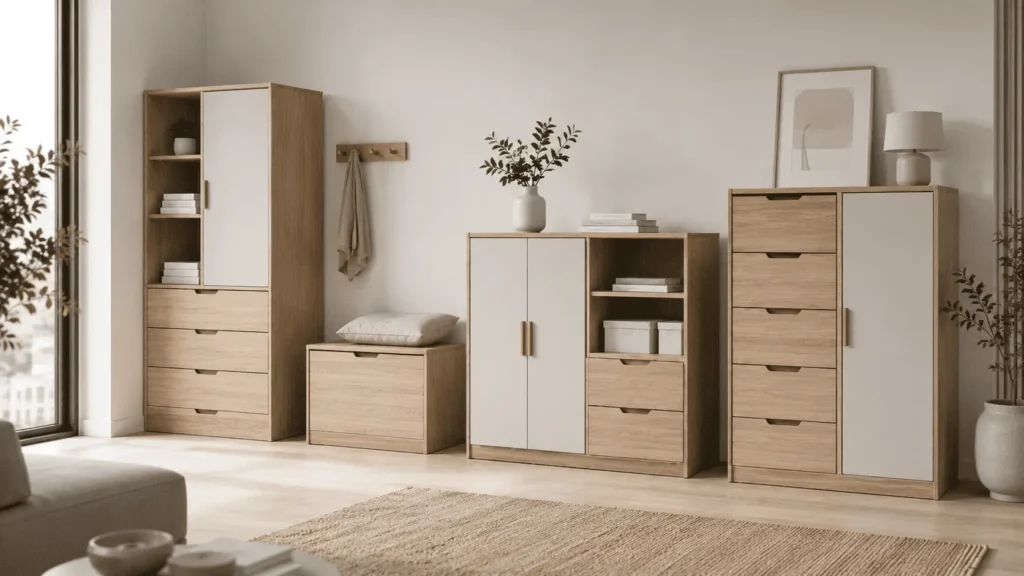
Instead of developing one isolated cabinet, buyers can often create a coordinated collection consisting of a narrow two-door cabinet, a wider drawer-and-door unit, a low storage cabinet and a vertical storage tower.
This approach gives retailers more selling options while allowing the factory to share board finishes, hardware and packaging components across several SKUs.
For buyers comparing ready-to-develop models, our multi-purpose storage cabinets product range can be used as the starting point for OEM discussion. View our Multi-Functional Storage Cabinet manufacturing range
Apartment and Rental Housing Projects
Storage is particularly important in apartments because one cabinet often needs to perform more than one function.
A compact unit may need to serve as:
- entryway storage;
- linen storage;
- utility storage;
- bedroom organization;
- dining-room storage;
- home-office filing;
- general household storage.
For multi-unit developments, the best cabinet is not necessarily the model with the most components. Every additional shelf, drawer, fitting and installation step is multiplied across the entire project.
The factory should therefore engineer the cabinet around the actual usage requirement rather than adding unnecessary specification.
Hotels and Serviced Apartments
Hotel and serviced-apartment projects usually require a stronger balance between appearance, durability, housekeeping access and installation efficiency.
A storage cabinet may be specified for a guest room, minibar area, wardrobe zone, housekeeping area, serviced-apartment kitchen, hallway or back-of-house space.
Project buyers should confirm the room layout, available wall space, loading requirement, door clearance, required finish and installation sequence before approving dimensions.
For broader hospitality and apartment packages, buyers can also review our project furniture manufacturing capability for coordinated room furniture rather than sourcing each cabinet independently.
2. Select Panel Materials and Finishes by Market Position
The phrase “wooden storage cabinet” is not a sufficient material specification for a professional RFQ.
Two cabinets with nearly identical photographs may have significantly different costs because of panel type, thickness, surface finish, edge treatment, back-panel construction and hardware specification.
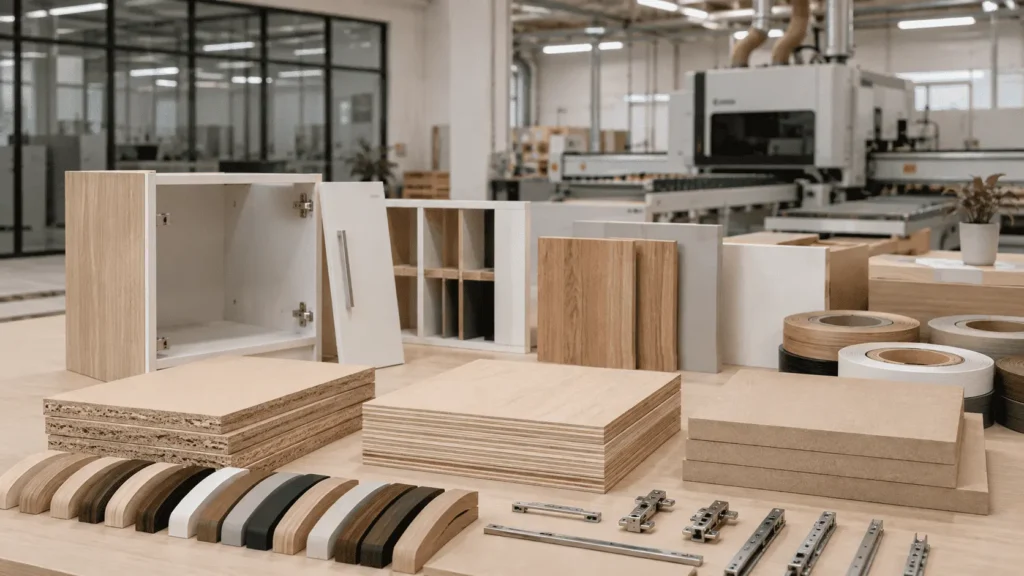
Particle Board for Cost-Efficient Volume Programs
Particle board is widely used for value-oriented flat-pack storage cabinets because it supports efficient panel production, melamine finishing and repeatable large-volume manufacturing.
It is often suitable for:
- retail furniture programs;
- online furniture;
- apartment furnishing;
- rental housing;
- student accommodation;
- general home organization cabinets.
However, board density, thickness and screw-holding requirements should be matched to the cabinet structure.
A taller cabinet or heavily loaded adjustable shelf may require a different engineering solution from a compact bedside storage unit.
MDF for Detailed Finishes and Painted Components
MDF can be useful where the buyer requires smooth surfaces, routed details, painted doors or specific decorative profiles.
Typical applications include:
- painted storage cabinets;
- decorative doors;
- drawer fronts;
- bathroom-related storage where the specification is appropriate;
- higher-value residential furniture collections.
Buyers should not simply request MDF because it sounds more premium. The correct decision depends on finish, structure, target cost, transport weight and end-use environment.
Plywood for Selected Structural Requirements
Plywood may be used where the design, market position or technical specification justifies it.
Because plywood generally carries a different material cost from standard particle board, it is important to identify where plywood adds purchasing value rather than automatically specifying it throughout the cabinet.
A practical OEM strategy can combine different engineered panel materials according to structural and visual requirements.
Melamine, Laminate, Veneer and Painted Finishes
Finish affects much more than appearance.
It influences:
- raw-material sourcing;
- color consistency;
- scratch resistance;
- edge treatment;
- production sequence;
- MOQ;
- sample development;
- packaging protection;
- future repeat-order matching.
For price-sensitive programs, melamine finishes often provide a practical balance between appearance and production efficiency.
For more decorative programs, buyers may consider veneer, laminate or painted components according to their target price and design brief.
Composite-Wood Compliance Should Be Confirmed Before Production
For U.S.-bound programs using hardwood plywood, MDF or particleboard, buyers should identify applicable composite-wood requirements during RFQ and material approval—not after mass production. The U.S. Environmental Protection Agency explains that TSCA Title VI regulates relevant composite wood panels and finished goods containing them. U.S. EPA — Formaldehyde Emission Standards for Composite Wood Products
For products intended for California, buyers should also review the California Air Resources Board composite wood products program, which covers hardwood plywood, particleboard, MDF and finished goods such as cabinets. California Air Resources Board — Composite Wood Products Program
Where a sourcing program requires certified forest materials, procurement teams can additionally review the Forest Stewardship Council’s Chain of Custody framework and specify the required certification/documentation during quotation. FSC — Chain of Custody Standards
The important factory principle is simple:
Compliance must become part of the material specification before the purchase order is released.
3. Engineer Cabinet Construction and Hardware for Repeat Use
A good storage cabinet is not defined by the front view alone.
For B2B buyers, the more important questions are often hidden inside the cabinet.
Shelf Loading and Shelf Span
Wide shelves can gradually deflect when panel thickness or support design is insufficient for the intended load.
During development, buyers should clarify what the shelves are expected to hold:
- clothing;
- books;
- files;
- kitchenware;
- toys;
- household supplies;
- hotel amenities;
- office materials.
A narrow decorative shelf and a wide book-storage shelf should not automatically use the same specification.
Adjustable shelf positions also need to be planned carefully. Too many drilling holes can affect appearance, while too few limit usability.
Door Alignment
Tall or wide cabinet doors quickly reveal drilling and assembly inconsistencies.
Factory QC should evaluate:
- hinge drilling position;
- uniform door gaps;
- door height alignment;
- opening clearance;
- handle position;
- soft-close operation where specified;
- cabinet squareness.
For new OEM designs, buyers should inspect a fully assembled sample rather than approving only separate panels.
Drawer Systems
Drawer cabinets require additional attention because every moving component introduces another possible source of after-sales complaints.
The RFQ should clarify:
- number of drawers;
- usable internal drawer dimensions;
- drawer slide type;
- standard or soft-close mechanism;
- drawer-bottom construction;
- maximum expected load;
- anti-pullout requirements where applicable.
A cheaper slide does not always produce the lowest total cost if it creates alignment problems or warranty claims.
Back Panel Construction
The back panel is frequently overlooked during sourcing discussions.
However, it can influence cabinet rigidity, installation and packing.
Depending on the design, common solutions may include groove-mounted back panels, nailed back panels or other knock-down structures.
The appropriate construction should be selected according to product dimensions, assembly method and target cost.
Anti-Tip and Installation Considerations
Tall storage furniture should be evaluated for stability and appropriate installation according to product type and destination-market requirements.
When relevant, the buyer should specify wall-fixing or anti-tip hardware, installation instructions and any required performance testing.
For professional storage-unit evaluation, ISO 7170:2021 provides test methods covering strength, durability and stability of fully assembled storage units. ISO 7170:2021 — Furniture Storage Units
For commercial and institutional applications, buyers may also reference the relevant BIFMA requirements. BIFMA describes ANSI/BIFMA X5.9 as a storage-unit standard providing test methods for freestanding, mobile and wall-mounted units. BIFMA — Storage Unit Standards Descriptions
Testing requirements should always be confirmed for the exact product, market and project rather than assumed from a similar cabinet.
4. Build Multi-Purpose Storage Around Real Organization Needs
“Multi-purpose” should describe functionality—not simply be added as a marketing word.
For an OEM furniture program, every storage zone should answer a real user need.
Door-and-Shelf Cabinets
This is one of the most flexible configurations for home organization.
Adjustable internal shelves allow one cabinet platform to work for:
- living rooms;
- dining rooms;
- bedrooms;
- rental apartments;
- hotel suites;
- utility areas.
The advantage for B2B buyers is that one basic cabinet construction can be adapted through dimensions, door design, finish and internal shelf positions.
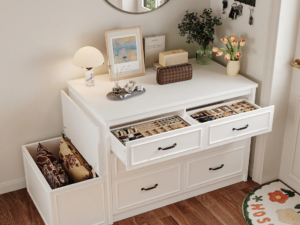
Drawer-and-Door Combination Cabinets
Combining concealed shelves with drawers creates more organized storage while increasing the perceived retail value of the product.
However, more drawers also mean:
- additional hardware;
- more drilling operations;
- more components;
- more assembly steps;
- larger hardware packs;
- higher production and QC cost.
Buyers should therefore compare the selling benefit against the incremental manufacturing cost.
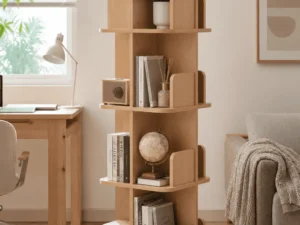
Vertical Storage Towers
Tall, narrow cabinets are useful where floor area is limited.
They work especially well for:
- urban apartments;
- entryways;
- compact kitchens;
- home offices;
- student rooms;
- serviced apartments.
For tall cabinets, stability and wall-fixing requirements need additional attention.
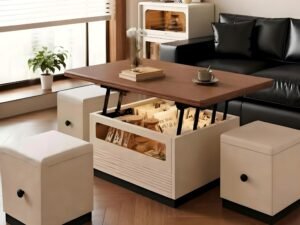
Modular Storage Cabinets
Modular programs can be particularly valuable to importers and furniture brands.
Instead of sourcing unrelated products, buyers can develop several modules sharing:
- panel finish;
- edge banding;
- handles;
- legs;
- hinge specifications;
- shelf systems;
- packaging graphics.
This simplifies collection management and helps create a recognizable furniture family.
It can also improve purchasing efficiency when several models share common materials.
Entryway Organization
Entryway cabinets may combine shoe storage, drawers, shelving, hooks or open compartments.
For project buyers, entryway furniture can also be coordinated with wardrobes and other apartment furniture to create one consistent finish package.
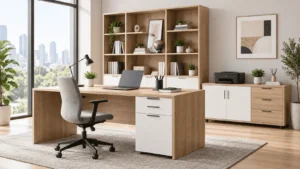
Home-Office Organization
Storage cabinets for home offices may require different internal dimensions from general household storage.
Buyers should consider:
- files and document sizes;
- printer storage;
- adjustable shelves;
- cable access;
- lockable sections;
- drawer configuration.
This is why defining the application before quotation is more important than simply selecting a cabinet photograph.
5. Plan OEM/ODM Customization Before Sampling
OEM and ODM storage cabinet development works best when the buyer sends a commercial brief rather than only a mood board.
If you already have a product design, dimensions or sample, an OEM storage cabinet manufacturer can review the construction and adapt it for scalable production.
If you are developing a new collection, the ODM process can begin with target market, target price, function, style direction and shipping requirements.
Our broader OEM & ODM furniture manufacturing services cover product development from specification review and sampling through production, QC, packing and shipment.
What Can Be Customized?
Typical storage cabinet customization can include:
- width, depth and height;
- internal shelf layout;
- doors and drawer configuration;
- panel material;
- board thickness;
- melamine or decorative finish;
- color and texture;
- edge banding;
- handles;
- hinges;
- drawer slides;
- legs or plinth;
- glass components where required;
- cable openings;
- knock-down structure;
- private-label cartons;
- barcode labels;
- assembly instructions;
- hardware bags.
The commercial objective should not be “customize everything.”
It should be:
Customize the details that create market value while standardizing the details that improve cost and production consistency.
Sample Approval Should Cover More Than Color
A sample review should include:
- external dimensions;
- cabinet squareness;
- door and drawer gaps;
- shelf fit;
- finish and color;
- edge quality;
- hardware function;
- assembly sequence;
- assembled stability;
- packaging concept.
For a new flat-pack cabinet, we also recommend carrying out an assembly trial using the same type of instructions and hardware organization intended for the final customer.
A product that is easy for the factory technician to assemble may not be equally easy for an installer or retail customer seeing it for the first time.
Freeze the Specification Before Bulk Production
One of the biggest causes of sourcing problems is allowing a sample to enter production while materials, fittings or packaging are still changing.
Before bulk manufacturing, buyers should approve a final specification that identifies:
- dimensions;
- materials;
- finish reference;
- hardware;
- construction;
- carton requirements;
- markings;
- instructions;
- required testing;
- approved sample.
This becomes the reference point for QC and future repeat orders.
6. Confirm MOQ, Cost Drivers and Production Lead Time
Professional buyers should treat MOQ and lead time as part of product engineering rather than separate sales questions.
MOQ for Storage Cabinet Programs
Our current factory positioning is based on container-scale export business; the website states a minimum order quantity of one container. The exact number of units per model, mixed-SKU possibilities and loading plan should be reviewed during quotation because cabinet dimensions and carton volume directly affect container quantity.
For example, combining several models may be easier when they use the same:
- panel finish;
- hardware;
- edge banding;
- packaging specification;
- production process.
A highly customized low-volume SKU with a unique painted color may create different MOQ requirements from a standard melamine cabinet.
Therefore, instead of asking only “What is the MOQ?”, buyers should ask:
What MOQ gives the most efficient material purchasing and container loading for this collection?
Main Storage Cabinet Cost Drivers
Factory pricing is normally influenced by:
- cabinet dimensions;
- panel material and thickness;
- finish;
- number of doors;
- number of drawers;
- hinge specification;
- drawer slides;
- metal legs or frames;
- glass components;
- internal shelves;
- special hardware;
- packaging requirements;
- order volume;
- testing or documentation;
- labeling and private-label requirements.
A reference photograph cannot communicate all of these variables.
For an accurate quotation, provide the target specification first.
Lead Time Should Be Confirmed After Specification Approval
Production lead time depends on the final material, finish, quantity, packaging and current production plan.
For new OEM projects, the complete timeline should separate:
Technical review → quotation → sample → sample approval → material preparation → mass production → QC → packing → container loading.
Buyers should avoid treating a preliminary sales estimate as the final shipment commitment before the sample and specification are frozen.
If a project has a fixed installation date, tell the manufacturer at the RFQ stage.
The factory can then work backwards from the required delivery window and identify which activities—sampling, finish confirmation, packaging development or testing—are on the critical path.
7. Control Export Packaging, Testing and Project Delivery
For flat-pack storage cabinets, packaging is part of the product.
A cabinet can pass factory inspection and still generate losses if long panels are insufficiently protected or hardware is allowed to move inside the carton.
Flat-Pack Engineering for Export
A well-engineered RTA or KD storage cabinet should be designed with both manufacturing and shipping in mind.
Important considerations include:
- panel size;
- carton dimensions;
- carton weight;
- vulnerable edges and corners;
- glass protection where applicable;
- hardware positioning;
- assembly instructions;
- carton opening sequence;
- container loading efficiency.
Large one-piece panels may make assembly simpler but can increase carton size and damage exposure.
Dividing the structure into too many pieces may reduce panel length but increase drilling, hardware and assembly complexity.
The factory must find the commercial balance.
Export Carton Protection
Depending on the product and buyer specification, a packaging plan may include:
- corrugated export carton;
- edge and corner protection;
- foam or other protective materials where required;
- panel separation;
- hardware bags;
- component identification;
- assembly instructions;
- carton labels;
- barcode labels;
- private-label printing.
Packaging should be checked on the actual product-package combination, not evaluated only by carton material.
For buyers who require formal distribution testing, the International Safe Transit Association publishes different packaged-product testing procedures. Its 3-Series protocols are general simulation tests designed around transport hazards such as handling and vibration, with the appropriate procedure selected according to the distribution system. ISTA — Test Procedures for Packaged Products
The correct ISTA procedure should be specified by the buyer or agreed according to the actual distribution channel.
Container Loading Is a Purchasing Metric
Unit factory price alone does not determine landed cost.
For flat-pack furniture, carton cube affects:
- units per container;
- ocean freight cost per unit;
- warehouse efficiency;
- handling;
- final distribution cost.
During OEM development, reducing unnecessary carton volume can sometimes create more purchasing value than making a minor reduction in board cost.
This is why a professional panel furniture export factory should consider packaging engineering during product development rather than after production is complete.
Bulk Quality Control
For storage cabinets, a practical QC checklist should include:
- finished dimensions;
- board and finish confirmation;
- edge banding;
- drilling accuracy;
- surface defects;
- color consistency;
- door alignment;
- drawer alignment;
- hardware function;
- shelf fit;
- cabinet stability;
- assembly test;
- hardware quantity;
- carton contents;
- labeling;
- packaging protection.
A golden sample or final approved specification should be available as the production reference.
Storage Cabinets for Apartments, Hotels and Commercial Projects
Storage cabinet sourcing becomes more complex when it is part of a complete project rather than a single retail SKU.
Our project furniture manufacturing capability is designed for buyers who need coordinated panel furniture for apartments, rental housing, hotels, serviced apartments, offices and student accommodation.
Apartment Furniture Projects
Apartment buyers often need storage products across several areas:
- bedroom wardrobes;
- entryway storage;
- TV cabinets;
- sideboards;
- shoe cabinets;
- bathroom storage;
- kitchen storage;
- desks;
- general utility cabinets.
Using coordinated panel finishes and hardware across these products can simplify procurement and create a more consistent interior.
Hotel and Serviced-Apartment Projects
For hospitality buyers, storage cabinets may need to coordinate with:
- wardrobes;
- minibar cabinets;
- luggage racks;
- TV panels;
- writing desks;
- bedside tables;
- bathroom cabinets.
Rather than purchasing each item independently, a project buyer can issue a room furniture package with coordinated finishes and technical requirements.
Student Housing
Student accommodation typically prioritizes compact dimensions, straightforward assembly, cost control and practical durability.
Multi-purpose storage cabinets can help make better use of limited room area while reducing the number of separate furniture pieces.
Office and Commercial Furniture
For office applications, the specification may shift toward files, documents, stationery, equipment and lockable storage.
Commercial buyers should confirm whether a relevant institutional or storage performance standard is required before quotation.
Our Panel Furniture Factory Capability
We position storage cabinet manufacturing as part of a wider commercial furniture manufacturer and OEM/ODM panel furniture supply capability, rather than as an isolated home-storage product.
Buyers can start by reviewing our flat-pack furniture manufacturing platform and our panel furniture factory profile.
For storage cabinet programs, our manufacturing approach focuses on:
- OEM and ODM product development;
- panel furniture manufacturing;
- custom dimensions and layouts;
- MDF, particle board, plywood and engineered-panel options;
- melamine, laminate, veneer and painted finish directions;
- CNC-based panel processing;
- drilling and edge processing;
- custom hardware selection;
- sample development;
- knock-down and flat-pack engineering;
- private-label packaging;
- quality control;
- export packing;
- container loading support.
We work with importers, furniture brands, wholesalers, retailers, e-commerce programs and project buyers who need repeatable production rather than one-time custom furniture.
The objective is not simply to manufacture a cabinet that looks correct in a photograph.
It is to make a cabinet that can be quoted clearly, sampled accurately, produced repeatedly, packed efficiently and delivered at commercial scale.
What Buyers Should Include in a Storage Cabinet RFQ
A detailed RFQ helps the factory quote faster and reduces later specification changes.
Please include as much of the following information as possible:
- Product reference image or drawing
- Width × depth × height
- Number of doors and drawers
- Internal shelf layout
- Preferred panel material
- Board thickness if specified
- Surface finish and color reference
- Edge treatment
- Hinge requirements
- Drawer-slide requirements
- Handles, legs and other hardware
- Flat-pack or assembled requirement
- Target order quantity
- Mixed-SKU requirements
- Packaging requirements
- Private-label or barcode requirements
- Destination country
- Required testing or compliance documentation
- Target shipment schedule
- Target price, if available
When the target price is provided, a factory can usually give more useful value-engineering recommendations.
For example, instead of simply saying that the price is too low, we can evaluate whether the cost can be optimized through cabinet depth, panel thickness, hardware, drawer count, finish or packaging structure.
That is much more useful for an OEM buyer than repeatedly exchanging revised quotations without changing the specification.
Request an OEM Storage Cabinet Quote
If you are sourcing Storage Cabinets for a furniture brand, importer, wholesale program, apartment development, hotel, student housing project or commercial furniture package, send us your drawings, reference photos, dimensions, materials, finish requirements, hardware specification, quantity and destination market.
We can review the product from a manufacturing perspective and help you evaluate:
- cabinet construction;
- material selection;
- OEM/ODM customization;
- flat-pack structure;
- packaging;
- container efficiency;
- sampling;
- production requirements;
- project coordination.
For existing models, start with our multi-purpose storage cabinets range.
For new private-label products, use our OEM & ODM furniture manufacturing service.
For hotel, apartment or multi-room requirements, send the complete furniture schedule through our project furniture manufacturing channel.
Frequently Asked Questions About Storage Cabinets
1. Are you a storage cabinet manufacturer or a trading company?
We are positioned as a panel furniture export manufacturer supporting OEM and ODM furniture production for international buyers. Storage cabinets can be developed as individual products, coordinated furniture collections or part of larger apartment, hotel and commercial furnishing programs.
2. What types of storage cabinets can be customized?
Customization can cover living-room storage cabinets, modular cabinets, drawer cabinets, side cabinets, filing cabinets, entryway cabinets, compact apartment storage units, sideboards and other panel-based storage furniture. Dimensions, cabinet layout, materials, finishes, doors, drawers, shelves, hardware and packaging can be reviewed according to the project.
3. Which materials are available for OEM storage cabinets?
Common panel options include MDF, particle board, plywood and other engineered panels. Finish options can include melamine, laminate, veneer and painted surfaces depending on the design, target market, target price and production requirement.
4. What is the MOQ for storage cabinet orders?
The current factory positioning is container-scale export manufacturing, with a stated minimum order quantity of one container. Actual units per model and mixed-SKU feasibility depend on cabinet size, carton volume, finish, materials and production requirements, so the SKU plan should be confirmed during quotation.
5. Can you manufacture flat-pack or RTA storage cabinets?
Yes. Storage cabinets can be engineered for knock-down, RTA or flat-pack export where suitable. The development process should consider panel dimensions, connectors, assembly sequence, instructions, hardware packing, carton protection and container loading.
6. Can we customize dimensions, colors and hardware?
Yes. Buyers can submit drawings, samples, photographs or specifications for review. Typical OEM options include dimensions, layout, materials, color, finish, edge banding, hinges, drawer slides, handles, legs, shelving, carton markings, instruction manuals and private-label packaging.
7. Do you make storage cabinets for hotels and apartment projects?
Yes. Storage cabinets can be incorporated into apartment, serviced-apartment, hotel, rental housing, student accommodation, office and other project furniture packages. Project development can also coordinate cabinet finishes with wardrobes, desks, TV cabinets, sideboards and other panel furniture.
8. How long is the production lead time?
Lead time should be confirmed after the material, finish, quantity, packaging and approved sample are finalized. For new OEM projects, buyers should plan separately for technical review, quotation, sampling, sample approval, mass production, QC, packing and shipment.
9. Can you provide a sample before mass production?
Sample development can be arranged for new OEM/ODM programs when required. Buyers should use the sample stage to confirm dimensions, cabinet structure, finish, color, hardware, assembly, door and drawer alignment and packaging requirements before approving bulk production.
10. What information is required for a quotation?
Send drawings or reference photos, dimensions, cabinet layout, panel material, finish, hardware requirements, estimated order quantity, packaging requirements, destination country, testing requirements and target price if available. The more complete the RFQ, the more accurate the quotation and manufacturing recommendation can be.