ODM Wardrobe Factory vs OEM: Which Is Better for Private Label Buyers?
For furniture importers, private label brands, wholesalers, retailers, hotel purchasing teams, and apartment project buyers, choosing between OEM and ODM is not simply a question of terminology. It affects development cost, sampling time, MOQ, production risk, packaging, delivery schedules, and how quickly a new wardrobe collection can reach the market. When buyers already have completed drawings, OEM may be the logical route. But when the objective is to launch a market-ready product line without building every technical detail from zero, working with an experienced ODM wardrobe factory can make the sourcing process faster, more practical, and easier to scale.
At Starwood Industry Co., Ltd., our role as a panel furniture export factory is not limited to producing what appears on a drawing. For suitable projects, we help buyers convert a target market, price level, room requirement, reference image, storage concept, or product idea into an export-ready wardrobe program.
This guide focuses on the factory-side decisions that matter before you place an ODM wardrobe order.
Table of Contents
- What an ODM wardrobe factory actually does for B2B buyers
- ODM vs OEM wardrobe sourcing: the purchasing difference
- Seven situations where ODM is the better choice
- Wardrobe applications for retail and commercial projects
- Material selection and compliance requirements
- MOQ strategy for private label wardrobe programs
- Lead time and production planning
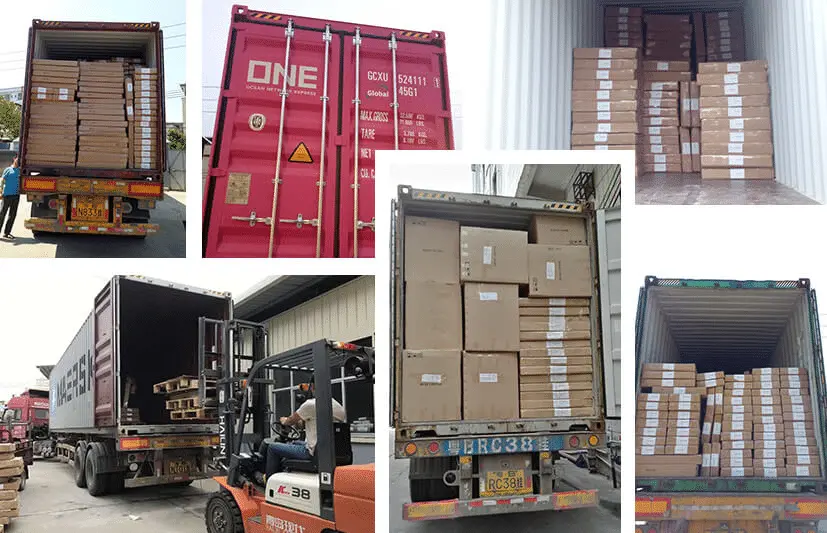
- Export packaging and container efficiency
- ODM wardrobe customization workflow
- How to evaluate a real wardrobe factory
- Buyer inquiry checklist
- FAQ
What Does an ODM Wardrobe Factory Actually Do?
An ODM wardrobe factory does more than attach your brand name to an existing cabinet.
For serious B2B projects, ODM normally starts with a commercial requirement rather than a finished engineering package.
A buyer may tell us:
- Target retail price
- Target wholesale price
- Preferred wardrobe width and height
- Sliding or hinged doors
- Required number of shelves and drawers
- Target market
- Preferred finish
- Container quantity
- Hotel, apartment, retail, or e-commerce application
- Reference images from an existing market
- Required private-label packaging
The factory then evaluates how those requirements can be converted into a manufacturable panel furniture product.
This may include changing board thickness, simplifying a structure, optimizing panel dimensions, selecting hardware, adjusting internal storage, improving flat-pack logic, reducing unnecessary components, or changing carton dimensions.
That is the real commercial value of ODM.
A professional OEM and ODM furniture manufacturer should therefore understand both product development and factory execution.
ODM vs OEM Wardrobe Sourcing: What Is the Purchasing Difference?
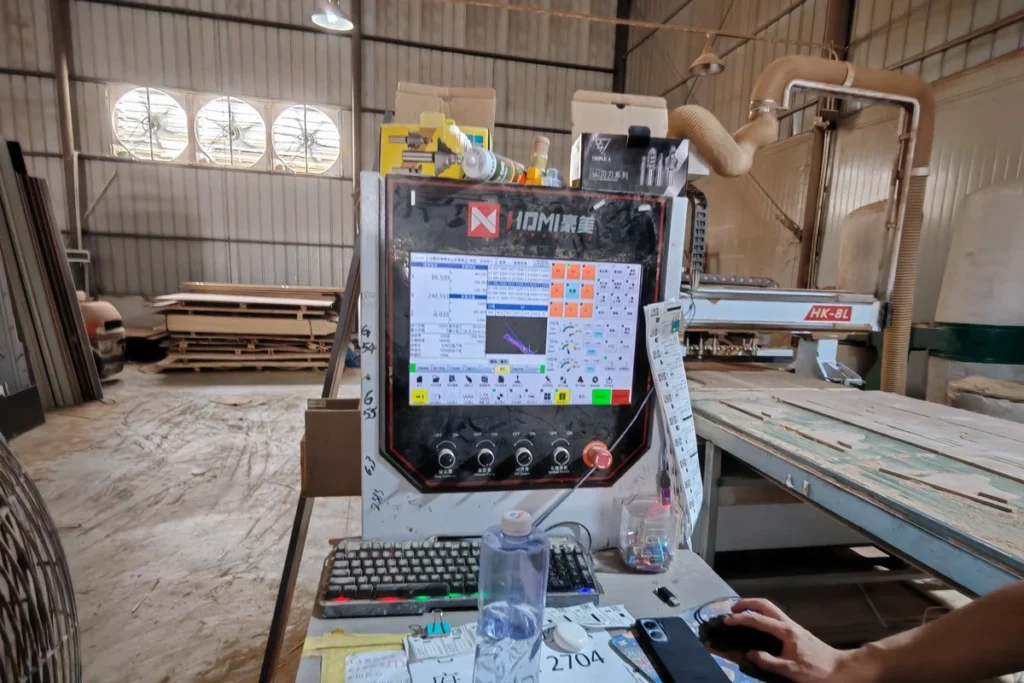
The simplest distinction is this:
OEM works best when the buyer already controls the product design.
ODM works best when the buyer controls the market requirement but wants the factory to help develop the product.
For an OEM wardrobe order, the buyer may already have CAD drawings, dimensions, BOM specifications, hardware standards, color references, packaging requirements, and assembly drawings.
The factory’s main responsibility is execution.
For an ODM wardrobe program, the buyer may instead provide a concept such as:
“We need a two-door flat-pack wardrobe for European rental apartments. It must fit into our entry-level furniture range, use an oak-look finish, include one hanging rail and adjustable shelves, and reach a specific landed-cost target.”
That is enough to begin a technical discussion.
A capable ODM furniture manufacturer can then help turn the commercial brief into a product specification suitable for sampling and mass production.
1. Choose an ODM Wardrobe Factory When You Need Faster Product Development
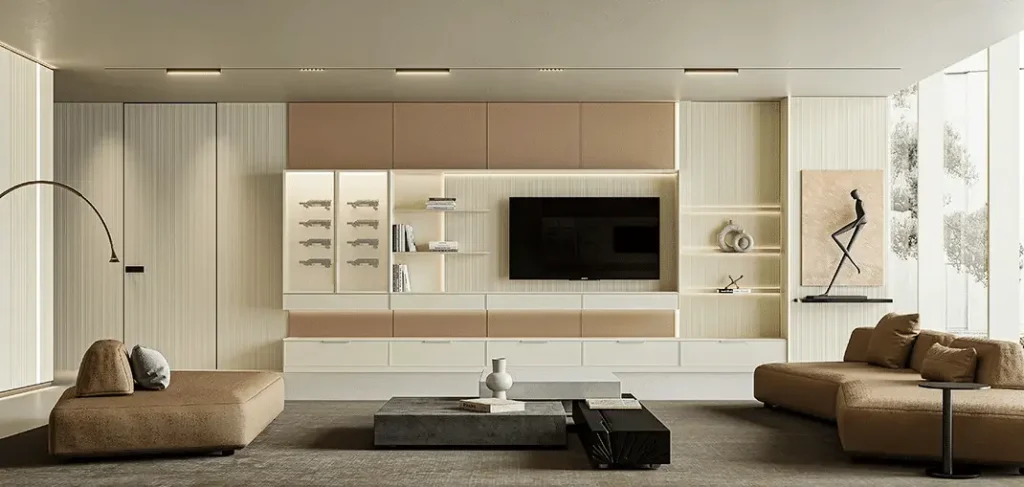
Private label buyers often lose months because product development begins with an empty page.
Industrial design, structure design, hardware selection, panel specification, assembly details, packaging, and sample testing all take time.
For many importers, however, the goal is not to invent a completely new wardrobe mechanism. The goal is to launch a competitive product that fits a specific market position.
An experienced ODM wardrobe factory already understands common manufacturing structures for:
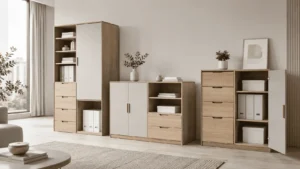
- Hinged-door wardrobes
- Sliding-door wardrobes
- Modular closets
- Wardrobes with drawers
- Wardrobes with mirrors
- Apartment wardrobes
- Hotel wardrobes
- Student housing storage
- Flat-pack retail wardrobes
Instead of developing every component independently, buyers can start from proven production logic and customize the parts that create commercial differentiation.
This reduces unnecessary engineering work and helps move the project toward sampling faster.
Buyers can review our existing wardrobes and closet manufacturing range to understand the types of structures that can serve as starting points for ODM development.
2. Choose ODM When You Have a Target Price but Not a Finished Specification
This is one of the most common situations we see with importers.
A buyer knows the market.
They know competitors are selling a wardrobe at a certain retail price. They know the distributor margin required. They know the approximate landed cost they need.
But they do not yet know whether the cabinet should use 15 mm or 18 mm board, which back panel is commercially appropriate, which drawer slide level to specify, or how the carton should be divided.
In this situation, sending an expensive over-engineered OEM specification to a factory may actually make sourcing harder.
ODM allows the factory and buyer to work backward from the commercial target.
For example, we may evaluate:
- MDF vs particle board vs plywood
- Melamine vs laminate vs painted finish
- Standard hinges vs soft-close hinges
- Number of shelves
- Drawer configuration
- Door construction
- Back panel structure
- Handle type
- Internal fittings
- Panel dimensions
- Number of cartons
- Hardware kit
- Packaging protection
The objective is not simply to make the cheapest wardrobe.
The objective is to build the right specification for the buyer’s price level.
That distinction is important for private label sourcing.
3. Choose ODM When You Want to Reduce Development Cost
Product development has a cost even before mass production begins.
The buyer may need designers, engineers, prototyping, technical drawings, BOM preparation, packaging design, assembly instructions, and repeated supplier discussions.
For large established brands, maintaining all of these resources internally may make sense.
For growing furniture brands, importers, distributors, and regional wholesalers, it may not.
An ODM model moves part of the development workload closer to the factory.
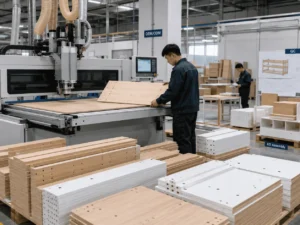
This is particularly useful for panel furniture because production efficiency is closely connected to manufacturing details such as CNC cutting, drilling positions, edge banding, connector systems, carton dimensions, and loading efficiency.
A product that looks simple in a rendering can become expensive if its structure does not match efficient production.
Factory involvement at the development stage can identify those problems earlier.
4. Choose ODM When You Need Private Label Differentiation Without Building a Product From Zero
Private label does not necessarily require a completely original structure.
In many markets, buyers create differentiation through a controlled combination of:
- Dimensions
- Finish
- Color
- Door style
- Handles
- Internal layout
- Shelving
- Drawer count
- Mirrors
- Hardware
- Branding
- Carton design
- Assembly instructions
- Collection coordination
For example, two buyers may start from a similar three-door wardrobe structure but sell very different final products.
One may specify white melamine, black handles, three drawers, and retail-ready cartons.
Another may use oak-look panels, concealed handles, open shelving, and project packaging for serviced apartments.
From a sourcing perspective, this is where ODM becomes commercially useful.
The buyer does not pay to reinvent basic cabinet engineering, but the final product can still match the brand’s market positioning.
5. Choose ODM for Hotel, Apartment, Student Housing, and Rental Projects
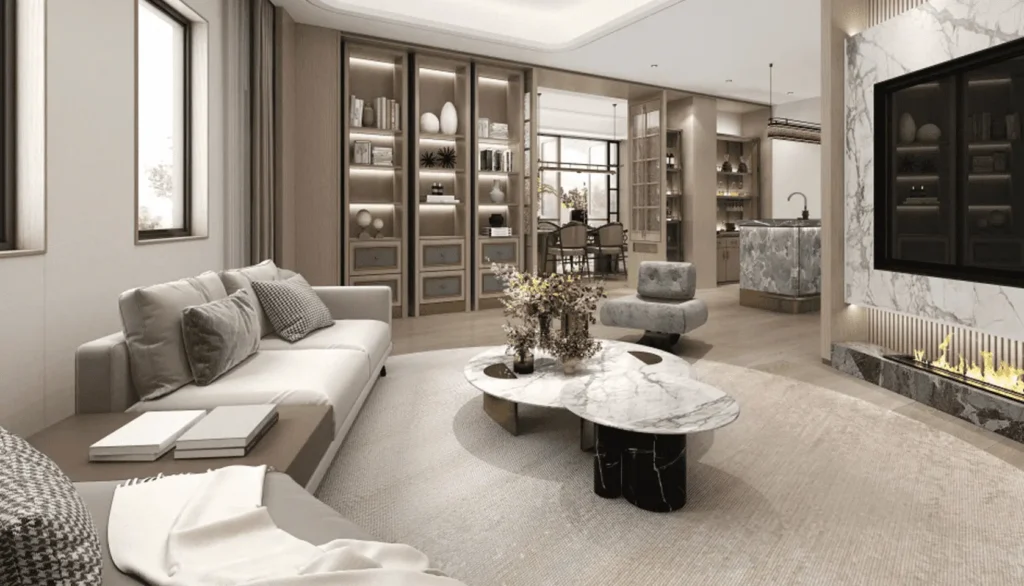
Project furniture buyers often have a different requirement from retail furniture buyers.
A hotel purchasing company may have room layouts but no production drawings.
A developer may have interior renderings but still need practical cabinet construction.
An apartment operator may need a wardrobe specification that balances durability, appearance, replacement cost, and installation efficiency.
This is a natural ODM application.
Our project furniture manufacturing service supports wardrobes and other panel furniture for apartments, hotels, serviced apartments, student housing, rental properties, offices, and commercial projects.
For these projects, the discussion may include:
Hotel Wardrobes
Hotel buyers typically focus on clean appearance, repeated installation, practical storage, hardware consistency, maintenance, and project scheduling.
ODM development can adapt wardrobe dimensions to the room layout and coordinate finishes with bedside tables, desks, luggage units, minibar cabinets, and other hotel furniture.
Apartment and Rental Furniture
Rental projects usually prioritize cost control, durability, easy replacement, and efficient installation.
A factory can help standardize wardrobe modules across multiple room types rather than producing unnecessary custom dimensions for every unit.
Student Housing
Student housing furniture generally requires compact dimensions, practical storage, repeatable structures, and efficient flat-pack delivery.
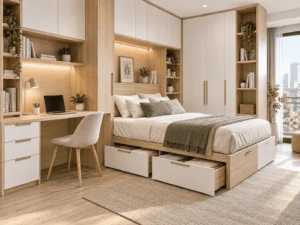
Wardrobes may be coordinated with beds, desks, shelving, and storage units as one room package.
Residential Development
For residential projects, developers may require several wardrobe sizes using the same finish and hardware family.
ODM development makes it easier to create a controlled product system rather than sourcing each cabinet independently.
6. Choose ODM When Flat-Pack Packaging and Freight Cost Matter
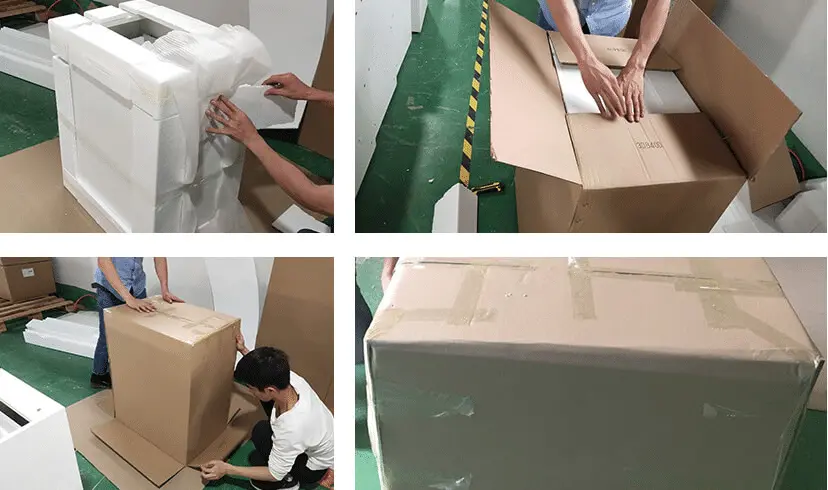
For exported panel furniture, the product is only part of the cost.
The carton matters.
Container utilization matters.
Damage rate matters.
Assembly efficiency matters.
A wardrobe that is inexpensive at factory level can become commercially unattractive if the carton is oversized, long panels are poorly protected, or too much empty volume is shipped.
That is why packaging should be discussed during product development rather than after production.
Our wardrobe programs can be designed around KD, RTA, and flat-pack structures to improve export handling.
Important packaging considerations include:
- Long-panel protection
- Corner protection
- Surface protection
- Hardware bags
- Part identification
- Assembly instructions
- Carton marks
- Barcode labels
- Private-label artwork
- Inner partitioning
- Carton strength
- Container loading sequence
If solid wood pallets, crates, or dunnage are used for international shipments, buyers should also check applicable phytosanitary requirements. The International Plant Protection Convention provides the official ISPM 15 guidance for wood packaging material in international trade.
Processed wood products such as plywood are treated differently from raw solid-wood packaging under the standard, so packaging specifications should be reviewed according to the destination market.
7. Choose ODM When You Need a Scalable Product Family
A good private-label furniture program should not stop at one wardrobe.
Buyers should consider whether a successful SKU can develop into:
- Two-door version
- Three-door version
- Sliding-door version
- Mirror-door version
- Compact apartment version
- Wardrobe with drawers
- Wardrobe with shelving
- Matching chest
- Matching bedside table
- Matching desk
- Matching storage bed
This is especially valuable for retailers and distributors because a coordinated bedroom collection can increase average order value and simplify sourcing.
An ODM relationship allows the same design language, finish, hardware, packaging, and manufacturing logic to be extended into additional SKUs.
This is one reason buyers should evaluate a supplier as a panel furniture factory, not only as a single-product wardrobe vendor.
Wardrobe Materials: What B2B Buyers Should Specify
Material selection should be connected to target price, product structure, destination market, and end use.
Common panel options include:
Particle Board
Particle board is widely used in cost-controlled flat-pack wardrobes and retail furniture.
It works particularly well with melamine finishes when the design is engineered around the material.
MDF
MDF provides a smooth and consistent panel surface and can be suitable for painted, laminated, routed, or decorative applications.
It may be selected for doors, decorative panels, or specific structural requirements.
Plywood
Plywood may be used where buyers want different structural characteristics or a higher material positioning.
However, using plywood everywhere does not automatically make a wardrobe commercially better. The correct decision depends on price target, structure, weight, finish, and customer expectations.
Engineered Wood and Mixed-Material Specifications
Many practical furniture programs use different materials for different components.
The important point for buyers is to define the specification at component level rather than simply writing “wooden wardrobe” in a purchase order.
Compliance Should Be Confirmed Before Quotation
Compliance requirements vary by destination market, product design, material, retailer, and contract.
They should therefore be discussed before sampling rather than after the goods are produced.
For U.S.-bound furniture containing regulated composite wood panels, purchasing teams should review the U.S. Environmental Protection Agency’s official information on TSCA Title VI formaldehyde emission standards for composite wood products.
For products entering California, buyers can also review the California Air Resources Board’s Composite Wood Products Airborne Toxic Control Measure.
If responsible forest sourcing is part of a retailer, hotel group, tender, or brand requirement, procurement teams can review the Forest Stewardship Council’s information on FSC Chain of Custody certification. FSC also provides specific guidance for the furniture sector.
European buyers should also evaluate applicable timber traceability and due-diligence obligations under the European Commission’s official information on the EU Regulation on Deforestation-free Products.
For certain freestanding wardrobes, armoires, and related clothing-storage products intended for the U.S. market, importers should review whether the product falls within applicable CPSC requirements. The U.S. Consumer Product Safety Commission provides current business guidance for clothing storage units.
The practical factory rule is simple:
Tell the factory the destination market before finalizing the material and structure.
Do not wait until the container is ready.
MOQ: How Private Label Buyers Should Discuss It
Asking only “What is your MOQ?” usually produces an incomplete answer.
For export panel furniture, MOQ depends on:
- Number of SKUs
- Material
- Finish
- Board color
- Hardware
- Packaging
- Printed cartons
- Quantity per SKU
- Container loading
- Whether the product is standard, OEM, or ODM
For many export furniture programs, the most efficient commercial discussion is based on a container plan or total project quantity.
Starwood’s general export MOQ is commonly planned around a 20GP container, while samples, trial development, mixed-product programs, and project quantities can be discussed according to the actual project.
For ODM programs, buyers should also distinguish between:
Sample MOQ: quantity required for development and approval.
Mass-production MOQ: quantity needed for efficient factory production.
Packaging MOQ: quantity required for custom printed cartons, branded instructions, labels, or specialized packaging materials.
A supplier that discusses these separately usually gives the buyer a more realistic sourcing picture.
Lead Time: Separate Development Time From Production Time
Another common procurement mistake is asking for one lead-time number.
ODM projects contain at least two timelines.
Development and Sampling
This can include:
Brief → quotation → technical review → drawing → material confirmation → sample → buyer comments → revised sample → approval.
The timeline depends on how quickly both sides confirm details.
Mass Production
After the specification is frozen, the factory schedules materials, CNC processing, edge banding, drilling, finishing, hardware, QC, packing, and container preparation.
Some existing wardrobe programs on our website indicate production references around 35–45 days after drawing and order confirmation, but an ODM collection should always be quoted according to quantity, finish, hardware, packaging, and sampling requirements.
For project buyers, the more important question is therefore:
“What are the separate sample, approval, mass-production, and shipment milestones?”
This gives procurement teams a much more reliable project schedule.
Our ODM Wardrobe Customization Process
At Starwood, a practical ODM wardrobe project normally follows this workflow:
Step 1: Buyer Brief
Send the target market, reference images, dimensions, quantity, price positioning, storage requirements, preferred finish, and packaging requirements.
Perfect drawings are not required at this stage.
Step 2: Factory Feasibility Review
We review structure, material options, hardware, manufacturing feasibility, packaging logic, and possible cost improvements.
Step 3: Preliminary Quotation
The quotation is based on an agreed product direction.
Where several material or hardware options are possible, buyers can compare different cost levels.
Step 4: Technical Development
Dimensions, construction, panels, internal layout, door system, hardware, and KD structure are refined.
Step 5: Sample Production
The sample allows both parties to check:
- Dimensions
- Door alignment
- Drawer operation
- Panel finish
- Hardware
- Stability
- Assembly
- Packaging concept
Step 6: Buyer Approval
Any required improvements are confirmed before mass production.
This stage is especially important for private label programs because repeat orders should use a frozen reference specification.
Step 7: Mass Production
Production follows the approved drawings, materials, finish standards, hardware details, and packaging requirements.
Step 8: Quality Control
Important wardrobe checks can include drilling accuracy, panel dimensions, edge finishing, hardware matching, door alignment, surface condition, carton content, labels, and assembly verification.
Step 9: Export Packing
Panels, hardware, manuals, fittings, labels, and protection materials are packed according to the agreed carton structure.
Step 10: Container Loading and Shipment
The loading plan should consider carton dimensions, SKU identification, unloading sequence, container utilization, and shipment documentation.
This full workflow is part of our OEM and ODM panel furniture manufacturing service.
How to Evaluate a Real ODM Wardrobe Factory
A low quotation does not prove that a supplier is suitable for a private label program.
Before placing a bulk order, buyers should evaluate whether the supplier can control the complete process.
Check Manufacturing Capability
Ask to see the actual factory, machinery, panel processing, edge banding, drilling, assembly checks, packing area, and loading process.
Our factory profile provides an overview of Starwood’s panel furniture manufacturing operations in Jiangmen, Guangdong, China.
Check Whether the Supplier Understands Flat-Pack Engineering
For exported wardrobes, accurate CNC processing and drilling are important because the final customer or project installer may assemble the unit thousands of kilometers away from the factory.
Assembly problems discovered after delivery are expensive.
Check Sampling Discipline
The purpose of a sample is not only to take attractive photographs.
It should verify whether the product is ready for repeat production.
Check Packaging Experience
Ask how long wardrobe side panels, mirrors, hardware, doors, and decorative surfaces are protected.
A supplier focused only on the finished cabinet but not the carton is not thinking like an export factory.
Check Project Communication
A factory should be able to discuss drawings, materials, samples, QC, packing, loading, and shipment in a structured way.
This matters even more when a buyer is sourcing multiple room types or product categories.
Which Buyers Are the Best Fit for ODM Wardrobe Manufacturing?
ODM is particularly suitable for:
- Furniture importers building a new wardrobe category
- Private label furniture brands
- Regional wholesalers
- Furniture retail chains
- E-commerce furniture brands
- Hotel furniture purchasing companies
- Apartment developers
- Serviced apartment operators
- Student housing suppliers
- Contractors and interior project companies
- Distributors expanding into bedroom furniture
- Buyers seeking coordinated furniture collections
If you already own complete engineering drawings and need strict build-to-print production, OEM may still be the better option.
If you understand your market but want manufacturing support to convert that market requirement into a scalable wardrobe product, ODM is often more efficient.
What to Send an ODM Wardrobe Factory for a Faster Quotation
A professional inquiry does not need to be complicated.
Send as much of the following information as possible:
- Reference photo or drawing
- Required width, depth, and height
- Sliding or hinged doors
- Internal shelf and hanging layout
- Drawers if required
- Material preference
- Finish or color
- Hardware requirements
- Mirror requirements
- Estimated quantity
- Destination market
- Packaging requirements
- Private-label requirements
- Target delivery schedule
- Target price if available
- Applicable testing or compliance requirements
If some details are unknown, state that clearly.
A good ODM supplier should help identify which specifications still need to be confirmed.
Why Work With Starwood as Your ODM Wardrobe Factory?
Starwood Industry Co., Ltd. is a China-based panel furniture manufacturer specializing in OEM and ODM flat-pack furniture for international buyers.
Since 2013, we have worked with furniture brands, importers, wholesalers, retailers, e-commerce sellers, hospitality buyers, and commercial project customers.
Our wardrobe manufacturing support includes:
- OEM production
- ODM development
- Custom dimensions
- MDF, plywood, particle board, and engineered panel options
- Melamine, laminate, veneer, and other finish directions
- Sliding and hinged door systems
- Custom shelving and drawer layouts
- Hardware matching
- Sample development
- Private-label packaging
- Flat-pack / KD / RTA structures
- Quality control
- Export carton planning
- Container loading support
- Hotel and apartment project furniture
- Coordinated bedroom furniture programs
We focus on practical production rather than simply showing catalog products.
Buyers can start with an existing wardrobe structure, send completed OEM drawings, or provide a commercial brief for ODM development.
Final Buyer Decision: ODM or OEM?
Choose OEM when you already have a mature, tested product specification and want the factory to reproduce it accurately.
Choose ODM when you know what your market needs but want the factory to help turn that requirement into a manufacturable, cost-controlled, export-ready product.
For many private label wardrobe buyers, the best result is actually a hybrid approach.
The buyer controls:
- Brand direction
- Market positioning
- Target price
- Product appearance
- Customer requirements
The factory contributes:
- Manufacturing knowledge
- Structure optimization
- Material recommendations
- Hardware selection
- Sampling
- Flat-pack engineering
- Packaging
- Production
- QC
- Export execution
That combination allows buyers to retain commercial control without carrying the full engineering workload internally.
Start Your Private Label Wardrobe Project
If you are looking for an ODM wardrobe factory, OEM wardrobe manufacturer, project furniture supplier, or long-term panel furniture export factory in China, send us your project details.
You can provide a finished drawing, existing product, reference image, room layout, target price, or simply an idea for a new wardrobe collection.
Our team can review your requirements and discuss the most practical route from product development to sampling, bulk production, quality control, export packing, and shipment.
Send us:
Product reference + dimensions + quantity + destination market + material requirements + packaging needs + target schedule.
Contact Starwood Industry Co., Ltd. for an ODM wardrobe quotation
Explore our manufacturing capabilities:
OEM & ODM Furniture Manufacturing
Wardrobe & Closet Manufacturing
Project Furniture Manufacturing
About Our Panel Furniture Factory
FAQ
What is an ODM wardrobe factory?
An ODM wardrobe factory helps B2B buyers develop and manufacture wardrobe products based on market requirements, reference designs, target prices, dimensions, functionality, materials, and branding needs. The factory may support product engineering, material selection, sampling, packaging, and mass production instead of requiring the buyer to provide complete manufacturing drawings.
What is the difference between an OEM and ODM wardrobe supplier?
An OEM wardrobe supplier mainly manufactures according to buyer-provided drawings and specifications. An ODM wardrobe supplier can participate earlier in product development by helping convert concepts, reference images, room requirements, target costs, and market requirements into production-ready wardrobe specifications.
Is ODM suitable for private label furniture brands?
Yes. ODM is especially useful for private label brands that want differentiated furniture without developing every technical detail internally. Buyers can customize dimensions, finishes, hardware, storage layouts, packaging, labels, instructions, and product positioning while using proven manufacturing structures.
What is the MOQ for ODM wardrobes?
MOQ depends on material, finish, hardware, number of SKUs, custom packaging, and container loading. For export panel furniture, orders are often planned according to a 20GP container, mixed-container program, or overall project quantity. Samples and product-development quantities should be discussed separately from mass-production MOQ.
How long does ODM wardrobe production take?
The total schedule includes product development, drawing confirmation, sample production, buyer approval, mass production, QC, packing, and shipment preparation. Some standard wardrobe programs may use a production reference of approximately 35–45 days after specifications are confirmed, while ODM projects require additional development and sampling time. Final lead time should always be confirmed for the specific order.
Can an ODM wardrobe factory manufacture furniture for hotels and apartments?
Yes. ODM manufacturing is suitable for hotels, apartments, serviced apartments, rental properties, student housing, and residential projects because dimensions, finishes, internal layouts, hardware, and packaging can be adapted to project specifications and budget requirements.
What materials can be used for private label wardrobes?
Common options include MDF, particle board, plywood, melamine-faced panels, laminated panels, veneer finishes, and other engineered wood materials. Material selection should be based on structure, price position, destination-market requirements, finish, product weight, and expected use.
Can you provide private-label packaging?
Yes. Private-label programs can include custom carton marks, brand labels, barcode labels, SKU identification, hardware bags, assembly instructions, packaging artwork, and export-ready flat-pack cartons. Packaging requirements should be confirmed before mass production.
Can I send only a reference photo instead of technical drawings?
Yes. For ODM projects, a reference photo can be a starting point. Buyers should also provide approximate dimensions, target market, quantity, required functions, material direction, price positioning, and any special requirements. The factory can then evaluate manufacturing feasibility before developing a final specification.
What information should I send for an ODM wardrobe quotation?
Send reference images or drawings, dimensions, door type, internal storage requirements, materials, finish, hardware requirements, estimated quantity, destination market, packaging needs, target delivery schedule, and applicable compliance requirements. A target price is also helpful when the factory needs to optimize the specification.