Table of Contents (TOC)
- Introduction: Market Demand for ODM Dining Tables
- What Is an ODM Dining Table Manufacturer (Definition & Roles)
- Benefits of Choosing an ODM Partner for Dining Tables
- Core Application Scenarios in B2B Projects
- Materials & Construction Standards for Durable Dining Tables
- Customization Capabilities: OEM/ODM Processes Explained
- Minimum Order Quantity (MOQ), Pricing & Lead Times Explained
- Quality Assurance, Certifications & Compliance Standards
- Packaging, Shipping & Export Preparations
- Case Studies: Successful Project Deployments
- How to Evaluate & Select the Right Manufacturer
- FAQ
- CTA: Request a Quote for Custom & Bulk Orders
1. Introduction: Market Demand for ODM Dining Tables
The global demand for quality dining tables in commercial and residential segments continues to rise, driven by hospitality projects, multi‑family residential developments, and large retail/contract furniture orders. Buyers sourcing ODM (Original Design Manufacturer) partners seek firms capable of delivering not just products, but integrated design, engineering, and supply chain coordination. According to Grand View Research, the furniture market size is projected to grow significantly through 2030 owing to expanding urbanization and segment diversification. Dining tables represent a core category in residential and contract furniture procurement. (Grand View Research: Furniture Market Size, Share & Trends Analysis Report).
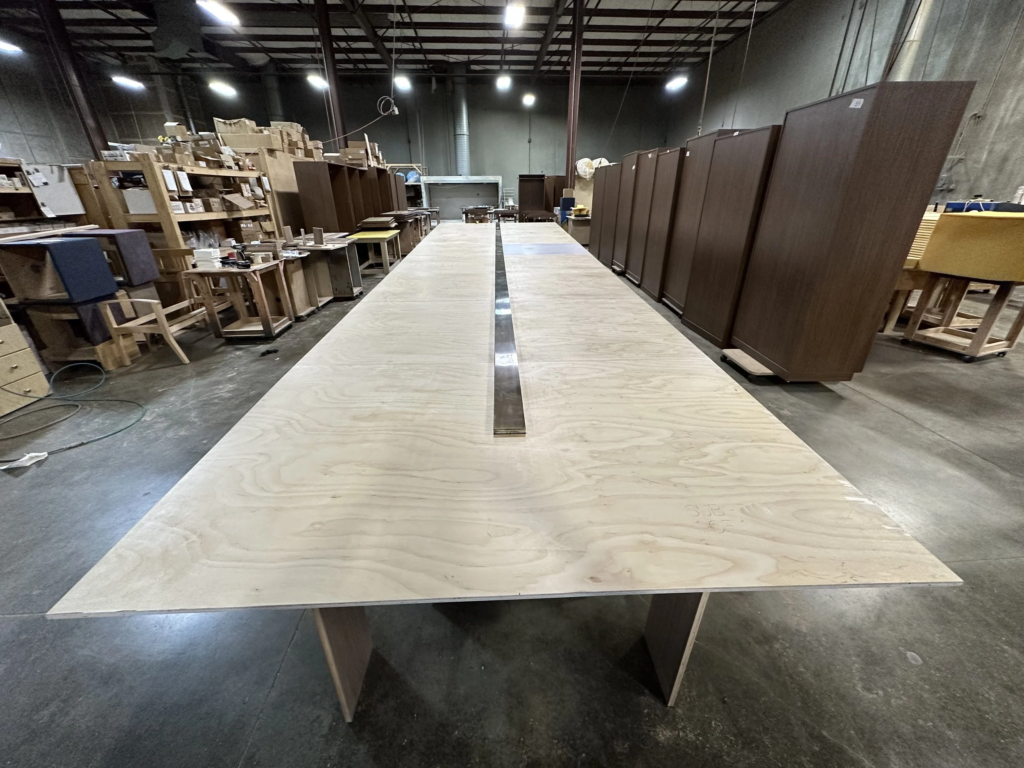
Commercial buyers prioritize factors such as material durability, ergonomic design, finish quality, and compliance with fire and safety standards. For hotels and apartments, dining tables must perform under high usage conditions, necessitating plywood grades with stability superior to traditional particleboard.
2. What Is an ODM Dining Table Manufacturer (Definition & Roles)
An ODM dining table manufacturer provides Original Design Manufacturing services. Unlike OEM (Original Equipment Manufacturing), where designs are supplied by the purchaser, ODM suppliers own design capabilities, prototyping resources, and engineering teams to deliver finished product concepts ready for production.
Key Roles:
- Product Design & Engineering: In‑house CAD design, prototype development.
- Material Specification: Selection of plywood grades, hardwood veneers, edge banding, and core materials.
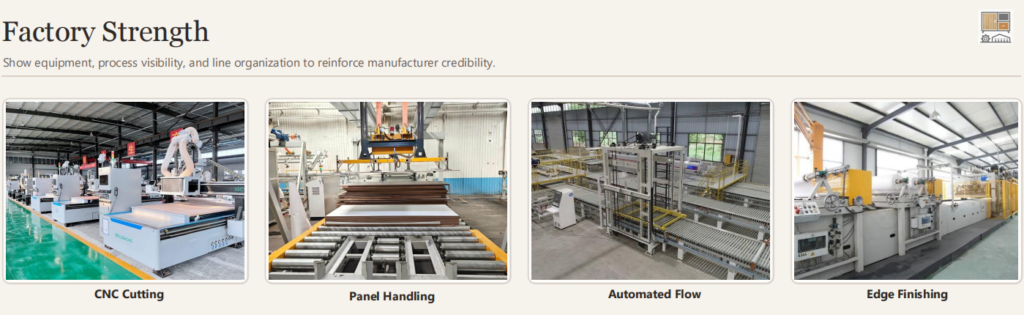
- Manufacturing Execution: CNC cutting, pressing, edge forming, finishing, and assembly.
- Quality Control: In‑line inspection, performance testing, compliance verification.
- Supply Chain Coordination: Packaging, logistics planning, export documentation.
This contrasts with pure OEM arrangements in which the buyer supplies the complete design and relies on the factory solely for manufacturing execution.
3. Benefits of Choosing an ODM Partner for Dining Tables
Selecting an ODM partner delivers strategic advantages for B2B buyers:
Design Innovation & Speed to Market
ODM partners invest in design libraries, trend forecasting, and rapid prototyping. The ability to iterate dining table concepts accelerates product launches in response to seasonal demand fluctuations.
Cost Efficiency Through Engineering Optimization
Experienced furniture engineers can re‑engineer components, joint systems, and material usage to reduce cost while ensuring performance. This drives lower manufacturing costs and improved margins.
Consistent Quality & Repeatability
Standardized manufacturing processes, ISO‑aligned quality control, and documented testing protocols ensure consistency across batches—critical for bulk orders.
Single Partner for End‑to‑End Solutions
ODM manufacturers coordinate product conception, production, packaging, and logistics—minimizing vendor management overhead for buyers.
4. Core Application Scenarios in B2B Projects
ODM dining tables are used across diverse commercial and residential contexts:
Hotel F&B Spaces
Durable, aesthetically consistent dining tables are required for restaurants, banquet halls, and guest room dining areas within hotels and resorts. Materials must resist abrasion and moisture in high‑use environments.
Apartment & Condominium Projects
Multi‑family housing developments demand coordinated dining furniture orders with consistent finish and dimensions to match interior design specifications.
Office Breakrooms & Cafeterias
Increasing workplace emphasis on communal spaces drives demand for tables that balance commercial standards with modern design.
Retail & Contract Projects
Retail display furniture, showroom layouts, and exhibition stands often feature dining tables as functional focal points.
Institutional & Educational Facilities
Durable tables suitable for cafeterias in schools and campuses need reinforced construction and certified finishes for safety.
5. Materials & Construction Standards for Durable Dining Tables
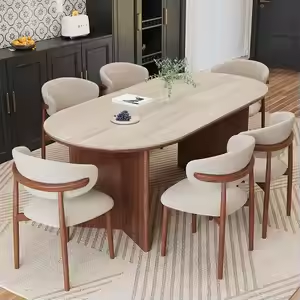
Material selection determines performance, durability, and cost. Commonly used materials in ODM dining table manufacturing include:
Plywood Core Boards
- Marine Plywood: High moisture resistance suitable for coastal regions or humid environments.
- Multi‑layer Birch Plywood: Offers greater dimensional stability; superior strength‑to‑weight ratio.
Plywood outperforms particleboard and MDF in screw holding strength and resistance to delamination under load.
Surface Veneers & Finishes
- Natural Wood Veneers: Oak, walnut, maple — deliver premium aesthetics.
- Laminate Surfaces: High‑pressure laminates (HPL) for scratch and stain resistance.
- UV / PU Finishes: Provide protective coating to resist wear.
Edge Banding & Joint Systems
Precision edge banding prevents moisture ingress and improves long‑term durability. Dowel, mortise‑and‑tenon, and cam lock joinery are selected based on application stress points.
Fasteners & Hardware
Commercial‑grade metal brackets, adjustable glides, and reinforcement plates enhance structural stability.
External Authoritative Reference:
- Wood Handbook — U.S. Department of Agriculture Forest Service: provides technical standards on wood product properties and appropriate applications. (https://www.fpl.fs.usda.gov/documents/pdf186.pdf)
6. Customization Capabilities: OEM/ODM Processes Explained
ODM manufacturers offer structured processes for customization and large orders. A standard workflow includes:
Concept Brief & Specification Gathering
Buyers provide functional requirements, target budget, and intended application scenarios. Collaborative reviews determine product feasibility.
Design & Engineering
Using CAD tools (e.g., SolidWorks), engineers produce detailed drawings with dimensions, materials lists, and finish options.
Prototype Development
Prototypes validate ergonomics, joinery, stability, and finish appearance. Adjustments are documented before mass production.
Pre‑Production Samples for Approval
Once finalized, buyers receive pre‑production samples for final inspection and sign‑off.
Batch Production Scheduling
Production planning includes BOM (Bill of Materials), CNC programming, workforce allocation, and quality checkpoints.
In‑Line Inspection & Final QA
Inspections occur at key stages: pre‑assembly, pre‑finishing, and post‑finish. Compliance with contract terms is confirmed before packing.
7. Minimum Order Quantity (MOQ), Pricing & Lead Times Explained
Minimum Order Quantity (MOQ) is influenced by material procurement costs, production setup, and inventory planning. Typical MOQs for custom dining tables range from 50 to 200 units per model, depending on complexity.
Pricing Structure:
- Unit Cost: Based on materials, labor, and overhead.
- Tiered Discounts: Bulk orders receive graduated price improvements.
- Customization Surcharges: Unique finishes, hardware upgrades, and custom dimensions affect pricing.
Lead Times:
- Sample Lead Time: 7–14 days.
- Mass Production Lead Time: 30–90 days depending on volume and complexity.
- Export Documentation: Additional time for packing lists, certificates of origin, and compliance certifications.
Providing transparent timelines helps buyers plan project schedules and align procurement with construction or interior fit‑out phasing.
8. Quality Assurance, Certifications & Compliance Standards
B2B buyers need confidence that dining tables meet quality expectations and compliance requirements.
Key Standards:
- ANSI/BIFMA: Performance and safety standards for commercial furniture. (https://www.bifma.org)
- ISO 9001: Quality Management Systems certification. (https://www.iso.org/standard/62085.html)
- CARB Phase 2: Limits formaldehyde emissions from composite wood products for U.S. compliance. (https://www.epa.gov/formaldehyde/carb-phase-2-compliance)
Documented testing records and third‑party lab reports underpin reliability claims for contract furniture.
9. Packaging, Shipping & Export Preparations
Proper packaging protects dining tables during sea freight and air freight transit.
Packaging Components:
- Corner Protectors: Prevent impact damage.
- Bubble Wrap & Foam Sheets: Cushion surfaces.
- Cartons with Edge Reinforcement: Heavy‑duty cardboard boxes or plywood crates.
Shipping Considerations:
- FCL (Full Container Load): Optimal for bulk orders to reduce per‑unit shipping cost.
- LCL (Less than Container Load): Suitable for smaller quantities with consolidated freight.
Accurate documentation (commercial invoice, packing list, bill of lading) ensures smooth customs clearance.
10. Case Studies: Successful Project Deployments
Hotel Contract Dining Tables
A four‑star hotel chain ordered 300 plywood dining tables with veneer finish for its restaurant spaces. The ODM partner delivered within 60 days, meeting fire safety and moisture resistance criteria.
Apartment Complex Fit‑Out
A residential developer standardized dining table designs across 500 units, achieving cost savings through material optimization and bulk production.
These examples illustrate how ODM partnerships streamline procurement cycles and enforce quality consistency across large‑scale furniture orders.
11. How to Evaluate & Select the Right Manufacturer
Criteria for Evaluation:
- Verified production capacity and facility tour reports.
- Clear MOQ and transparent pricing.
- Material sourcing policies and sustainability commitments.
- Quality control systems and certification documentation.
Request references from previous B2B clients and inspect sample quality before contract signing.
12. FAQ
Q: What is the advantage of choosing an ODM dining table manufacturer?
A: An ODM manufacturer provides end‑to‑end design, engineering, and production, enabling faster go‑to‑market and consistent quality without buyer‑provided designs.
Q: What are typical lead times?
A: Sample lead time is generally 7–14 days; production lead time for bulk orders is 30–90 days depending on customization.
Q: What materials are best for commercial dining tables?
A: Multi‑layer plywood with hardwood veneers and high‑pressure laminate finishes deliver durability and stability suitable for commercial usage.

13. Call‑to‑Action (CTA)
Ready to scale your commercial furniture offerings with custom ODM dining tables? Request a quote now for bulk and custom orders and gain competitive pricing, optimized design solutions, and reliable supply chain support.
Internal Suggested Anchor Text:
Dining Room Furniture — link to https://plywoodmfr.com/dining-room-furniture/
External Authoritative Links Embedded
- Wood Handbook — USDA Forest Service: https://www.fpl.fs.usda.gov/documents/pdf186.pdf
- BIFMA Standards: https://www.bifma.org
- ISO 9001 Certification Info: https://www.iso.org/standard/62085.html
- CARB Phase 2 Compliance: https://www.epa.gov/formaldehyde/carb-phase-2-compliance
- Furniture Market Size Report (Grand View Research): https://www.grandviewresearch.com/industry-analysis/furniture-market