Best Entryway Furniture Solutions for Small Apartments (Slim Shoe Cabinets & Narrow Shoe Racks)
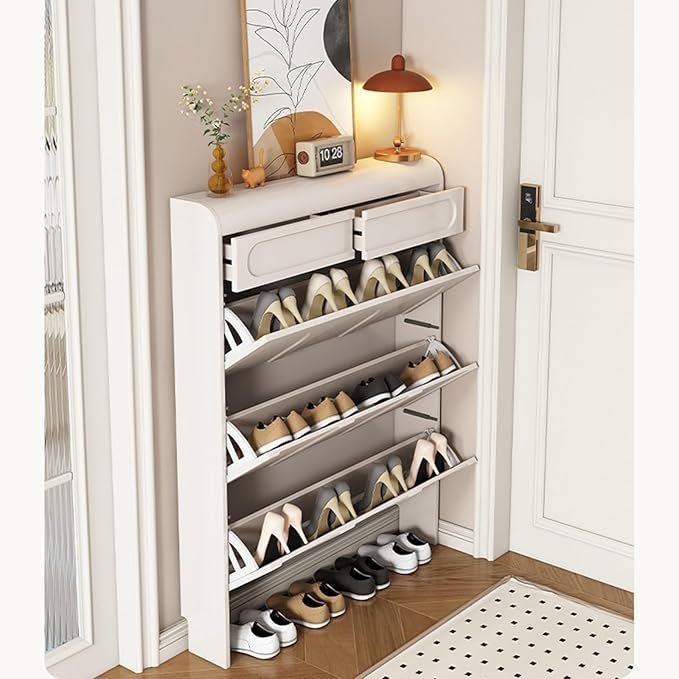
Small apartments don’t fail because they’re small—they fail because the entryway becomes a bottleneck. When your hallway is narrow, a single misplaced pair of shoes can turn “cozy” into “crowded.” The good news: you don’t need a bigger home. You need smarter entryway furniture, built around two heroes: the slim shoe cabinet and the narrow shoe rack.
In this guide, we’ll show practical layouts, sizing rules, and procurement-ready details. These are suitable for small apartments, tight corridors, rental properties, and project installations. We’ll also cover B2B considerations—OEM/ODM options, material choices, packaging, compliance, and how to standardize a solution across multiple units.
If you’re sourcing for retail, distribution, or projects, visit our factory homepage: https://plywoodmfr.com/ (OEM/ODM supported).
Table of Contents
- 1) Why narrow entryways fail in small apartments
- 2) Core design principles: slim, vertical, and closed storage
- 3) The measurement rules that prevent regret
- 4) Slim shoe cabinet: best choice for tight corridors
- 5) Narrow shoe rack: the fast-access layer
- 6) 7 layout templates for small apartments
- 7) Materials, finishes, and durability for high-traffic entryways
- 8) Safety & stability: anti-tipping and rental-friendly installs
- 9) B2B / OEM / ODM: how to standardize a winning entryway SKU
- 10) Project checklist: what to confirm before production
- FAQ
- Schema (BlogPosting + FAQ)
- Comments
1) Why narrow entryways fail in small apartments
Most “messy apartment” complaints start at the door. In small units, the entryway serves multiple functions. It becomes a shoe pile and a bag drop zone. It also transforms into a coat rack, a mail station, and sometimes a pet corner. These transformations happen all at once. When the hallway is narrow, every extra inch matters, so traditional bulky cabinets backfire.
Common pain points we see in compact apartments
- Blocked walkway: deep cabinets reduce the pass-through width and feel claustrophobic.
- Visual clutter: open racks show everything (and look messy fast).
- No “routine path”: keys, umbrellas, bags, and shoes lack dedicated zones.
- Rental constraints: minimal wall drilling, easy assembly, and safe stability are required.
- Project sourcing problems: inconsistent sizes, poor packaging, and weak QC create returns.
The solution isn’t “more furniture.” It’s fewer pieces that do more. They are designed around slim depth and vertical storage. Closed compartments make the entry instantly look tidy.
2) Core design principles: slim, vertical, and closed storage
Principle A: Slim depth wins in a narrow corridor
For small apartments, a slim shoe cabinet is ideal for corridors. It stores shoes behind doors for a clean look. It also keeps the footprint narrow. This is why “slim depth” is the first spec professional buyers confirm.
Principle B: Vertical storage increases capacity without stealing floor space
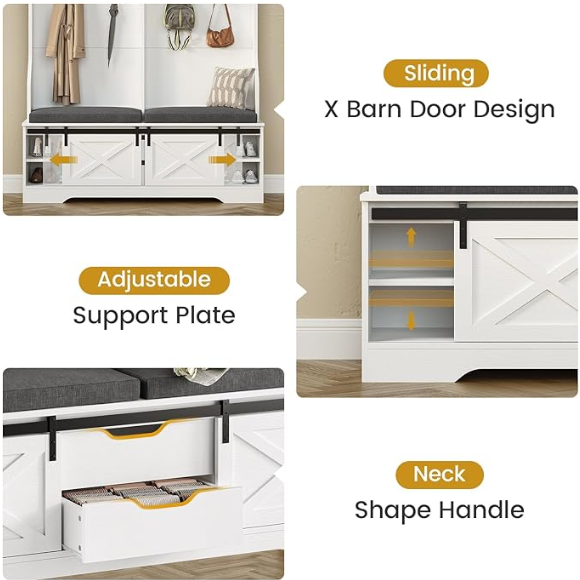
Use height—shelves, top ledges, hooks, and panels—to organize items that usually clutter the floor. When the base stays slim and the storage goes upward, entryways feel open instead of crowded.
Principle C: Closed shoe cabinet + open narrow shoe rack = best of both
A pure shoe cabinet can feel “too hidden” for everyday pairs. A pure shoe rack can look messy. The ideal solution is a layered system. Use a closed shoe cabinet for bulk storage. Create a narrow shoe rack zone for daily rotation.
3) The measurement rules that prevent regret
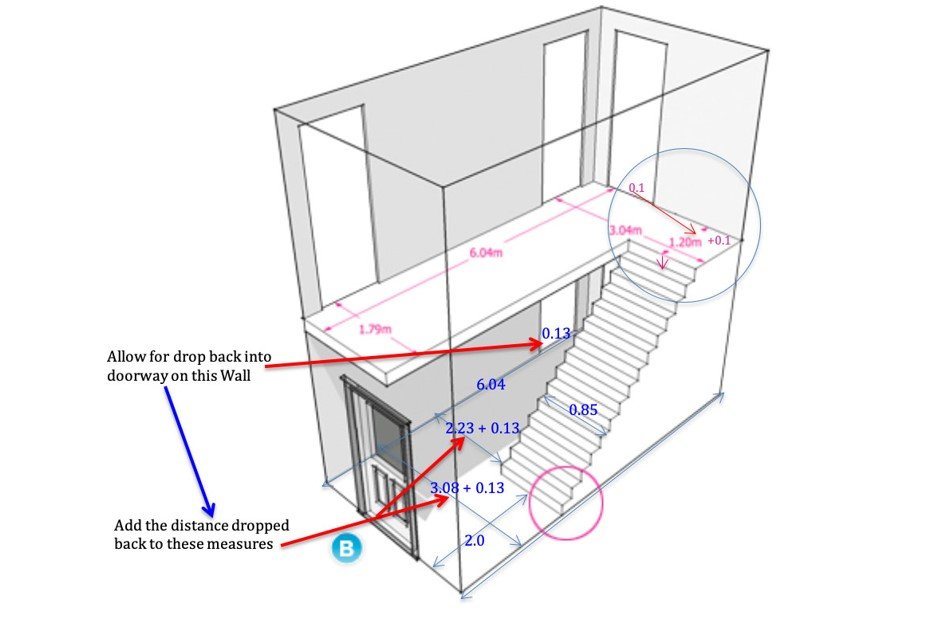
Before selecting entryway furniture, measure like a designer and think like a project manager. These rules reduce returns and improve user satisfaction—especially for e-commerce and multi-unit installs.
Rule 1: Protect your “clear walking width”
In many apartments, corridors feel comfortable when you maintain a generous pass-through. For narrow halls, prioritize a slim shoe cabinet over deep storage. If your cabinet feels like it “pushes you sideways,” it’s too deep.
Rule 2: Map door swings, not just wall length
Apartment entries often have a front door swing, closet door swing, or bathroom door swing nearby. Plan furniture placement so doors open freely and shoes aren’t kicked into hinges.
Rule 3: Decide your “shoe capacity target” realistically
In small households, most people only wear a few pairs weekly. Optimize for a clean daily routine. Keep 4–8 pairs accessible in the narrow shoe rack zone. Store the rest in the shoe cabinet.
4) Slim shoe cabinet: best choice for tight corridors
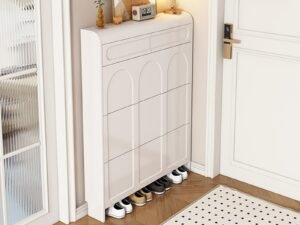
A slim shoe cabinet is a high-impact upgrade. It solves two problems at once. It stores shoes and reduces visual clutter. For small apartments, “visual calm” is as important as storage volume.
What makes a slim shoe cabinet “apartment-correct”
- Shallow footprint: optimized for narrow entryways and tight corridors.
- Closed doors: instantly cleaner look than open shoe racks.
- Top surface: key tray, small lamp, scent diffuser, mail basket.
- Easy-clean base: raised feet or a toe-kick for quick sweeping.
- Stable construction: suitable for daily use in rentals and family homes.
Best-use scenarios
Choose a slim shoe cabinet when your hallway is narrow. It is also a great choice when you care about a neat “first impression.” Additionally, select one when you need a storage solution that looks minimal even when fully loaded.
5) Narrow shoe rack: the fast-access layer
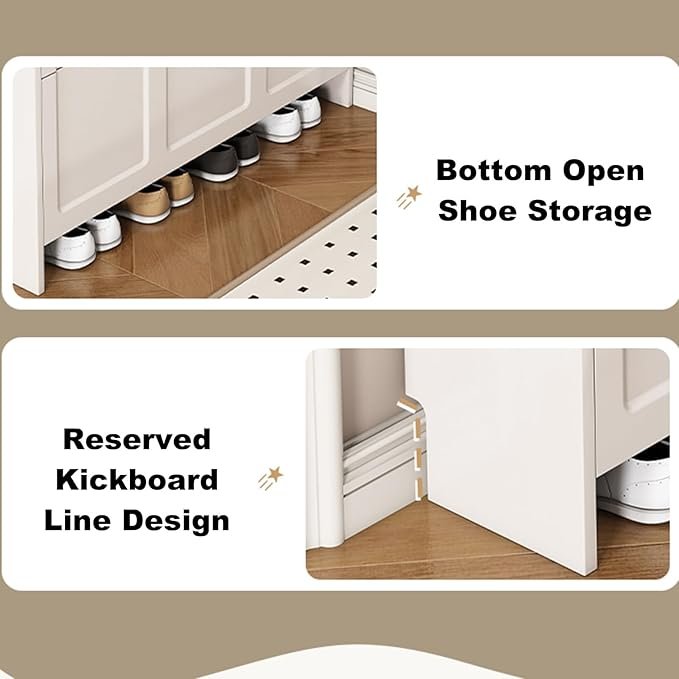
A narrow shoe rack works best as the “front line” storage layer—daily pairs in, daily pairs out. It prevents the most common problem: shoes lingering on the floor because putting them away feels inconvenient.
Where a narrow shoe rack fits perfectly
- Under a bench or cabinet base as an open cubby zone
- Beside a slim shoe cabinet as a daily-access strip
- Inside a hall tree base section to separate “indoor shoes” and “outdoor shoes”
Pro tip for small apartments
Keep your narrow shoe rack intentionally “underfilled.” When it’s full, it starts looking like clutter again. A good rule: reserve 20–30% empty space to maintain a clean visual.
6) 7 layout templates for small apartments
Template 1: The Corridor Wall (ultra-narrow hallway)
Use one slim shoe cabinet on the wall, plus a small hook rail above it. Add a narrow shoe rack strip only if you need daily rotation outside the cabinet.
Template 2: The “Drop Zone Ledge”
Place a slim shoe cabinet under a wall-mounted shelf/ledge. The shelf holds keys, mail, and small décor, while the cabinet hides shoes. This makes entryway furniture feel integrated and intentional.
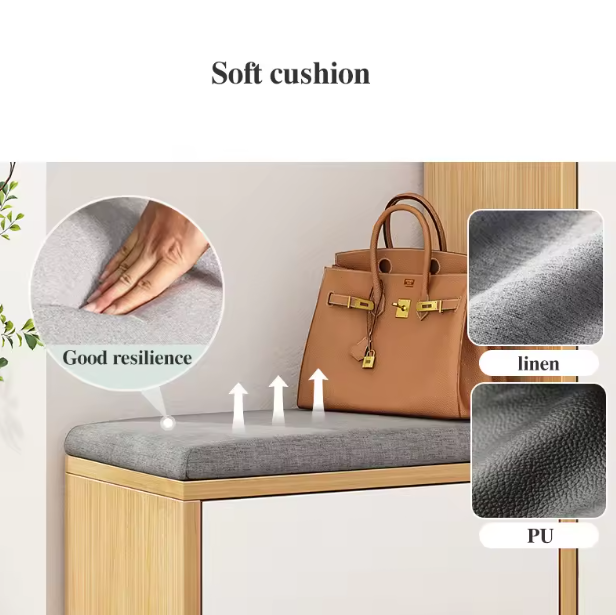
Template 3: The Bench + Cabinet Combo
If you can spare a little width, use a small bench seat. Combine it with a narrow shoe rack underneath, and add a slim shoe cabinet next to it. This creates a comfortable shoes-on/shoes-off routine.
Template 4: The Hall Tree System (maximum vertical storage)
For families or high-traffic rentals, a hall tree adds hooks, shelves, and shoe storage in one footprint. The best designs combine: hooks + top cubbies + closed shoe cabinet + open shoe rack.
Template 5: The Corner Entry (awkward angles)
Put the slim shoe cabinet on the longest clean wall and keep the adjacent wall open. This avoids “corner congestion” where bags and coats collide visually.
Template 6: The Behind-the-Door Strategy
If the corridor wall is too tight, use the space beside or behind the door for a slim shoe cabinet. Just ensure door swing clearance and avoid handles that catch.
Template 7: Multi-Unit Standardization (projects)
For property managers and developers, choose one standardized slim shoe cabinet design across units. Consistent sizing streamlines installation, reduces maintenance complexity, and improves resident experience.
7) Materials, finishes, and durability for high-traffic entryways
Entryways take abuse: moisture from shoes, friction from bags, repeated opening and closing, and frequent cleaning. For B2B sourcing, durability and finish stability often matter more than “trendy” details.
Material considerations (B2B-ready)
- Engineered wood / panel construction: stable, consistent, scalable for OEM/ODM production.
- Edge banding quality: protects against chipping and moisture intrusion.
- Hardware: hinges, slides, and handles define the daily experience—don’t under-spec these.
- Surface finish: choose easy-clean, scratch-resistant finishes for rental and project use.
Sustainability and compliance signals
Many buyers care about material sourcing and indoor air quality. If your project requires certifications, align early with recognized bodies such as FSC and GREENGUARD. This is often a procurement differentiator in hospitality, multifamily, and institutional projects.
8) Safety & stability: anti-tipping and rental-friendly installs
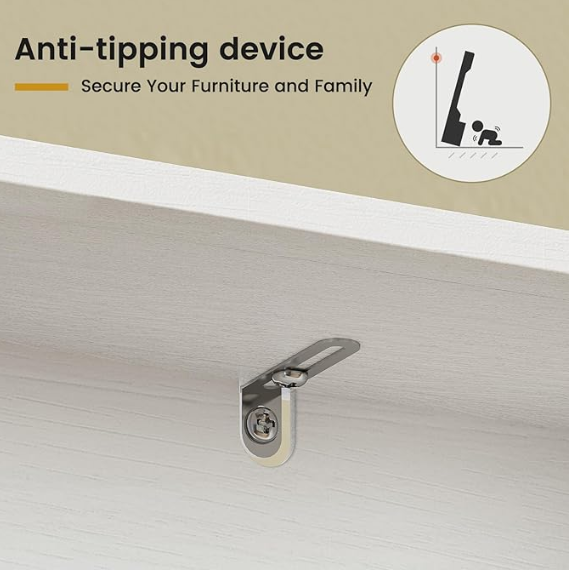
Safety is a non-negotiable in entryway furniture—especially tall units and hall trees. For apartments, include anti-tipping guidance and hardware options suitable for different wall types.
Anti-tipping best practices
- Provide an anti-tipping device and clear instructions
- Recommend anchoring for homes with kids or pets
- Design the base for stability (wide stance, balanced load)
- Use durable connectors and confirm pull-out performance during QC
Rental-friendly approach
For rentals, buyers appreciate solutions that can be installed with minimal wall damage. Provide multiple mounting options and clear “landlord-safe” installation notes.
9) B2B / OEM / ODM: how to standardize a winning entryway SKU
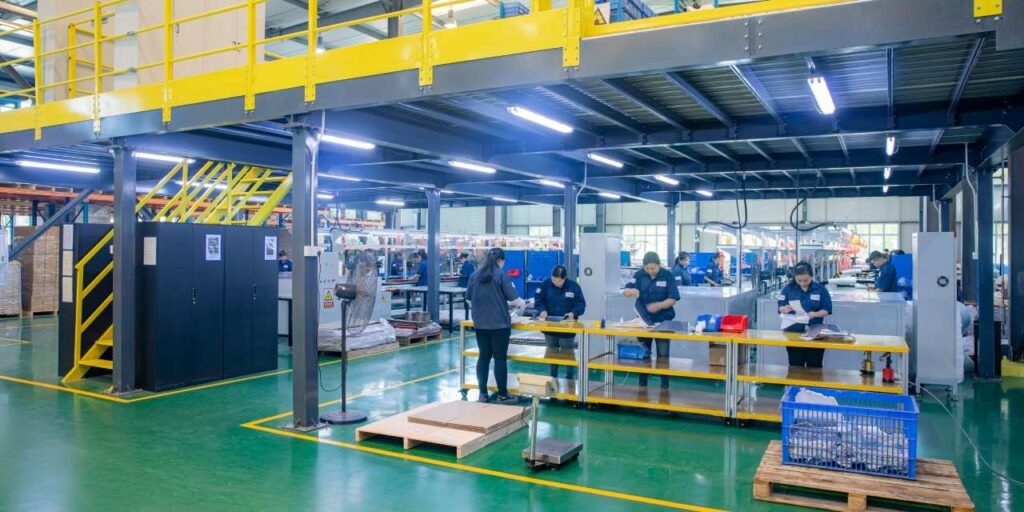
If you’re sourcing for retail, distribution, or engineering projects, the goal is repeatable success. This means fewer returns and consistent quality. You want a product that fits the most apartments possible. That’s where factory-direct OEM/ODM planning matters.
OEM/ODM customization levers that actually move sales
- Depth optimization: refine slim shoe cabinet depth for narrow corridors.
- Door style: modern flat, shaker, arch panel, or barn-door looks.
- Handle and hardware upgrades: premium feel with minimal cost impact.
- Modular packaging: easier shipping and reduced damage rate.
- Colorways: black for modern projects, white for airy apartments, wood-tone for warmth.
Why “apartment-fit” matters for procurement
A single slim shoe cabinet fits most narrow hallways. It can become a hero SKU, especially for property managers, hospitality buyers, and B2B catalogs. Standardization simplifies everything: shipping, spare parts, installation training, and long-term maintenance.
For factory capability, product development, and OEM/ODM collaboration, see: https://plywoodmfr.com/
10) Project checklist: what to confirm before production
Technical checklist
- Final dimensions (W × D × H) and tolerance plan
- Target shoe capacity and internal configuration (shelves/dividers)
- Hardware specification: hinges, slides, handles, anti-tipping kit
- Finish requirements: scratch resistance, stain resistance, easy-clean
- Packaging test standard (drop test, corner protection, moisture barrier)
Commercial checklist
- MOQ, lead time, and sample timeline
- Branding options (logo, carton print, manuals, inserts)
- Compliance needs (project-specific, region-specific)
- After-sales plan (spares, replacement hardware, quick fixes)
- Photography and listing assets (ALT text, lifestyle scenes, detail callouts)
When these items are confirmed early, your slim shoe cabinet and narrow shoe rack solutions ship faster. They install smoother. They perform better in real homes.
Authoritative Industry Resources
For buyers who need sourcing credibility, sustainability references, and quality-system alignment, these organizations and platforms are commonly referenced in B2B procurement discussions:
- International Furniture and Manufacturers Association (IFAMA)
- American Furniture Manufacturers Association (AFMA)
- European Furniture Manufacturers Federation (UEA)
- China National Furniture Association (CNFA)
- International Wood Products Association (IWPA)
- National Kitchen & Bath Association (NKBA)
- GREENGUARD Certification (Indoor Air Quality)
- Forest Stewardship Council (FSC)
- International Organization for Standardization (ISO)
- Alibaba (B2B Marketplace)
- Made-in-China (B2B Marketplace)
- Global Sources (B2B Sourcing)
- Thomasnet (North America Supplier Directory)
- Europages (Europe B2B Directory)
FAQ
What is the best entryway furniture for a very narrow apartment hallway?
A slim shoe cabinet is usually the best first choice because it keeps the walkway clear while hiding shoes. Add a narrow shoe rack zone only for daily pairs if needed.
Should I choose a shoe rack or a shoe cabinet for small apartments?
For most small apartments, choose a shoe cabinet for a cleaner look. Use a narrow shoe rack as a small “daily rotation” layer. This combo balances speed and aesthetics.
How do I keep an entryway looking tidy with limited space?
Use closed storage for bulk items. Keep the floor as clear as possible. Create a routine zone with hooks for bags and coats. Include a tray for keys and a defined spot for daily shoes.
Is anti-tipping really necessary for entryway furniture?
For tall units, hall trees, and homes with kids/pets, anti-tipping guidance is strongly recommended. Many project buyers and property managers require it for safety and liability reasons.
Can I source slim shoe cabinets with OEM/ODM customization?
Yes. Many factories support OEM/ODM. This includes size optimization, door styles, and finishes. They also offer hardware upgrades, packaging engineering, and branding inserts for retail or projects.
What should B2B buyers confirm before ordering entryway furniture in bulk?
Confirm final dimensions, hardware specs, finish requirements, packaging tests, compliance needs, lead time, and after-sales support (spare parts, replacement hardware).