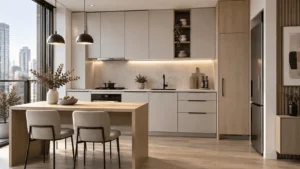
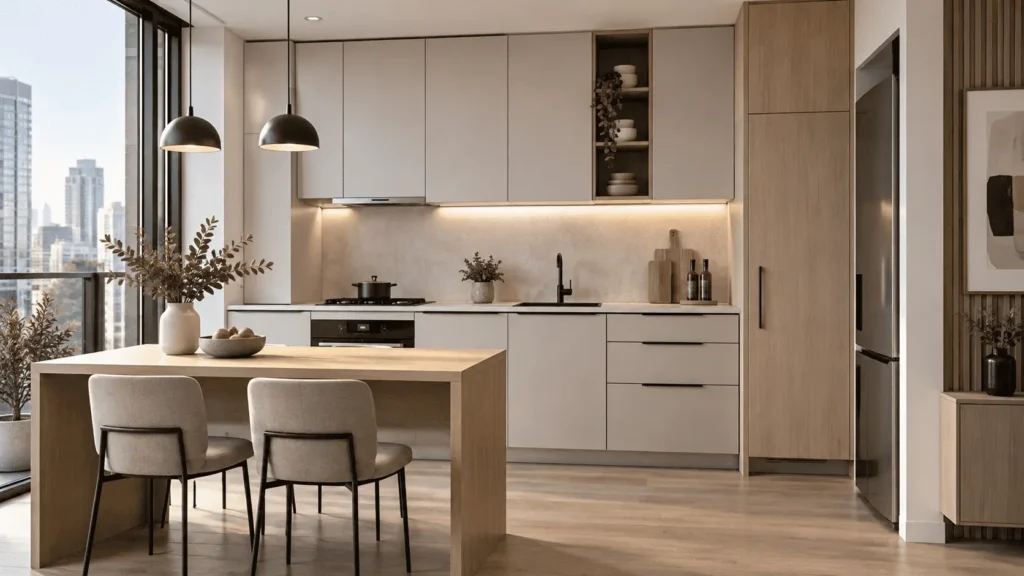
For importers, property developers, contractors, cabinet distributors, and furniture brands, sourcing modern kitchen cabinets for apartments is not mainly about finding the most attractive kitchen photograph. A successful apartment cabinet program has to balance usable storage, repeatable dimensions, material cost, surface durability, installation efficiency, packaging volume, and consistent mass production.
When one cabinet specification is repeated across dozens or hundreds of apartments, a small design decision can affect purchasing cost, container loading, installation time, replacement rates, and future repeat orders.
As a panel furniture export manufacturer, we therefore look at modern apartment kitchens from a production and procurement perspective: Which cabinet structures are practical to manufacture at scale? Which finishes are easier to maintain? Which layouts work with compact units? How should buyers specify materials, hardware, MOQ, packaging, and OEM/ODM requirements before requesting a quotation?
This guide answers those questions.
Table of Contents
- What Makes Apartment Kitchen Cabinets Different?
- Which Modern Cabinet Door Styles Work for Apartment Projects?
- Which Colors and Finishes Are Most Practical?
- Compact Kitchen Layouts and Space Optimization
- Choosing MDF, Plywood, or Particle Board
- Storage and Hardware Specifications Buyers Should Confirm
- Designing Cabinets for Repeatable Apartment Production
- MOQ, Lead Time, Packaging, and Export Planning
- OEM/ODM Customization and the RFQ Process
- Modern Kitchen Cabinet Specifications by Market Position
- Why Factory Capability Matters
- FAQ for Apartment Kitchen Cabinet Buyers
What Makes Modern Kitchen Cabinets for Apartments Different?
Apartment cabinetry should be treated as a repeatable product system, not as a single custom residential kitchen.
A homeowner may accept a kitchen designed around one unusual wall, one appliance package, and one decorative preference. A developer supplying 80, 300, or 800 units usually has a different priority: the kitchen needs to be repeatable across several unit types while staying within an approved cost and installation schedule.
That changes the specification.
For an apartment project, buyers normally need to control:
- cabinet module dimensions;
- door and drawer proportions;
- finish consistency;
- appliance openings;
- countertop coordination;
- hinge and drawer-slide specifications;
- cabinet identification;
- installation sequence;
- replacement parts;
- packing volume;
- and production repeatability.
The commercial objective is not simply to produce one impressive kitchen. It is to reproduce an approved kitchen specification consistently across every applicable apartment.
That is why the most commercially practical apartment kitchen cabinets tend to use a controlled family of modular base, wall, drawer, sink, pantry, and tall cabinets rather than a large number of unique cabinet constructions.
For buyers sourcing complete kitchen programs, our modern kitchen cabinets and kitchen furniture range covers modular, RTA, flat-pack, storage, pantry, island, and OEM kitchen cabinet applications. Starwood’s current kitchen program supports custom dimensions, finishes, hardware, cabinet structures, packaging, and private-label options.
Which Modern Cabinet Door Styles Work for Apartment Projects?
For a project buyer, the best door style is not necessarily the one with the highest decorative complexity. It is the one that fits the target property’s positioning while remaining economical and repeatable.
Flat-Panel Cabinets
Flat-panel or slab-front cabinets are one of the most practical directions for contemporary apartment projects.
The simple geometry works particularly well with:
- frameless cabinet boxes;
- matte or high-gloss finishes;
- woodgrain melamine;
- PET surfaces;
- laminate;
- painted MDF;
- handleless designs;
- and slim-profile handles.
From a manufacturing perspective, flat-panel fronts also make it easier to coordinate multiple cabinet widths while maintaining a consistent visual language.
They are especially suitable for studios, rental apartments, serviced apartments, student housing, and contemporary residential developments where space is limited and the interior design needs to remain visually clean.
Slim Shaker and Shaker Cabinets
Shaker fronts remain useful when the target market prefers a warmer or more transitional kitchen.
For project applications, however, buyers should distinguish between a traditional detailed shaker door and a simplified slim-shaker profile. More complicated routed profiles can affect machining, painting, cleaning, production cost, and lead time.
When the project brief calls for a contemporary rather than traditional kitchen, a slim shaker design can provide more visual character without making the cabinet program excessively decorative.
Handleless and Integrated-Pull Cabinets
Handleless cabinet designs can support a premium modern appearance, particularly in urban apartments and serviced residences.
Before specifying them, confirm the actual construction method. A true integrated profile, routed pull, push-to-open mechanism, and applied finger-pull handle are not the same from a manufacturing or cost perspective.
For large apartment programs, we normally recommend approving a full-size door or cabinet sample instead of making the decision only from a rendering.
Which Colors and Finishes Are Most Practical?
Color trends change, but apartment buyers should separate design preference from project risk.
For repeatable modern kitchen programs, neutral finishes are often easier to coordinate with flooring, wall paint, countertops, appliances, and future replacement requirements.
Warm White and Off-White
White remains useful because it visually lightens compact kitchens and combines easily with different countertops and interior palettes.
For project procurement, however, the buyer should define the exact color reference rather than simply writing “white” on a purchase order.
A warm white, cool white, high-gloss white, matte white, painted white, and white melamine can look significantly different under the same lighting.
Light Grey and Greige
Light grey and greige give developers a neutral alternative to pure white.
These finishes work especially well when the apartment specification combines neutral walls, stone-look countertops, black hardware, or warm wood flooring.
Natural Oak and Woodgrain Finishes
Woodgrain cabinets can add visual warmth without requiring a real-wood door throughout the entire kitchen.
For cost-controlled projects, a stable decorative panel or laminate may allow buyers to reproduce a wood appearance consistently across multiple apartment units.
The most important purchasing point is batch consistency. The buyer should approve the reference sample and establish how replacement components will be matched later.
High-Gloss Cabinets
High gloss cabinets remain relevant for certain markets, particularly where buyers want reflective, easy-to-recognize contemporary finishes.
In small kitchens, a reflective surface can contribute to a brighter visual effect. From a procurement perspective, however, high-gloss surfaces also make scratches, protective-film quality, color variation, and handling marks more noticeable.
For high-gloss cabinet programs, evaluate the finish under actual lighting and inspect:
- surface flatness;
- reflection consistency;
- edge quality;
- protective film;
- scratch resistance;
- and carton protection.
For rental and high-turnover properties, a durable matte or textured finish may sometimes be more forgiving than a highly reflective surface.
Compact Kitchen Layouts and Space Optimization
Compact kitchen design is not simply about using smaller cabinets.
The more important goal is to reduce wasted space while keeping the kitchen straightforward to manufacture and install.
One-Wall Kitchens
One-wall kitchens are suitable for studios, smaller apartments, student accommodation, and certain hotel-apartment layouts.
They typically require careful coordination of:
- refrigerator position;
- sink cabinet;
- hob or cooktop;
- drawer storage;
- wall cabinets;
- hood cabinet;
- and tall storage where space permits.
Because everything is placed on one run, even a small dimensional mistake can affect the complete layout.
Galley Kitchens
Galley kitchens can provide good storage density without requiring a large room.
Project buyers should pay particular attention to cabinet depth, opposing door clearances, appliance openings, drawer extension, and walking space.
The drawing review should therefore be completed before cabinet production rather than relying on installers to solve conflicts on site.
L-Shaped Kitchens
L-shaped kitchens are widely applicable to one-bedroom and two-bedroom apartments because they can combine working space and corner storage while maintaining an open connection to the living area.
The corner requires deliberate specification. Buyers should decide whether the design uses a blind corner, corner shelf, rotating accessory, or other solution before quotation.
Tall Cabinets
Where floor area is limited, vertical storage becomes commercially valuable.
Tall pantry units can combine:
- food storage;
- appliance housing;
- cleaning supplies;
- drawers;
- adjustable shelves;
- and integrated utility storage.
For an apartment project, it is usually more efficient to standardize a small number of tall-unit configurations than to develop a different pantry for every floor plan.
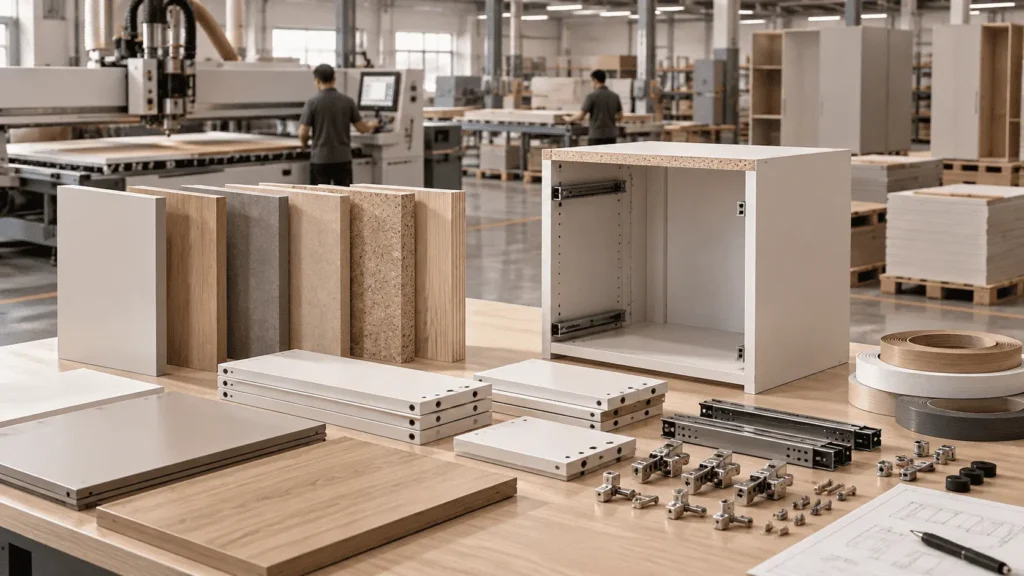
Choosing MDF, Plywood, or Particle Board
There is no single panel material that is automatically correct for every modern kitchen cabinet project.
The correct material depends on the component, finish, project budget, destination market, performance requirements, and intended service life.
MDF
MDF provides a uniform surface and is commonly considered for painted, lacquered, routed, PET, or other decorative door-front applications.
Its consistency can make it suitable for modern flat-panel and painted cabinet designs.
The buyer should specify panel grade, thickness, finish construction, edge treatment, and applicable emission requirements rather than requesting only “MDF kitchen cabinets.”
Plywood
Plywood can be selected where the project requires a different structural or moisture-performance profile.
However, “plywood” alone is not a sufficient procurement specification. Core construction, face quality, thickness, glue system, panel grade, and final surface still need to be defined.
Particle Board
Particle board combined with melamine or laminate is widely used in panel furniture because it can provide a cost-efficient and repeatable cabinet-box solution.
For project work, edge sealing, drilling accuracy, fastener design, moisture exposure, and panel density are important considerations.
Do Not Specify Only One Material for the Entire Kitchen
One of the easiest ways to over-specify an apartment kitchen is to insist that every component use the same substrate.
A more efficient approach can be to engineer different components according to actual performance requirements.
For example, the carcass, door, drawer bottom, back panel, shelf, countertop support, and decorative end panel do not necessarily need identical construction.
That approach allows the factory and buyer to balance performance with project cost rather than paying for an unnecessary specification everywhere.
Compliance Should Follow the Destination Market
For kitchens entering the United States, buyers using regulated composite wood products should review the U.S. EPA’s official TSCA Title VI composite wood guidance. EPA states that its formaldehyde standards cover hardwood plywood, MDF, particleboard, and finished goods containing regulated composite wood products.
For California programs, buyers can additionally consult the California Air Resources Board’s Composite Wood Products ATCM information when determining applicable requirements.
Where certified responsible sourcing is part of the specification, procurement teams can also reference the Forest Stewardship Council’s FSC Chain of Custody requirements. FSC explains that Chain of Custody certification applies to the handling of certified forest materials through production and trade.
The important point is not to add certification logos to a specification automatically. Buyers should first determine which standards are actually required by the destination market, customer, tender, retailer, architect, or contract.
Storage and Hardware Specifications Buyers Should Confirm
Apartment kitchens sell usable storage, not simply cabinet volume.
A well-planned cabinet system should make frequently used storage easy to access without creating unnecessary hardware cost.
Drawer Bases
Wide drawer bases are useful for cookware, dishes, and daily kitchen items.
For project procurement, specify:
- drawer quantity;
- drawer height;
- internal width;
- slide type;
- loading expectation;
- soft-close requirement;
- and whether the system uses metal drawer sides or panel-built drawers.
Do not leave “soft-close” as the only hardware specification. Different hinge and slide systems have different construction, loading, adjustment, and pricing.
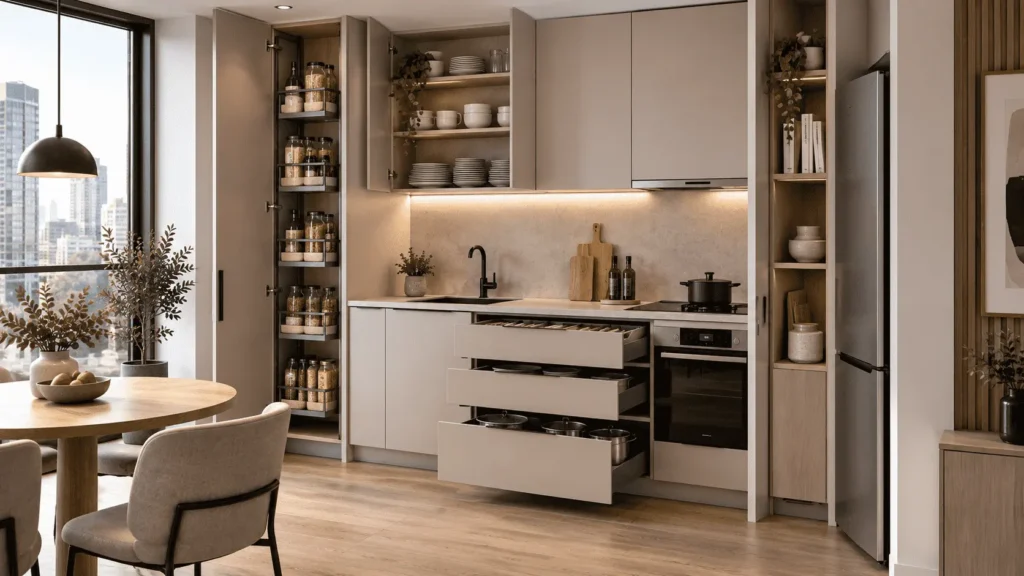
Pantry Storage
Tall pantry units can provide high storage capacity within a relatively small floor footprint.
The buyer should decide whether the pantry uses adjustable shelves, internal drawers, baskets, pull-out hardware, or simple shelving.
Special accessories can improve usability, but every additional mechanism also adds procurement cost and potential replacement requirements. For rental housing, simpler storage solutions can therefore be commercially attractive.
Sink Cabinets
Sink units need sufficient allowance for plumbing and site installation.
Where projects have different plumbing conditions, this should be considered before the factory pre-drills or closes unnecessary areas.
Waste-Bin Storage
Integrated waste-bin cabinets are increasingly specified in contemporary kitchens. For project buyers, check whether the hardware can be sourced consistently for repeat orders and whether replacement components will remain available.
Performance Testing
For buyers who need a formal cabinet-performance benchmark, the ANSI/KCMA A161.1 Quality Cabinet Certification program covers structural, door, drawer, and finish testing for kitchen and vanity cabinets. Buyers should treat this as a specification reference where relevant rather than assuming that any cabinet is certified unless certification has actually been verified.
Designing Modern Kitchen Cabinets for Repeatable Apartment Production
This is where factory engineering becomes different from interior-design inspiration.
Consider a development with six apartment types.
If every room type uses completely unrelated cabinet modules, the project creates:
- more drawings;
- more CNC programs;
- more hardware combinations;
- more carton SKUs;
- more installation identification;
- more spare-part requirements;
- and more opportunities for site errors.
A stronger project approach is to reuse modules where possible.
For example, several unit types may share the same base drawer cabinet, wall cabinet, sink unit, or tall pantry even though the complete kitchen layouts are different.
This creates a controlled cabinet platform rather than hundreds of isolated custom parts.
Coordinate Appliance Dimensions Early
Appliance specifications should be confirmed before mass production.
Important dimensions include refrigerator openings, oven housing, cooktop cut-outs, microwave positions, hood requirements, dishwasher openings, ventilation allowances, and service access.
A last-minute appliance change can affect multiple cabinet modules.
Use a Cabinet Schedule
For project purchasing, a cabinet schedule or BOQ is preferable to a collection of reference images.
Each cabinet can be identified by:
- cabinet code;
- width, depth, and height;
- material;
- finish;
- door type;
- hardware;
- quantity per unit;
- apartment type;
- and total project quantity.
This helps the factory quote, manufacture, inspect, pack, and identify each module more accurately.

MOQ, Lead Time, Packaging, and Export Planning
MOQ should be discussed as a production program, not simply as one number.
A project containing 300 kitchens with one common finish is very different from an order containing 30 kitchens in ten finishes.
Factors affecting MOQ include:
- finish quantity;
- panel purchasing requirements;
- hardware purchasing quantities;
- custom color preparation;
- cabinet-module mix;
- countertop requirements;
- packaging;
- and private-label components.
Starwood’s factory profile states that it supports lower-MOQ programs for market testing, but the exact MOQ should be confirmed against the actual product mix rather than published as a universal figure.
Lead Time Should Be Divided Into Stages
Instead of asking only, “What is your lead time?”, a professional RFQ should separate:
Technical review → material confirmation → sample production → sample approval → mass production → QC → packing → loading.
A highly customized cabinet program normally requires more preparation than a repeat order using an already-approved specification.
The safest purchasing practice is to confirm the production schedule after materials, drawings, quantity, packaging, and sample requirements have been finalized.
Flat-Pack vs Assembled Cabinets
For international procurement, flat-pack or RTA construction can reduce shipping volume and make container loading more efficient.
However, saving freight is only useful when the structure remains simple and reliable to assemble.
Flat-pack cabinets should therefore be engineered around:
- accurate CNC drilling;
- repeatable connectors;
- hardware identification;
- protective packing;
- installation instructions;
- and logical carton labeling.
Starwood currently supports flat-pack/RTA kitchen cabinets with protected panels, hardware kits, assembly instructions, carton marks, and export packaging.
For buyers that need formal transport-package validation, the International Safe Transit Association provides several test procedures, including ISTA Procedure 2C for packaged furniture products. ISTA describes 2C as a partial-simulation test for individual packaged furniture case goods.
Label by Project, Unit, or Installation Sequence
For multi-unit projects, labeling can be almost as important as the carton itself.
Depending on the installation plan, cartons can identify:
Project → Building → Floor → Apartment → Room → Cabinet Code.
Good identification helps installers locate components without opening multiple cartons and reduces the risk that cabinets from different unit types are mixed together.
Clarify Trade Terms Before Comparing Quotations
A cabinet quotation is not directly comparable unless delivery terms are consistent.
Before choosing between EXW, FOB, CIF, DAP, or other arrangements, procurement teams should understand where cost and risk transfer. The International Chamber of Commerce maintains the official Incoterms 2020 rules, which define responsibilities, costs, and risks between sellers and buyers.
OEM/ODM Customization and the RFQ Process
Modern apartment cabinets often require some degree of customization.
For OEM projects, the buyer may already have construction drawings, existing cabinet specifications, samples, or an established retail collection.
For ODM development, the factory may begin with a target price, reference image, apartment layout, or market concept and convert it into a manufacturable product.
Starwood’s OEM and ODM furniture manufacturing service covers technical review, materials, structure optimization, samples, production, QC, packaging, and export preparation for panel furniture programs.
For an efficient kitchen cabinet quotation, send as much of the following information as possible:
- Floor plan or kitchen layout.
- Cabinet dimensions or BOQ.
- Total number of apartments.
- Quantity by apartment type.
- Preferred carcass material.
- Door material and finish.
- Color reference.
- Hardware specifications.
- Countertop requirement, if applicable.
- Appliance dimensions.
- RTA or assembled preference.
- Private-label requirements.
- Destination country.
- Required compliance documentation.
- Target delivery schedule.
- Target price range, if available.
A detailed RFQ allows the factory to identify cost drivers before quoting instead of adding unnecessary safety margins to an incomplete specification.
Modern Kitchen Cabinet Specifications by Market Position
Rather than asking, “Which cabinet is best?”, B2B buyers should first decide what price and performance position the apartment project requires.
Cost-Controlled Rental Housing
A commercially practical direction may include:
- modular frameless construction;
- melamine-faced engineered board;
- simple flat-panel fronts;
- white, grey, or woodgrain finish;
- standardized hinges and drawer slides;
- straightforward internal shelves;
- and flat-pack export packaging.
The goal is stable daily functionality, simple installation, controlled cost, and easy replacement.
Mainstream Apartment Development
The specification can move toward:
- coordinated frameless cabinet boxes;
- better-finished flat-panel or slim-shaker doors;
- matte, PET, lacquer, laminate, or upgraded decorative surfaces;
- soft-close hardware;
- drawer-heavy base cabinets;
- tall storage;
- coordinated end panels;
- and project-specific packaging.
This category gives the developer greater design differentiation without moving into highly customized luxury joinery.
Premium Apartments and Serviced Residences
Premium projects may introduce:
- upgraded plywood or engineered cabinet construction where required;
- veneer or premium decorative finishes;
- handleless profiles;
- branded hardware;
- more internal organizers;
- integrated appliance panels;
- custom color matching;
- stone or quartz coordination;
- and more detailed factory pre-assembly inspection.
The important purchasing principle is to upgrade the features residents actually see or use rather than increasing specifications indiscriminately.
Why Factory Capability Matters for Apartment Cabinet Projects
The cabinet design is only one part of a successful project.
The supplier also has to convert approved specifications into repeatable production.
Starwood Industry Co., Ltd. describes itself as a panel furniture manufacturer in Jiangmen, Guangdong, specializing in OEM and ODM flat-pack furniture since 2013 and serving importers, wholesalers, furniture brands, e-commerce companies, and commercial projects.
For buyers who want to understand the production side before sending an RFQ, see our panel furniture export factory profile.
For complete developments rather than individual kitchen SKUs, our project furniture manufacturing service supports apartment, rental housing, hotel, serviced-apartment, student-housing, office, and commercial projects, including custom dimensions, finishes, hardware, packaging, QC, and container-loading support.
This distinction matters.
A buyer searching for modern kitchen cabinets may begin with a door style or reference image. A successful B2B project eventually becomes a much broader manufacturing question involving drawings, materials, batch consistency, machining, hardware, QC, cartons, installation identification, shipping, and repeat supply.
That is where a project-oriented cabinet factory should add value.
Final Buyer Checklist Before Requesting a Quote
Before sending your apartment kitchen project to a manufacturer, make sure five basic areas are clear:
Design: floor plan, cabinet schedule, appliance dimensions, color, and style.
Materials: cabinet box, doors, backs, shelves, countertops, edge banding, and required compliance.
Hardware: hinge, drawer system, handles, organizers, and branded-hardware requirements.
Commercial Terms: total quantity, quantity per unit type, MOQ constraints, sample requirements, project timeline, and Incoterm.
Logistics: assembled or RTA construction, carton identification, spare parts, loading method, and destination.
The more of these variables are confirmed before quotation, the easier it becomes to compare suppliers on the same basis.
Looking for Modern Kitchen Cabinets for an Apartment Project?
If you are sourcing modern kitchen cabinets for apartments, rental housing, serviced apartments, hotels, retail programs, or private-label cabinet collections, send us your floor plans, reference designs, quantities, material requirements, target market, and packaging requirements.
We can review the project from a manufacturing perspective and help you evaluate cabinet structure, panel materials, finishes, hardware, modular sizes, flat-pack construction, packaging, and production requirements before bulk ordering.
Explore our modern kitchen cabinets or contact Starwood with your project brief for an OEM/ODM quotation.
Send your drawings, BOQ, reference photos, or apartment schedules and tell us the destination market and required quantity. We can then prepare a more accurate technical proposal and factory quotation for your cabinet program.
Frequently Asked Questions
What type of modern kitchen cabinets work well for apartment projects?
Flat-panel and frameless cabinets are commonly suited to contemporary apartment projects because they create a clean appearance and allow a modular cabinet system. Shaker or slim-shaker fronts can also be used where the market requires a more transitional style. The final choice should reflect target price, interior style, durability requirements, and production quantity.
Are frameless kitchen cabinets suitable for small apartments?
Yes. Frameless cabinets are commonly used in compact and contemporary kitchens because the construction eliminates the traditional face frame and works well with full-overlay doors. Project buyers should still evaluate cabinet dimensions, hardware, installation method, and structural requirements for the intended market.
Which material is better for apartment kitchen cabinets: MDF, plywood, or particle board?
Each material has different applications. MDF is commonly used where a smooth painted or decorative door surface is required. Plywood may be selected for particular structural or moisture-performance requirements. Melamine-faced particle board is widely used for cost-controlled cabinet boxes. A project can also combine different substrates according to the function of each component.
Do you manufacture high-gloss kitchen cabinets?
High-gloss finishes can be incorporated into OEM/ODM kitchen cabinet programs depending on the selected substrate and surface system. Buyers should approve finish samples and confirm scratch resistance, color, edge quality, protective film, and packaging before mass production.
What is the MOQ for custom apartment kitchen cabinets?
MOQ depends on cabinet quantity, number of finishes, custom hardware, material purchasing requirements, packaging, and whether the order is a new development or repeat production. Rather than applying one MOQ to every kitchen program, buyers should submit the cabinet mix and total project quantity for evaluation.
What is the production lead time for an apartment cabinet project?
Lead time depends on drawing approval, material selection, sample requirements, finish complexity, order quantity, hardware sourcing, and production schedule. Buyers should confirm separate timing for technical review, sampling, sample approval, mass production, QC, packing, and shipment instead of relying on one generic lead-time figure.
Can apartment kitchen cabinets be supplied as RTA or flat pack?
Yes. Flat-pack/RTA construction can be used for suitable cabinet programs and may improve container utilization and overseas handling. Accurate drilling, reliable connectors, hardware kits, installation instructions, carton protection, and cabinet identification are important parts of an export-ready RTA program.
What information should I send for an OEM kitchen cabinet quotation?
Send the floor plan or cabinet drawings, required dimensions, apartment quantity, unit types, material and finish requirements, hardware specification, appliance dimensions, packing preference, destination country, compliance requirements, and expected delivery schedule. A detailed BOQ or cabinet schedule will normally produce a more accurate quotation than reference images alone.