Table of Contents
- Why B2B Buyers Search for Modular Living Room Furniture Manufacturers
- What Modular Living Room Furniture Means for Projects
- Application Scenarios for Commercial and Residential Projects
- Factory Capability: What a Real Manufacturer Should Provide
- Materials for Modular Panel Furniture Production
- OEM/ODM Customization Options for Buyers
- MOQ, Lead Time, Sampling, and Production Planning
- Packaging and Export Loading for Modular Furniture
- Quality Control Points Buyers Should Check
- How to Work With a Panel Furniture Export Factory
- Internal Product and Project Resources
- Final Sourcing Checklist
- FAQ
Why B2B Buyers Search for Modular Living Room Furniture Manufacturers
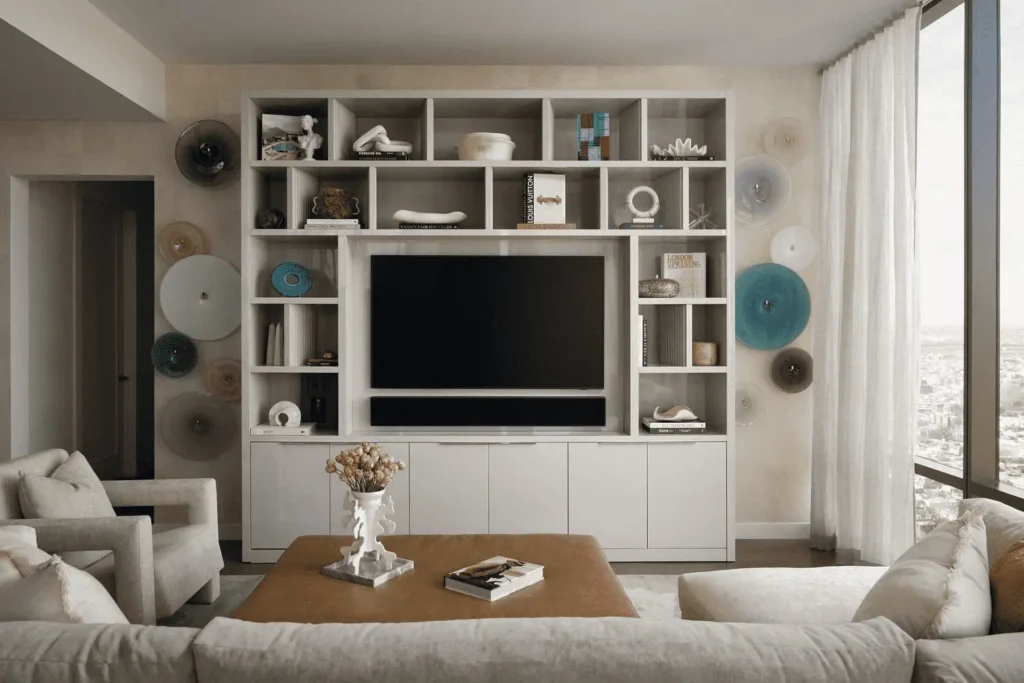
For importers, furniture brands, apartment developers, hotel contractors, and project procurement teams, modular living room furniture is not only a home design category. It is a procurement solution that affects cost control, container loading, installation efficiency, SKU planning, and after-sales service. When buyers search for a modular living room furniture manufacturer, they usually need a factory that can handle OEM/ODM orders, stable panel furniture production, project documentation, export packaging, and repeat supply.
A professional modular living room furniture factory should understand more than style. It should understand buyer drawings, material matching, hardware selection, knock-down structure, production tolerance, carton protection, loading plans, and delivery schedules. This is especially important for commercial furniture projects such as serviced apartments, rental housing, hotel living areas, student accommodation, co-living spaces, and real estate furnished units.
At PlywoodMFR, we focus on panel furniture manufacturing for export buyers, including living room furniture, storage cabinets, TV units, modular wall systems, coffee tables, shelving, wardrobes, and project furniture solutions. Buyers can learn more about our factory background on The Company, explore our OEM/ODM furniture manufacturing services, or review our project furniture manufacturing capability.
What Modular Living Room Furniture Means for Projects
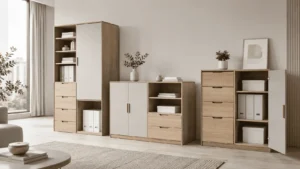
For B2B buyers, modular living room furniture means flexible product units that can be combined, adjusted, packed, shipped, and installed according to different room layouts. A modular system may include TV cabinets, wall-mounted storage, open shelves, side cabinets, coffee tables, display units, bookcases, and multi-functional storage modules.
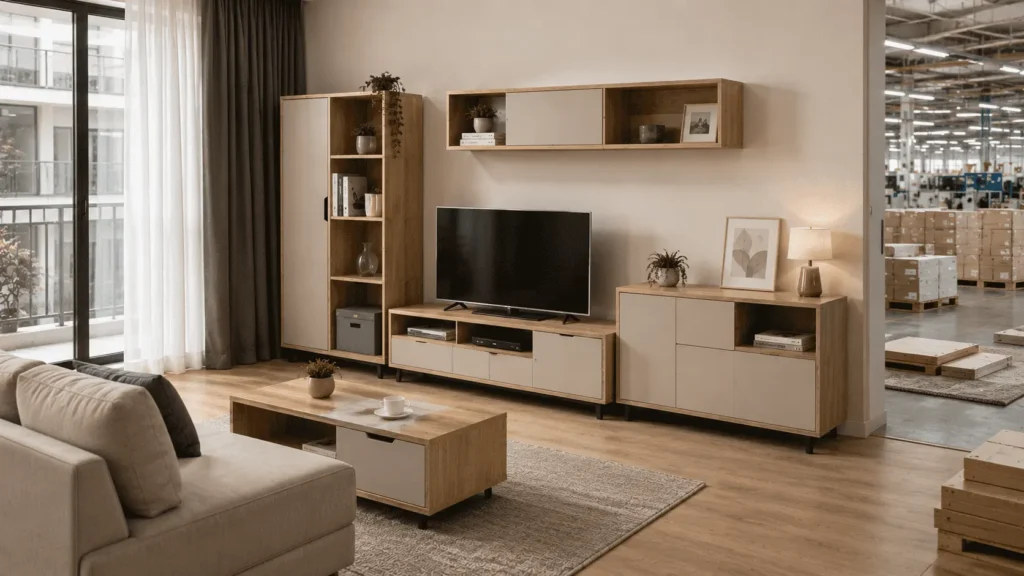
Unlike single-piece furniture, modular living room furniture helps buyers create different product combinations from shared components. This is useful for wholesalers, e-commerce brands, apartment operators, and project contractors because one production platform can serve multiple market needs.
For example, a buyer may use the same cabinet body structure for three different sales models. By changing the door finish, handle type, shelf layout, color, or package combination, the buyer can create budget, mid-range, and premium product lines without developing everything from zero.
This is why many buyers search for terms such as modular living room furniture factory, modular living room furniture OEM, living room cabinet manufacturer, or panel furniture export factory. They want a production partner that can turn a flexible furniture concept into repeatable, export-ready products.
For commercial buyers, modularity is not only about design. It is about controlling purchasing risk.
A good modular furniture program should help buyers:
- Reduce development cost by using shared structures
- Improve production efficiency with standardized panel sizes
- Support different apartment or hotel room layouts
- Lower spare parts complexity
- Improve packaging and container utilization
- Make future reorders easier
- Support private label and regional market requirements
When designed correctly, modular living room furniture can become a long-term product system rather than a one-time order.
Application Scenarios for Modular Living Room Furniture
1. Apartment and Rental Housing Projects
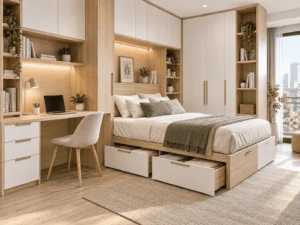
Apartment buyers often need furniture that is compact, durable, easy to clean, and suitable for different floor plans. Modular living room furniture works well because TV units, side cabinets, storage shelves, and coffee tables can be adjusted according to room size.
For furnished apartment projects, buyers usually care about cost per unit, installation speed, replacement parts, and long-term maintenance. A modular system allows the purchasing team to use similar components across multiple room types. This helps reduce confusion during installation and makes spare part management easier.
For apartment projects, we usually recommend melamine-faced particle board, MDF, or plywood-based structures depending on the buyer’s target budget, durability requirement, and market positioning. Edge banding, anti-scratch surfaces, and stable knock-down fittings are also important for rental furniture.
2. Hotel and Serviced Apartment Living Areas
Hotels and serviced apartments need furniture that matches the brand design while also meeting practical project requirements. Modular living room furniture can be used in suites, lobby lounges, long-stay rooms, and serviced apartment living zones.
For this type of project, buyers usually provide interior design drawings, reference images, finish boards, or room schedules. The factory should be able to convert these requirements into production drawings, sample units, packing solutions, and batch production plans.
A strong OEM ODM furniture supplier should also help with value engineering. For example, if the design uses expensive veneer or complex hardware, the factory can suggest more practical alternatives while keeping the same visual effect. This is where factory experience becomes valuable.
3. Wholesale and Retail Product Lines
Furniture wholesalers and retail brands often want modular living room products that can be sold as separate SKUs or combined sets. A TV cabinet may be sold alone, while matching wall shelves, coffee tables, or storage cabinets can be added as optional items.
This approach allows buyers to build a product family around one design language. It also helps with catalog planning, showroom display, and e-commerce product bundling.
For wholesale buyers, the most important points are stable quality, competitive MOQ, repeatable finishes, clear carton marks, and reliable loading quantity. A professional modular living room furniture manufacturer should support all of these requirements.
4. Co-Living, Student Housing, and Staff Accommodation
Co-living spaces, student apartments, and staff accommodation projects require furniture that is cost-effective, functional, and easy to maintain. Modular living room furniture is suitable because it can combine storage, display, media units, and compact tables in one system.
For these projects, the factory should focus on durability, simple installation, and replacement-friendly design. Buyers usually prefer finishes that hide scratches, hardware that is easy to source, and carton packaging that can withstand long-distance transportation.
5. Real Estate Furnished Units
Real estate developers may need living room furniture for model rooms, show flats, or fully furnished apartments. In this situation, appearance and project consistency are both important. Modular furniture helps keep design consistency across different unit types while allowing size adjustments.
For developers, the biggest concern is often project schedule. A factory must understand sample approval, material lead time, production planning, inspection, loading, and shipping deadlines.
Factory Capability: What a Real Manufacturer Should Provide
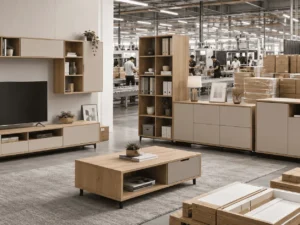
A real panel furniture export factory should not only quote a price. It should provide a complete manufacturing solution from product evaluation to export delivery.

Production Drawing Review
Before production, the factory should review buyer drawings and confirm dimensions, panel thickness, structure, hardware, edge banding, finish, and assembly method. Many problems can be avoided at this stage.
For example, if a TV cabinet is too long for standard carton protection, the factory may suggest splitting the structure into modules. If a wall-mounted shelf requires stronger support, the factory may recommend improved back panels or mounting hardware.
This is the difference between a trading-style supplier and a real project furniture manufacturer.
Material Matching
For modular living room furniture, common materials include particle board, MDF, plywood, melamine board, laminate board, veneer board, and painted panels. The factory should help the buyer select materials based on target market, price level, durability, and compliance needs.
For buyers selling into markets with formaldehyde emission requirements, it is important to understand local regulations and documentation. For example, buyers importing composite wood products into the United States often pay attention to EPA TSCA Title VI requirements. You can review the official EPA information about composite wood product formaldehyde standards here: EPA Formaldehyde Emission Standards for Composite Wood Products.
OEM/ODM Engineering Support
A professional factory should support OEM and ODM work, including size adjustment, structure development, color matching, hardware options, packaging design, private label, carton marks, and product documentation.
For buyers who already have drawings, the factory can provide OEM production. For buyers who only have a market idea, the factory can help develop ODM product concepts based on target price, market style, and shipping requirements.
More details are available on our OEM/ODM Furniture Manufacturing Services page.
Project Production Management
Project furniture orders are different from small retail orders. They require better coordination between sample approval, batch materials, production schedule, inspection, packing, and shipment.
For apartment or hotel projects, the factory should be able to organize production by room type, floor plan, or installation sequence. This can make receiving and installation easier for the buyer’s project team.
You can also visit our Project Furniture Manufacturing page for more information about project-based manufacturing.
Materials for Modular Panel Furniture Production
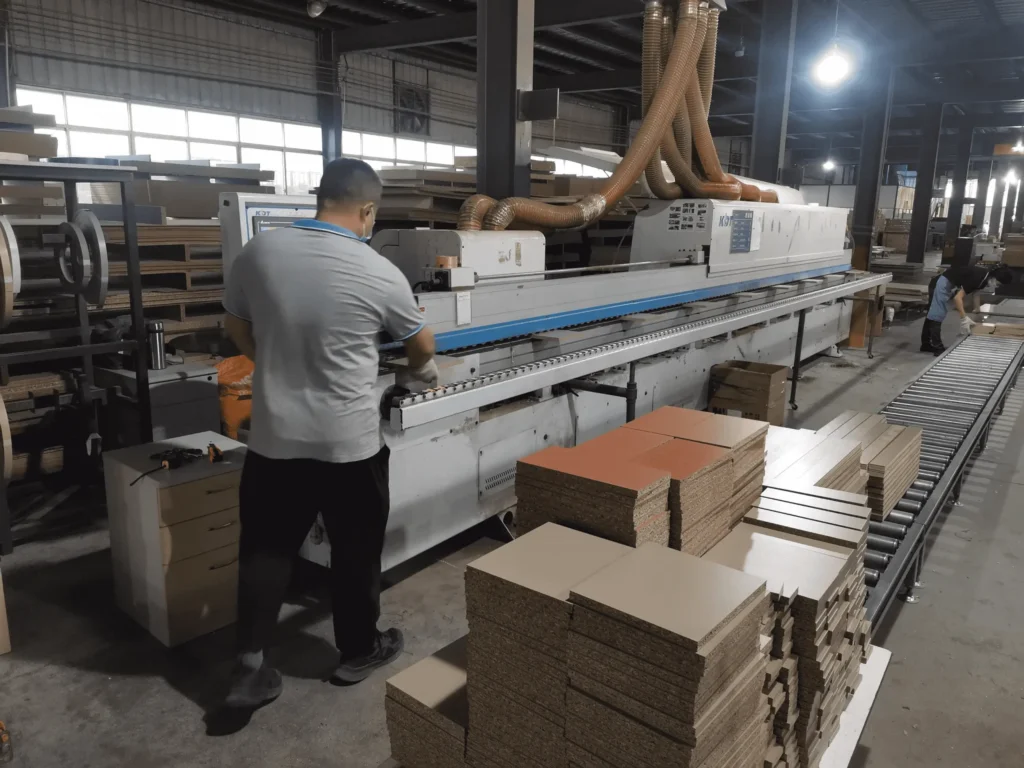
Material selection has a direct effect on price, strength, appearance, packing weight, and target market positioning. For B2B buyers, the right material is not always the most expensive one. It is the material that matches the project requirement and selling channel.
Particle Board
Particle board is widely used for cost-effective panel furniture. It works well for TV cabinets, storage units, shelves, and living room cabinets when combined with good surface paper, melamine finish, and proper edge banding.
For price-sensitive markets, particle board can help buyers reach competitive landed cost. However, buyers should confirm density, screw-holding strength, surface quality, and moisture resistance according to product use.
MDF
MDF provides a smoother surface and is often used for painted panels, routed designs, decorative doors, and modern living room furniture. It is suitable for buyers who want a clean finish or more detailed design.
For modular living room furniture, MDF can be used for doors, drawer fronts, side panels, or decorative elements. The factory should control moisture content, surface treatment, and edge sealing to reduce production defects.
Plywood
Plywood is stronger and more stable in many applications. It can be used for higher-end structures, heavier storage units, or project furniture requiring better strength. As a plywood-related manufacturer, we understand the importance of core quality, bonding, thickness tolerance, and panel stability.
Buyers who want stronger modular living room furniture for apartment or commercial projects may consider plywood-based structures or plywood reinforcement in key areas.
Melamine and Laminate Finishes
Melamine is common for modular panel furniture because it is cost-effective, easy to clean, and available in many colors and wood grains. Laminate can provide higher surface durability for commercial use.
For rental apartments and hospitality projects, buyers often choose neutral wood grain, white, grey, walnut, oak, black, or two-tone combinations. The factory should provide finish samples before mass production.
Edge Banding
Edge banding affects both appearance and durability. Poor edge banding can lead to chipping, glue marks, moisture problems, and customer complaints. For export furniture, PVC, ABS, or matching edge tape should be selected according to buyer requirements.
Hardware
Hardware may include cam locks, dowels, hinges, drawer slides, handles, wall brackets, adjustable feet, shelf supports, and connectors. Hardware quality affects assembly experience and long-term use.
For project buyers, we usually suggest using stable and easy-to-replace hardware instead of overly complicated fittings. This helps reduce after-sales risk.
Furniture buyers who need performance references can also review organizations such as BIFMA, which develops safety, performance, and sustainability standards for furniture. While every project has its own requirements, understanding recognized furniture standards helps buyers set clearer quality expectations.
OEM/ODM Customization Options for Buyers
A strong modular living room furniture OEM supplier should offer flexible customization without making the project difficult to control.
Size Customization
Buyers can customize TV cabinet length, shelf height, storage depth, wall unit size, coffee table dimensions, and cabinet combinations. For apartment and hotel projects, size customization is often based on room layout.
Color and Finish Customization
Common finishes include oak, walnut, ash, white, grey, black, beige, marble effect, matte solid color, and two-tone combinations. Buyers can provide reference samples, Pantone references, or existing product images.
Structure Customization
The structure can be free-standing, wall-mounted, floor-standing, knock-down, semi-assembled, or fully assembled depending on market and shipping needs.
For export orders, knock-down structure is often preferred because it improves container loading quantity and reduces shipping cost. However, the factory must design clear assembly instructions and stable connectors.
Hardware Customization
Buyers may choose soft-close hinges, push-open systems, concealed handles, metal legs, plastic feet, or wall brackets. The factory should balance cost and durability.
Branding and Private Label
For importers and furniture brands, private label service may include logo labels, carton marks, instruction manuals, barcode labels, SKU stickers, and customized packaging.
Packaging Customization
Packaging can be customized according to retail, e-commerce, wholesale, or project delivery needs. Drop-test requirements, mail-order packaging, corner protection, foam, honeycomb board, and reinforced cartons may be considered.
Documentation Support
For serious B2B buyers, documentation is part of the product. A professional factory should support product specifications, packing lists, assembly instructions, material descriptions, and loading plans.
MOQ, Lead Time, Sampling, and Production Planning
MOQ and lead time are key concerns for every buyer. For modular living room furniture, these depend on material, finish, structure, hardware, packaging, and order complexity.
MOQ
For standard panel furniture models, MOQ may be more flexible if the buyer uses existing materials and common finishes. For customized colors, special hardware, new molds, or exclusive structures, MOQ may be higher because the factory needs to purchase materials and arrange production separately.
For OEM/ODM modular furniture, buyers should provide the following information when asking for MOQ:
- Product drawings or reference photos
- Target dimensions
- Material requirement
- Finish color
- Hardware preference
- Packaging requirement
- Target order quantity
- Destination market
- Expected delivery time
With this information, the factory can provide a more accurate MOQ and quotation.
Sampling
A sample is important before mass production, especially for new modular furniture systems. The sample helps confirm structure, size, color, hardware, packing, assembly, and overall appearance.
For project orders, sample approval should be handled carefully. Once the buyer approves the sample, the factory can use it as a production standard.
Lead Time
Lead time depends on order quantity, material availability, sample approval speed, and factory schedule. For many panel furniture export orders, buyers should plan enough time for sampling, material preparation, production, inspection, packaging, and shipment booking.
Project buyers should avoid confirming production too late, especially before peak shipping seasons or major holidays. Early planning helps reduce delays.
Production Planning
For hotel, apartment, and commercial projects, production planning should be connected with the project schedule. The factory may need to deliver by batch, by room type, or by installation sequence.
A factory with project experience can help buyers reduce confusion during receiving and installation.
Packaging and Export Loading for Modular Furniture
Packaging is one of the most important parts of export furniture. A product that looks good in the showroom can still fail if packaging is weak.
Carton Protection
Modular living room furniture usually includes many panels, edges, corners, hardware bags, and instruction sheets. Each carton should protect panels from scratches, dents, moisture, and movement during transport.
Common packaging materials include:
- Strong export cartons
- Foam or EPE protection
- Corner protectors
- Honeycomb board
- Inner paper sheets
- Plastic bags
- Hardware bags
- Instruction manuals
- Carton labels and marks
Knock-Down Packing
Knock-down packing helps improve container loading and reduce freight cost. However, the design must be easy for end users or installers to assemble. The factory should test assembly before mass production.
Carton Marking
Clear carton marks are important for importers, wholesalers, and project contractors. Carton marks may include item number, product name, color, quantity, carton number, gross weight, net weight, dimensions, and destination information.
For project orders, carton marks may also include room number, building number, or installation area.
Loading Plan
A good loading plan helps buyers estimate freight cost and avoid wasted container space. For modular furniture, the factory should consider carton size, weight distribution, product sequence, and unloading convenience.
The International Trade Administration provides export-related market and trade resources through its Country Commercial Guides, which can be useful for buyers and suppliers when reviewing market conditions, regulations, and business practices.
Quality Control Points Buyers Should Check
Quality control should begin before production, not only before shipment. For modular living room furniture, buyers should check both product appearance and structure.
Before Production
Before production, confirm drawings, materials, finish samples, hardware, packaging, carton marks, and inspection standards. Any unclear point should be solved before materials are cut.
During Production
During production, the factory should check panel cutting accuracy, drilling position, edge banding quality, surface defects, hardware fitting, and color consistency.
Before Packing
Before packing, the factory should assemble or trial-fit key products to confirm that holes, connectors, doors, shelves, and drawers work correctly. This is very important for modular furniture because one wrong hole position can affect the entire system.
Final Inspection
Final inspection should include:
- Product dimensions
- Surface quality
- Color consistency
- Edge banding
- Hardware quantity
- Assembly test
- Carton strength
- Label accuracy
- Packing method
- Loading quantity
For furniture categories where international safety, durability, or performance standards apply, buyers can also refer to organizations such as ISO/TC 136 Furniture and ISO/TC 89 Wood-based Panels. These references help procurement teams understand how furniture and wood-based panel quality requirements are commonly structured.
How to Work With a Panel Furniture Export Factory
Working with a panel furniture export factory is more efficient when the buyer prepares clear information from the beginning.
Step 1: Send Product Requirement
The buyer sends drawings, photos, target sizes, materials, finish, hardware, and estimated order quantity. If drawings are not available, reference photos and room layouts can also help.
Step 2: Factory Review
The factory reviews structure, material feasibility, cost factors, packaging, and production process. If needed, the factory suggests improvements.
Step 3: Quotation
The factory provides quotation based on confirmed specifications. Buyers should compare not only unit price but also material, thickness, hardware, packaging, MOQ, loading quantity, and service scope.
Step 4: Sample Development
For OEM/ODM orders, sampling is recommended. The buyer reviews the sample and confirms changes before mass production.
Step 5: Order Confirmation
After confirming sample, price, payment terms, packaging, and delivery schedule, the order can move into mass production.
Step 6: Production and QC
The factory arranges materials, cutting, edge banding, drilling, assembly test, cleaning, packing, and inspection.
Step 7: Packing and Shipment
After inspection, products are packed, loaded, and shipped according to the buyer’s instructions.
Step 8: Repeat Order Improvement
After the first shipment, buyers may collect market feedback and improve packaging, instructions, hardware, or product combinations for repeat orders.
This practical process helps buyers reduce risk and build long-term cooperation with the manufacturer.
Sustainability and Responsible Sourcing
Many B2B furniture buyers now pay more attention to material responsibility, wood legality, and supply chain transparency. For modular living room furniture made from wood-based panels, buyers may ask about material origin, board grade, formaldehyde emission level, and certification options.
For responsible wood sourcing, buyers can refer to the Forest Stewardship Council, which provides globally recognized standards for responsible forest management. FSC-related sourcing information can help buyers understand wood traceability and responsible material choices.
Not every project requires the same certification, but serious buyers should discuss documentation requirements early. This helps the factory prepare suitable materials and avoid delays.
Internal Product and Project Resources
If you are sourcing modular living room furniture, you may also find these pages useful:
- Learn about our factory background: The Company
- Explore custom production support: OEM/ODM Furniture Manufacturing Services
- Review project supply capability: Project Furniture Manufacturing
- Browse related product category: Living Room Furniture
These internal pages help procurement teams understand our production capability, customization process, and project furniture supply experience.
Final Sourcing Checklist for Buyers
Before choosing a modular living room furniture manufacturer, buyers should confirm the following points:
- Does the factory have real panel furniture production capability?
- Can the factory support OEM/ODM customization?
- Can it produce TV cabinets, storage units, wall systems, shelves, and coffee tables in one modular program?
- Are materials, finishes, hardware, and edge banding clearly specified?
- Can the factory provide samples before mass production?
- Is the MOQ suitable for your market or project?
- Is the lead time realistic?
- Is export packaging strong enough for your shipping channel?
- Can the factory support private label, carton marks, and documentation?
- Does the factory understand hotel, apartment, rental, and commercial project requirements?
A good supplier should not only offer a low price. It should help buyers reduce purchasing risk, improve product consistency, and support long-term repeat orders.
Why Choose Starwood for Modular Living Room Furniture Manufacturing
As a board furniture and panel furniture export manufacturer, PlywoodMFR works with B2B buyers who need practical, scalable, and customizable furniture solutions. Our focus is not only making furniture pieces, but helping buyers turn product ideas and project requirements into manufacturable, export-ready furniture.
We support modular living room furniture for wholesalers, importers, furniture brands, apartment projects, hotel projects, and commercial interiors. Our production experience covers panel selection, structure optimization, OEM/ODM development, sample making, packaging planning, and export delivery.
Whether you need a modular TV cabinet system, wall storage units, living room cabinet sets, coffee tables, apartment furniture packages, or project furniture for furnished units, we can help develop suitable solutions based on your market and budget.
If you are looking for a commercial furniture manufacturer, OEM ODM furniture supplier, or panel furniture export factory, contact us with your drawings, reference photos, material requirements, and target quantity. Our team can review your project and provide a practical manufacturing proposal.
Contact us for modular furniture solutions tailored to your target market:
OEM/ODM Furniture Manufacturing Services
FAQ
1. What is modular living room furniture for B2B projects?
Modular living room furniture refers to flexible furniture units such as TV cabinets, shelves, storage cabinets, wall units, coffee tables, and side cabinets that can be combined in different layouts. For B2B projects, it helps buyers control cost, improve product consistency, and adapt to different apartment, hotel, or retail market requirements.
2. Can you manufacture modular living room furniture with OEM designs?
Yes. We can manufacture modular living room furniture based on buyer drawings, reference photos, room layouts, material requirements, finish samples, and packaging needs. OEM production is suitable for furniture brands, importers, wholesalers, and project contractors with existing designs.
3. Do you provide ODM modular furniture development?
Yes. If buyers only have a market idea, target price, or reference style, we can help develop ODM modular living room furniture concepts. This may include structure suggestions, material selection, finish matching, size planning, and packaging recommendations.
4. What materials are commonly used for modular living room furniture?
Common materials include particle board, MDF, plywood, melamine board, laminate board, veneer board, and painted panels. The best choice depends on budget, target market, durability requirement, surface finish, and project use.
5. What is the MOQ for modular living room furniture?
MOQ depends on product size, material, finish, hardware, packaging, and customization level. Standard models with common finishes usually have more flexible MOQ. Fully customized OEM/ODM items may require higher MOQ because of material purchasing and production setup.
6. How long is the production lead time?
Lead time depends on sample approval, material availability, order quantity, and factory production schedule. For customized modular furniture, buyers should plan enough time for sampling, material preparation, mass production, inspection, packing, and shipment booking.
7. Can you supply furniture for hotel and apartment projects?
Yes. We support hotel, serviced apartment, rental apartment, co-living, student housing, and commercial furniture projects. We can work according to room layouts, project schedules, product lists, and installation requirements.
8. Can you provide export packaging for modular furniture?
Yes. We provide export cartons, internal protection, hardware bags, instruction sheets, carton marks, and loading support. Packaging can be adjusted for wholesale, retail, e-commerce, or project delivery requirements.
9. Can you help reduce cost without changing the design too much?
Yes. We can review the structure, materials, panel thickness, hardware, finish, and packaging to suggest cost-saving options. This value engineering process helps buyers keep the desired appearance while improving production efficiency and landed cost.
10. How should I request a quotation?
Please send product drawings, reference images, dimensions, materials, finish colors, hardware requirements, packaging needs, target quantity, and destination market. If you are working on a hotel or apartment project, room layouts and project schedules are also helpful.