Sideboard vs Buffet Cabinet: Project-Grade Dining Storage Specs
Looking for project-ready options right now? Explore our Sideboard & Buffet collection (OEM/ODM support for apartment and multi-unit programs).
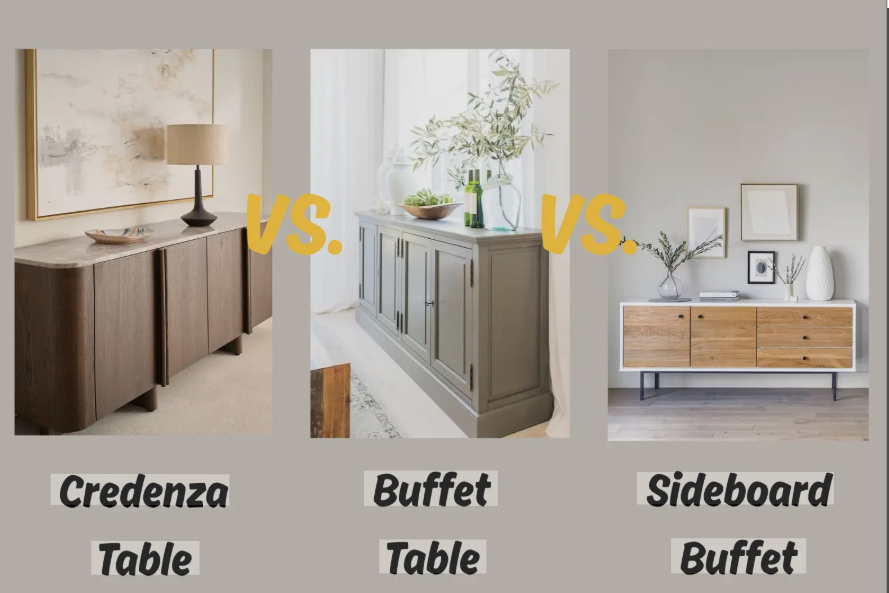
Table of Contents
- Why “Sideboard vs Buffet Cabinet” Is a Procurement Issue (Not a Style Debate)
- US Buyers Search Map: Category Naming That Prevents Ordering Mistakes
- Top Searched Configurations: How to Spec Drawers, Glass Doors, Hutches, and Narrow Footprints
- Compliance & Risk (US): TSCA Title VI Paperwork + Anti-Tip Policy
- Project-Grade Construction: Substrates, Surfaces, Hardware, and Failure Modes
- Packaging & Install: Reduce Damage, Rework, and Schedule Risk
- Copy-Paste RFQ Template for Sideboard / Buffet Cabinet Programs
- Buyer Checklist: What to Lock Before PO
- FAQ
Why “Sideboard vs Buffet Cabinet” Is a Procurement Issue (Not a Style Debate)
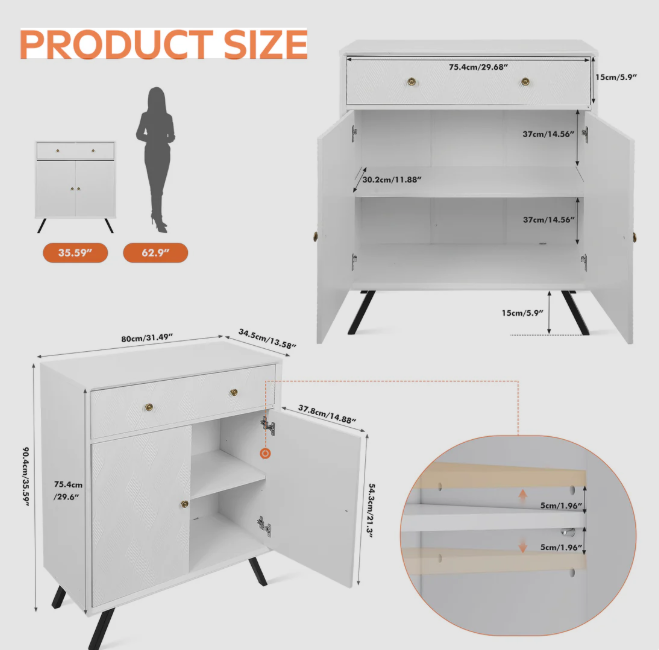
In US apartment furnished packages, the choice between sideboard vs buffet cabinet affects more than aesthetics. For multi-unit and build-to-rent (BTR) teams, it impacts several factors that contribute to the total cost of ownership. These include the delivery damage rate, assembly time, punch-list volume, compliance documentation, and warranty exposure.
Procurement teams often search both “sideboard cabinet” and “buffet cabinet.” They also use combinations like “buffet cabinets and sideboards” or “sideboard and buffet cabinets” when building a bid list. If the terms are not aligned in the BOQ, suppliers may interpret dimensions and layouts in various ways. This is particularly true when “cabinet buffet” appears in internal spreadsheets as shorthand.
This article is written in a B2B, spec-first format to help developers, FF&E buyers, and procurement teams standardize requirements. You’ll find configuration-by-configuration specs, risk controls, authority references, and an RFQ template you can copy into your next bid.
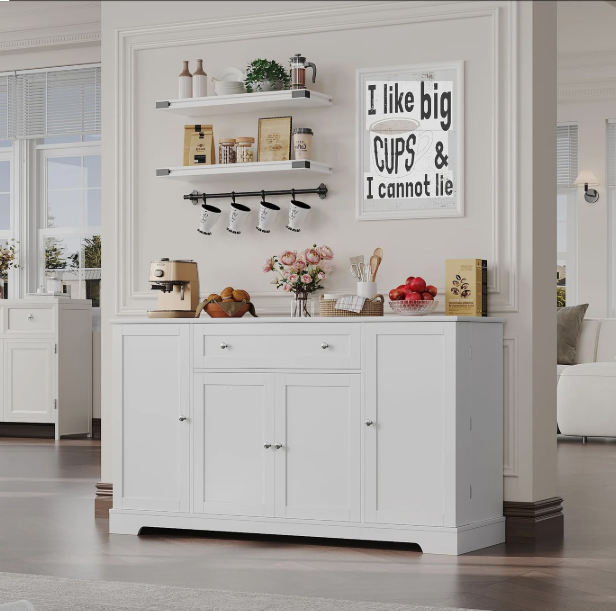
US Buyers Search Map: Category Naming That Prevents Ordering Mistakes
Sideboard vs Buffet Cabinet: how to write BOQ language that avoids ambiguity
For US projects, buyers frequently use “sideboard” and “buffet cabinet” interchangeably. The safest way to prevent quote confusion is to label the category with both terms. Next, lock the physical spec details, including inches, layout, and install method.
Recommended BOQ category line:
- Category: Sideboard Cabinet (Buffet Cabinet)
- Intended Use: Dining storage / staging surface for apartment units or amenity lounge
- Core Requirements: Defined dimensions, defined configuration (drawers/doors/hutch), anti-tip kit policy, TSCA Title VI documentation for composite wood components
Practical tip: include one sentence to address “cabinet buffet.” This prevents it from becoming a separate item in procurement spreadsheets. “Sideboard cabinet (buffet cabinet) may also be referenced as ‘cabinet buffet’ in internal naming.”
“Buffet cabinets and sideboards” vs “sideboard and buffet cabinets”: how to structure your site category
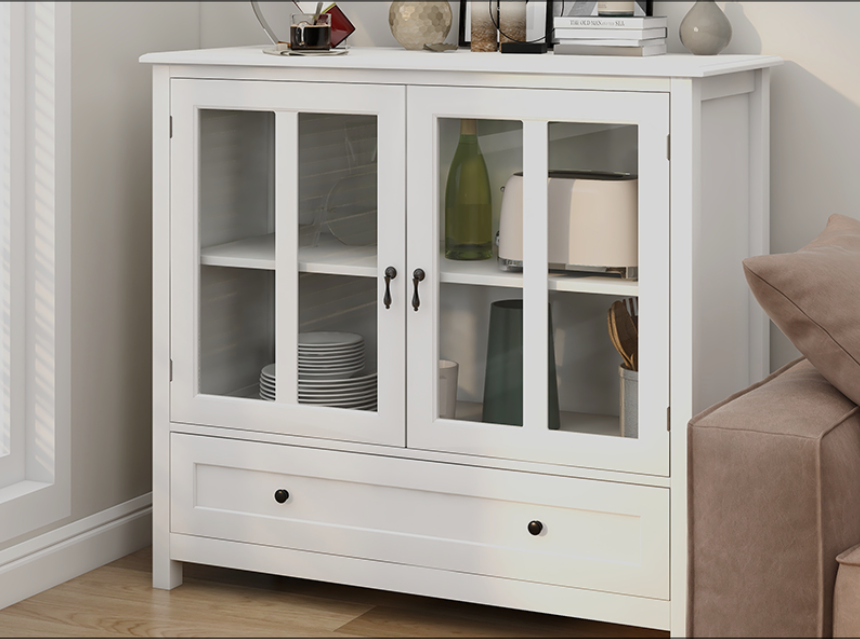
- Category Name (recommended): Sideboards & Buffet Cabinets
- Page H1 (recommended): Sideboard Cabinet (Buffet Cabinet) for Multi-Unit & BTR Projects
- Filters: drawers / glass doors / hutch / narrow / large / white / wood finish
Internal linking note: link your blog guide to the product category page and back again. Example: Sideboard & Buffet Cabinets (Project Options) .
Top Searched Configurations: How to Spec Drawers, Glass Doors, Hutches, and Narrow Footprints
The highest-intent buyer queries are feature-based. If you align your product naming and spec tables to these searches, you reduce quoting cycles and avoid “assumption-based” builds. Below are the most common long-tail searches and the project-grade decisions that matter.
1) Buffet cabinet with drawers / Sideboard cabinet with drawers
A buffet cabinet with drawers (or sideboard cabinet with drawers) is popular in multi-unit settings. It improves tenant usability by providing space for cutlery, linens, bar tools, and miscellaneous storage. But drawers also increase stability risk when fully extended.
Project-grade drawer specification (what buyers should define):
- Drawer load rating: specify a minimum rating and intended use (light dining accessories vs heavier items)
- Slide type: undermount vs side-mount; soft-close optional; define cycle expectation for rental grade
- Drawer box construction: plywood drawer box or engineered option with reinforced joints
- Anti-racking / stop behavior: reduce diagonal stress during delivery and daily use
- Full-extension stability: define an anchoring policy when multiple drawers can be extended simultaneously
If you see searches like “sideboard cabinet drawers” or “drawer sideboard cabinet,” clarify the internal layout. Explain whether it includes top shallow drawers and deep base storage or if it has fully stacked drawers. This impacts tooling, hardware, and packaging.
2) Buffet cabinet with glass doors
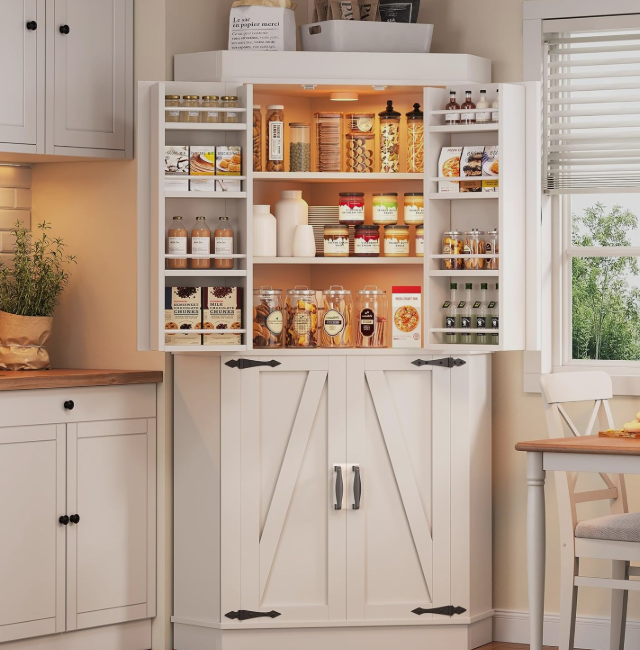
A buffet cabinet with glass doors is typically specified for premium packages, model units, or amenity spaces. For projects, glass doors are a delivery and service issue first—your spec should control breakage and replacement speed.
Glass-door spec controls that reduce claims:
- Glass definition: thickness + edge treatment; specify tempered where required by project policy
- Hinge performance: soft-close helps reduce slam damage and callbacks
- Packaging requirements: isolate glass panels, add corner guards, and protect door edges
- Spare parts kit: hinges, plates, screws, and (for large rollouts) a policy for spare glass availability
Packaging validation matters. ISTA is a widely recognized organization for transit packaging testing and lab resources. Use ISTA as a reference point when requesting packaging validation or test capability. ISTA (International Safe Transit Association).
3) Buffet cabinet with hutch
A buffet cabinet with hutch adds vertical storage and display, often requested for higher-tier units or common areas. In multi-unit, this configuration must be treated as an installation system, not just furniture.
Hutch + base cabinet (must-define) items for procurement:
- Anchoring hardware: specify what is included and what substrate it anchors into (stud, concrete, etc.)
- Installation responsibility: define whether GC or furniture installer anchors the unit
- Back panel reinforcement: ensure anchors are tied into reinforced structure
- Site tolerance: leveling feet or shim strategy for imperfect floors/walls
- Shelf load ratings: published and consistent across batch production
4) Narrow buffet cabinet
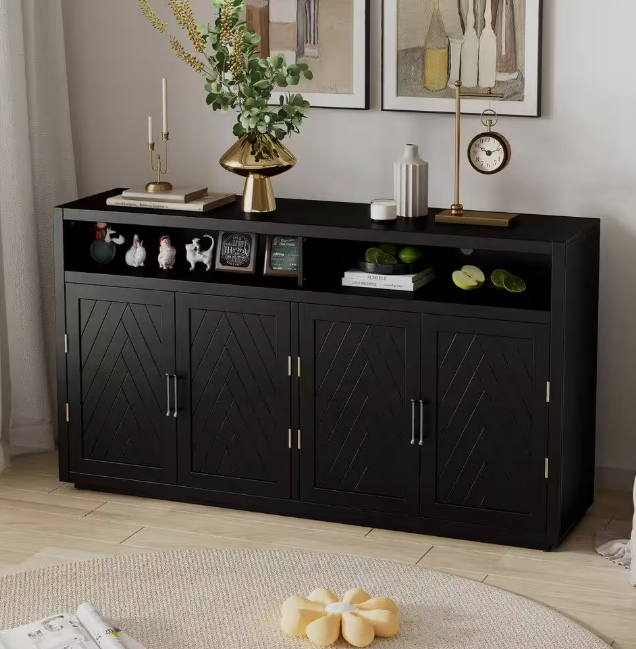
A narrow buffet cabinet is increasingly common in compact apartment layouts. The procurement risk is that “narrow” is subjective—define depth and clearance in inches, including pulls/handles.
If a cabinet is placed along a route, it functions as an accessible path in a public or common area. In such cases, buyers often reference ADA guidance for clear width. The US Access Board’s ADA guide specifies that the typical minimum continuous clear width is 36 inches. There are limited reductions in specific conditions. Confirm with your project’s accessibility consultant and local code requirements. ADA Accessible Routes (US Access Board).
Narrow footprint spec checklist:
- Max depth (in): cabinet box + door thickness + pulls
- Door/drawer clearance: ensure open positions don’t block circulation
- Toe-kick: cleaning access and perceived bulk
- Anchoring plan: narrow cabinets become more tip-sensitive when drawers extend
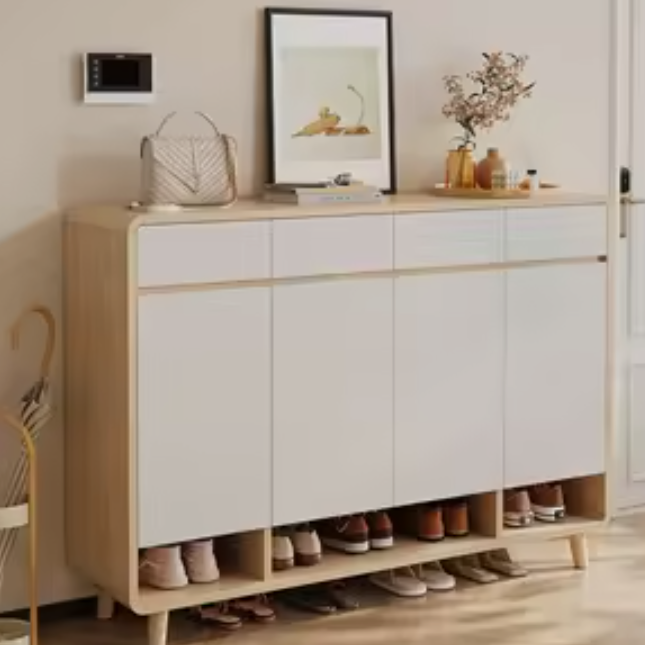
Bonus: high-intent variations you should include in naming and filters
- white sideboard buffet cabinet (finish consistency + touch-up strategy)
- large buffet cabinet (weight, shelf span, delivery handling)
- wooden buffet cabinet (wood look with stable construction)
- sideboard buffet cabinets (hybrid phrasing commonly searched)
Quick comparison table (copy into your post)
| Buyer Concern | What to Specify | Why It Matters in Multi-Unit |
|---|---|---|
| Drawers (capacity + stability) | Slide rating, cycle expectation, drawer box build, anchoring policy | Reduces service calls and tip risk when drawers extend |
| Glass doors (breakage) | Glass thickness/type, hinge spec, packaging isolation, spare parts | Controls damage rate and punch-list delays |
| Hutch (vertical load) | Wall anchor kit + responsibility + reinforcement + leveling | Prevents instability claims and site disputes |
| Narrow footprint | Max depth incl. pulls; clearance; toe-kick; anchoring | Protects circulation and reduces install conflict |
| Finish consistency (white / wood) | Color code, sheen, scratch/chemical resistance, touch-up plan | Keeps phases consistent; reduces rejections and rework |
Compliance & Risk (US): TSCA Title VI Paperwork + Anti-Tip Policy
Composite wood compliance: TSCA Title VI requirements and documents (EPA + 40 CFR 770)
Procurement teams frequently request TSCA Title VI alignment for US multi-unit furniture programs using composite wood. This includes particleboard, MDF, hardwood plywood with composite core, and components containing these materials. They also request documentation. EPA provides program guidance for the Formaldehyde Emission Standards for Composite Wood Products rule. EPA TSCA Title VI program page.
40 CFR Part 770 is available through the eCFR. The CFR PDF is published on GovInfo. Both are useful for project recordkeeping. eCFR: 40 CFR Part 770 and GovInfo: 40 CFR Part 770 (PDF).
What buyers should ask suppliers to submit (typical TSCA Title VI submittal pack):
- Panel compliance statements from panel suppliers (for relevant composite wood categories)
- Traceability (lot/batch references aligned to production)
- Bill of materials mapping showing which components contain composite wood
- Finish system info (optional but common when indoor air quality is specified)
For indoor-air signals that many owners and institutions recognize, UL GREENGUARD is a widely used low-emitting product certification program. UL GREENGUARD Certification.
Stability / anti-tip: how to define an “anti-tip kit / anchoring policy” at project level (CPSC framework)
Tip-over risk is a major liability issue in the US, especially for drawer-based storage. CPSC provides business guidance for clothing storage units, including references to the federal safety standard at 16 CFR Part 1261. CPSC clothing storage units guidance and eCFR: 16 CFR Part 1261.
Important nuance for procurement: not every dining sideboard is classified as a “clothing storage unit.” Many multi-unit owners still adopt an anti-tip hardware policy for any freestanding storage with drawers. The reason is the similar risk mechanism, with extended drawers shifting the center of gravity. In project execution, what matters is not arguing categories; it’s defining responsibility and documentation.
How to write the anti-tip policy in your RFQ (copy-paste):
- Supplier to include anti-tip kit in every carton (with illustrated instruction sheet).
- Buyer/GC to define installation responsibility (GC vs furniture installer) and wall substrate assumptions.
- Supplier to provide stability rationale (internal test notes; anchoring recommendations; drawer extension warnings if required).
- For amenity/common areas, require anchor installation sign-off at turnover.
Project-Grade Construction: Substrates, Surfaces, Hardware, and Failure Modes
Plywood vs MDF vs particleboard: what drives defects and complaint volume
For sideboard cabinets in apartments, the most common early-life issues are edge damage. Another issue is hardware loosening or pull-out. Additionally, finish wear from aggressive cleaners can occur. A “project-grade” build is a system: core choice + edge banding + surface + hardware + packaging.
- Plywood: strong screw holding and stable carcasses; a frequent choice for contract / project grade sideboard programs.
- MDF: excellent for painted surfaces. This is especially true for white sideboard buffet cabinet lines. However, edges must be sealed properly. Also, the hardware strategy is important.
- Particleboard: cost-effective at scale; performance depends heavily on lamination quality, edge banding thickness, and correct fasteners.
Spec lines that prevent supplier “interpretation”:
- Define core type (plywood/MDF/particleboard) and thickness for carcass, shelves, and doors.
- Define edge banding thickness on all exposed edges (and sealing for cutouts).
- Define hardware standards (hinge type, slide type/rating, fastener method).
Top surface durability: HPL vs melamine vs veneer + coating (cleaning chemical tolerance)
In rentals and BTR, top surfaces are exposed to spills, abrasion, and cleaning chemicals. Buyers typically choose:
- HPL: strong abrasion and stain resistance; great for amenity spaces and heavy-use units.
- Melamine/MFC: consistent color and cost control; specify performance expectations.
- Veneer + coating: premium look for “wooden buffet cabinet” requests; define scratch/stain resistance and repair strategy.
If your procurement team needs a broader furniture performance framework, BIFMA is a widely recognized source for furniture standards (safety/performance/sustainability). BIFMA standards overview.
Cable holes, back reinforcement, toe-kicks: details that reduce site surprises
Sideboards in apartments often become charging stations or router stands. Small design details reduce punch-list and tenant complaints:
- Cable management: grommeted pass-through holes, sealed edges, and neat rear access.
- Back panel reinforcement: especially for anchoring and hutch configurations.
- Toe-kick design: cleaning access and scuff resistance.
For large buffet cabinet programs, define shelf span and load rating to avoid sagging. In multi-unit, shelf sag becomes a high-volume warranty issue.
Packaging & Install: Reduce Damage, Rework, and Schedule Risk
Assembled vs KD/RTA: elevator logistics, corridor handling, and install speed
In multi-unit delivery, the building is part of the supply chain: elevator bookings, narrow turns, limited staging, and floor-by-floor movement. The assembled vs KD/RTA decision should be made with a total-cost lens:
- Assembled: faster on-site, fewer assembly errors, but larger cartons and higher transit/handling damage risk.
- KD/RTA: easier building logistics and often lower damage, but requires clear instructions and robust hardware kits.
For narrow buffet cabinet programs, KD/RTA often wins because it reduces corner impacts and makes elevator movement easier.
Drop-test validation, corner guards, glass protection, and spare parts kits (why ISTA matters)
Packaging is not an afterthought—it is a performance system. When buyers request “validated packaging,” ISTA is a common reference point for test capability and transit testing networks. ISTA.
Packaging KPI recommendations for multi-unit sideboard/buffet programs:
- Corner protection on all cartons (to reduce edge crush and finish chips).
- Hardware kit redundancy (extra cams/screws/hinge plates) to prevent site delays.
- Glass isolation modules for “buffet cabinet with glass doors.”
- Clear labeling for unit ID / room / phase to reduce sorting errors.
Copy-Paste RFQ Template for Sideboard / Buffet Cabinet Programs
Use this RFQ block to get apples-to-apples quotes for sideboard buffet cabinets and reduce the risk of “interpretation-based” manufacturing.
RFQ Template
- Item Name: Sideboard Cabinet (Buffet Cabinet)
- Project Type: Apartment / Multi-Unit / BTR
- Total Quantity: ____ units (phase split: ____ / ____ / ____)
- Dimensions (inches): W ____ x D ____ x H ____ (include max depth with pulls)
- Configuration (choose):
- buffet cabinet with drawers / sideboard cabinet with drawers (drawer count ____; internal depth ____)
- buffet cabinet with glass doors (glass thickness/type ____; hinge type ____)
- buffet cabinet with hutch (anchoring kit included: yes/no; reinforcement: yes/no)
- narrow buffet cabinet (define “narrow” max depth ____ including pulls)
- large buffet cabinet (define shelf load rating ____; max carton weight ____)
- Finish: white sideboard buffet cabinet / wooden buffet cabinet (color code ____; sheen ____; touch-up method ____)
- Materials: plywood / MDF / particleboard (carcass thickness ____; shelf thickness ____)
- Edges: edge banding thickness ____ on exposed edges; sealed cutouts required
- Top Surface: HPL / melamine / veneer+coating (cleaning chemical tolerance required: ____)
- Hardware: hinge ____; slides ____ (load rating ____; soft-close yes/no)
- Compliance (US): TSCA Title VI documentation required for applicable composite wood components (references: EPA, 40 CFR 770)
- Safety: anti-tip kit included + responsibility statement (reference: CPSC guidance)
- Packaging: assembled vs KD/RTA; glass isolation; corner guards; spare parts kit; ISTA-aligned packaging validation request (ISTA)
- QC: pre-production sample approval + golden sample retention
- Warranty: ____ years; spare parts availability ____ months
Buyer Checklist: What to Lock Before PO (Multi-Unit Sideboards & Buffet Cabinets)
- Naming: use “Sideboard Cabinet (Buffet Cabinet)” consistently; map any “cabinet buffet” shorthand to the same item.
- Dimensions: define max depth incl. pulls; define door/drawer clearance.
- Config: drawers vs doors vs glass vs hutch; publish internal layout drawings.
- Stability policy: anti-tip kit included + installer responsibility documented.
- Compliance: TSCA Title VI documentation schedule (submit before mass production).
- Construction: core type + thickness + edge banding thickness on exposed edges.
- Finish: color code + sheen + touch-up method (critical for white programs).
- Packaging: corner guards, glass isolation, spare parts kit, and packaging validation expectations.
- Spare parts & service: define what is included and how replacements are shipped.
Sustainability note: if your owners request sustainable sourcing signals, FSC is a widely recognized forestry certification framework. FSC.
OEM/ODM Support for Apartment Sideboards & Buffet Cabinets
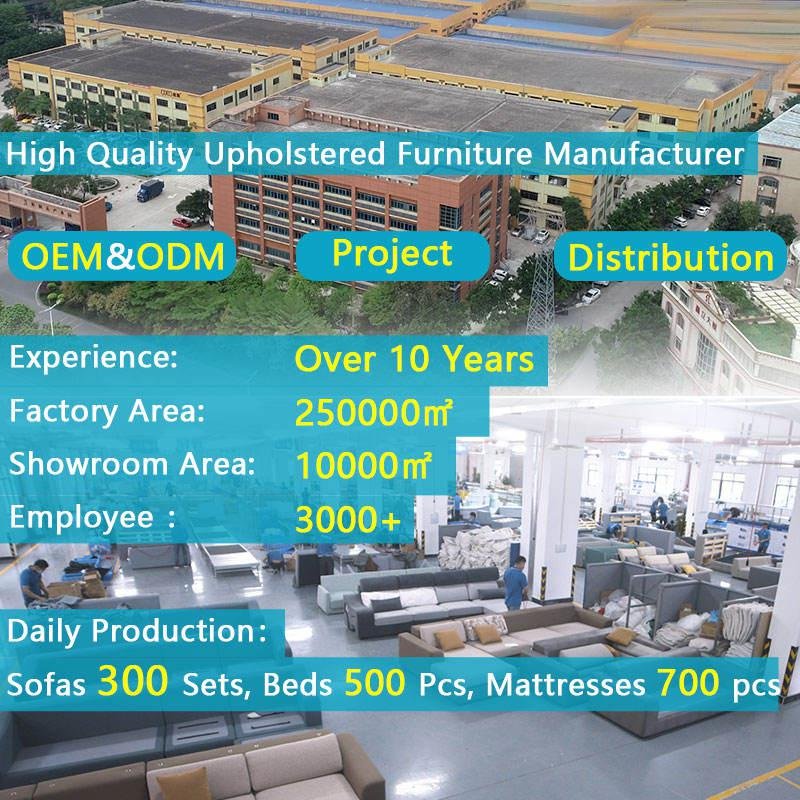
For multi-unit rollouts, the “best” sideboard/buffet program is the one that installs fast, survives turnover, and has clean documentation. We support OEM/ODM projects with spec-driven engineering. Our approach includes stable core selection and durable surfaces. We ensure TSCA Title VI-ready submittals and include an anti-tip hardware inclusion policy. We also focus on packaging optimization and spare-part planning.
Start with the category page and share your target price tier, quantities, and configuration: Sideboard & Buffet Cabinets .
FAQ
Is a buffet cabinet the same as a sideboard in the US?
In most US sourcing contexts, the terms are treated as near-synonyms. “Buffet cabinet” emphasizes dining/serving use, while “sideboard” is broader. For BOQs and procurement, use “Sideboard Cabinet (Buffet Cabinet)” and then define the exact configuration and dimensions.
What documents should I request for TSCA Title VI?
Request composite wood compliance documentation and traceability for applicable components, and define when submittals are due (ideally before mass production). EPA program context and regulatory references are available here: EPA and 40 CFR Part 770.
Do sideboard cabinets in apartments need anti-tip kits?
Many owners and GCs require anti-tip kits as a project risk-control policy, especially for drawer-heavy designs. CPSC guidance on tip-over risk in storage units is a useful reference for policy framing: CPSC guidance.
What’s the safest way to spec “narrow buffet cabinet”?
Define maximum depth in inches including pulls, define door/drawer clearance, and confirm circulation requirements for your building type. For common area routes, ADA guidance on accessible route clear width is a helpful reference point: US Access Board.
How do I reduce glass door breakage and site delays?
Specify glass isolation packaging, corner guards, and spare parts kits, and request validated packaging capability. ISTA is a common authority reference for transit packaging testing resources: ISTA.
Get in Touch & Start Your Project
Whether you’re launching a new furniture brand, remodeling an apartment, or need large-scale furniture orders, Starwood is here to help. Contact us today to get started — let’s turn your vision into finely crafted furniture.
STARWOOD INDUSTRY CO.,LTD
Contact: Winnie Huang (Sales Manager)
Email: [hwinnie168@gmail.com]
Phone: +86‑13691994727
WhatsApp / WeChat / Skype: hwinnie168@gmail.com
Add: No.150 Yongshen Road, Pengjiang Area, Jiangmen City, Guangdong Province, China
We look forward to collaborating with you and bringing your furniture dreams to life.