How to Choose the Right Shoe Cabinet Size and Capacity for Projects (Apartments & Hotels)
Designing entryway storage for a project is not about choosing a “pretty shoe cabinet.” It involves capacity planning. You must balance guest or resident behavior, corridor clearance, shoe types, and door mechanics. This ensures your apartment or hotel rooms stay tidy and operational long after handover.
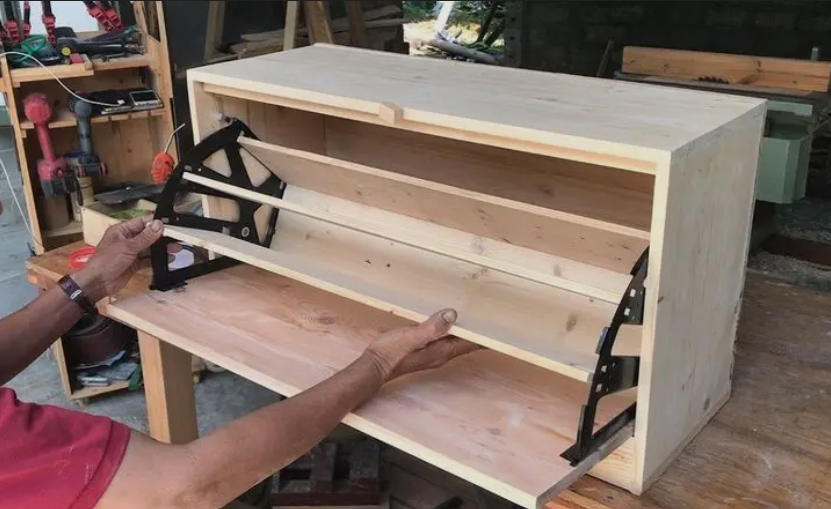
This guide walks project teams through a practical sizing method. It includes tips on how many pairs per room and what depth works for real shoes. You will also learn how to choose tip-out versus hinged doors. Additionally, the guide covers how to write a spec that a B2B factory, OEM, or ODM supplier can quote accurately. For reference, our own entryway category focuses on space-saving, durable designs for bulk and custom projects direct from the factory.
Table of Contents
- Start with the project scenario
- Capacity planning: how many pairs per apartment or hotel room?
- Depth and clearance: the most common sizing mistake
- Height, width, shelf spacing: turning dimensions into real capacity
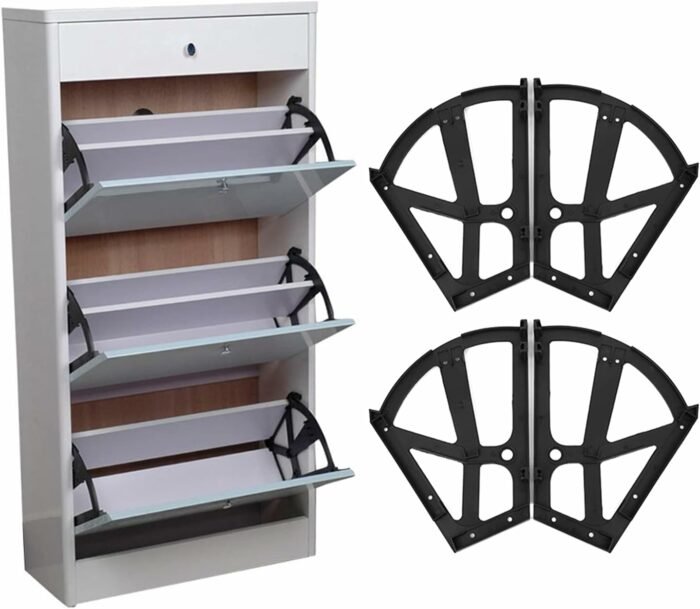
- Tip-out vs hinged door vs open rack: which works best for projects?
- Apartment vs hotel: recommended cabinet “modules”
- Specification checklist for OEM/ODM and project procurement
- Common pitfalls and how to avoid them
- FAQ
Start with the project scenario
Before dimensions, define the use case. In project work (multifamily, hospitality, student housing, serviced apartments), the shoe cabinet is part of a system:
- Traffic pattern: Is it inside the unit entry, or in a corridor niche?
- Occupancy: 1–2 residents in a studio vs 2–4 in a family unit; hotel double vs twin.
- Turnover: nightly housekeeping vs long-stay residents.
- Shoe mix: sneakers and flats vs boots and shoe boxes.
- Maintenance: how easily can staff clean under/around it?
This step matters because door type, depth, ventilation, and internal layout change based on the above.
Capacity planning: how many pairs per apartment or hotel room?
The “active shoes” rule (good for apartments)
For residential entryways, a practical baseline is to store only the active rotation, not the full wardrobe. Many organizers use a simple sizing rule:
(Number of household members) × (3–4 pairs of everyday shoes) = minimum entryway capacity Nested Goods
That gives you a realistic “daily-use” capacity that keeps entryways uncluttered.
Apartment project quick guide (per unit):
- Studio / 1BR (1–2 residents): 6–10 pairs capacity (active rotation)
- 2BR (2–3 residents): 9–15 pairs capacity
- Family unit (3–4 residents): 12–20 pairs capacity
If your client wants seasonal storage inside the same cabinet, add 30–50% more capacity (or specify an additional closet solution).
Hotel room capacity (what actually gets used)
Hotel guests do not arrive with 10 pairs each. Typical stays prioritize convenience:
- 1–2 pairs per guest for standard stays (walking shoes + formal/backup)
- Up to 3 pairs per guest in business travel or longer stays
Hotel capacity recommendation (per room):
- Single / Double occupancy: 4–6 pairs total capacity
- Twin / 2 guests with longer stays: 6–8 pairs
- Serviced apartment / extended stay: 8–12 pairs
Project tip: hotels often do better with a small cabinet + open shoe tray zone (for wet shoes). This is better than a tall high-capacity unit that becomes a housekeeping burden.
Depth and clearance: the most common sizing mistake
Recommended shoe cabinet depth ranges
Depth determines what shoes physically fit—and whether doors close without crushing toes, heels, or hardware.
A widely cited practical range for shoe cabinet depth includes 30 cm, 35 cm, and 40 cm. The selection depends on shoe type and size. 30 cm suits many flats and sneakers. 35 cm is safer for larger sizes. 40 cm is better for boots or storing shoe boxes.
Project-friendly depth guidelines (metric + practical meaning):
- 300 mm depth: good for compact cabinets and tip-out designs; best for flats/sneakers
- 350 mm depth: safer all-rounder for mixed shoes, including larger men’s sizes
- 400 mm depth: boots, bulkier shoes, or shoe boxes; requires more clearance planning
Corridor clearance and door swing
Depth is not only about shoe length. You must also account for:
- Door thickness + hinges
- Handle projection
- Front clearance to open (especially hinged doors)
If your entry corridor is narrow, a “standard” hinged cabinet can block circulation. That is why tip-out and sliding solutions often win in tight layouts (more on that below).
Height, width, shelf spacing: turning dimensions into real capacity
Capacity is the outcome of internal geometry, not marketing claims. When specifying a shoe cabinet for apartments/hotels, translate “pairs” into shelf math.
Shelf spacing by shoe type (typical working ranges)
Use adjustable shelves wherever possible so the same carcass can serve multiple markets.
- Flats / sandals: ~120–140 mm per level
- Sneakers / casual: ~150–180 mm per level
- High-top / some men’s shoes: ~180–200 mm per level
- Ankle boots: ~220–260 mm per level
- Tall boots: special vertical bay or a separate storage plan
A simple capacity estimator for hinged-door cabinets
For project specs, you can estimate:
- Pairs per shelf ≈ cabinet internal width ÷ 250–280 mm (depends on shoe size mix and whether you store sideways)
- Number of shelves ≈ usable internal height ÷ shelf spacing
Example (easy for procurement teams):
- 800 mm internal width typically stores 3 pairs per shelf (average mixed sizes)
- 5 usable shelves → ~15 pairs capacity (realistic, not inflated)
Note: some consumer articles cite a 24″ W × 12″ D × 36″ H cabinet holding ~18–20 pairs. However, project results vary widely with shoe size distribution. They also vary with shelf spacing choices. Megafurniture
Tip-out vs hinged door vs open rack: which works best for projects?
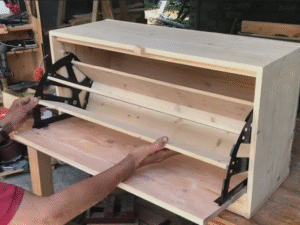
Tip-out (flip) shoe cabinet
Best for: narrow corridors, small apartments, “entryway furniture for small spaces”
Why projects choose it: shallow depth and a clean façade in tight areas
Trade-offs:
- Typically less flexible for bulky shoes/boots
- Internal bins limit shoe orientation
- Capacity is “good enough” for hotels and compact units, not for families
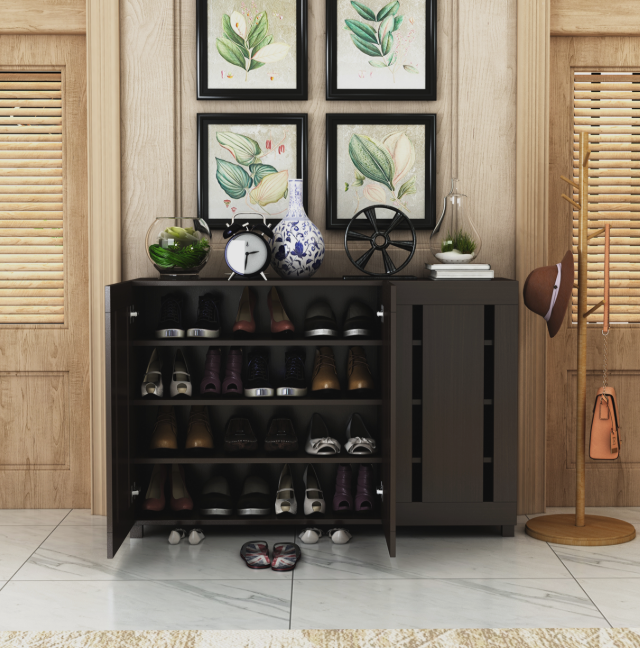
Hinged door (traditional cabinet)
Best for: deeper entry zones, family units, higher capacity needs
Why projects choose it: easiest to standardize shelves and maximize usable volume
Trade-offs:
- Needs front swing clearance; can block narrow hallways
- Handles/hardware can snag traffic if poorly placed
Open rack / shoe bench cabinet
Best for: wet climates, snow/rain areas, quick housekeeping access
Why projects choose it: shoes air out; easier cleaning; fast turnover
Trade-offs:
- Visual clutter if not managed
- Dust exposure (more frequent cleaning)
For many developments, a hybrid works best: closed cabinet for visual order + a small open zone for wet shoes. This aligns with entryway organization advice that entry areas should avoid becoming a cluttered “drop zone.” Real Simple
Apartment vs hotel: recommended cabinet “modules”
Below are practical, repeatable cabinet modules that are easy to quote with an OEM/ODM supplier and easy to maintain onsite.
Module A: Hotel standard (4–6 pairs)
- Type: tip-out or compact hinged
- Depth: 300–350 mm
- Height: 700–1000 mm (keeps it visually light and easy to clean)
- Capacity target: 4–6 pairs
Ideal for guest behavior and housekeeping speed.
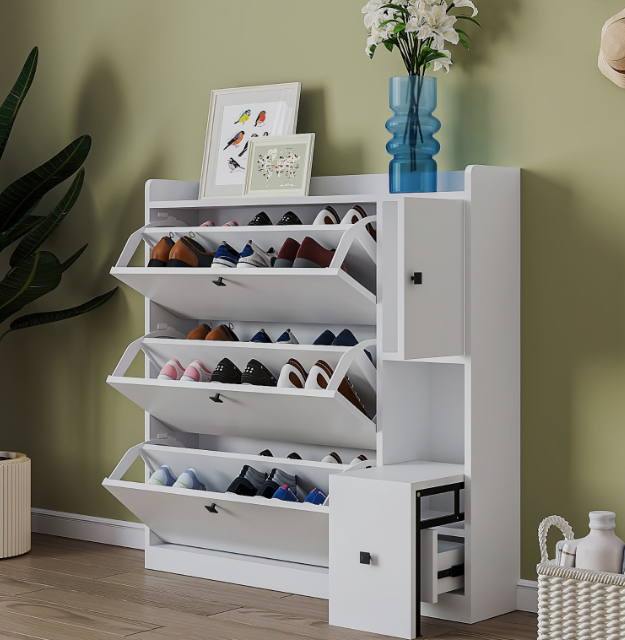
Module B: Apartment compact (6–10 pairs)
- Type: tip-out + top surface (console function)
- Depth: 300–350 mm
- Height: 1000–1200 mm
- Capacity target: 6–10 pairs
Great for studios and 1BR units where hallway depth is limited.
Module C: Apartment family (12–20 pairs)
- Type: hinged door cabinet with adjustable shelves
- Depth: 350–400 mm
- Height: 1600–2000 mm (taller, vertical storage)
- Capacity target: 12–20 pairs
Works when entry space allows deeper furniture and residents need real capacity.
If you are sourcing from a flat-pack manufacturer, select modules like these. This supports stable bulk production. It also allows finish/size variations by market.
Specification checklist for OEM/ODM and project procurement
A strong RFQ reduces sampling cycles and avoids “surprises” after the first container lands.
1) Dimensions (with tolerances)
- Overall W × D × H
- Internal usable depth (after door + back panel)
- Toe kick / base height (cleaning clearance)
2) Capacity definition (don’t just say “large”)
Specify:
- Target pairs
- Target shoe mix (sneakers vs boots)
- Shelf count + shelf spacing range
3) Door mechanism and clearance
- Tip-out vs hinged vs sliding
- Hinge type, opening angle, soft-close requirement
- Handle type (or handleless) and projection limits
4) Materials + compliance positioning
If you sell into markets sensitive to indoor air quality or sustainability, reference recognized systems:
- FSC for responsible forest management certification positioning
- UL GREENGUARD for low-emission/indoor air quality positioning (if applicable to your product program)
- ISO 9001 as a quality management framework many buyers understand
If you are sourcing timber-based panels at scale, follow trade resources like the International Wood Products Association (IWPA). This can support responsible sourcing discussions.
5) Packaging and project logistics
- Flat pack / RTA carton requirements
- Drop-test standard (if required by your retailer)
- Labeling: SKU, barcode, country-of-origin, warning labels
- Spare parts pack (hinges/screws) for site maintenance
6) Supplier capability signals (useful for buyers)
Industry groups can be referenced as credibility context in your content marketing and compliance awareness:
- AHFA (US home furnishings compliance resources) AHFA
- EFIC (European furniture industry confederation context) efic
- CNFA (China National Furniture Association industry context) 中国家具协会
For sourcing visibility and buyer discovery, major directories and platforms include Alibaba.com, Thomasnet, and Europages. Alibaba+2托马斯网+2
Common pitfalls and how to avoid them
- Choosing depth based on drawings
Do not choose based on shoes. Use 350 mm when in doubt for mixed markets. 300 mm is safest only if you control the shoe profile. - Overstating capacity
Capacity must be tested against shoe size distribution and shelf spacing, not “idealized” layouts. - Ignoring door swing in tight corridors
Hinged doors can turn into a usability complaint in narrow entryways. Tip-out or sliding designs reduce traffic conflict. - No plan for wet shoes
Projects in rain or snow markets should have ventilation. Alternatively, provide a small open zone for wet shoes. This helps protect panels and reduces odor. - No spare parts or service plan
In hospitality, a missing hinge can mean an entire unit looks “broken.” Include spares.
FAQ
What shoe cabinet depth should I specify for mixed EU/UK markets?
A safe project baseline is 350 mm, because it fits more shoe types than 300 mm while staying compact. If your market includes boots or shoe boxes inside cabinets, consider 400 mm.
How many pairs should a hotel room shoe cabinet hold?
For most hotels, 4–6 pairs per room cover typical guest behavior. Extended-stay concepts may need 6–12 pairs, depending on occupancy and stay length.
Tip-out vs hinged doors: which is better for small corridors?
Tip-out designs often perform better in narrow corridors because they can be shallower and reduce swing conflicts. Hinged doors usually offer more flexible capacity but need clearance.
What’s a good rule for apartment entryway shoe capacity?
A practical baseline is household members × (3–4 pairs) for “active rotation” storage. Nested Goods
What should I include in an RFQ to an OEM/ODM factory?
Provide W×D×H, door type, target capacity (pairs), shoe mix, shelf layout, finish, packaging specs, and destination/Incoterms. If you need OEM/ODM support, ensure your supplier clearly offers it as part of their service scope.
Official Info

We’re here to assist and answer all your inquiries.